



ADA Accessibility Standards
The U.S. federal standard for physical accessibility in public accommodations and government facilities.
The 2010 ADA Standards for Accessible Design — commonly referenced as ADAAG — define the dimensional and functional requirements that public facilities must meet to ensure access for people with disabilities. This guide covers the compliance framework, priority-based barrier removal system, and the critical measurement thresholds inspectors verify during an accessibility audit.

What is ADA/ADAAG?
The 2010 ADA Standards for Accessible Design (ADAAG) are the U.S. federal requirements for physical accessibility in public accommodations and government facilities. Enforced by the Department of Justice, the standard defines strict dimensional thresholds for parking, routes, doors, and restrooms — producing binary Compliant or Non-Compliant determinations for each inspected element.
- Full Name
- 2010 ADA Standards for Accessible Design
- Issuing Body
- U.S. Department of Justice (DOJ)
- Current Revision
- 2010 Standards (effective March 15, 2012)
OVERVIEW
How ADA Accessibility Audits Work
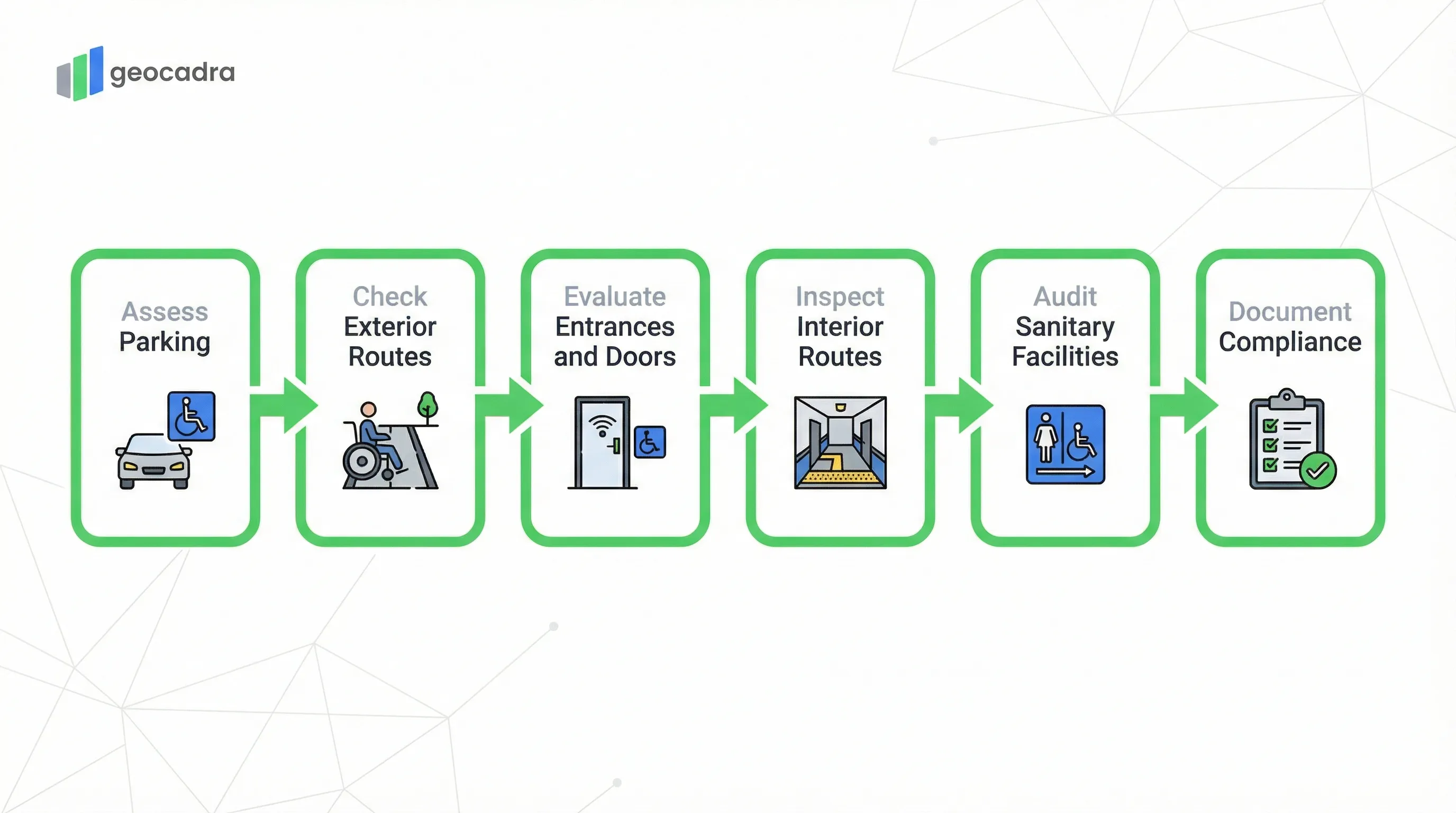
An ADA accessibility audit is a quantitative compliance assessment. The inspector physically measures elements — slopes, widths, heights, forces — and compares each measurement against rigid threshold values defined in the 2010 Standards. Unlike condition assessment standards that produce a graded score, ADA produces a binary determination: Compliant or Non-Compliant. The audit follows the "ADA Checklist for Existing Facilities" methodology, which organizes the inspection into four priorities based on the path a visitor takes through a facility — from parking and approach, through entrance and interior, to restrooms and additional amenities.
The standard is enforced by the U.S. Department of Justice and builds on the technical guidelines developed by the U.S. Access Board.
COMPLIANCE STATUS
The Five Compliance Determinations
Every element inspected receives one of five compliance determinations. Two legal distinctions — Safe Harbor and Technically Infeasible — are critical for existing facilities built before the 2010 Standards took effect.
| Status | Description |
|---|---|
| Compliant | The element meets all applicable 2010 ADA Standards dimensional and functional requirements. |
| Non-Compliant | The element fails to meet one or more defined thresholds — for example, a door opening narrower than 32 inches or a ramp slope exceeding 8.33%. |
| Safe Harbor | The element does not meet 2010 Standards but was built in compliance with the 1991 Standards and has not been altered since March 15, 2012. |
| Technically Infeasible | Full compliance cannot be achieved because existing structural conditions — such as load-bearing walls or terrain — prohibit modification. |
| N/A | The requirement does not apply to this element or facility type — for example, elevator requirements in a single-story building. |
Safe Harbor applies only to elements that have not been altered since March 15, 2012, and that complied with the 1991 ADA Standards.
BARRIER PRIORITIES
The Priority-Based Barrier Removal System
The ADA Checklist organizes barriers into a priority hierarchy based on a visitor's path through the facility. This sequence determines which non-compliant elements should be remediated first when full compliance cannot be achieved immediately.
| Priority | Focus Area | Description |
|---|---|---|
| Critical | Safety | A safety hazard or total blockage of access — such as steps at the only entrance with no ramp alternative. |
| Priority 1 | Approach & Entrance | Barriers preventing entry to the building: inaccessible parking, missing curb ramps, blocked exterior routes, non-compliant entrance doors. |
| Priority 2 | Goods & Services | Barriers preventing access to the primary function of the facility: narrow interior aisles, inaccessible service counters, non-operable elevator controls. |
| Priority 3 | Restrooms | Barriers in sanitary facilities: insufficient turning space, missing grab bars, non-compliant toilet heights, exposed pipes. |
| Minor | Other Amenities | Barriers affecting drinking fountains, telephones, fire alarm strobes, and other secondary amenities. |
Remediation should follow the priority order from Critical downward.
Try this ADA form in Geocadra
We have a pre-built ADA inspection template ready to go. Sign up and start your first condition assessment today.
Free 14-day trial. No credit card required.
KEY THRESHOLDS
Critical Dimensional Thresholds
ADA compliance is determined by exact measurements against fixed thresholds. The table below lists the most frequently assessed dimensional requirements across parking, routes, doors, and restrooms.
| Element | Requirement | Threshold |
|---|---|---|
| Parking Space Width (Car) | Minimum | 96 inches |
| Parking Space Width (Van) | Minimum | 132 inches |
| Access Aisle Width | Minimum | 60 inches |
| Parking Slope (Any Direction) | Maximum | 2.08% (1:48) |
| Curb Ramp Running Slope | Maximum | 8.33% (1:12) |
| Curb Ramp Cross Slope | Maximum | 2.08% (1:48) |
| Exterior Route Width | Minimum | 36 inches |
| Door Clear Opening Width | Minimum | 32 inches |
| Door Threshold (Beveled) | Maximum | 0.50 inches |
| Door Threshold (Vertical) | Maximum | 0.25 inches |
| Interior Door Opening Force | Maximum | 5 lbs |
| Door Closing Speed (90° to 12°) | Minimum | 5 seconds |
| Elevator Call Button Height | Maximum | 48 inches |
| Service Counter Height | Maximum | 36 inches |
| Toilet Seat Height | Range | 17–19 inches |
| Toilet Centerline from Side Wall | Range | 16–18 inches |
| Rear Grab Bar Height | Range | 33–36 inches |
| Rear Grab Bar Length | Minimum | 36 inches |
| Side Grab Bar Length | Minimum | 42 inches |
| Sink Rim Height | Maximum | 34 inches |
| Sink Knee Clearance | Minimum | 27 inches (height) |
| Restroom Turning Space | Minimum | 60-inch diameter circle |
All measurements are from the 2010 ADA Standards for Accessible Design. Van accessible spaces require 132″ total width including access aisle.
Complete dimensional requirements are published in the 2010 ADA Standards for Accessible Design.
DIGITAL WORKFLOW
Digitize ADA Audits with Geocadra
Traditional ADA audits rely on tape measures, clipboards, and manual data entry. Geocadra replaces that workflow with structured digital forms that validate measurements against ADA thresholds in real time.
Threshold-validated measurement fields
Number fields for slopes, widths, and heights automatically flag values that exceed ADA thresholds. The inspector sees a pass/fail indication the moment a measurement is entered — no manual lookup required.
Repeatable element sub-forms
Parking zones, doors, and restrooms are structured as repeatable collections. The inspector adds "Door 1," "Door 2," and so on, each with its own measurements and compliance determination.
Photo-linked evidence
Every non-compliant finding is tied to geotagged photos. Reviewers see exactly which door, ramp, or restroom element failed — not just a row in a spreadsheet.
Priority-based reporting
Barriers are automatically grouped by priority level in the final report, making it clear which non-compliant elements should be remediated first.
QUESTIONS
Frequently Asked Questions
What is the ADA Standards for Accessible Design?
The 2010 ADA Standards for Accessible Design are U.S. federal requirements that define dimensional and functional criteria for physical accessibility in public accommodations and government facilities. They cover parking, routes, entrances, doors, restrooms, and other elements to ensure access for people with disabilities.
What is the difference between ADA and ADAAG?
The ADA (Americans with Disabilities Act) is the civil rights law. ADAAG (ADA Accessibility Guidelines) are the technical design standards originally issued by the Access Board. The 2010 ADA Standards adopted by the DOJ incorporate and supersede ADAAG for enforcement purposes.
What does Safe Harbor mean in ADA compliance?
Safe Harbor protects existing facility elements that were built in compliance with the 1991 ADA Standards and have not been altered since March 15, 2012. These elements are not required to be retrofitted to the 2010 Standards until the next renovation or alteration.
What does Technically Infeasible mean?
An element is Technically Infeasible when full ADA compliance cannot be achieved due to existing structural conditions such as load-bearing walls, terrain, or utility conflicts. In these cases, the facility must comply to the maximum extent feasible.
How often should an ADA accessibility audit be performed?
There is no mandated frequency, but best practice is to audit every 3 to 5 years and after any renovation or alteration. Proactive audits help identify barriers before complaints or lawsuits trigger mandatory corrective action.
What are the four ADA barrier removal priorities?
Priority 1 covers approach and entrance (parking, curb ramps, entrance doors). Priority 2 covers access to goods and services (interior routes, counters, elevators). Priority 3 covers restrooms. Priority 4 covers other amenities such as drinking fountains and fire alarms.
Is ADA compliance mandatory for all buildings?
ADA Title II applies to all state and local government facilities. Title III applies to places of public accommodation — businesses, restaurants, medical offices, hotels, and similar establishments open to the public. Private residences are generally exempt unless used for public purposes.
In practice
See how the round runs in Geocadra
The solution page shows this inspection regime on real open data: the import, the form, the round, the record per asset and the export.
Condition assessments, roof checks and statutory tests for public building portfolios, with every visit appended to the buildingOpen the solution page: Buildings & FacilitiesTRY IT FREE
Digitize your ADA inspections
Replace paper forms and spreadsheets with structured digital inspections, built for standards like ADA.
No credit card requiredFree trial included