AS 4685 Playground Inspection
The Australian standard for operational inspection of playground equipment, surfacing, and site safety.
AS 4685 is the primary safety standard series governing playground equipment across Australia and New Zealand. The operational inspection — Level 2 under AS 4685.0 — sits between the routine visual check and the comprehensive annual audit, providing a structured monthly-to-quarterly assessment of equipment stability, wear, surfacing compliance, and entrapment hazards. This guide covers the inspection methodology, condition rating scale, safety criteria, and risk framework that inspectors apply in the field.

What is AS 4685?
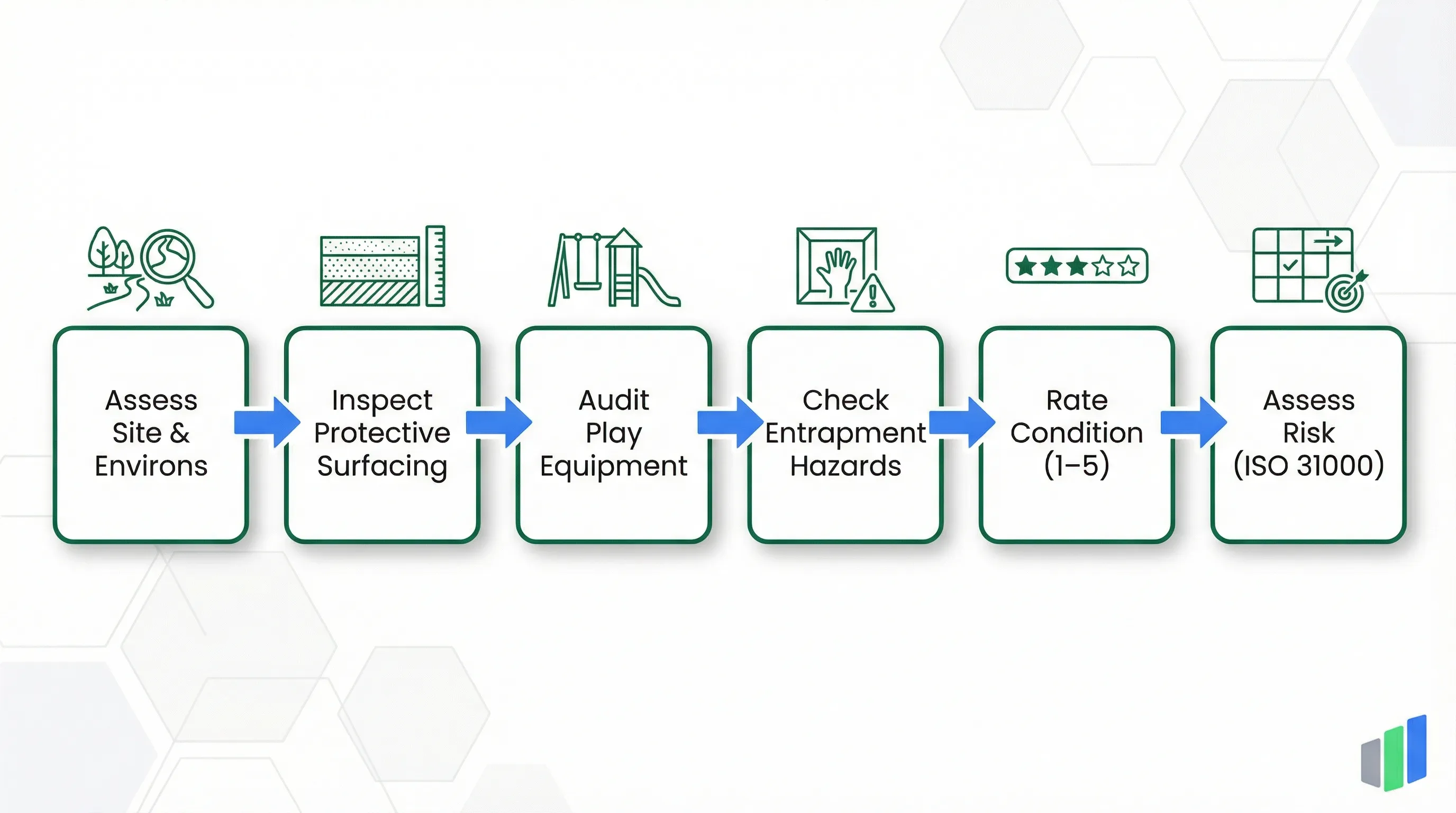
AS 4685 is the Australian/New Zealand standard series for playground equipment safety covering design, manufacture, installation, and inspection. The operational inspection (Level 2) per AS 4685.0 Clause 8.5.4 assesses structural stability, equipment wear, surfacing compliance under AS 4422, and entrapment hazards — producing a 1-to-5 condition rating and an ISO 31000-based risk classification for each piece of play equipment.
- Full Name
- Playground equipment and surfacing — General safety requirements
- Issuing Body
- Standards Australia / Standards New Zealand
- Current Revision
- AS 4685.0:2017
INSPECTION OVERVIEW
How AS 4685 Operational Inspections Work
AS 4685.0 defines three levels of playground inspection. The routine visual inspection (Level 1) is a quick daily or weekly walk-through that identifies obvious hazards such as broken glass, vandalism, or missing components. The comprehensive annual inspection (Level 3) is a full engineering assessment including below-ground footing checks and compliance verification against all parts of the AS 4685 series. The operational inspection (Level 2) falls between these extremes — it is a hands-on assessment of each piece of equipment's operation and stability, performed monthly to quarterly by a trained inspector.
In the field, the operational inspection follows three logical phases. First, the inspector assesses the site and its surroundings — access pathways per AS 1428, fencing and gate latches, signage, vegetation hazards, drainage, and general cleanliness. Second, the protective surfacing is evaluated against AS 4422 requirements, including depth measurements for loose fill and condition checks for unitary surfaces. Third, each piece of play equipment is audited individually: the inspector tests structural stability, checks moving parts and bearings, inspects hardware and fasteners, evaluates chains and rope wear, performs entrapment checks, and assigns both a condition rating and a risk classification. This per-asset repeatable structure means a playground with fifteen items generates fifteen individual audit records, each with its own photos, ratings, and recommended actions.
The standard is maintained by Standards Australia. Inspector training and certification is offered by organisations such as the Playground Safety Institute of Australia (PSIA).
CONDITION RATING
The 5-Point Condition Rating Scale
Each piece of play equipment receives a condition rating from 1 (Very Good) to 5 (Very Poor / Failed). This scale follows standard Australian asset management practice and drives maintenance prioritization across the playground portfolio.
| Rating | Condition | Description |
|---|---|---|
| 1 | Very Good | New or near-new condition. No defects observed. Only preventative maintenance required. |
| 2 | Good | Superficial wear and tear only. Minor cosmetic defects that do not affect safety or function. |
| 3 | Fair | Moderate wear visible. Function is unaffected, but maintenance — cleaning, tightening, painting — is required to prevent further deterioration. |
| 4 | Poor | Significant wear or defects. Function is impaired. Component replacement or significant repair is required within a defined timeframe. |
| 5 | Very Poor / Failed | Asset is structurally unsound, hazardous, or non-functional. Immediate replacement or quarantine is required — the equipment must be closed to the public. |
Equipment rated 4 or 5 should be closed or quarantined until repair or replacement is complete.
ENTRAPMENT & SAFETY
Entrapment Hazards and the 30% Chain Wear Rule
Entrapment is the single most critical safety check in a playground operational inspection. AS 4685 defines specific dimensional thresholds that identify openings capable of trapping a child's head, fingers, or clothing. Any identified entrapment hazard should trigger immediate closure of the equipment until the risk is assessed and eliminated.
Head and Neck Entrapment (89–230 mm)
Openings between 89 mm and 230 mm present the most serious entrapment risk — a child's body can pass through but the head cannot. AS 4685 requires inspectors to test all openings in this range using calibrated probes. Head entrapment is a life-threatening hazard because it can lead to strangulation. Equipment with any opening in this range that is accessible to children must be closed immediately. In the form, the inspector flags Head/Neck entrapment in the multi-select Entrapment Check field, which should trigger a change in Operational Status to Closed / Quarantined.
Finger Entrapment (8–25 mm)
Gaps between 8 mm and 25 mm can trap children's fingers, particularly in forced movement zones where equipment moves the child — such as swing chains, carousel bearings, and seesaw pivots. Unlike head entrapment, finger entrapment is hazardous specifically in areas where the gap opens and closes during use. The inspector checks chain links, bearing housings, and articulation points for gaps in this critical range. In the form, these are captured under the Entrapment Check multi-select alongside the Chains & Connectors and Moving Parts fields.
Clothing Entrapment
V-shaped openings, protruding bolts, and catch points on slides, poles, and climbing structures can snag toggles, drawstrings, and hood cords. While less immediately life-threatening than head entrapment, clothing entrapment on elevated equipment can cause falls or strangulation if the child becomes suspended. The inspector identifies catch points, exposed bolt threads, and any V-shaped gap that could hook clothing during normal or foreseeable play.
The 30% Chain Wear Rule
AS 4685 guidance establishes that swing chains must be replaced when wear exceeds 30% of the original link diameter. In the form, the Chains & Connectors field uses three thresholds: Pass (wear below 30%), Monitor (wear approaching limits), and Fail (wear exceeding 30% or visible deformation). The 30% threshold is an industry-standard trigger derived from the standard's guidance on chain link integrity — once a link has lost nearly a third of its cross-section, its load-bearing capacity is significantly compromised and failure during use becomes foreseeable.
For further guidance on playground safety standards, refer to Play Australia, the national peak body for play safety.
Try this AS 4685 form in Geocadra
We have a pre-built AS 4685 inspection template ready to go. Sign up and start your first condition assessment today.
Free 14-day trial. No credit card required.
SURFACING (AS 4422)
Protective Surfacing and Fall Height Compliance
Impact-attenuating surfacing is mandatory under AS 4685 for all equipment with a Free Height of Fall (FHoF) exceeding 600 mm. The companion standard AS 4422 specifies the performance requirements that surfacing must meet to reduce head injury risk during falls.
The operational inspection evaluates two broad categories of surfacing. Loose fill materials — bark, mulch, and sand — require a measured depth of at least 200 mm, or 300 mm or more for equipment with higher fall heights. The inspector measures depth at multiple points in the fall zone and records the value in millimetres. If the measured depth drops below the 200 mm minimum maintenance threshold, the form flags it for top-up. Compaction is equally critical: loose fill that has hardened into a solid mat loses its impact-absorbing properties and must be raked, aerated, or replaced. Contamination — rocks, glass, animal waste, or sharp debris embedded in the fill — must also be recorded.
Unitary surfaces — wet-pour rubber, synthetic grass, and rubber tiles — are assessed for shrinkage gaps wider than 3 mm (trip hazards), worn areas exposing the base layer, lifted edges, and hardening that reduces impact absorption. Unlike loose fill, unitary surfaces cannot be easily topped up in the field; defects typically require professional repair or panel replacement. The inspector also verifies fall zone clearances: the impact area around each piece of equipment must be free of obstacles such as fence posts, retaining walls, and adjacent equipment within the required falling space. Edging and borders are checked to ensure they are flush and do not present a trip or impact hazard at the boundary of the surfacing material.
Surface types assessed include bark/mulch and sand (loose fill), wet-pour rubber and synthetic grass (unitary), and natural grass — which is only acceptable for low fall heights. Each type has specific inspection criteria within the standards directory.
RISK ASSESSMENT
The ISO 31000-Based Risk Matrix
AS 4685.0 incorporates a risk management framework based on ISO 31000. After completing the equipment audit, the inspector determines the overall risk level by evaluating the Likelihood of an injury occurring against the Consequence if it does. The resulting risk classification directly determines the urgency and type of action required.
| Likelihood | Insignificant | Minor | Moderate | Major | Catastrophic |
|---|---|---|---|---|---|
| 5 — Almost Certain | High | High | Extreme | Extreme | Extreme |
| 4 — Likely | Moderate | High | High | Extreme | Extreme |
| 3 — Possible | Low | Moderate | High | Extreme | Extreme |
| 2 — Unlikely | Low | Low | Moderate | High | Extreme |
| 1 — Rare | Low | Low | Low | High | High |
Consequence levels: Insignificant (no injury), Minor (first aid), Moderate (medical attention), Major (hospitalization/permanent injury), Catastrophic (death).
Recommendation Priority Levels
Based on the calculated risk level, the inspector selects an action recommendation. When the risk level is High or Extreme, specifying a concrete action in the form becomes mandatory.
| Priority | Action | Timeframe |
|---|---|---|
| Immediate | Close equipment, remove, or barricade | Now — equipment must not be used |
| High | Significant repair or component replacement | Within 14 days |
| Medium | Scheduled repair during maintenance cycle | Within 1 month |
| Low / Monitor | Note for next inspection cycle | Next scheduled inspection |
| No Action | Equipment is compliant and serviceable | — |
When the calculated risk level is High or Extreme, the Action Required field becomes mandatory in the form.
Similar condition-based assessment frameworks are used in other inspection standards, such as the NEN 2767 condition assessment for building components.
DIGITAL WORKFLOW
Digitize AS 4685 Inspections with Geocadra
Traditional playground inspections rely on paper checklists and manual risk calculations. Geocadra replaces that workflow with structured digital forms purpose-built for AS 4685 operational inspections.
Repeatable equipment audit blocks
Each piece of play equipment — swing, slide, climber, combo unit — is captured in a repeatable audit section. The inspector taps "Add Equipment" for every asset on site, each with its own condition rating, entrapment check, photo evidence, and action notes.
Surfacing depth validation
Numeric fields for loose fill depth trigger automatic warnings when the measured value falls below the AS 4685 minimum maintenance threshold of 200 mm. The inspector sees the flag immediately, not after returning to the office.
Entrapment-triggered closure logic
When the inspector selects any entrapment hazard — head/neck, finger, or clothing — the form defaults the Operational Status to Closed / Quarantined, ensuring the equipment is taken out of service before the risk assessment is even complete.
Photo-linked defect records
Every equipment audit and site issue is tied to geotagged photos. Reviewers see exactly which swing, which chain link, or which surfacing patch failed — not just a line in a spreadsheet.
QUESTIONS
Frequently Asked Questions
What is AS 4685?
AS 4685 is the Australian/New Zealand standard series for playground equipment safety. It covers design, manufacture, installation, and ongoing inspection requirements. AS 4685.0 specifically addresses management and operational inspection protocols, including the three-level inspection hierarchy and risk management framework.
What are the three levels of playground inspection under AS 4685?
Level 1 is the routine visual inspection — a quick daily or weekly walk-through for obvious hazards. Level 2 is the operational inspection — a detailed monthly-to-quarterly check of equipment stability, wear, and safety. Level 3 is the comprehensive annual inspection — a full engineering assessment including below-ground checks.
What entrapment hazards does AS 4685 check for?
AS 4685 identifies three entrapment types: head/neck entrapment (openings between 89 mm and 230 mm), finger entrapment (gaps between 8 mm and 25 mm, particularly in forced movement zones), and clothing entrapment (V-shaped openings or protrusions that can catch toggles and drawstrings).
How often should AS 4685 operational inspections be performed?
AS 4685.0 recommends operational inspections at monthly to quarterly intervals, depending on the level of use, environmental exposure, and manufacturer recommendations. High-traffic playgrounds in coastal or harsh climates may warrant monthly inspections.
What is the Critical Fall Height and how does it relate to surfacing?
The Critical Fall Height (CFH) is the maximum height from which a life-threatening head injury would not be expected to occur for a given surfacing type and depth. AS 4422 defines the CFH for each surface material. Loose fill must be at least 200 mm deep, with 300 mm or more for higher fall heights.
What qualifications are needed to perform an AS 4685 inspection?
While there is no single mandatory certification, industry bodies such as the Playground Safety Institute of Australia (PSIA) and Kidsafe offer recognized training and certification programs for playground inspectors. Many local councils require inspectors to hold a current PSIA certification or equivalent.
How does AS 4685 relate to AS 4422?
AS 4685 governs the playground equipment itself — design, installation, and inspection. AS 4422 is the companion standard that specifies performance requirements for impact-attenuating surfacing beneath and around equipment. An AS 4685 operational inspection always includes a surfacing check against AS 4422 criteria.
In practice
See how the round runs in Geocadra
The solution page shows this inspection regime on real open data: the import, the form, the round, the record per asset and the export.
Playground checks, headstone tests and green-space acceptances on a map, with every round appended to the siteOpen the solution page: Municipalities & Public SpaceTRY IT FREE
Digitize your AS 4685 inspections
Replace paper forms and spreadsheets with structured digital inspections, built for standards like AS 4685.
No credit card requiredFree trial included