
DIN 1076 Bridge Inspection
The German standard for structural inspection of bridges using RI-EBW-PRÜF damage rating and ASB-ING classification.
DIN 1076 is the governing standard in Germany for monitoring and inspecting civil engineering structures along roads and paths — with bridges as its primary scope. The inspection methodology is defined by the RI-EBW-PRÜF guidelines, which require every defect to be rated on three independent axes: Stability (S), Traffic Safety (V), and Durability (D). This guide covers the inspection types, the S-V-D rating system, nine ASB-ING component groups specific to bridges, the damage catalog for concrete, steel, and masonry structures, and the resulting Condition Grade (Zustandsnote) from 1.0 to 4.0.
What is DIN 1076?
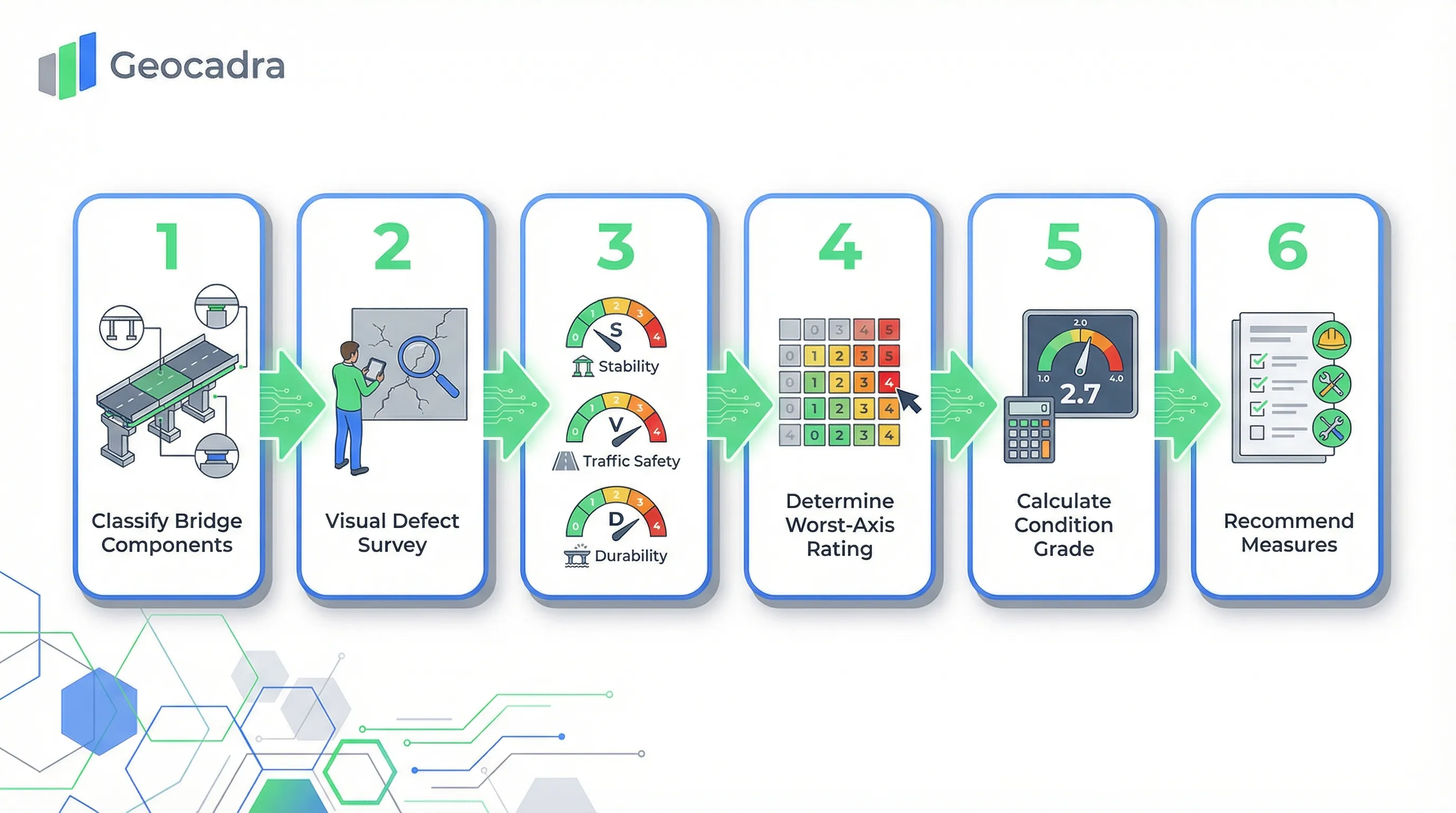
DIN 1076 is the German standard for monitoring and inspection of civil engineering structures along roads and paths, with bridges as the primary asset class. Under the RI-EBW-PRÜF guidelines, each defect is rated on three axes — Stability (S), Traffic Safety (V), and Durability (D) — on a 0-to-4 scale, producing an overall Condition Grade (Zustandsnote) from 1.0 to 4.0.
- Full Name
- Ingenieurbauwerke im Zuge von Straßen und Wegen — Überwachung und Prüfung
- Issuing Body
- Deutsches Institut für Normung (DIN)
- Current Revision
- DIN 1076:1999-11
INSPECTION TYPES
Five Levels of Structural Inspection Under DIN 1076
DIN 1076 defines a hierarchy of inspection types that differ in scope, depth, and required access. The inspection type selected determines how thoroughly the bridge must be examined and what access equipment is necessary.
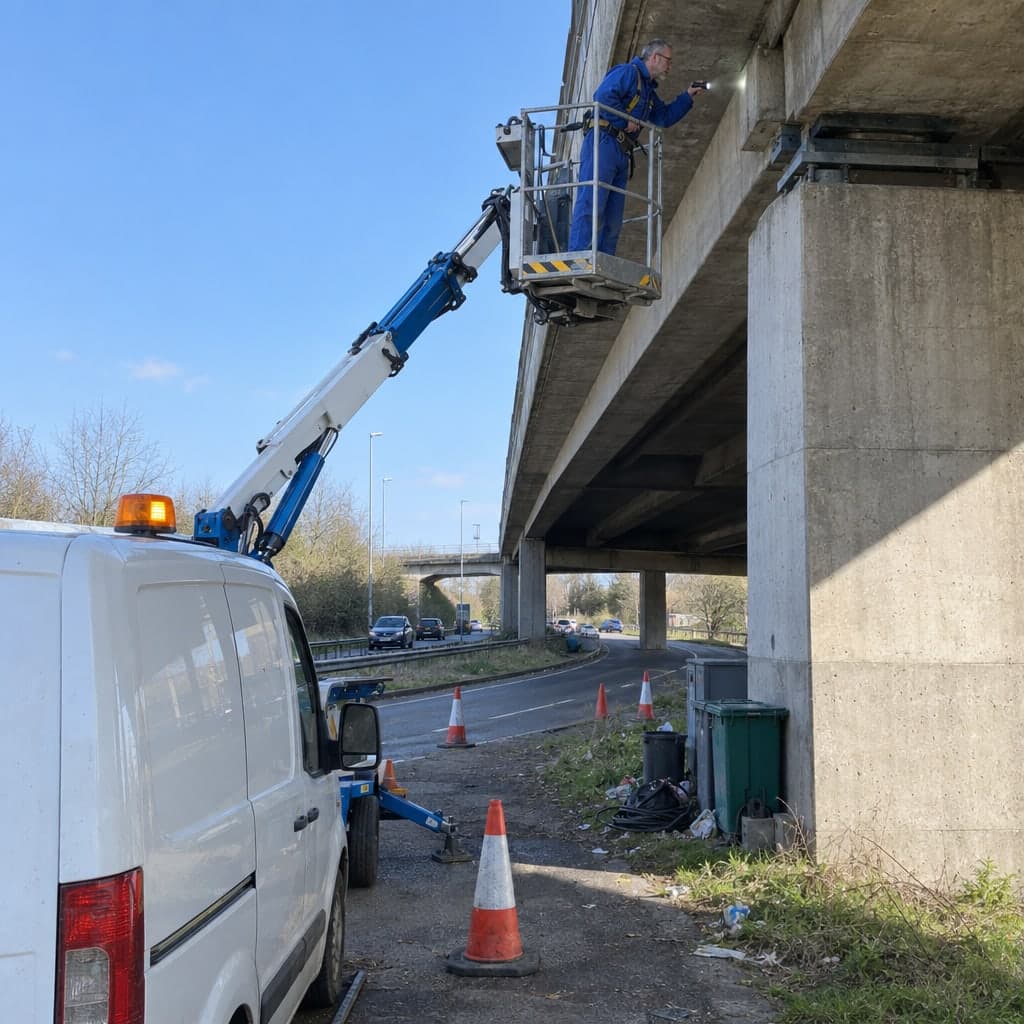
The Hauptprüfung (H) — Main Inspection — is the most comprehensive assessment and the foundation of Germany's bridge maintenance regime. It requires hand-close (handnah) examination of all structural components and is mandatory every six years, split into H1 and H2 cycles. For bridges, this means the inspector must physically reach the superstructure underside, bearings, abutments, pier shafts, expansion joints, drainage outlets, and the bridge deck — using under-bridge inspection units (Untersichtgeräte), aerial lifts, boats, scaffolding, or drones where direct access is impractical. Every visible and accessible component is examined, and all defects are rated using the S-V-D system. The Main Inspection is the baseline for the structure's Condition Grade.
The Einfache Prüfung (E) — Simple Inspection — is performed three years after each Main Inspection, providing a mid-cycle visual assessment. It focuses on changes since the last Main Inspection: new cracks, progression of existing defects, bearing displacement, joint seal deterioration, and drainage blockages. While less intensive than the Main Inspection, it still requires the inspector to evaluate each component group and update defect records. Defects flagged with the EP-Vormerkung (Simple Inspection Flag) during the previous Main Inspection receive special attention. The Sonderprüfung (S) — Special Inspection — is triggered by specific events such as floods, vehicle impacts, overloading, or earthquakes. It can be ordered at any time and focuses on the damage caused by the triggering event. Additionally, DIN 1076 defines the Besichtigung (B) — a visual check that serves as a quick-status review between formal inspections.
In the digital form, the inspector selects the Prüfungsart (Inspection Type) as the first field — choosing between Hauptprüfung (H1), Hauptprüfung (H2), Einfache Prüfung (E), Sonderprüfung (S), or Besichtigung (B) — which sets the expected scope for the entire inspection. A Hauptprüfung triggers the full defect logging workflow with mandatory S-V-D ratings for every finding, while a Besichtigung may only require a general status note. The Besichtigungsgeräte (Access Equipment) multi-select field documents what tools were used — aerial lift, under-bridge unit, boat, scaffolding, ladder, or drone — providing proof that hand-close inspection was achieved where required.
Inspection standards are maintained by the Federal Highway Research Institute (BASt), which provides training programs and inspection guidelines.
S-V-D DAMAGE RATING
The Three-Axis Defect Rating System (RI-EBW-PRÜF)
The core of every DIN 1076 bridge inspection is the per-defect S-V-D rating. Unlike standards that assign a single severity grade, RI-EBW-PRÜF requires the inspector to evaluate each defect's impact on three independent criteria — producing a nuanced risk profile rather than a flat score.
Standsicherheit (S) — Stability — measures how the defect affects the bridge's structural load-bearing capacity. A crack in a prestressed concrete main girder receives a far higher S-rating than the same crack type in a non-structural cap, because it directly threatens the primary load path. Corrosion of bearing plates or anchor bolts scores high on S because bearings transfer the entire superstructure load to the substructure. An S-rating of 4 means stability is critically impaired or lost — the bridge can no longer safely carry its design loads and immediate propping, load restrictions, or closure is required. An S-rating of 0 means the defect has no impact on structural capacity whatsoever.
Verkehrssicherheit (V) — Traffic Safety — evaluates whether the defect poses a risk to road users, pedestrians, cyclists, or workers on or under the bridge. For bridges, this axis is critical for railings, pavement condition, expansion joint ride quality, cap stones, and any overhead hazard from spalling concrete. A pothole at an expansion joint that could cause a cyclist to fall scores high on V even if the bridge structure is sound. A V-rating of 4 means safety is not given — the structure must be closed to traffic immediately. Dauerhaftigkeit (D) — Durability — captures the defect's effect on the bridge's long-term service life. Efflorescence on the superstructure underside, dampness penetration through the waterproofing membrane, and early-stage corrosion of reinforcement may not threaten stability today, but they accelerate deterioration and shorten the structure's remaining useful life. A key rule in practice: D is almost always greater than or equal to S, because any defect that impairs stability also impairs durability — but not every durability issue threatens stability.
The three axes are rated independently for each defect. A single crack in the superstructure might receive S:2, V:0, D:3 — it slightly affects stability, poses no traffic safety risk (located on the underside, not accessible to users), but significantly impacts durability because water can penetrate and corrode reinforcement. This three-dimensional profile is what drives the algorithmic Condition Grade calculation: the system takes the maximum rating across all defects for each axis, factors in the extent (Ausbreitung) of each defect — whether it is spot-local (punktuell), widespread (flächig), or linear (linienförmig) — and computes a Zustandsnote that reflects the worst finding across all three dimensions.
| Value | Stability (S) | Traffic Safety (V) | Durability (D) |
|---|---|---|---|
| 0 | No impact on structural capacity | No impact on safety | No impact on service life |
| 1 | Minor impact — safety factors fully maintained | Hardly any impact — safety fully given | Minor impact — long-term effect only |
| 2 | Impaired — repair required in medium term | Slightly impaired — safety still given | Impaired — damage progression likely |
| 3 | Not fully ensured — safety factors reduced; restriction required soon | Impaired — warning signs or restrictions required immediately | Impaired medium-term — accelerated wear expected |
| 4 | Stability no longer given — immediate closure or support required | Safety no longer given — immediate closure required | Durability no longer given — component failure imminent |
Each defect receives independent ratings for all three axes. The overall Condition Grade (Zustandsnote) is algorithmically derived from the maximum S, V, and D values across all defects, weighted by defect extent.
The same S-V-D methodology is also applied in the DIN 1076 retaining wall inspection. Similar multi-dimensional rating approaches are found in the NEN 2767 condition assessment, which uses severity, intensity, and extent as three dimensions of defect assessment.
Try this DIN 1076 form in Geocadra
We have a pre-built DIN 1076 inspection template ready to go. Sign up and start your first condition assessment today.
Free 14-day trial. No credit card required.
COMPONENTS & DAMAGE
Nine Component Groups and the Damage Catalog for Bridges
DIN 1076 bridge inspections follow the ASB-ING hierarchical classification: Structure (Bauwerk) → Component Group (Bauteilgruppe) → Defect (Schaden). Every defect must be assigned to a specific component group before it is rated.
Bridges are decomposed into nine component groups per ASB-ING — significantly more than retaining walls, reflecting the complexity of bridge structures. The Überbau (Superstructure) encompasses the main load-carrying elements: girders, slabs, arches, or trusses that span between supports. Defects here — particularly cracks in prestressed concrete or fatigue cracks in steel — receive the highest Stability attention because they directly affect the primary load path. The Unterbau (Substructure) covers piers, abutments, and wing walls that transfer superstructure loads to the foundations. The Gründung (Foundation) includes pile caps, spread footings, and deep foundations — often partially submerged or buried, requiring boats or excavation for full inspection.
The Lager (Bearings) are the mechanical connection between superstructure and substructure, transferring loads while accommodating thermal movement, rotation, and deformation. Seized, corroded, or displaced bearings are among the most critical defects because they can introduce unintended forces into the structure. The Fahrbahnübergänge (Expansion Joints) accommodate deck movement at abutments and midspan hinges — damaged joints allow water infiltration to bearings and substructure below, making them a leading indicator of future durability problems. The Kappen (Caps/Sidewalks) are the reinforced concrete edge beams that carry railings, barriers, and pedestrian walkways. The Beläge (Pavements/Coatings) include the wearing surface and waterproofing membrane that protects the structural deck. The Geländer (Railings/Barriers) are critical for traffic safety — any loosening, deformation, or corrosion directly affects the V-axis rating. Finally, the Entwässerung (Drainage) covers scuppers, pipes, and channels that remove water from the bridge deck and prevent it from reaching structural elements.
The damage catalog defined by RI-EBW-PRÜF provides standardized defect types across all material classes. Riss (Crack) is the most common finding, with distinct implications depending on whether it appears in reinforced concrete, prestressed concrete, steel, or masonry. Abplatzung (Spalling) indicates concrete cover has broken away, potentially exposing and accelerating corrosion of reinforcement. Kiesnest (Honeycombing) reveals poor concrete compaction during construction. Korrosion (Corrosion) affects steel components, bearings, and exposed reinforcement — scoring high on both S and D axes. Ausblühung (Efflorescence) signals water migration through concrete, while Feuchtigkeit (Dampness) indicates waterproofing membrane failure. Hohlstelle (Void/Delamination) is detected by hammer-tapping and indicates internal concrete degradation. Bewuchs (Vegetation) in joints, drainage, or masonry can mask underlying defects. In the form, the inspector selects the Bauteilgruppe (Component Group), then the Schadensart (Damage Type), locates the defect using the free-text Bauteil/Ort field, and documents it with mandatory photographs.
For further information on the SIB-Bauwerke database system, refer to the Federal Highway Research Institute (BASt), which maintains the system on behalf of the federal government.
CONDITION GRADE
The Zustandsnote: Bridge Condition Grade 1.0–4.0
The Zustandsnote is the overall condition grade assigned to the entire bridge. It synthesizes all individual defect S-V-D ratings into a single number between 1.0 (Very Good) and 4.0 (Unsatisfactory), driving maintenance budgeting and intervention planning across Germany's 40,000+ federal road bridges.
The Zustandsnote is not a simple average of defect ratings. The SIB-Bauwerke system calculates it algorithmically by taking the maximum S, V, and D ratings across all logged defects, factoring in the extent classification (spot, area, or linear) of each defect. A single S:4 defect on a main girder — even if localized — can push the entire bridge's grade to 3.5–4.0 because stability is critically impaired. Conversely, widespread D:2 defects across the deck waterproofing (many areas with slight durability impact) may aggregate to a higher Zustandsnote than an isolated D:2 finding, because the extent modifier amplifies the rating. For bridges, the number of defects per inspection is typically much higher than for simpler structures — a single Main Inspection may produce 20 to 50+ individual defect records, each with its own S-V-D rating.
The responsible engineer reviews the algorithmically calculated grade and assigns a final Zustandsnote (Manuell), which may differ from the calculated value based on engineering judgment. For bridges, this manual override is particularly important when the inspector identifies systemic patterns — for example, when a combination of individually low-rated defects in bearings, joints, and drainage collectively indicates that the waterproofing system has failed, requiring a grade adjustment that the per-defect algorithm does not capture. The manual grade is the legally binding assessment that determines the bridge's maintenance classification. Bridges graded 3.0 or higher trigger mandatory repair planning, while grades of 3.5–4.0 may require immediate load restrictions, speed limits, or full closure — a decision with significant traffic network impact.
| Grade | German | English | Meaning |
|---|---|---|---|
| 1.0–1.4 | Sehr guter Zustand | Very Good | No defects or only trivial findings with slight long-term durability impact. No action required. |
| 1.5–1.9 | Guter Zustand | Good | Minor defects. Durability might be slightly affected long-term. Routine maintenance sufficient. |
| 2.0–2.4 | Befriedigender Zustand | Satisfactory | Standard condition. Durability affected, but Stability and Traffic Safety are fully intact. |
| 2.5–2.9 | Ausreichender Zustand | Sufficient | Significant durability impact. Stability and Traffic Safety are still given, but repair is needed. |
| 3.0–3.4 | Nicht ausreichender Zustand | Inadequate | Stability and/or Traffic Safety impaired. Durability no longer given. Repair needed soon. |
| 3.5–4.0 | Ungenügender Zustand | Unsatisfactory | Stability and/or Traffic Safety heavily impaired or lost. Immediate action — restriction or closure — required. |
The responsible engineer assigns the final grade (Zustandsnote Manuell), which may differ from the algorithmically calculated value based on engineering judgment.
Recommended Measures
Based on the Condition Grade and defect pattern, the inspecting engineer selects a standardized recommended measure per RI-EBW-PRÜF.
| Measure | German | When Applied |
|---|---|---|
| No action | Keine Maßnahme | Grade 1.0–1.4 — bridge is in very good condition. |
| Monitor | Beobachtung | Grade 1.5–1.9 — defect noted, re-check at next inspection cycle. |
| Routine maintenance | Unterhaltung | Grade 1.5–2.4 — minor upkeep within regular maintenance cycles. |
| Repair | Instandsetzung | Grade 2.5–3.4 — defects require targeted structural repair. |
| Renewal | Erneuerung | Grade 3.0+ — component or structure requires full replacement. |
| Immediate action | Sofortmaßnahme | Any S:4 or V:4 finding — immediate closure, propping, or load restriction. |
The recommended measure is selected by the inspecting engineer based on the Condition Grade and the specific defect pattern observed. The EP-Vormerkung flag marks defects for re-inspection at the next Simple Inspection (3 years later).
All condition grades and measures are recorded in the standards directory -referenced SIB-Bauwerke system.
DIGITAL WORKFLOW
Digitize DIN 1076 Bridge Inspections with Geocadra
DIN 1076 bridge inspections generate complex, multi-defect records — often 20 to 50+ findings per structure — that must be compatible with the SIB-Bauwerke database system. Geocadra replaces paper-based RI-EBW-PRÜF forms with structured digital workflows purpose-built for German structural inspection requirements.
Repeatable defect logging blocks
Each defect — crack, spalling, corrosion, efflorescence, vegetation — is captured in a repeatable section with its own component group, material type, damage type, S-V-D rating, extent classification, photos, and location description. A bridge with forty defects generates forty individually rated records, each traceable to a specific component and location.
Three-axis S-V-D rating enforcement
The form enforces mandatory Stability (S), Traffic Safety (V), and Durability (D) ratings for every defect entry. The inspector cannot submit a defect without completing all three axes, ensuring the Zustandsnote calculation has complete input data. The EP-Vormerkung toggle flags critical defects for follow-up at the next Simple Inspection.
Nine ASB-ING component groups for bridges
Dropdown fields align with the ASB-ING key tables for bridge component groups — Superstructure, Substructure, Foundation, Bearings, Expansion Joints, Caps, Pavements, Railings, and Drainage — so exported data maps directly to the SIB-Bauwerke database without manual recoding. A material selector covers reinforced concrete, prestressed concrete, steel, masonry, and timber.
Photo-linked defect evidence with context fields
Every defect entry requires photo documentation. Images are geotagged and linked to the specific defect record. Additional context fields capture weather conditions, temperature at time of inspection, traffic restrictions in place, and access equipment used — building the complete evidence chain that DIN 1076 Main Inspections require.
QUESTIONS
Frequently Asked Questions
What is a DIN 1076 bridge inspection?
A DIN 1076 bridge inspection is the mandatory structural assessment of road bridges in Germany. Using the RI-EBW-PRÜF methodology, every defect is rated on three axes — Stability (S), Traffic Safety (V), and Durability (D) — on a 0-to-4 scale. Results are recorded in the SIB-Bauwerke system and produce a Zustandsnote from 1.0 to 4.0.
What is the S-V-D rating system used in bridge inspections?
The S-V-D system requires inspectors to rate every defect on three independent axes: Standsicherheit (S) for structural stability, Verkehrssicherheit (V) for traffic safety, and Dauerhaftigkeit (D) for durability. Each axis uses a 0-to-4 scale where 0 means no impact and 4 means critical failure requiring immediate action.
How is the Zustandsnote (Condition Grade) calculated for bridges?
The Zustandsnote is algorithmically derived from the maximum S, V, and D ratings across all logged defects, weighted by the extent classification (spot, area, or linear) of each defect. The responsible engineer then assigns a final manual grade from 1.0 (Very Good) to 4.0 (Unsatisfactory) based on engineering judgment.
What is the difference between H1 and H2 bridge inspections?
Both H1 and H2 are Hauptprüfungen (Main Inspections) with the same scope — comprehensive hand-close examination of all components. They alternate every six years in a twelve-year cycle: H1 at year 0, E at year 3, H2 at year 6, E at year 9. The distinction allows tracking of long-term change patterns across two successive full inspection datasets.
What are the nine component groups for bridge inspections under ASB-ING?
The nine groups are: Überbau (Superstructure), Unterbau (Substructure), Gründung (Foundation), Lager (Bearings), Fahrbahnübergänge (Expansion Joints), Kappen (Caps/Sidewalks), Beläge (Pavements), Geländer (Railings/Barriers), and Entwässerung (Drainage). Each defect must be classified into one of these groups.
What is the EP-Vormerkung flag in a DIN 1076 inspection?
The EP-Vormerkung (Simple Inspection Flag) marks a defect for specific re-examination during the next Einfache Prüfung (Simple Inspection), which occurs three years after the Main Inspection. It is used for defects that need monitoring but do not yet require immediate repair — ensuring they are not overlooked in the less intensive mid-cycle inspection.
How does DIN 1076 bridge inspection differ from retaining wall inspection?
Both use the same RI-EBW-PRÜF S-V-D methodology and Zustandsnote scale. The key difference is scope: bridges have nine ASB-ING component groups (including bearings, expansion joints, and superstructure), while retaining walls typically have seven. Bridges also require more specialized access equipment and generate significantly more defect records per inspection.
In practice
See how the round runs in Geocadra
The solution page shows this inspection regime on real open data: the import, the form, the round, the record per asset and the export.
Main and routine inspections of bridges, walls, roads and signs on a map, with every inspection appended to the structureOpen the solution page: Bridges, Roads & StructuresTRY IT FREE
Digitize your DIN 1076 inspections
Replace paper forms and spreadsheets with structured digital inspections, built for standards like DIN 1076.
No credit card requiredFree trial included