



FHWA NBIS/SNBI Bridge Inspection
The U.S. federal standard for bridge safety inspection, component condition rating, and element-level structural assessment.
The FHWA NBIS/SNBI framework is the backbone of bridge safety in the United States. It governs how over 600,000 highway bridges are inspected, rated, and reported to the National Bridge Inventory — driving federal funding decisions, load posting requirements, and rehabilitation priorities. The 2022 SNBI update replaces the legacy NBI Coding Guide with more granular component tracking and mandates element-level data collection for all National Highway System bridges.

What is FHWA NBIS/SNBI?
The FHWA Specifications for the National Bridge Inventory (SNBI) is the United States federal standard governing how bridge inspection data is collected and reported under the National Bridge Inspection Standards (NBIS). It uses a dual-tier rating system: a 0-to-9 component condition scale for major bridge parts and a four-state element-level assessment for National Highway System structures.
- Full Name
- Specifications for the National Bridge Inventory (SNBI)
- Issuing Body
- Federal Highway Administration (FHWA), U.S. Department of Transportation
- Current Revision
- SNBI 2022 (Effective January 2025)
OVERVIEW
How NBIS Bridge Inspection Works
NBIS bridge inspection follows a structured, federally mandated process that combines high-level safety ratings with detailed structural analysis.
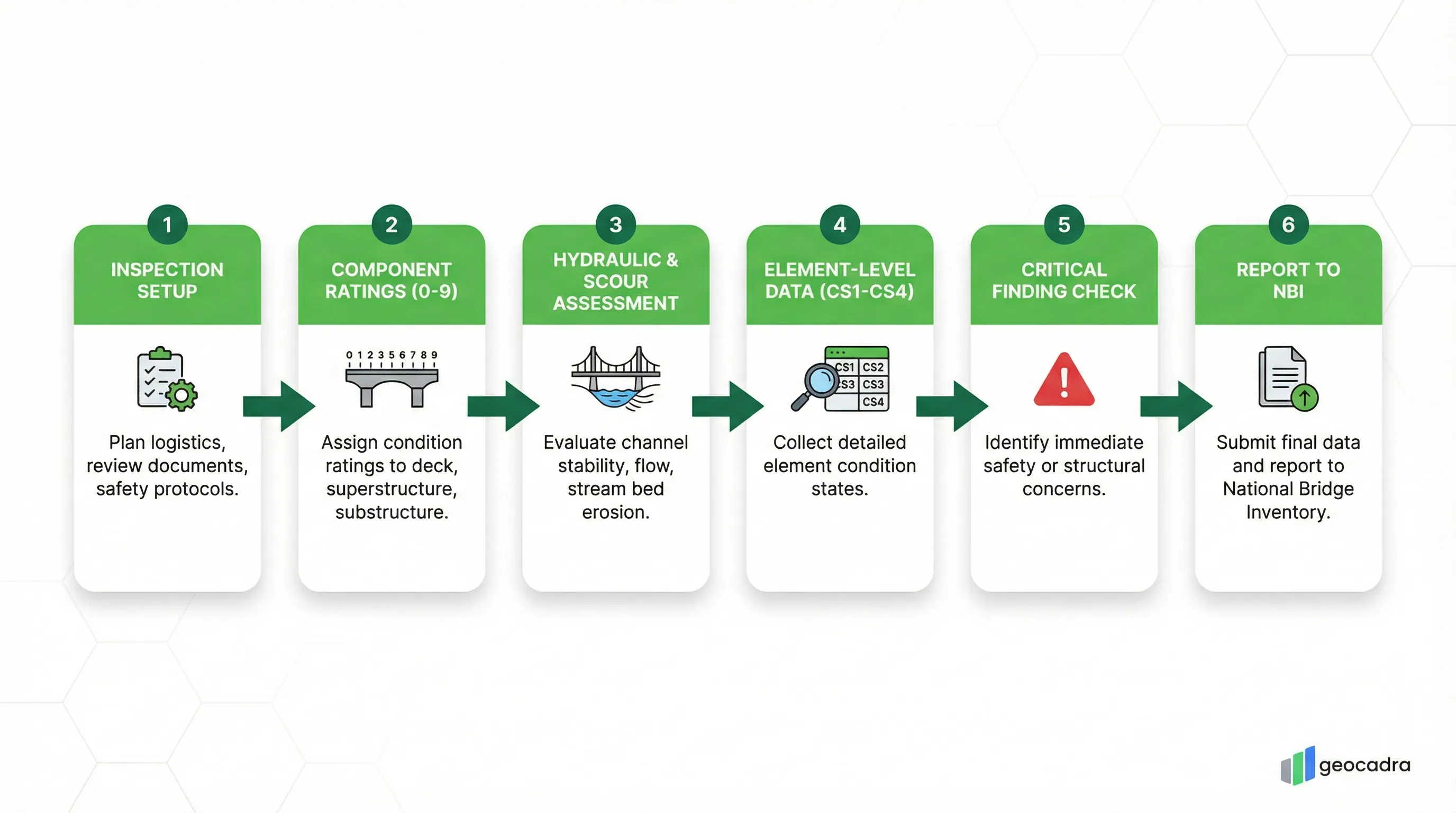
The National Bridge Inspection Standards (NBIS) require every public highway bridge in the United States to undergo routine inspection at intervals not exceeding 24 months. The Specifications for the National Bridge Inventory (SNBI) define exactly what data inspectors must collect during each visit — from broad condition ratings of major components to detailed element-level quantity breakdowns. This data feeds the National Bridge Inventory (NBI), the federal database that tracks the condition of every bridge in the country.
A typical NBIS inspection begins with documenting the inspection event itself — the type of inspection (Routine, Initial, Damage, In-Depth, Special, or NSTM), the equipment used, and site conditions. The inspector then moves through each major bridge component, assigning a condition rating on the 0-to-9 NBI scale. For bridges on the National Highway System (NHS), the inspector also performs element-level data collection, breaking each structural element into four condition states and recording the quantity in each state.
The SNBI replaced the legacy NBI Recording and Coding Guide in 2022. States began collecting SNBI-format data in January 2025, with full compliance required by March 2028. The update introduces granular component tracking — bearings and joints, previously buried within the superstructure rating, now have dedicated condition fields. Bridge railings and transitions moved from binary pass/fail assessments to the full 0-to-9 condition scale. These changes give asset managers significantly more actionable data for maintenance planning and federal funding allocation.
The standard is maintained by the Federal Highway Administration (FHWA) and administered through the National Bridge Inventory program. For international bridge standards, see the DIN 1076 Bridge Inspection standard used in Germany.
CONDITION SCALE
Component Condition Rating Scale (0–9)
Every major bridge component receives a condition rating from 0 (Failed) to 9 (Excellent). These ratings drive federal classification of bridges as "Good," "Fair," or "Poor" and determine eligibility for Highway Bridge Program funding.
The 0-to-9 General Condition Rating scale is the cornerstone of NBI reporting. Inspectors assign a single rating to each major component — Deck (B.C.01), Superstructure (B.C.02), Substructure (B.C.03), and Culvert (B.C.04) — based on the overall observed condition. A bridge classified as "Structurally Deficient" under legacy rules typically had at least one component rated 4 (Poor) or below. Under SNBI, the terminology has shifted to a "Good/Fair/Poor" classification where ratings 7–9 are Good, 5–6 are Fair, and 4 or below is Poor.
The SNBI expands component-level tracking beyond the traditional Deck/Superstructure/Substructure triad. Bearings (B.C.07) and Bridge Joints (B.C.08) now have dedicated condition fields, reflecting their outsized impact on bridge maintenance costs. Similarly, Bridge Railing (B.C.05) and Railing Transitions (B.C.06) are now rated on the full 0-to-9 scale rather than the legacy binary "Meets/Does Not Meet Standards" assessment. In the form, each component is presented as a dropdown selector with the full rating scale, and a code of "N" (Not Applicable) is available for components that do not exist on the structure — for example, Culvert is coded "N" on beam bridges, and Bearings is coded "N" on integral-abutment structures.
| Code | Label | Description |
|---|---|---|
| N | Not Applicable | Component does not exist on the structure. |
| 9 | Excellent | Isolated inherent defects only. |
| 8 | Very Good | Some inherent defects present. |
| 7 | Good | Some minor defects noted. |
| 6 | Satisfactory | Widespread minor or isolated moderate defects. |
| 5 | Fair | Some moderate defects; strength and performance not affected. |
| 4 | Poor | Widespread moderate or isolated major defects; strength and/or performance affected. |
| 3 | Serious | Major defects; strength and/or performance seriously affected. May necessitate load restrictions or corrective action. |
| 2 | Critical | Major defects; component severely compromised. Typically requires load restrictions and/or corrective action. |
| 1 | Imminent Failure | Major defects; component has failed or failure is imminent. Bridge closed to traffic. |
| 0 | Failed | Component has failed and is beyond corrective action. Bridge closed. |
Components rated 4 or below classify the bridge as "Poor" in the federal Good/Fair/Poor system. Ratings of 3 or below typically trigger a Critical Finding workflow.
ELEMENT INSPECTION
Element-Level Condition States (CS1–CS4)
For National Highway System bridges, SNBI mandates element-level data collection based on the AASHTO Manual for Bridge Element Inspection (MBEI). Each structural element is decomposed into four condition states by quantity.
Element-level inspection provides a fundamentally different view of bridge condition than the 0-to-9 component ratings. Where a component rating gives a single overall grade for the entire deck or superstructure, element-level data quantifies exactly how much of each specific element is in each condition state. For example, an inspector might report that a steel girder bridge has 1,000 linear feet of Steel Open Girder (Element 107), with 800 ft in CS1 (Good), 150 ft in CS2 (Fair), and 50 ft in CS3 (Poor). This granularity enables bridge engineers to model deterioration curves, estimate remaining service life, and plan targeted repairs rather than wholesale replacements.
The AASHTO element catalog defines over 100 National Bridge Elements (NBEs), Bridge Management Elements (BMEs), and Agency-Developed Elements (ADEs). Common elements include Reinforced Concrete Deck (Element 12), Steel Open Girder/Beam (Element 107), Prestressed Concrete Girder (Element 109), Reinforced Concrete Column (Element 205), Concrete Abutment (Element 215), and Pourable Joint Seal (Element 301). In the digital form, the inspector selects an element from a predefined dropdown, enters the total quantity, and then allocates that quantity across the four condition states. A critical validation rule enforces that CS1 + CS2 + CS3 + CS4 must exactly equal the Total Quantity — any mismatch is flagged immediately, preventing data errors before they reach the NBI database.
| State | Label | Description |
|---|---|---|
| CS1 | Good | No defects. Element is in as-built or as-rehabilitated condition. |
| CS2 | Fair | Minor defects present — hairline cracks, minor surface rust, minor spalling. Structural capacity essentially intact. |
| CS3 | Poor | Moderate defects — active corrosion, measurable section loss, open cracks, visible spalling. Structural capacity essentially intact but deterioration progressing. |
| CS4 | Severe | Major defects affecting structural capacity — significant section loss, broken members, large deformations. Typically triggers structural review. |
Condition state quantities are measured in element-specific units (sq ft, linear ft, or each). The sum CS1 + CS2 + CS3 + CS4 must equal the Total Quantity.
Try this FHWA NBIS/SNBI form in Geocadra
We have a pre-built FHWA NBIS/SNBI inspection template ready to go. Sign up and start your first condition assessment today.
Free 14-day trial. No credit card required.
HYDRAULIC ASSESSMENT
Hydraulic & Scour Assessment
For bridges crossing waterways, SNBI requires dedicated assessment of channel conditions, scour damage, and scour vulnerability — the leading cause of bridge failure in the United States.
Scour — the erosion of streambed material around bridge foundations — is responsible for more bridge failures in the United States than any other single cause. The SNBI dedicates three separate data items to evaluating water-related risk. Channel Condition (B.C.09) rates the observed state of the waterway channel on the standard 0-to-9 scale, assessing bank stability, debris accumulation, and channel alignment relative to the bridge opening. Scour Condition (B.C.11) evaluates the actual physical evidence of scour at the foundation — whether erosion has exposed footings, undermined piles, or created voids beneath the structure.
Scour Vulnerability (B.AP.03) is distinct from scour condition — it is an engineering determination of the bridge's theoretical susceptibility to scour, not an observed field condition. Bridges are classified into codes A through U: Code A means the foundations are designed to resist scour (e.g., driven piles to bedrock), Code B indicates stability through installed countermeasures like riprap, Code C means a scour screening analysis confirmed low risk, Code D marks bridges as scour-critical based on hydraulic calculations, and Code U indicates unknown foundations where scour vulnerability cannot be determined. In the digital form, these assessments are conditionally displayed — they appear only when the bridge crosses water, keeping the interface clean for grade-separation structures and overpasses that have no hydraulic risk.
| Code | Classification | Description |
|---|---|---|
| A | Scour Stable (Standard Foundation) | Bridge foundations designed to resist scour (e.g., piles to bedrock or deep footings). |
| B | Scour Stable (Protection) | Scour stability provided by installed countermeasures such as riprap or sheet piling. |
| C | Scour Stable (Screening) | Scour screening analysis confirms low risk. No countermeasures required. |
| D | Scour Critical (Calculated) | Hydraulic calculations indicate bridge foundations are vulnerable to scour. Monitoring plan required. |
| U | Scour Unknown | Foundation type unknown. Scour vulnerability cannot be determined. Investigation recommended. |
Scour vulnerability is an engineering determination, not a field observation. Bridges coded D or U require a Plan of Action for Scour-Critical Bridges.
CRITICAL FINDINGS
Critical Finding Logic and Safety Triggers
A Critical Finding is a structural or safety-related deficiency that requires immediate follow-up action. NBIS regulations mandate that these findings trigger a defined response workflow.
The NBIS requires that any structural or safety-related deficiency requiring immediate follow-up be documented as a Critical Finding. In practice, a Critical Finding is triggered whenever any component condition rating falls to 3 (Serious) or below. At a rating of 3, the component has major defects that seriously affect structural capacity or performance — conditions that typically necessitate load restrictions, lane closures, or emergency shoring. At 2 (Critical), the component is severely compromised, and at 1 (Imminent Failure), the bridge must be closed to traffic.
When a Critical Finding is triggered, the digital form automatically initiates a mandatory documentation workflow. The inspector must provide a detailed text description of the critical defect, record the immediate action taken (such as "Lane closed," "Load posted to 15 tons," or "Shored with temporary supports"), and attach photographic evidence. This information flows directly to the bridge owner and FHWA, ensuring that safety-critical conditions receive immediate attention rather than waiting for routine reporting cycles. The SNBI also requires that Critical Finding follow-up actions be tracked until the deficiency is resolved, creating an auditable chain of accountability from detection through remediation.
Beyond component ratings, Critical Findings can also be triggered by extreme scour conditions (Scour Condition B.C.11 rated 3 or below), by observed settlement or movement of structural elements, or by any condition the inspector judges to present an immediate safety hazard. The threshold is not purely numerical — a professionally licensed bridge inspector retains the authority to declare a Critical Finding based on engineering judgment even when individual component ratings do not meet the automatic trigger threshold.
Automatic Trigger
When any component rating drops to 3 or below, the form automatically flags the inspection as critical and requires mandatory documentation: defect description, immediate action taken, and photographic evidence.
QUESTIONS
Frequently Asked Questions
What is the FHWA NBIS/SNBI?
The Specifications for the National Bridge Inventory (SNBI) is the U.S. federal data standard that defines what bridge inspection data must be collected and how it is reported to the National Bridge Inventory. It replaced the legacy NBI Coding Guide in 2022 and governs inspections under the National Bridge Inspection Standards (NBIS).
What is the difference between component ratings and element-level inspection?
Component ratings assign a single 0-to-9 score to major bridge parts (Deck, Superstructure, Substructure) as an overall condition assessment. Element-level inspection breaks each specific structural element into four condition states (CS1–CS4) by measured quantity, providing significantly finer-grained deterioration data for bridge asset management and lifecycle planning.
What triggers a Critical Finding in bridge inspection?
A Critical Finding is triggered when any component condition rating falls to 3 (Serious) or below, indicating major structural defects. It can also be triggered by extreme scour, observed settlement, or any condition the inspector deems an immediate safety hazard. Mandatory documentation and follow-up action are required.
What is the difference between SNBI and the legacy NBI Coding Guide?
The SNBI introduces granular component tracking — bearings and joints now have dedicated fields instead of being buried in the superstructure rating. Railings moved from binary pass/fail to the 0-to-9 scale. States began SNBI data collection in January 2025, with full compliance by March 2028.
How often must NBIS bridge inspections be performed?
Federal regulations require routine inspections at intervals not exceeding 24 months for most public highway bridges. However, bridges with known structural deficiencies, fracture-critical members, underwater elements, or scour-critical foundations may require significantly more frequent inspection cycles, including annual monitoring or even quarterly observation visits.
What qualifications are needed to perform an NBIS bridge inspection?
NBIS requires that routine bridge inspections be led by a licensed Professional Engineer (PE) or an individual who has successfully completed the FHWA-approved National Highway Institute (NHI) comprehensive bridge inspection training course and has documented field bridge inspection experience under a qualified team leader.
What is scour vulnerability in bridge inspection?
Scour vulnerability (B.AP.03) is an engineering assessment of a bridge's susceptibility to streambed erosion around its foundations. Bridges are classified from A (stable) through D (scour-critical) and U (unknown). Scour is the leading cause of bridge failure in the United States.
In practice
See how the round runs in Geocadra
The solution page shows this inspection regime on real open data: the import, the form, the round, the record per asset and the export.
Main and routine inspections of bridges, walls, roads and signs on a map, with every inspection appended to the structureOpen the solution page: Bridges, Roads & StructuresTRY IT FREE
Digitize your FHWA NBIS/SNBI inspections
Replace paper forms and spreadsheets with structured digital inspections, built for standards like FHWA NBIS/SNBI.
No credit card requiredFree trial included