



NASSCO MACP Manhole Assessment
The North American standard for systematic manhole condition assessment and defect documentation.
NASSCO MACP provides a standardized language for evaluating manhole structures across North America. By decomposing each manhole into discrete vertical components — from cover to channel — and applying a consistent coding system to every defect, MACP ensures that condition data is comparable across utilities, contractors, and inspection teams. The result is actionable asset data that drives rehabilitation planning and capital budgeting.

What is NASSCO MACP?
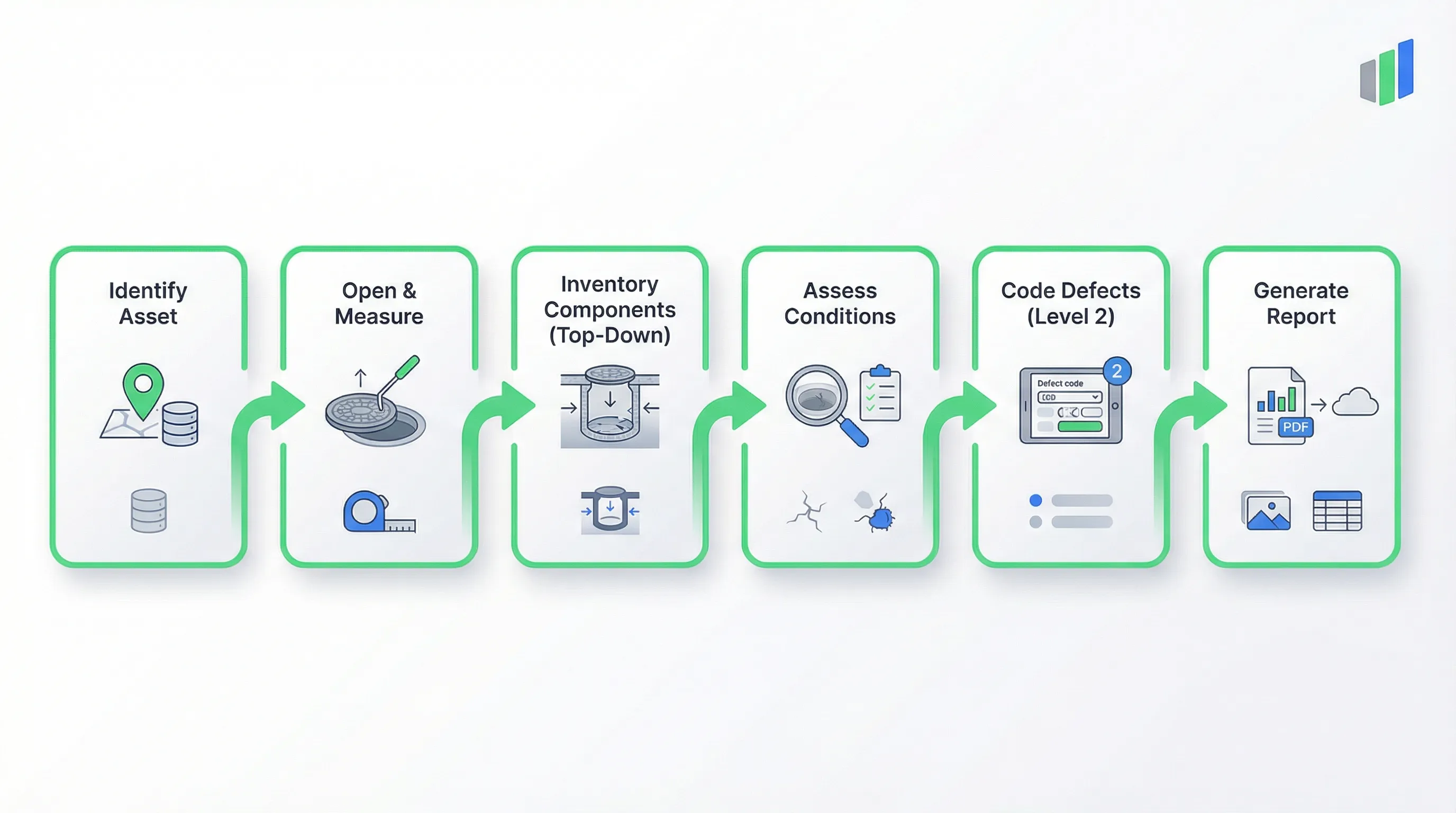
NASSCO MACP (Manhole Assessment Certification Program) is the North American standard for systematic assessment and documentation of manhole conditions. It defines a two-tier inspection protocol — Level 1 for surface screening and Level 2 for detailed defect coding — assigning condition grades from 1 (Excellent) to 5 (Immediate Attention).
- Full Name
- Manhole Assessment Certification Program
- Issuing Body
- NASSCO (National Association of Sewer Service Companies)
- Current Revision
- Version 7.0
INSPECTION TIERS
Level 1 vs Level 2 Inspections
MACP defines two distinct inspection tiers that serve different assessment needs and trigger different data collection requirements.
Level 1 — Surface Screening
A Level 1 inspection is a limited visual assessment conducted from the surface — the inspector looks down into the manhole without entering the confined space. The purpose is to establish a basic inventory of the structure: what materials it is built from, its approximate dimensions, and whether any component shows visible defects from the topside vantage point. Each component receives a binary condition mark of "Sound" or "Defective." In the digital form, the Component Inventory section captures these Sound/Defective assessments for the cover, frame, chimney, cone, wall, bench, channel, and steps. Level 1 is a screening tool. When a component is marked "Defective," it signals the need for a follow-up Level 2 inspection to document the specific defect types and their severity. Municipalities commonly use Level 1 inspections for system-wide screening programs where thousands of manholes need triage within a limited budget. The binary output makes it efficient — an inspector can complete a Level 1 assessment in under 10 minutes per structure.
Level 2 — Detailed Defect Coding
A Level 2 inspection is a comprehensive assessment that documents every defect using NASSCO's standardized coding protocol. It typically requires confined space entry, CCTV cameras, or 3D scanning equipment to inspect all components closely. Each defect is recorded with its specific component location, defect group (Structural, O&M, or Construction), a defect code with descriptor, a condition grade from 1 to 5, clock position, and a mandatory photograph. The form's Defect Coding section is a repeatable block — one entry per observed defect — allowing inspectors to build a complete defect inventory for the structure. Level 2 data feeds directly into asset management systems for rehabilitation prioritization. The structural and O&M defect grades are summed separately to produce composite ratings, and a Quick Rating code summarizes the peak severity and frequency of defects. This granular data allows utilities to compare manholes across the network and allocate capital budgets where deterioration is most advanced.
Level 1 inspections feed into the broader collection pipeline alongside NASSCO PACP sewer inspections.
COMPONENT ANATOMY
Top-to-Bottom Manhole Structure
MACP treats every manhole as a vertical assembly of discrete components, inspected from the surface downward.
The NASSCO MACP inspection protocol is organized around a strict top-to-bottom component hierarchy that mirrors the physical structure of a manhole. This sequence is not arbitrary — it reflects the order in which an inspector encounters each element when looking down into or descending through the structure. By enforcing this consistent flow, MACP ensures that no component is overlooked and that data from different inspectors can be directly compared.
Cover (Lid)
The topmost element. MACP tracks cover type (solid, vented, grate, or inner door), material (cast iron, ductile iron, steel, plastic, or concrete), and condition. A defective cover — cracked, missing, or improperly seated — is a safety hazard and is often the first trigger for a Level 2 inspection.
Frame
The ring that seats the cover. Frame material (cast iron, ductile iron, concrete, or brick), seal presence, and condition are recorded. Frame-to-chimney misalignment is a common defect that indicates grade settlement.
Chimney (Adjustment Rings)
The vertical section between the frame and cone, typically composed of brick courses, concrete rings, or plastic risers. The chimney is particularly susceptible to infiltration at mortar joints and lateral displacement from traffic loads.
Cone / Corbel
The tapered transition from the chimney to the barrel. MACP distinguishes conical (tapered) and flat-top configurations. Cracking at the cone-to-wall joint is a common structural finding.
Wall (Barrel)
The main vertical cylinder. Wall material (precast concrete, brick, block, or poured concrete) and any lining (cementitious, epoxy, or CIPP) are documented. The wall typically has the largest surface area and greatest potential for structural and infiltration defects.
Bench & Channel
The bench is the sloped platform at the base that directs flow into the channel. The channel (invert) is the trough that carries flow through the structure. MACP records bench presence, material, and exposure type (open, pipe, or trough). Bench deterioration accelerates inflow and infiltration.
Steps
Access steps (plastic, cast iron, aluminum, or steel) are assessed for presence, material, and condition. Missing or corroded steps are a confined-space safety concern and a common O&M defect finding.
Each component is assessed independently. A manhole with a sound cover but a fractured wall receives different grades for each, allowing targeted rehabilitation of only the failing components.
Try this NASSCO MACP form in Geocadra
We have a pre-built NASSCO MACP inspection template ready to go. Sign up and start your first condition assessment today.
Free 14-day trial. No credit card required.
CONDITION SCALE
The 5-Point Condition Grade
Every defect identified during a Level 2 inspection receives a condition grade from 1 to 5, reflecting its severity and remaining useful life.
NASSCO MACP uses a 5-point condition grading scale where Grade 1 represents minor, cosmetic deterioration and Grade 5 indicates immediate structural or safety failure. The grade assigned to each defect is not an overall manhole rating — it applies to a specific defect on a specific component. A single manhole may contain defects across multiple grades. The overall condition of the structure is expressed through two composite metrics: a Structural Rating (the sum of all structural defect grades) and an O&M Rating (the sum of all operation and maintenance defect grades). Additionally, the NASSCO Quick Rating condenses the entire defect profile into a compact 4-character code — for example, "5132" means the worst defect is Grade 5, occurring once, with one Grade 3 defect and two Grade 2 defects. This Quick Rating allows asset managers to sort and compare thousands of manholes at a glance without reviewing individual defect logs.
| Grade | Classification | Definition | Examples |
|---|---|---|---|
| 5 | Immediate Attention | Most significant defect. The element has failed or will likely fail within the next 5 years. | Collapse, broken wall with void, gusher infiltration |
| 4 | Poor | Significant defect. Severe deterioration that will become Grade 5 within the foreseeable future (5–10 years). | Broken with soil visible, runner infiltration |
| 3 | Fair | Moderate defect. Deterioration will continue but does not threaten near-term failure (10–20 years RUL). | Fracture, deformation <10%, dripper infiltration |
| 2 | Good | Minor to moderate defect. Early deterioration that has not begun to significantly progress (>20 years RUL). | Crack, surface spalling, minor deposits |
| 1 | Excellent | Minor defect. No significant deterioration observed — normal wear consistent with age. | Surface roughness, stain |
DEFECT CODING
Hierarchical Defect Classification
Level 2 inspections use a structured coding hierarchy that narrows from component to defect family to specific code to descriptor.
The MACP defect coding system is hierarchical by design. Every defect entry in the repeatable Defect Coding section of the form follows a four-level selection path: the inspector first identifies which component is affected (Cover, Frame, Chimney, Cone, Wall, Bench, Channel, or Steps), then selects the defect group, then the specific defect code, and finally a descriptor that refines the observation. This hierarchy ensures that coded data is machine-readable and directly comparable across inspections. Each defect entry also records a clock position to locate the defect on the component's cross-section, a magnitude or measurement value where applicable (such as crack width in inches or root blockage percentage), and a mandatory photograph for verification.
Structural Defects
Defects affecting the physical integrity of the manhole structure. Codes include Crack (C), Fracture (F), Broken (B), Hole (H), Deformed (D), and Surface Damage/Spalling (S). Each code supports descriptors — for example, cracks are further classified as Longitudinal (L), Circumferential (C), or Multiple (M). Structural defects drive the Structural Rating and are weighted more heavily in rehabilitation prioritization.
O&M (Operation & Maintenance) Defects
Defects that affect flow capacity or operational access but are typically removable or manageable through maintenance activities. Codes include Roots (R) with descriptors for Fine, Medium, Ball, and Tap; Deposits (D) for attached or settled material; and Infiltration (I) with descriptors for Dripper, Runner, and Gusher. O&M defects drive the O&M Rating and inform maintenance scheduling rather than capital replacement.
Construction Defects
Defects originating from original construction or subsequent modifications. This group covers intruding seals, improper line or grade, and construction debris. Construction defects are less common than structural or O&M findings but indicate systemic quality issues that may affect multiple manholes in the same corridor.
The complete MACP coding reference is maintained by NASSCO. locale === 'en' ? 'For broader context on condition assessment methodology, see the ' : 'Für einen breiteren Überblick zur Zustandsbewertungsmethodik siehe den '} locale === 'en' ? 'inspection standards library' : 'Inspektionsnormen-Bibliothek'}.
QUESTIONS
Frequently Asked Questions
What is NASSCO MACP?
NASSCO MACP (Manhole Assessment Certification Program) is the North American standard for assessing and documenting manhole conditions. It provides a two-tier inspection protocol and a standardized defect coding system that assigns condition grades from 1 (Excellent) to 5 (Immediate Attention) to individual manhole components.
What is the difference between MACP Level 1 and Level 2?
Level 1 is a surface-level screening that marks each component as Sound or Defective without confined space entry. Level 2 is a comprehensive defect-by-defect assessment using standardized codes, condition grades, photographs, and clock positions — typically requiring entry, CCTV, or 3D scanning.
How is the MACP condition grade determined?
Each individual defect receives a grade from 1 (minor) to 5 (immediate attention) based on severity and remaining useful life. The grades are summed separately for structural and O&M defects. A Quick Rating code summarizes the highest grade and frequency of defects across the structure.
What manhole components does MACP inspect?
MACP inspects nine component zones in a top-to-bottom sequence: cover (lid), frame, chimney (adjustment rings), cone (corbel), wall (barrel), bench, channel (invert), steps, and pipe connections. Each component is assessed independently for material, condition, and defects.
What is the difference between MACP and PACP?
MACP covers manhole (vertical) structures while PACP covers pipe (horizontal) segments. Both are NASSCO programs using similar coding conventions and 1-to-5 grading, but MACP organizes by component and PACP organizes by footage along the pipe run. They are designed as companion standards.
Is NASSCO MACP certification required?
NASSCO recommends certification through its training program, and many utilities require MACP certification as a contract qualification for inspection work. Certification validates that inspectors understand the coding system, grading criteria, and data collection protocols defined in the MACP standard.
How does Geocadra support MACP inspections?
Geocadra provides structured digital forms with pre-configured MACP component inventories, hierarchical defect code selectors, condition grade dropdowns, clock position inputs, and mandatory photo capture — replacing paper-based MACP inspection workflows with verifiable, geo-tagged digital records.
In practice
See how the round runs in Geocadra
The solution page shows this inspection regime on real open data: the import, the form, the round, the record per asset and the export.
Lighting columns, poles, sewers and charge points inspected on a map, with every round appended to the assetOpen the solution page: Utilities & Public LightingTRY IT FREE
Digitize your NASSCO MACP inspections
Replace paper forms and spreadsheets with structured digital inspections, built for standards like NASSCO MACP.
No credit card requiredFree trial included