
ASTM D6433 Parking Lot Inspection
The standard practice for visual pavement distress surveys in parking lots and paved areas.
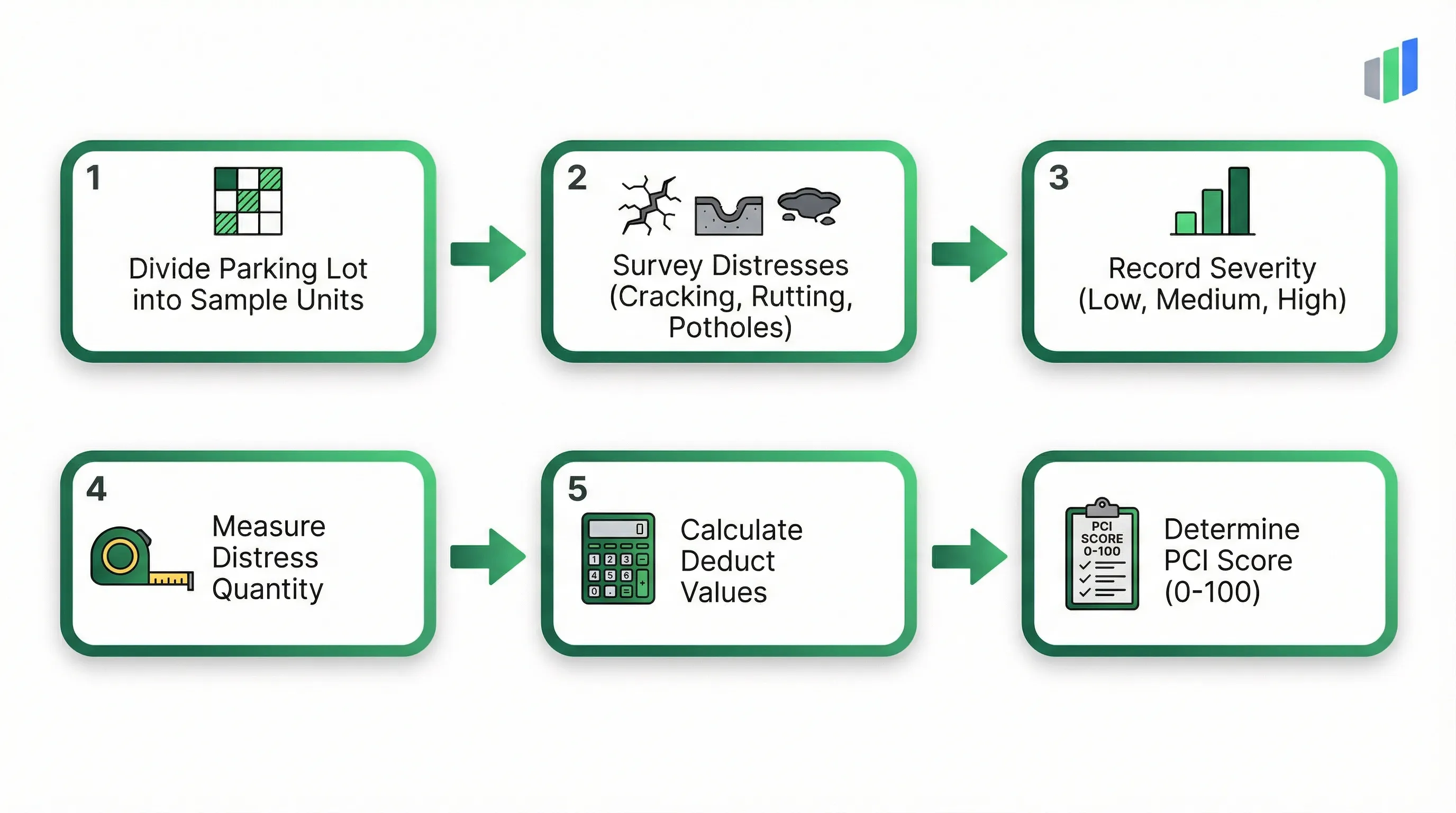
ASTM D6433 provides a systematic, repeatable method for quantifying the surface condition of parking lots. Each parking lot is divided into sample units that are surveyed for visible distresses — cracking, rutting, potholes, spalling, and more. The inspector records each distress by type, severity (Low, Medium, or High), and measured quantity. These observations feed into the Pavement Condition Index (PCI) calculation, a 0-to-100 score that translates subjective visual findings into an objective, comparable number used for maintenance prioritization and capital planning across entire parking portfolios.

What is ASTM D6433?
ASTM D6433 is the standard practice for Pavement Condition Index (PCI) surveys of parking lots. Inspectors identify distress types, severity levels, and quantities across asphalt (AC) and concrete (PCC) surfaces to calculate a PCI score from 0 (Failed) to 100 (Good).
- Full Name
- Standard Practice for Roads and Parking Lots Pavement Condition Index Surveys
- Issuing Body
- ASTM International
- Current Revision
- ASTM D6433-23
SAMPLE UNITS
How Parking Lots Are Divided for Inspection
ASTM D6433 treats each parking lot as a Branch within the pavement network. The lot is subdivided into Sections and then into Sample Units — the actual areas that get inspected.
The parking lot inspection begins with defining the inventory hierarchy. Each parking lot is assigned a Branch ID (e.g., "PL-001") and divided into one or more Sections — contiguous areas with uniform construction history, surface type, and traffic patterns. A large parking lot with an asphalt main area and a concrete loading dock would constitute two separate Sections. Each Section is then divided into Sample Units of a defined size: approximately 2,500 square feet (±1,000 sq ft) for asphalt concrete (AC) surfaces, or approximately 20 contiguous slabs (±8 slabs) for Portland cement concrete (PCC) surfaces. The sample unit is the fundamental unit of inspection — all distress data is recorded per sample unit, and PCI is calculated per sample unit before being averaged across the Section.
Sample units are classified as either Random or Additional. Random sample units are selected using a systematic random sampling procedure to represent the Section statistically — inspecting a minimum number of random units allows the PCI to be extrapolated to the entire Section with a known confidence level. Additional sample units are selected deliberately because they contain unusual or severe distress that the random selection might miss. Additional units are calculated individually but are not included in the statistical projection of the Section PCI. This distinction is critical in the digital form: the Sample Type field (Random or Additional) determines how the PCI calculation engine treats the data downstream. In the form, the inspector records the Surface Type (AC or PCC) — a critical field because it determines which distress dropdown is shown and which measurement rules apply.
DISTRESS TYPES
AC and PCC Distress Catalogs
ASTM D6433 defines 19 distress types for asphalt concrete and 19 for Portland cement concrete. The Surface Type selection determines which catalog is active in the form.
The distress catalog is the core reference of any ASTM D6433 inspection. For asphalt concrete (AC) surfaces, the standard defines 19 numbered distress types ranging from AC-01 Alligator Cracking (interconnected fatigue cracks caused by repeated traffic loading) through AC-19 Weathering/Raveling (surface erosion from oxidation and moisture). Each distress type has specific visual identification criteria and measurement conventions. Alligator cracking, block cracking, and rutting are measured in square feet. Edge cracking, longitudinal and transverse cracking, and joint reflection cracking are measured in linear feet. Potholes are counted as individual occurrences. Polished aggregate is unique — it has no severity levels and is simply recorded as present or absent.
| Code | Distress Type | Measurement Unit |
|---|---|---|
| AC-01 | Alligator Cracking | Square Feet |
| AC-02 | Bleeding | Square Feet |
| AC-03 | Block Cracking | Square Feet |
| AC-04 | Bumps and Sags | Linear Feet |
| AC-05 | Corrugation | Square Feet |
| AC-06 | Depression | Square Feet |
| AC-07 | Edge Cracking | Linear Feet |
| AC-08 | Joint Reflection Cracking | Linear Feet |
| AC-09 | Lane/Shoulder Drop-off | Linear Feet |
| AC-10 | Longitudinal & Transverse Cracking | Linear Feet |
| AC-11 | Patching & Utility Cut | Square Feet |
| AC-12 | Polished Aggregate | Square Feet (No Severity) |
| AC-13 | Potholes | Count |
| AC-14 | Railroad Crossing | Square Feet |
| AC-15 | Rutting | Square Feet |
| AC-16 | Shoving | Square Feet |
| AC-17 | Slippage Cracking | Square Feet |
| AC-18 | Swell | Square Feet |
| AC-19 | Weathering / Raveling | Square Feet |
For Portland cement concrete (PCC) surfaces, a separate catalog of 19 distress types applies, numbered PCC-21 through PCC-39. PCC distresses include structural failures like Blowup/Buckling, Corner Breaks, and Divided Slabs, as well as surface deterioration like Scaling, Popouts, and Durability Cracking. A key distinction from AC inspection is that nearly all PCC distresses are measured by counting the number of affected slabs rather than measuring area or length. This slab-count convention simplifies field data collection but requires the inspector to clearly define slab boundaries. Joint Seal Damage (PCC-26) is a special case — it is typically rated once for the entire sample unit rather than per individual slab.
SEVERITY LEVELS
Low, Medium, and High Severity Classifications
Each distress observation is assigned a severity level that reflects the progression and impact of the distress on ride quality, structural integrity, or safety.
ASTM D6433 uses a three-level severity scale — Low (L), Medium (M), and High (H) — applied to each distress observation. The severity definitions are distress-specific: what constitutes "Low" for alligator cracking is different from "Low" for rutting. For alligator cracking, Low severity means fine longitudinal cracks running parallel with few interconnecting cracks and no spalling, while High severity means a well-developed pattern of interconnected cracks where pieces may rock under traffic and surface spalling is present. For rutting, Low corresponds to a rut depth of 6–13 mm, Medium to 13–25 mm, and High to ruts deeper than 25 mm. Potholes are classified by both diameter and depth — a pothole less than 450 mm wide and 25–50 mm deep is Low, while one over 750 mm wide and deeper than 50 mm is High.
| Level | Abbreviation | General Description |
|---|---|---|
| Low | L | Early-stage distress with minor impact on ride quality. Cracks are tight, deformations are shallow, and the surface remains largely functional. |
| Medium | M | Moderate distress causing noticeable ride quality reduction. Cracks are widening, deformations are measurable, and some repair action is warranted. |
| High | H | Advanced distress significantly affecting ride quality and structural performance. Cracks are open and spalled, deformations are deep, and immediate repair is recommended. |
| N/A | — | Reserved for Polished Aggregate (AC-12) and similar distresses where severity levels are not defined by the standard. |
One notable exception is Polished Aggregate (AC-12), which has no severity levels defined in the standard. When this distress is present, it is recorded without a severity designation — the form should either hide the severity selector or auto-assign N/A. The severity level directly affects the Deduct Value assigned to each distress during PCI calculation: a High-severity distress of a given type and density produces a substantially larger deduct than the same distress at Low severity. This means that accurate severity classification is not just a documentation exercise — it materially changes the resulting PCI score and maintenance recommendations.
Try this ASTM D6433 form in Geocadra
We have a pre-built ASTM D6433 inspection template ready to go. Sign up and start your first condition assessment today.
Free 14-day trial. No credit card required.
PCI RATING
The Pavement Condition Index Scale (0–100)
The Pavement Condition Index is a numerical indicator from 0 to 100 that summarizes the overall surface condition of a sample unit based on the type, severity, and density of observed distresses.
ASTM D6433 calculates the PCI through a multi-step process. For each distress entry, the inspector's recorded quantity is divided by the total sample unit area (or slab count) to produce a Distress Density percentage. This density, combined with the severity level and distress type, is used to look up a Deduct Value from standardized curves published in the ASTM standard. The individual deduct values are then corrected using a procedure that accounts for the number of deducts present (the Corrected Deduct Value), and the final PCI equals 100 minus the maximum Corrected Deduct Value. A PCI of 100 represents a pavement with no observable distress, while 0 represents complete failure. The standard defines seven verbal condition ratings that map to PCI ranges.
| PCI Range | Condition Rating | Suggested Action |
|---|---|---|
| 86–100 | Good | Routine monitoring. No maintenance action required. |
| 71–85 | Satisfactory | Preventive maintenance to preserve condition. |
| 56–70 | Fair | Minor rehabilitation or targeted repairs. |
| 41–55 | Poor | Major rehabilitation or overlay required. |
| 26–40 | Very Poor | Structural rehabilitation or reconstruction. |
| 11–25 | Serious | Reconstruction necessary. Safety concerns likely. |
| 0–10 | Failed | Complete failure. Immediate action required. |
PCI ratings are calculated from deduct value curves, not directly from severity counts. Two sample units with identical distress lists may produce different PCIs depending on distress density.
For parking lot applications specifically, the PCI provides a standardized way to compare surface condition across dozens or hundreds of lots in a portfolio. Facility managers use PCI data to identify which lots need immediate rehabilitation (PCI below 40), which need preventive maintenance (PCI 55–85), and which require only routine monitoring (PCI above 85). The PCI is not calculated in the field form itself — the form collects the raw distress data, and the PCI computation happens in the analysis software (such as MicroPAVER or equivalent) using the deduct value curves. In the Geocadra digital workflow, the distress data from each sample unit is structured for direct export to PCI calculation engines.
MEASUREMENT RULES
Distress-Specific Measurement Conventions
Unlike many inspection standards that use a single measurement unit, ASTM D6433 requires different units depending on the distress type — area, length, or count for AC, and slab counts for PCC.
One of the most distinctive aspects of ASTM D6433 is its distress-specific measurement system. Not every distress is measured the same way, and applying the wrong unit will produce incorrect density calculations and invalid PCI results. For asphalt concrete, the majority of distresses — including alligator cracking, block cracking, bleeding, corrugation, depression, patching, rutting, shoving, slippage cracking, swell, and weathering — are measured in square feet of affected area. Linear distresses — bumps and sags, edge cracking, joint reflection cracking, lane/shoulder drop-off, and longitudinal and transverse cracking — are measured in linear feet along their length. Potholes (AC-13) are the only distress measured by count: the inspector tallies the number of individual potholes rather than measuring their combined area.
For Portland cement concrete, the measurement convention shifts entirely to slab counts. Nearly every PCC distress is recorded as the number of slabs affected, regardless of whether the defect is a crack, a spall, or a surface condition. This means the inspector counts how many slabs contain the distress rather than measuring the physical dimensions of each defect. The one notable exception is Joint Seal Damage (PCC-26), which is typically rated once for the entire sample unit. In the digital form, the Unit of Measure field dynamically displays the correct unit based on the selected Distress Type — "Square Feet" for area distresses, "Linear Feet" for length distresses, "Count" for potholes, or "Number of Slabs" for PCC distresses. This automation prevents the most common data entry error in manual PCI surveys: recording a distress in the wrong unit.
For road and highway applications of the same standard, see the ASTM D6433 PCI road survey form. The complete distress identification manual is published by ASTM International.
locale === 'en' ? 'Explore all available inspection standards in the ' : 'Alle verfügbaren Inspektionsnormen finden Sie in der '} locale === 'en' ? 'standards library' : 'Normenbibliothek'}.
QUESTIONS
Frequently Asked Questions
What is ASTM D6433?
ASTM D6433 is the standard practice for conducting Pavement Condition Index (PCI) surveys of roads and parking lots. It defines a systematic visual inspection method where distress types, severity levels, and quantities are recorded to calculate a PCI score from 0 (Failed) to 100 (Good).
How is the PCI score calculated for a parking lot?
The PCI is calculated from the distress data collected in the field. Each distress density and severity combination maps to a Deduct Value from standardized curves. The deduct values are corrected for multiple distresses, and the PCI equals 100 minus the maximum Corrected Deduct Value.
What is the difference between AC and PCC distress types in ASTM D6433?
AC (asphalt) distresses include 19 types like alligator cracking, rutting, and potholes, measured in square feet, linear feet, or count. PCC (concrete) distresses include 19 types like corner breaks, divided slabs, and spalling, measured primarily by counting affected slabs.
What is a Sample Unit in ASTM D6433?
A Sample Unit is the defined area that gets inspected. For asphalt, it is approximately 2,500 square feet (±1,000 sq ft). For concrete, it is approximately 20 contiguous slabs (±8 slabs). All distress data and PCI calculations are performed at the sample unit level.
Why does Polished Aggregate have no severity level?
ASTM D6433 defines Polished Aggregate (AC-12) as a condition where surface texture has worn smooth. Because the standard does not distinguish degrees of polishing, no Low/Medium/High severity is assigned — the distress is simply recorded as present with its affected area.
What is the difference between Random and Additional sample units?
Random sample units are selected statistically to represent the entire section. Their PCI is extrapolated to the full section. Additional sample units are selected deliberately for unusual distress and are calculated individually but excluded from the section-level PCI projection.
How does Geocadra support ASTM D6433 parking lot inspections?
Geocadra provides structured digital forms with AC/PCC surface type switching, the full 38-distress catalog, automatic measurement unit display per distress type, severity selectors, repeatable distress entries, and geotagged photo capture — replacing paper-based PCI survey workflows.
In practice
See how the round runs in Geocadra
The solution page shows this inspection regime on real open data: the import, the form, the round, the record per asset and the export.
Main and routine inspections of bridges, walls, roads and signs on a map, with every inspection appended to the structureOpen the solution page: Bridges, Roads & StructuresTRY IT FREE
Digitize your ASTM D6433 inspections
Replace paper forms and spreadsheets with structured digital inspections, built for standards like ASTM D6433.
No credit card requiredFree trial included