

ASTM D6433 PCI Road Survey
The standard methodology for calculating Pavement Condition Index on road networks.
ASTM D6433 is the most widely adopted pavement condition assessment methodology in the world. Used by municipalities, departments of transportation, airports, and military installations, it provides a repeatable, objective process for quantifying road surface condition. The standard defines how to divide a road network into inspectable units, which distresses to look for, how to measure them, and how to translate those observations into a single PCI score that drives maintenance budgeting, rehabilitation timing, and network-level capital planning.

What is ASTM D6433?
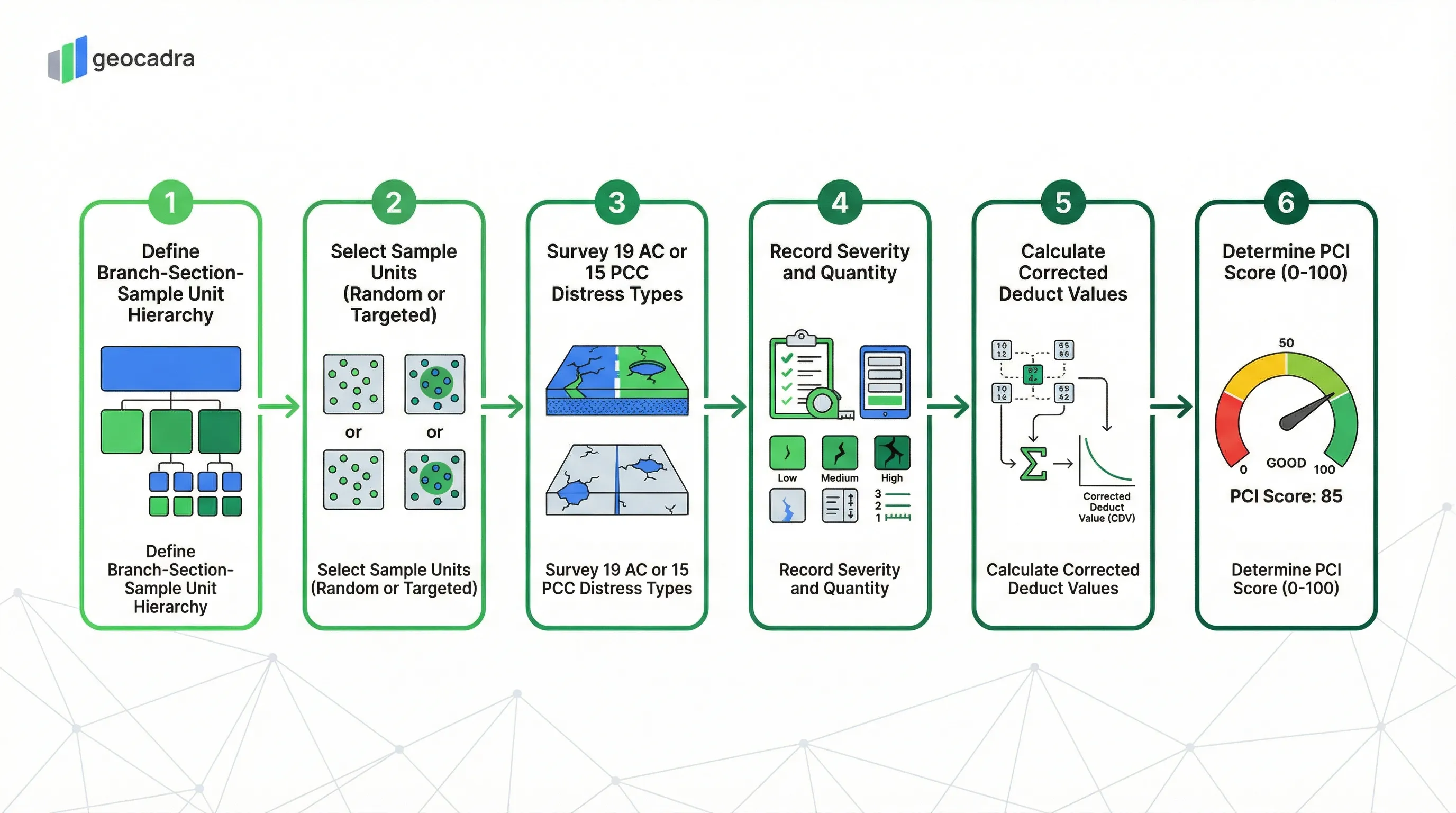
ASTM D6433 defines the Pavement Condition Index (PCI) methodology for road networks. Inspectors survey sample units within a Branch–Section hierarchy, recording distress types, severity levels, and quantities to produce a PCI score from 0 (Failed) to 100 (Good).
- Full Name
- Standard Practice for Roads and Parking Lots Pavement Condition Index Surveys
- Issuing Body
- ASTM International
- Current Revision
- ASTM D6433-23
NETWORK HIERARCHY
Branch, Section, and Sample Unit Structure
ASTM D6433 organizes a road network into a three-level hierarchy that scales from a single street to an entire city pavement management system.
The PCI methodology begins with inventory structure, not inspection. Before any distress data is collected, the road network must be decomposed into Branches, Sections, and Sample Units. A Branch is typically a single road or street identified by name or route number (e.g., "Main Street" or "Route 42"). Each Branch is divided into one or more Sections — contiguous segments that share the same construction history, traffic volume, surface type, and condition. A section of Main Street that was repaved in 2020 is a different Section from the adjoining segment last surfaced in 2005, even though they share the same Branch. Sections are the level at which PCI is reported and maintenance decisions are made.
Each Section is further divided into Sample Units — the actual areas that inspectors walk and survey. For asphalt concrete (AC) roads, a sample unit is approximately 2,500 square feet (±1,000 sq ft), which typically corresponds to a lane width multiplied by a length of about 100 feet. For Portland cement concrete (PCC) roads, a sample unit is approximately 20 contiguous slabs (±8 slabs). The standard provides formulas for calculating the minimum number of sample units to inspect per Section to achieve a 95% confidence level for the Section PCI. In the digital form, the Branch ID (often the street name), Section ID, and Sample Unit ID fields establish this hierarchy. The Sample Unit Area field captures the exact size in square feet, which serves as the denominator in all density calculations. Without an accurate area, the PCI computation cannot produce valid results.
The same ASTM D6433 standard applies to parking lots — see the ASTM D6433 parking surface condition form.
DISTRESS SURVEY
Recording Distresses in the Field
The core of a PCI survey is the distress log — a repeatable entry for each distinct distress type and severity level found within the sample unit.
For asphalt concrete roads, the inspector identifies distresses from a standardized list of 19 types defined in ASTM D6433. These range from load-related failures like Alligator Cracking (AC-01), which indicates fatigue at the base of the asphalt layer, to environmental distresses like Weathering/Raveling (AC-19), which reflects surface erosion from oxidation and freeze-thaw cycles. Each distress is recorded with three data points: the Distress Type (selected from the numbered catalog), the Severity Level (Low, Medium, or High), and the Quantity measured in the appropriate unit. The measurement unit varies by distress type — most are measured in square feet of affected area, but linear distresses like Edge Cracking and Longitudinal & Transverse Cracking are measured in linear feet, and Potholes are counted individually.
| Code | Distress Type | Unit | Severity |
|---|---|---|---|
| 01 | Alligator Cracking (Fatigue) | Sq Ft | L / M / H |
| 02 | Bleeding | Sq Ft | L / M / H |
| 03 | Block Cracking | Sq Ft | L / M / H |
| 04 | Bumps and Sags | Lin Ft | L / M / H |
| 05 | Corrugation | Sq Ft | L / M / H |
| 06 | Depression | Sq Ft | L / M / H |
| 07 | Edge Cracking | Lin Ft | L / M / H |
| 08 | Joint Reflection Cracking | Lin Ft | L / M / H |
| 09 | Lane/Shoulder Drop-off | Lin Ft | L / M / H |
| 10 | Long. & Trans. Cracking | Lin Ft | L / M / H |
| 11 | Patching & Utility Cuts | Sq Ft | L / M / H |
| 12 | Polished Aggregate | Sq Ft | N/A |
| 13 | Potholes | Count | L / M / H |
| 14 | Railroad Crossing | Sq Ft | L / M / H |
| 15 | Rutting | Sq Ft | L / M / H |
| 16 | Shoving | Sq Ft | L / M / H |
| 17 | Slippage Cracking | Sq Ft | L / M / H |
| 18 | Swell | Sq Ft | L / M / H |
| 19 | Weathering and Raveling | Sq Ft | L / M / H |
Polished Aggregate (12) has no defined severity levels per ASTM D6433. All other distresses require Low, Medium, or High classification.
A single sample unit may contain multiple entries of the same distress at different severities. For example, an inspector might record 50 square feet of Low-severity alligator cracking and 20 square feet of High-severity alligator cracking as two separate entries. This granularity is essential because each severity level has a different deduct value curve — combining them into a single entry would produce an incorrect PCI. For PCC roads, 19 additional distress types (numbered PCC-21 through PCC-39) apply, with quantities measured primarily by counting the number of affected slabs. The form enforces this distinction through the Surface Type field: selecting AC shows only AC distresses, selecting PCC shows only PCC distresses.
Try this ASTM D6433 form in Geocadra
We have a pre-built ASTM D6433 inspection template ready to go. Sign up and start your first condition assessment today.
Free 14-day trial. No credit card required.
DEDUCT VALUES
From Distress Data to Pavement Condition Index
The PCI is not a simple sum of distress counts. It is derived through a multi-step calculation involving Distress Density, Deduct Value curves, and a Corrected Deduct Value procedure.
The PCI calculation methodology is what makes ASTM D6433 a quantitative standard rather than a subjective rating system. After field data collection is complete, the calculation proceeds through four steps. First, each distress entry is converted to a Distress Density by dividing the measured quantity by the total sample unit area. A sample unit with 125 square feet of alligator cracking in a 2,500 square foot area has a density of 5%. Second, each density-severity combination is mapped to a Deduct Value (DV) using standardized curves published in the ASTM standard — there is one curve for each of the 19 distress types at each severity level, totaling 57 curves for AC alone. These curves are nonlinear: a Low-severity alligator cracking density of 5% might yield a deduct value of 12, while the same density at High severity might yield 35.
Third, the individual deduct values are sorted from highest to lowest, and a Corrected Deduct Value (CDV) is computed using an iterative procedure. The standard provides correction curves that account for the diminishing marginal impact of additional distresses — the tenth defect in a sample unit does not degrade the pavement as much as the first. The maximum number of deducts allowed (m) decreases as the highest individual deduct value increases. Fourth, the PCI equals 100 minus the maximum CDV across all iterations. This methodology means that a sample unit dominated by a single severe distress may have the same PCI as one with many minor distresses — reflecting the engineering reality that a single structural failure can render a pavement section unusable regardless of how pristine the surrounding area appears.
The full deduct value curves are published in the appendices of ASTM D6433-23 locale === 'en' ? 'published' : 'veröffentlicht'}. Many agencies perform PCI calculations using the U.S. Army Corps MicroPAVER system locale === 'en' ? ' through' : ' durch'}.
PCI RATING
The 0-to-100 Pavement Condition Scale
The final PCI score maps to a 7-level verbal rating scale that standardizes condition reporting across agencies, jurisdictions, and time periods.
The Pavement Condition Index is a dimensionless number from 0 to 100, where 100 represents a pavement with no visible distress and 0 represents complete failure. The ASTM D6433 standard defines seven verbal condition categories that map to PCI ranges. These categories provide a common language for communication between engineers, asset managers, elected officials, and the public. A road rated "Good" (PCI 86–100) requires only routine monitoring, while a "Failed" road (PCI 0–10) demands immediate reconstruction. The intermediate categories — Satisfactory, Fair, Poor, Very Poor, and Serious — guide the type and urgency of maintenance intervention. Most pavement management systems use the PCI to trigger maintenance actions: preventive treatments (seal coats, crack sealing) are cost-effective above PCI 70, while below PCI 40, only major rehabilitation or reconstruction restores structural adequacy.
| PCI Range | Condition Rating | Typical Maintenance Action |
|---|---|---|
| 86–100 | Good | Routine monitoring. No maintenance action required. |
| 71–85 | Satisfactory | Preventive maintenance (seal coats, crack sealing). |
| 56–70 | Fair | Minor rehabilitation or targeted surface repairs. |
| 41–55 | Poor | Major rehabilitation or structural overlay required. |
| 26–40 | Very Poor | Structural rehabilitation or partial reconstruction. |
| 11–25 | Serious | Reconstruction necessary. Safety hazards likely present. |
| 0–10 | Failed | Complete failure. Immediate reconstruction required. |
These ranges follow the standard ASTM D6433 7-level scale. Some agencies use alternative verbal labels (e.g., "Excellent" for 86–100) but the numeric boundaries remain consistent.
SAMPLING STRATEGY
Random vs. Additional Sample Units
ASTM D6433 uses a statistical sampling approach that allows inspectors to survey a subset of sample units and extrapolate the PCI to the entire Section with known confidence.
Not every sample unit in a Section needs to be inspected. ASTM D6433 provides a formula for calculating the minimum number of random sample units (n) that must be surveyed to estimate the Section PCI within ±5 PCI points at a 95% confidence level. For a typical Section with 20 to 40 sample units, this usually means inspecting 5 to 8 random units — a significant efficiency gain over 100% inspection. The random units are selected using a systematic random sampling procedure: the inspector divides the total number of units by n to get an interval (i), selects a random starting unit between 1 and i, and then inspects every i-th unit thereafter. This systematic approach ensures spatial coverage across the Section.
Additional sample units complement the random selection. These are units that the inspector deliberately selects because they contain distress patterns not captured by the random sample — a severely deteriorated intersection, a utility cut cluster, or a drainage failure zone. Additional units are inspected and their PCI is calculated individually, but they are explicitly excluded from the Section-level PCI average. This two-tier approach balances statistical validity with completeness: the random units provide an unbiased estimate of average condition, while the additional units document the worst-case areas that maintenance crews need to address regardless of the Section average. In the form, the Sample Unit Type field (R for Random, A for Additional) flags each unit's role.
Explore all available inspection standards in the standards library.
QUESTIONS
Frequently Asked Questions
What is the ASTM D6433 Pavement Condition Index?
The PCI is a numerical rating from 0 to 100 that quantifies the surface condition of a pavement section based on visible distresses. It is calculated from field-recorded distress types, severity levels, and quantities using standardized deduct value curves published in ASTM D6433.
How many distress types does ASTM D6433 define?
The standard defines 19 distress types for asphalt concrete (AC) surfaces and 19 for Portland cement concrete (PCC) surfaces, totaling 38 distress types. Each has specific identification criteria, measurement units, and severity level definitions.
What is a Deduct Value in PCI calculation?
A Deduct Value is a numerical weight derived from standardized curves that translates a distress observation (type, severity, and density) into its impact on pavement condition. Higher severity and density produce larger deduct values. The PCI equals 100 minus the maximum Corrected Deduct Value.
How many sample units need to be inspected per Section?
ASTM D6433 provides a formula to calculate the minimum number of random sample units needed for 95% confidence within ±5 PCI points. For typical sections, this ranges from 5 to 8 random units plus any additional units selected for unusual distress.
What is the difference between ASTM D6433 for roads and parking lots?
The distress catalogs and PCI calculation are identical. The main differences are operational: roads use a Branch (street name) hierarchy, while parking lots use lot-based Branch IDs. Sample unit sizes are the same, but parking lots often have more PCC surfaces and different traffic patterns.
Can ASTM D6433 be used for airport pavements?
ASTM D6433 applies to roads and parking lots. Airport pavements use the companion standard ASTM D5340, which defines additional distress types specific to aircraft loading patterns, jet blast effects, and runway/taxiway configurations.
How does Geocadra support ASTM D6433 road surveys?
Geocadra provides structured digital forms with Branch–Section–Sample Unit hierarchy, the full 38-distress catalog with automatic unit-of-measure switching, severity selectors, repeatable distress entries, surveyor signature capture, and geotagged photo documentation.
In practice
See how the round runs in Geocadra
The solution page shows this inspection regime on real open data: the import, the form, the round, the record per asset and the export.
Main and routine inspections of bridges, walls, roads and signs on a map, with every inspection appended to the structureOpen the solution page: Bridges, Roads & StructuresTRY IT FREE
Digitize your ASTM D6433 inspections
Replace paper forms and spreadsheets with structured digital inspections, built for standards like ASTM D6433.
No credit card requiredFree trial included