BIV-Richtlinie Gravestone Safety
The German guideline for annual gravestone stability testing with visual inspection, 300 N force test, and four-grade safety rating.
The BIV-Richtlinie "Erstellung und Prüfung von Grabmalanlagen" (7th Edition, June 2020) is the recognized rule of technology in Germany for the construction and recurrent safety testing of memorial structures. Published by the Bundesinnungsverband des Deutschen Steinmetz- und Steinbildhauerhandwerks (BIV), it mandates a two-stage annual inspection for every gravestone: a visual check followed by a 300 N force test for monuments taller than 50 cm. This guide covers the inspection methodology, monument classification, the four-grade stability rating from I (Stable) to IV (Acute Danger), foundation and joint assessment, and the immediate safety measures cemetery operators must document to fulfill their Verkehrssicherungspflicht (duty to ensure public safety).
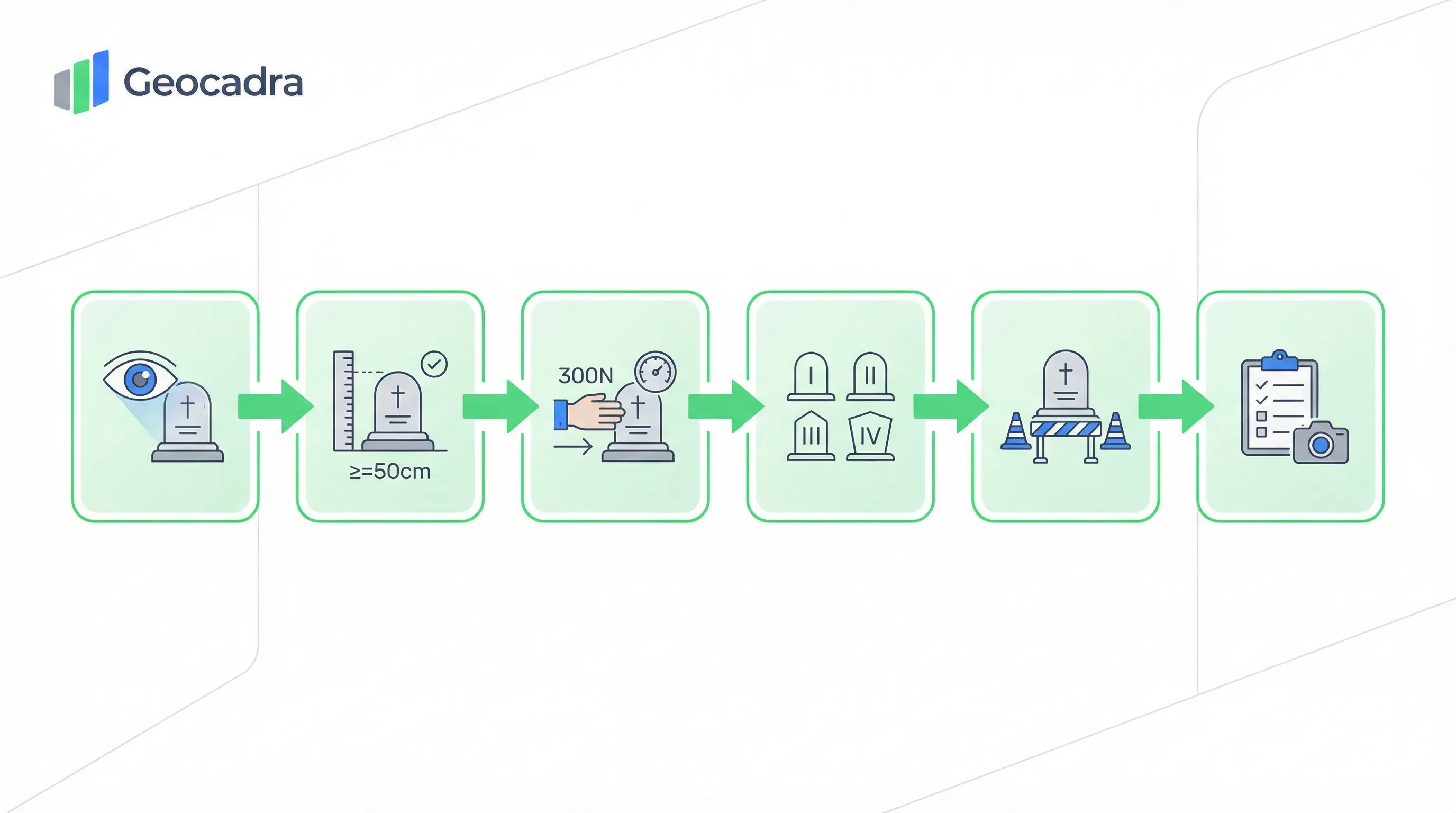
What is BIV-Richtlinie?
The BIV-Richtlinie (7th Edition 2020) is the German guideline for the construction and annual safety inspection of gravestones (Grabmalanlagen). It mandates a two-stage process: visual inspection (Inaugenscheinnahme) followed by a 300 N force test (Standsicherheitsprüfung) for monuments above 50 cm. The result is a four-grade stability rating from I (Stable) to IV (Acute Danger).
- Full Name
- Richtlinie für die Erstellung und Prüfung von Grabmalanlagen
- Issuing Body
- Bundesinnungsverband des Deutschen Steinmetz- und Steinbildhauerhandwerks (BIV)
- Current Revision
- 7th Edition, June 2020
TWO-STAGE INSPECTION
The Two-Stage Assessment: Visual Check and 300 N Force Test
The BIV-Richtlinie 2020 defines a strict two-stage inspection sequence that every annual gravestone safety check must follow. Stage 1 is non-contact; Stage 2 applies defined mechanical force. The sequence is safety-critical: if Stage 1 reveals acute danger, the force test is skipped to avoid toppling the stone.
Stage 1 - the Inaugenscheinnahme (visual inspection) - is the precursor to any physical contact with the monument. The inspector examines the gravestone for visible signs of instability: Schiefstellung (leaning), open or gaping joints (klaffende Fugen), mortar loss, foundation settlement, material degradation such as cracks, spalling, efflorescence, or frost damage, and vegetation interference such as roots lifting the foundation or ivy pulling the stone. The BIV-Richtlinie sets a critical threshold at 5% inclination - any tilt beyond this level is considered a significant indicator of compromised stability. If the visual check identifies acute danger (Akute Gefahr), the inspector must immediately classify the monument as Category IV without proceeding to the force test, because applying 300 N to an obviously unstable stone risks causing it to collapse during inspection.
Stage 2 - the Standsicherheitsprüfung (stability test) - is the physical application of force. For established monuments taller than 50 cm, the standard test load is 300 N (30 daN), applied at the top of the stone or at a maximum height of 1.20 m for taller monuments. The force must be sustained for at least 2 seconds. The inspector may use either a calibrated force gauge (Prüfgerät) or manual hand testing (Handprüfung). The BIV standard explicitly prefers instrumented testing for documentation purposes, but permits hand testing for small monuments or where expert judgment warrants it. In the form, the inspector records the Reaktion bei Belastung (reaction to load), which ranges from "Fest / Keine Bewegung" (firm, no movement) through "Elastische Bewegung" (elastic movement that returns to the original position), "Bleibende Verformung" (permanent shift), "Wackelt / Lose" (wobbles or loose), to "Kippt" (tips over). A critical secondary observation is whether the Standfuge (base joint) opens during the test - if it does, the dowel or connection has failed regardless of whether the stone remained upright.
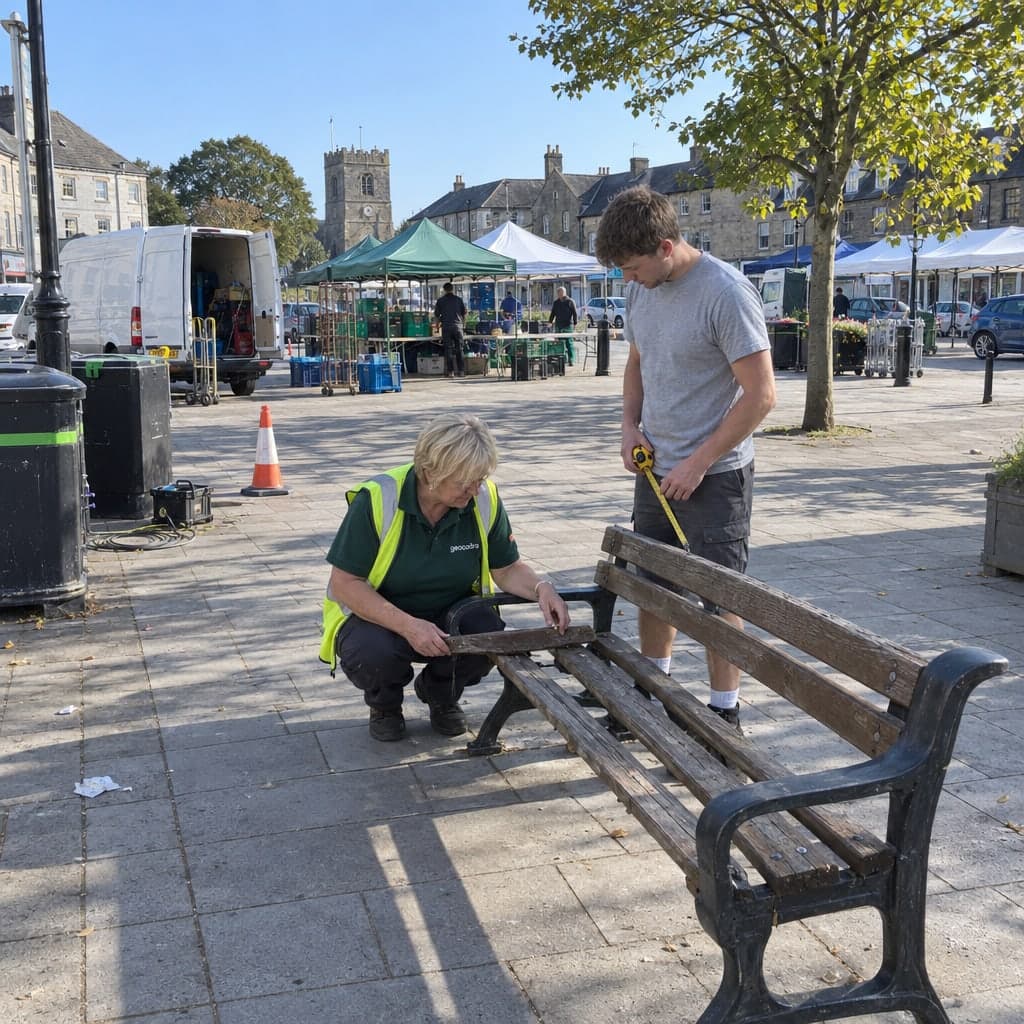
The 50 cm height rule is strict in the BIV 2020 edition. Monuments below this threshold are not subjected to the 300 N lever test because the disproportionate leverage could damage the structure. Instead, they receive a Handrüttelprüfung (manual shake test) using hand force only. Newly installed monuments require a higher acceptance test load of 500 N, but annual inspections use the reduced 300 N load to avoid accumulating damage over repeated testing cycles. The documentation duty (Dokumentationspflicht) under the BIV standard explicitly requires that inspection records be "nachvollziehbar" (verifiable) - increasingly, cemetery administrators request photographs of the gauge reading or the test being performed to protect against liability claims.
The BIV-Richtlinie is published by the Federal Guild Association of German Stonemasons and Stone Sculptors (BIV), which also offers training programs for gravestone inspection.
MONUMENT CLASSIFICATION
Gravestone Types, Materials, and Structural Assessment
Before any stability test can be performed, the inspector must classify the monument by type and material. These classifications determine testing requirements and influence which defects are likely to be present.
The BIV-Richtlinie recognizes seven monument types, each with distinct structural characteristics that affect stability testing. The Stehendes Grabmal (upright headstone) is the most common type and the primary target of the 300 N force test - it has the highest center of gravity relative to its base and is most susceptible to toppling. The Liegendes Grabmal (flat marker) presents minimal tipping risk but must still be checked for trip hazards and connection integrity. Stelen (steles) are tall, narrow monuments that can be particularly vulnerable to wind and frost heave. Wandstelen (wall graves) are integrated into cemetery walls and transfer their load differently than freestanding monuments. Urnenanlagen (urn systems) may consist of multiple small components with individual connection points. Holzkreuze (wooden crosses) have entirely different degradation patterns - rot at the base instead of mortar failure. The "Sonstiges" (other) category captures non-standard memorial designs.
Material classification drives the inspector's attention to specific defect patterns. Naturstein (natural stone) - granite, marble, sandstone, limestone - is the dominant material and subject to weathering, frost damage, and biological colonization. Kunststein/Beton (artificial stone and concrete) degrades through carbonation, reinforcement corrosion, and surface spalling. Holz (wood) is assessed for rot, insect damage, and structural weakening at the ground contact zone. Metall (metal) - wrought iron, cast iron, bronze - is examined for corrosion, weld failures, and anchor deterioration. Glas (glass) elements require checking for delamination, seal failure, and impact damage. In the form, the inspector selects both the Art des Grabmals (monument type) and Material as required fields, along with the Höhe ab Fundament (height from foundation) in centimeters, which determines whether the 300 N force test or manual check applies.
The Fundament (foundation) and Fugen (joints) are structural elements that the inspector assesses independently of the monument body. Foundation condition ranges from Verdeckt/Erdüberdeckt (covered by soil, where visual assessment is limited) through Sichtbar intakt (visibly intact) to Abgesackt/Setzung (subsided or settled) and Zerbröselt/Defekt (crumbled or defective). Joint condition is classified as Intakt (intact), Rissig (cracked), Offen/Klaffend (open or gaping), or Mörtel fehlt (mortar missing). Gaping joints and missing mortar are specific BIV-Richtlinie indicators of instability - they signal that the mechanical connection between monument parts has degraded. A monument with open joints may pass the force test today but is likely to fail within the next annual cycle, making it a candidate for Category II (Stable with Monitoring).
Gravestone guidelines and safety regulations are also discussed in the context of the German cemetery administration and TA-Grabmal guidelines. For related public facility safety inspections, see also the FLL tree inspection guidelines, which represents a parallel duty of care obligation on cemetery grounds.
Try this BIV-Richtlinie form in Geocadra
We have a pre-built BIV-Richtlinie inspection template ready to go. Sign up and start your first condition assessment today.
Free 14-day trial. No credit card required.
STABILITY RATING
The Four-Grade Condition Rating: From Standsicher to Akute Umsturzgefahr
The BIV-Richtlinie produces a four-grade overall condition rating (Gesamtzustand) that determines the immediate action required. Unlike scored condition assessment standards, this rating is a categorical safety classification with direct legal consequences under Verkehrssicherungspflicht.
Category I - Standsicher (Stable) means the monument withstands the 300 N pressure test without any movement in the foundation. Joints remain closed during and after the test. No visual defects affect stability. The prescribed action is none - the next inspection is due in one year. Category II - Standsicher mit Beobachtung (Stable with Monitoring) means the monument withstands the 300 N load, but the visual inspection revealed defects that do not yet compromise immediate stability: hairline cracks, slightly weathered joints, minor leaning below the 5% threshold, or early-stage material degradation. These defects are noted for the following annual inspection. No notification to the grave owner is required yet, but the inspector documents the findings as a baseline for future comparison.
Category III - Nicht standsicher (Unstable) represents a failed inspection. The monument moves significantly under the 300 N load - joints open up, the stone wobbles, or permanent displacement occurs. However, the monument does not threaten to fall immediately without external force. The response protocol is defined: the inspector must apply a Warnaufkleber (warning sticker) to the monument and the cemetery administration must notify the Nutzungsberechtigten (grave owner or rights holder) to arrange repairs within a fixed timeframe, typically 4 weeks to 6 months depending on severity. Category IV - Akute Umsturzgefahr (Acute Toppling Danger) is the most severe classification. The monument is loose even without applying the test force - it moves by hand touch, leans beyond 5%, or the foundation is broken. Immediate on-site action is mandatory: the stone must be laid down (Grabmal umgelegt), cordoned off (abgesperrt), or secured with posts and safety tape (gesichert mit Pfosten/Band) before the inspector leaves the site.
The legal weight of this rating system stems from the Verkehrssicherungspflicht - the cemetery operator's duty to ensure public safety on their premises. German courts have repeatedly held cemetery operators liable for injuries caused by falling gravestones when annual inspections were not documented or follow-up measures were not enforced. The BIV-Richtlinie's grading system directly supports the legal defense: a properly documented Category I or II result demonstrates that the operator fulfilled their duty of care. A Category III result with documented notification to the grave owner transfers part of the repair obligation. The digital form captures not just the grade but also which specific Maßnahmen (measures) were taken - sticker applied, area cordoned, monument laid down, monument secured, owner notified - creating the evidence chain that protects the operator in liability proceedings.
| Grade | German | English | Description & Required Action |
|---|---|---|---|
| I | Standsicher | Stable | Withstands 300 N test. No movement, joints closed, no visual defects. No action required. Re-inspect in 1 year. |
| II | Standsicher (Beobachtung) | Stable (Monitor) | Withstands 300 N test. Visual defects present (minor cracks, slight weathering, leaning < 5%) but not yet compromising stability. Document and monitor at next annual inspection. |
| III | Nicht standsicher | Unstable | FAIL. Significant movement under 300 N. Joints open, stone wobbles, or permanent shift. Apply warning sticker, notify grave owner, set repair deadline (4 weeks to 6 months). |
| IV | Akute Umsturzgefahr | Acute Danger | CRITICAL FAIL. Loose without test force, severe leaning, broken foundation. Immediate action: lay monument down, cordon off, or secure with posts/tape before leaving site. |
The overall rating is assigned based on the combined results of the visual inspection (Stage 1) and the stability test (Stage 2). The worst finding determines the grade. Categories III and IV trigger mandatory action and owner notification under Verkehrssicherungspflicht.
For more information on condition assessment of structures and infrastructure, see our standards directory, which summarizes related inspection standards and assessment methodologies.
SAFETY MEASURES
Immediate Actions and Remediation Deadlines Under BIV-Richtlinie
When a gravestone fails the stability test, the BIV-Richtlinie requires documented immediate safety measures. These measures are not optional recommendations - they are legal obligations under the cemetery operator's Verkehrssicherungspflicht.
The Warnaufkleber (warning sticker) is the standard first-response action for Category III monuments. It is a standardized adhesive label applied directly to the unstable gravestone, warning visitors not to touch or lean against it. The sticker serves a dual legal purpose: it alerts the public to the hazard, and it constitutes documented evidence that the operator identified and marked the danger. For Category IV monuments, the sticker alone is insufficient - the inspector must take physical action to eliminate the immediate toppling risk. The three options are: Grabmal umgelegt (monument laid flat on the ground), Abgesperrt (area cordoned off with barrier tape or posts), or Gesichert mit Pfosten/Band (monument secured in place using supporting posts and bands). The choice depends on the monument's size, weight, and the available equipment.
Notification of the Nutzungsberechtigten (rights holder or grave owner) is a critical administrative step that the form documents separately. For Category III findings, the cemetery administration sends a formal letter requiring the owner to arrange professional repairs by a qualified stonemason within the specified Frist zur Behebung (remediation deadline). The BIV-Richtlinie provides four standard deadline tiers: Sofort (immediately, for the most urgent cases), 4 Wochen (4 weeks), 3 Monate (3 months), and 6 Monate (6 months). The deadline selection depends on the severity of instability and seasonal factors - a monument tested in spring that shows minor instability may receive a 6-month deadline, while one tested in autumn with significant wobble may receive 4 weeks to avoid the freeze-thaw cycle worsening the condition. If the owner fails to act within the deadline, the cemetery operator may remediate at the owner's expense.
The Bemerkungen (notes) free-text field and the Foto Dokumentation (photo documentation) are the inspector's evidence tools. While the structured fields capture the classification and measures taken, the notes field records specifics that dropdown menus cannot capture: "Dowel rusted through on left side," "Root growth visible under base plate," or "Owner verbally informed on site." Photography is particularly important for failed inspections - the BIV standard increasingly expects visual proof that the test was actually performed and that safety measures were properly implemented. The Prüfer Unterschrift (inspector signature) is the final required field, legally validating the entire inspection record as a formal document under the operator's duty of care.
| Measure | German | When Applied |
|---|---|---|
| No action | Keine | Category I - monument is stable. No defects. |
| Warning sticker applied | Warnaufkleber angebracht | Category III - monument failed stability test. Standard first-response marking. |
| Area cordoned off | Abgesperrt | Category III/IV - monument poses hazard. Barrier tape or posts placed around grave. |
| Monument laid down | Grabmal umgelegt | Category IV - acute danger. Stone physically laid flat to eliminate toppling risk. |
| Secured with posts/tape | Gesichert (Pfosten/Band) | Category IV - acute danger. Monument braced in position using external supports. |
| Owner notified | Nutzungsberechtigten informiert | Category III/IV - formal written notification sent to grave rights holder with repair deadline. |
Multiple measures may apply simultaneously. A Category IV monument typically receives both physical securing (laid down or braced) and owner notification. Documentation of all measures taken is mandatory under Verkehrssicherungspflicht.
DIGITAL WORKFLOW
Digitize BIV-Richtlinie Gravestone Inspections with Geocadra
Annual gravestone inspections in German cemeteries generate thousands of individual records - a medium-sized cemetery with 3,000 graves produces 3,000 inspection records per year. Geocadra replaces paper-based BIV inspection protocols with a structured digital workflow that enforces the two-stage sequence and documents all required safety measures.
GIS-linked grave identification
Each inspection begins by selecting the Grabnummer (grave ID) from a GIS-linked cemetery map, eliminating transcription errors and allowing year-over-year comparison. The inspector immediately sees the previous year's condition rating, enabling targeted attention for monuments that were Category II (Monitor) in the prior cycle.
Two-stage workflow enforcement
The form enforces the BIV-Richtlinie two-stage sequence. Stage 1 visual fields (leaning, joints, foundation, acute danger) must be completed before Stage 2 stability test fields become active. If the inspector flags Akute Gefahr in Stage 1, the form automatically skips the force test section and routes directly to Category IV classification with mandatory safety measures.
Height-dependent test load logic
The monument height field (Höhe ab Fundament) drives automatic test load selection. Monuments above 50 cm default to the standard 300 N test load. Monuments at or below 50 cm switch to Handkraft (manual hand test) with adjusted reaction criteria. This enforces the BIV height rule and prevents inspectors from applying disproportionate force to small monuments.
Photo-documented safety measures with signature
For Category III and IV findings, the form requires photographic evidence of the measures taken - warning sticker placement, cordoning, or monument laid down. The digital signature field legally validates the inspection record. All data is timestamped and geotagged, creating the verifiable documentation chain that the BIV standard demands.
QUESTIONS
Frequently Asked Questions
What is the BIV-Richtlinie for gravestone inspections?
The BIV-Richtlinie (7th Edition 2020) is the German recognized rule of technology for the construction and safety testing of memorial structures. Published by the Federal Guild Association of Stonemasons, it mandates annual two-stage inspections: a visual check followed by a 300 N force test for monuments taller than 50 cm, producing a stability rating from I (Stable) to IV (Acute Danger).
What is the 300 N force test in a gravestone stability inspection?
The 300 N (30 daN) force test is the Stage 2 mechanical stability check required for gravestones taller than 50 cm. A calibrated force is applied at the top of the stone (or at 1.20 m for taller monuments) for at least 2 seconds. The inspector records whether the stone remains firm, shows elastic movement, shifts permanently, wobbles, or tips.
What is the difference between Category III and Category IV under BIV-Richtlinie?
Category III (Nicht standsicher) means the monument moves under the 300 N test but does not pose immediate collapse risk. A warning sticker is applied and the owner is notified to arrange repairs. Category IV (Akute Umsturzgefahr) means the monument is dangerously loose even without test force. Immediate physical securing - laying down, cordoning, or bracing - is required before leaving the site.
How often must gravestone inspections be performed under BIV-Richtlinie?
The BIV-Richtlinie mandates at least one safety inspection per year, typically conducted after the frost period in spring when freeze-thaw damage has fully manifested. Some cemetery operators perform a second visual check in autumn. The annual frequency is a legal minimum under the Verkehrssicherungspflicht (duty to ensure public safety).
What is Verkehrssicherungspflicht in the context of cemetery inspections?
Verkehrssicherungspflicht is the German legal principle that requires property operators to ensure public safety on their premises. For cemeteries, this means the operator must conduct annual gravestone stability inspections, document all findings, take immediate action for unsafe monuments, and notify grave owners of required repairs. Failure to do so creates personal liability for injuries.
Why is the 50 cm height threshold important in the BIV-Richtlinie?
Monuments taller than 50 cm must receive the full 300 N force test because their higher center of gravity creates meaningful toppling risk. Monuments at or below 50 cm receive only a manual hand shake test (Handrüttelprüfung), because applying 300 N of leverage force to a small stone could disproportionately damage it. The threshold directly determines which test protocol applies.
What qualifications are needed to perform a BIV-Richtlinie gravestone inspection?
The BIV-Richtlinie expects inspections to be performed by qualified stonemasons (Steinmetze) or trained cemetery administration staff. The inspector must understand force application techniques, monument construction methods, and the legal documentation requirements. Many municipalities require certification through industry courses offered by regional Steinmetz guilds or the BIV itself.
In practice
See how the round runs in Geocadra
The solution page shows this inspection regime on real open data: the import, the form, the round, the record per asset and the export.
Playground checks, headstone tests and green-space acceptances on a map, with every round appended to the siteOpen the solution page: Municipalities & Public SpaceTRY IT FREE
Digitize your BIV-Richtlinie inspections
Replace paper forms and spreadsheets with structured digital inspections, built for standards like BIV-Richtlinie.
No credit card requiredFree trial included