FLL Tree Inspection (Baumkontrolle)
The German standard for visual tree inspection and traffic safety verification.
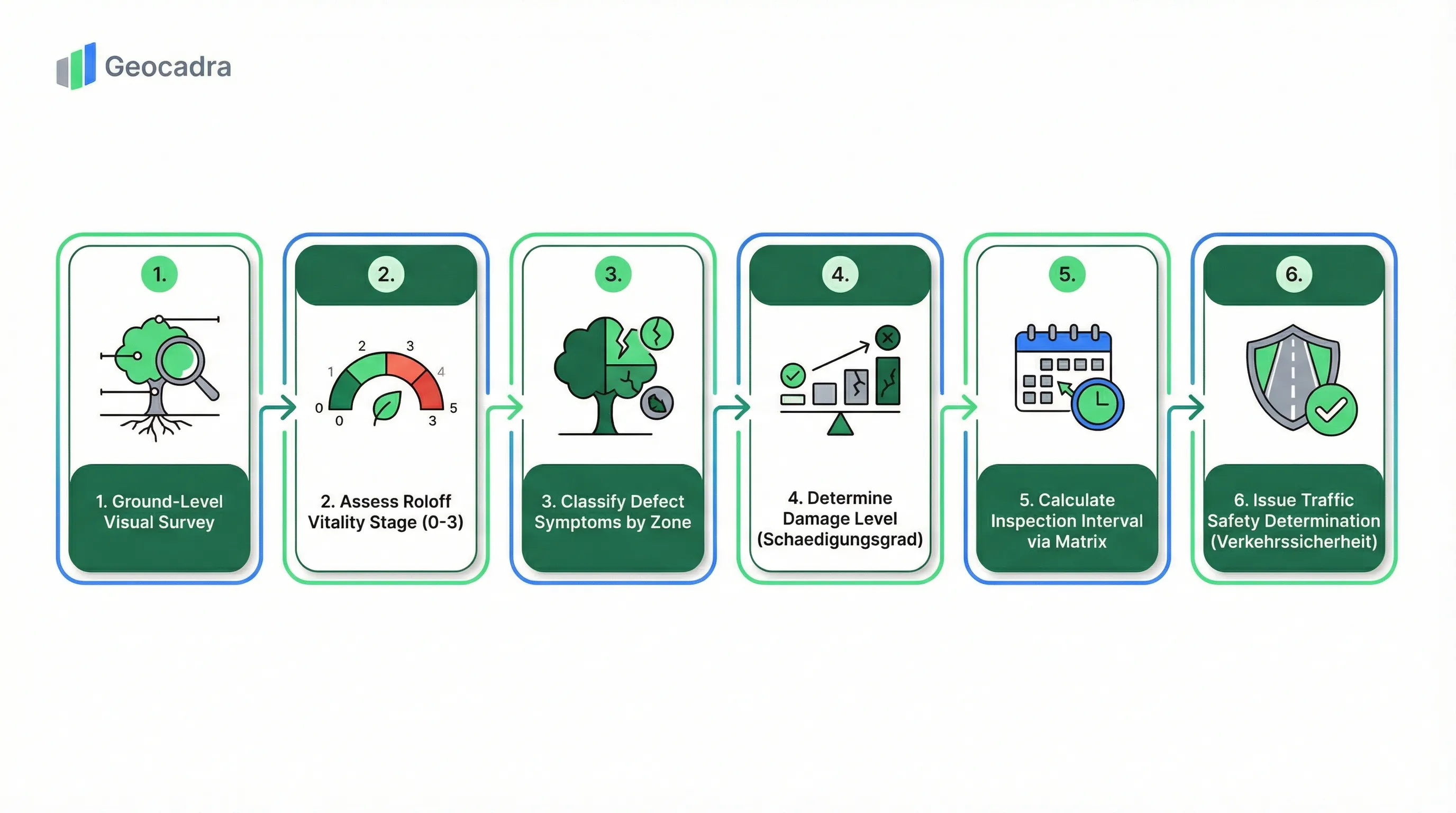
The FLL Baumkontrollrichtlinien 2020 is the definitive German regulation for fulfilling the legal duty of care (Verkehrssicherungspflicht) for trees. It provides municipalities, property owners, and arborists with a standardized visual inspection procedure performed from the ground, covering roots, trunk base, trunk, and crown. Every inspection concludes with a legally binding traffic safety determination and, where necessary, prescribed measures and follow-up intervals.
What is FLL Baumkontrolle?
FLL Baumkontrollrichtlinien 2020 is the German technical regulation for visual tree inspection to verify traffic safety (Verkehrssicherheit). It defines a systematic ground-level assessment covering roots, trunk, and crown, classifying defect symptoms by zone and determining inspection intervals through a matrix of safety expectation, development phase, and damage level.
- Full Name
- Richtlinien für Baumkontrollen zur Überprüfung der Verkehrssicherheit
- Issuing Body
- FLL (Forschungsgesellschaft Landschaftsentwicklung Landschaftsbau)
- Current Revision
- 2020 Edition
VITALITY
Vitality Assessment: Roloff Scale and Damage Level
The FLL inspection begins by classifying the tree's physiological condition through two complementary scales: Roloff's vitality stages and the FLL damage level.
FLL Baumkontrolle uses the Roloff vitality classification (Vitalitätsstufen) to assess a tree's physiological capacity. The scale ranges from Stage 0 (Exploration) representing optimal vitality with vigorous shoot growth and dense foliage, through Stage 1 (Degeneration) indicating slightly weakened crown periphery, Stage 2 (Stagnation) showing visible gaps and brush-like shoot clusters, to Stage 3 (Resignation) marking severe dieback and structural loss. A fifth option, Dead (Abgestorben), completes the scale for trees with no remaining physiological activity. The vitality stage is not just a health indicator but feeds directly into the inspection interval calculation: a tree at Stage 2 or 3 demands shorter re-inspection cycles because its ability to produce compensatory growth wood is diminished.
Alongside vitality, the inspector records the Damage Level (Schädigungsgrad), a three-tier classification that captures the structural integrity of the tree. "Healthy or Slightly Damaged" (Gesund / Leicht geschädigt) indicates a tree with no significant structural impairments. "More Strongly Damaged" (Stärker geschädigt) describes trees where defects are present and require monitoring. "Lastingly Damaged" (Nachhaltig geschädigt) identifies trees with irreversible structural compromise where immediate action or advanced investigation is typically warranted. In the form, the inspector selects from these three options in the Schädigungsgrad field. This damage level, combined with the safety expectation and development phase, determines the next inspection date through the FLL interval matrix.
| Stage | German | English | Crown Indicators |
|---|---|---|---|
| 0 | Exploration | Optimal | Vigorous shoot growth, dense foliage to outer periphery, no dieback. Full capacity for repair wood production. |
| 1 | Degeneration | Slightly Weak | Slightly ragged crown periphery, characteristic "spike" shoots visible, minor foliage retraction. |
| 2 | Stagnation | Weak | Visible gaps in crown, brush-like shoot clusters (Kurztriebketten), leaf loss from inside outward. |
| 3 | Resignation | Severe | Large gaps, dieback of crown parts, distinct structural loss, no meaningful shoot extension. |
| Dead | Abgestorben | Dead | Complete cessation of physiological activity. No capacity for structural self-repair. |
Vitality directly influences the inspection interval matrix: trees at Stage 2 or higher with structural defects require shortened re-inspection cycles.
DEFECT ZONES
Zone-Based Defect Assessment: The FLL Symptom Catalogue
The FLL 2020 edition organizes all defect symptoms into four anatomical tree zones, creating a systematic head-to-toe inspection workflow that ensures no area is overlooked.
The FLL defect catalogue is what sets this standard apart from less structured tree inspection approaches. Rather than a free-form notes field, FLL prescribes a standardized list of defect symptoms (Defektsymptome) that the inspector selects per zone. Each defect is recorded with its zone, the specific symptom, a severity description, whether it triggers action, and photographic evidence. This repeatable structure allows a single tree to carry multiple concurrent defects across different zones, mirroring the reality that a tree often presents root decay alongside crown deadwood or trunk cavities combined with bark damage. In the digital form, the Defect Assessment section is implemented as a repeatable group: the inspector adds one entry per observed defect, selecting the zone from a dropdown (Wurzel/Umfeld, Stammfuß/Wurzelanlauf, Stamm, Krone), then the specific symptom from the standardized list, followed by a free-text severity description and the mandatory action-required toggle.
Root & Environment (Wurzel / Umfeld)
The root zone inspection covers the ground surrounding the tree and the visible root system. Key symptoms include soil cracks (Bodenrisse) radiating from the base, which indicate potential root plate movement under wind loading. Mechanical root damage (Wurzelschaden) from construction or vehicle activity compromises anchorage. Fungal fruiting bodies (Pilzfruchtkörper) at root level, particularly Meripilus giganteus or Armillaria species, confirm active biological decomposition. Root collar rot (Wurzelhalsfäule) is especially critical because it attacks the structural transition between root system and trunk. The FLL 2020 edition explicitly extends coverage to trees in spatial stands (e.g., forest edges along roads), recognizing that root competition and canopy interactions create unique failure patterns.
Trunk Base & Root Collar (Stammfuß / Wurzelanlauf)
The trunk base zone focuses on the first meter above ground, where the structural load-bearing transitions from roots to stem. This is where many critical defects concentrate. Bark damage and necrosis (Rindenschaden / Nekrose) reduce the functional sapwood cross-section. Cavities (Höhlung) at the base are structurally more significant than those higher on the trunk because they reduce the bending resistance precisely where the moment arm from wind loading is greatest. Decay (Fäule) at this height often indicates root-connected fungal pathogens spreading upward. Vehicle impact damage (Anfahrschaden) is common for street trees and creates entry points for decay organisms.
Trunk (Stamm)
The trunk zone covers the main stem from above the root collar to the first major scaffold branches. Cracking (Rissbildung), both longitudinal and transverse, may indicate frost damage, internal tension wood failure, or progressive structural splitting. Codominant stems (Zwiesel / Druckzwiesel) with included bark form a structural weakness where neither stem is adequately supported, creating a failure point that worsens with increasing crown weight. Lean (Schiefstand) is evaluated for whether it is historical (compensated by reaction wood) or acute (indicating root failure). Fungal fruiting bodies on the trunk often signal established decay columns extending over several meters.
Crown (Krone)
Crown defects are assessed from the ground using binoculars or visual scanning. Deadwood (Totholz) above traffic areas is one of the most common triggers for immediate action because dead branches can fall without warning. Broken branches and hangers (Astausbruch / Hänger) are existing fall hazards. Crown dieback (Wipfeldürre), where the top of the tree dies back progressively, signals severe physiological stress often linked to drought or root damage. Ivy and other climbing vegetation (Baumfremder Bewuchs) obstruct the visual inspection and must be removed before a thorough assessment is possible. Defective cabling systems (Kronensicherung defekt) require immediate attention since they were installed to mitigate a known risk.
The FLL Baumkontrollrichtlinien 2020 is published by the Forschungsgesellschaft Landschaftsentwicklung Landschaftsbau (FLL). For municipal implementation guidance, the Deutsche Gartenamtsleiterkonferenz (GALK) provides supplementary resources on urban tree management.
Try this FLL Baumkontrolle form in Geocadra
We have a pre-built FLL Baumkontrolle inspection template ready to go. Sign up and start your first condition assessment today.
Free 14-day trial. No credit card required.
INTERVAL MATRIX
The FLL Inspection Interval Matrix
FLL 2020 determines re-inspection frequency through a three-factor matrix that balances public risk exposure against the tree's structural condition.
The FLL inspection interval matrix is one of the most distinctive features of the standard and one that inspectors frequently reference. Rather than prescribing a fixed annual cycle for all trees, FLL recognizes that inspection resources should be concentrated where risk is highest. The matrix combines three inputs: Safety Expectation (Sicherheitserwartung), which classifies the traffic load around the tree as High (A), Medium (B), or Low (C); Development Phase (Entwicklungsphase), which distinguishes between Youth (Jugendphase), Maturity (Reifephase), and Old Age (Altersphase); and the Damage Level (Schädigungsgrad) determined during inspection.
For a mature tree in a high-traffic location such as a school or main road (Safety Expectation A) that is assessed as Healthy or Slightly Damaged, the interval is 1 year. The same tree in a medium-traffic residential street (B) could qualify for a 1-to-2-year interval. In a low-traffic field path environment (C), intervals extend to 2-to-3 years. As soon as the damage level increases to "More Strongly Damaged," the interval tightens to 1 year regardless of traffic load. At "Lastingly Damaged," the interval drops to 6 months or the tree is recommended for felling. Trees in the Youth phase (Jugendphase) generally require inspection only for structural pruning needs, not full safety assessment, unless they show damage. The Next Inspection (Nächste Kontrolle) field in the form captures the inspector's determination, with options ranging from half-yearly to 3-year intervals, plus a special "After Measure" option for trees awaiting remedial action.
| Safety Expectation | Healthy / Slight Damage | Stronger Damage | Severely Damaged |
|---|---|---|---|
| A: High (Schools, Main Roads) | 1 Year | 1 Year | 6 Months (or fell) |
| B: Medium (Residential Streets) | 1-2 Years | 1 Year | 6 Months |
| C: Low (Field Paths) | 2-3 Years | 1 Year | 6 Months |
Trees in the Youth phase (Jugendphase) generally require inspection for structural pruning only, not full safety assessment, unless damaged.
MEASURES
Measures, Priority, and Advanced Investigation
Every FLL inspection concludes with a legally binding traffic safety determination and, where defects are found, a prescribed set of measures with assigned urgency.
The Measures and Outcome section (Maßnahmen & Ergebnis) represents the legal conclusion of the FLL inspection. The inspector must make a definitive determination: is the tree traffic safe (Verkehrssicher) or not? This binary verdict carries legal weight under German civil liability law. A "Yes" confirms the tree owner has fulfilled their duty of care at the time of inspection. A "No" triggers mandatory follow-up actions. If the visual inspection is inconclusive, the standard provides a third path: triggering an Advanced Investigation (Eingehende Untersuchung) using instrumental methods.
The form provides a standardized catalogue of measures (Maßnahmen) aligned with the ZTV Baumpflege, the German technical contract conditions for tree care. Available measures include deadwood removal (Totholzentfernung), clearance pruning (Lichtraumprofilschnitt) for restoring traffic clearance envelopes, crown maintenance (Kronenpflege), crown reduction (Kroneneinkürzung) to reduce wind loading on a compromised trunk, installation of crown cabling systems (Kronensicherungseinbau) for codominant stems, felling (Fällung) for trees beyond remediation, and ivy removal (Efeu entfernen) to restore inspection visibility. Each prescribed measure receives a priority classification: "Immediate Danger" (Gefahr im Verzug / Sofort) for conditions posing active public risk, "Urgent" (Dringend / Zeitnah) for near-term action, "Medium-term" (Mittelfristig), "Long-term" (Langfristig), or "Routine" (Turnusgemäß) for incorporation into scheduled maintenance cycles.
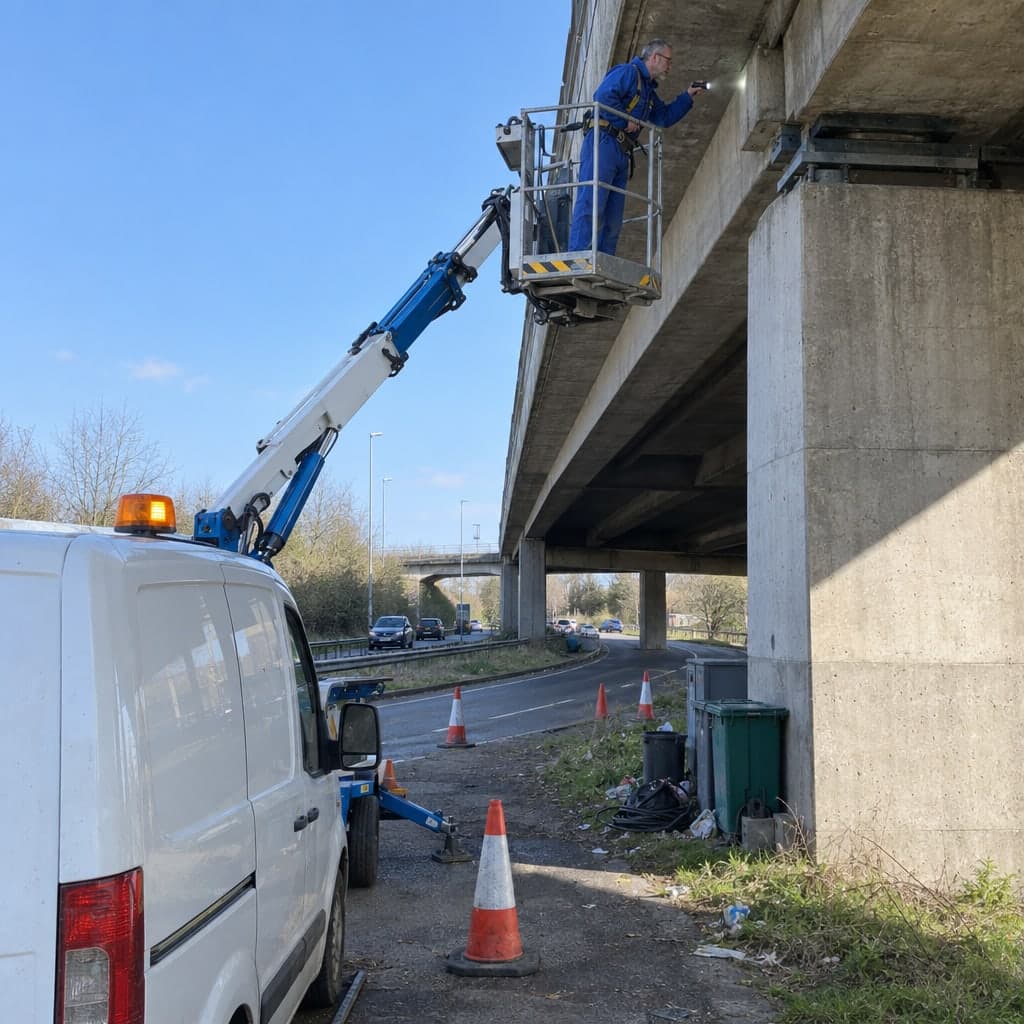
When the visual inspection suggests internal defects but cannot confirm their extent, the inspector flags the tree for Advanced Investigation and selects the appropriate diagnostic method. Resistograph drilling (Bohrwiderstandsmessung) produces a density profile of the wood cross-section, revealing decay pockets and cavities. Sonic tomography (Schalltomographie) maps internal hollows by measuring sound wave travel times between sensors placed around the trunk. Pull testing (Zugversuch) simulates wind loading to assess root anchorage. Aerial inspection (Hubsteiger) provides access to crown defects unreachable from the ground. Species protection surveys (Artenschutz) are triggered when cavities may host legally protected species such as bats or nesting birds.
For a biomechanical approach to tree assessment that progresses from visual symptoms to instrumental testing, see the VTA Mattheck tree assessment guide. Explore all available inspection standards in the standards library.
QUESTIONS
Frequently Asked Questions
What is FLL Baumkontrolle?
FLL Baumkontrolle (Baumkontrollrichtlinien 2020) is the German technical regulation for visual tree inspection to verify traffic safety. It defines a systematic ground-level assessment covering roots, trunk, and crown, classifying defect symptoms by zone and determining inspection intervals based on safety expectation, development phase, and damage level.
How does the FLL inspection interval matrix work?
The FLL interval matrix combines three factors: Safety Expectation (High, Medium, or Low traffic load), Development Phase (Youth, Maturity, or Old Age), and Damage Level (Healthy, Stronger Damage, or Severely Damaged). High-traffic trees with severe damage require inspection every 6 months, while low-traffic healthy trees can follow a 2-to-3-year cycle.
What is the difference between FLL Baumkontrolle and VTA?
FLL Baumkontrolle is a regulatory standard defining the minimum requirements for routine visual tree inspection in Germany. VTA (Visual Tree Assessment by Mattheck) is a biomechanical diagnostic method used when the visual inspection identifies symptoms requiring deeper analysis. FLL defines when to inspect; VTA provides the tools for advanced investigation.
Is FLL Baumkontrolle legally required in Germany?
While FLL is not a law itself, it is the recognized technical standard for fulfilling the duty of care (Verkehrssicherungspflicht) under German civil liability law. Courts regularly reference the FLL guidelines to determine whether a tree owner has met their obligation. Following FLL is therefore effectively mandatory for municipalities and property managers.
What defect symptoms does FLL 2020 cover?
FLL 2020 provides a standardized catalogue of defect symptoms organized by four tree zones: Root/Environment (soil cracks, root damage, fungi), Trunk Base (bark damage, cavities, decay), Trunk (cracks, codominant stems, lean), and Crown (deadwood, broken branches, dieback, ivy). Each defect is recorded with severity and action-required status.
When is an advanced investigation (Eingehende Untersuchung) triggered?
An advanced investigation is triggered when the visual ground-level inspection suggests internal defects but cannot confirm their extent. Methods include resistograph drilling for density profiling, sonic tomography for cavity mapping, pull testing for root anchorage assessment, aerial inspection by cherry picker, and species protection surveys for legally protected fauna.
What qualifications are needed for FLL tree inspections?
FLL inspections should be performed by trained arborists, certified tree inspectors (zertifizierte Baumkontrolleure), or persons with equivalent knowledge of tree biology and biomechanics. The FLL recommends documented training, and many German municipalities require the FLL-Zertifikat Baumkontrolle or equivalent certification from recognized training providers.
In practice
See how the round runs in Geocadra
The solution page shows this inspection regime on real open data: the import, the form, the round, the record per asset and the export.
Regular tree checks, biotope mapping and ecological surveys on a map, with every visit appended to the tree or the siteOpen the solution page: Trees, Habitats & EcologyTRY IT FREE
Digitize your FLL Baumkontrolle inspections
Replace paper forms and spreadsheets with structured digital inspections, built for standards like FLL Baumkontrolle.
No credit card requiredFree trial included