

DIN 18040 Accessibility Audit
The German standard for barrier-free building design and compliance auditing.
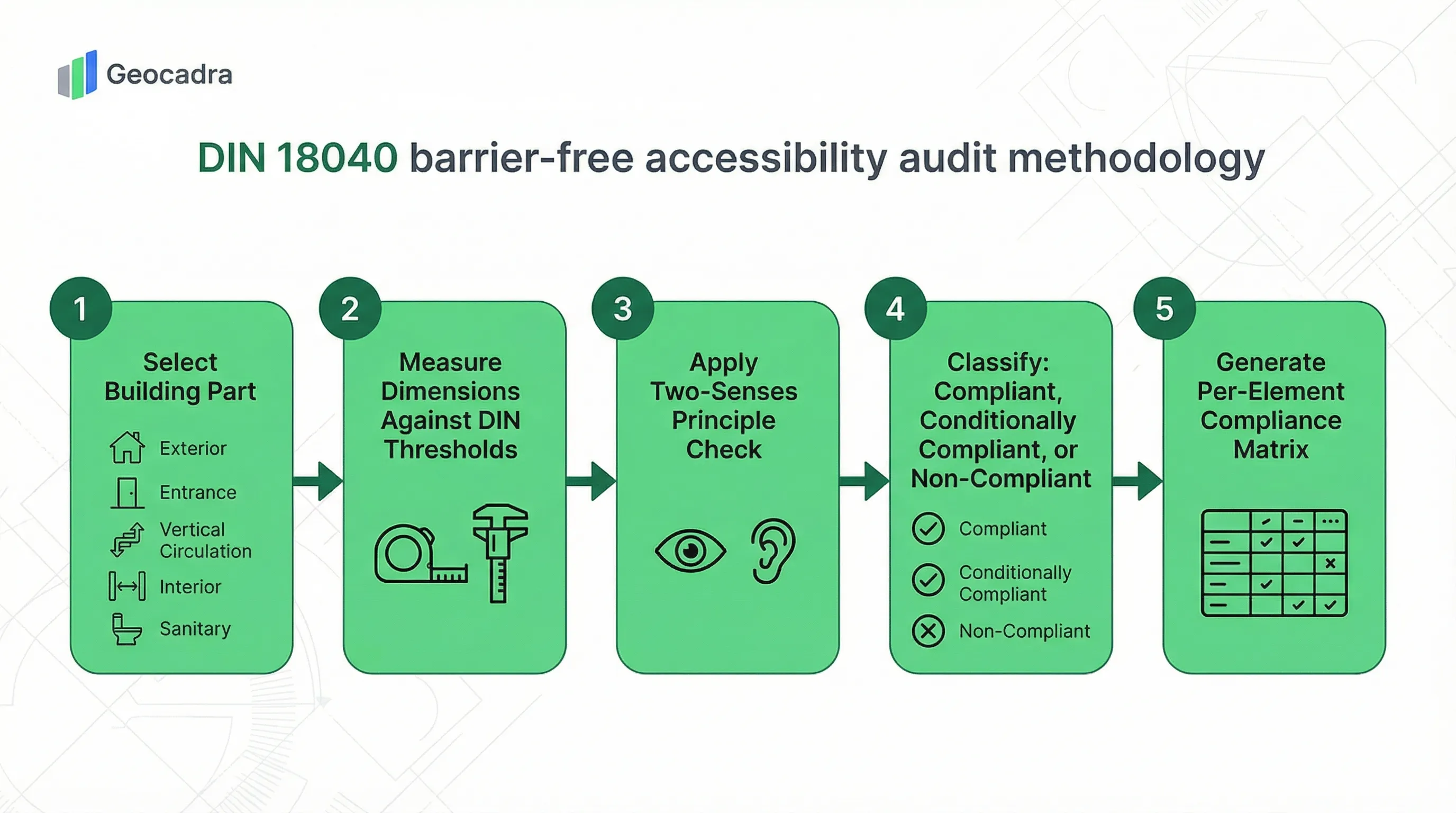
DIN 18040 is the authoritative standard governing accessible construction in Germany. Referenced in all sixteen state building codes (Landesbauordnungen), it translates the legal requirements of the Behindertengleichstellungsgesetz (BGG) into measurable dimensional thresholds and sensory criteria. An accessibility audit under DIN 18040 is not a subjective quality assessment but a quantitative compliance check: every door width, ramp slope, threshold height, and contrast ratio is measured against fixed values and classified as Compliant (Konform), Conditionally Compliant (Bedingt Konform), or Non-Compliant (Nicht Konform). The standard covers the full journey from public open spaces through building entrances, vertical circulation, interior rooms, and sanitary facilities.

What is DIN 18040?
DIN 18040 (Barrierefreies Bauen) is the German national standard for barrier-free construction. It defines dimensional thresholds, surface requirements, and sensory criteria for public buildings (Part 1), housing (Part 2), and public open spaces (Part 3), producing a compliance status of Compliant, Conditionally Compliant, or Non-Compliant per element.
- Full Name
- Barrierefreies Bauen — Planungsgrundlagen
- Issuing Body
- DIN (Deutsches Institut für Normung)
- Current Revision
- DIN 18040-1:2010, DIN 18040-3:2014
COMPLIANCE SCALE
DIN 18040 Compliance Classification
Unlike condition assessment standards that rate physical deterioration, DIN 18040 evaluates binary dimensional compliance against fixed thresholds.
DIN 18040 does not use a numerical condition score. Instead, every audited element receives a compliance status that compares its measured value against the standard's threshold. A door with a clear width of 92 cm is Compliant because DIN 18040-1 requires a minimum of 90 cm. A door at 88 cm may be classified as Conditionally Compliant if it still meets the protection goal (Schutzziel) despite the minor deviation. A door at 75 cm is Non-Compliant because it presents a definitive barrier to wheelchair users. This three-level system replaces the graduated scales found in condition assessment standards with a pass/conditional/fail framework that directly maps to regulatory enforcement.
The compliance status is determined individually for each inspected element, not for the building as a whole. A building may have compliant entrances but non-compliant sanitary facilities, or compliant ramps but missing tactile guidance systems. The audit report therefore produces a per-element compliance matrix that identifies exactly where barriers exist and what remediation is needed. In the digital form, the inspector selects the Compliance Status from three options: "Konform (Compliant)," "Bedingt Konform (Cond. Compliant)," and "Nicht Konform (Non-Compliant)." An additional usability scale from A (Very Good) to E (Defective) can capture the physical condition of compliant elements — a ramp may meet the 6% slope threshold but have a deteriorated surface that affects practical usability.
| Status | German | Meaning | Example |
|---|---|---|---|
| Compliant | Konform | Meets all DIN 18040 requirements for this element. | Door clear width >= 90 cm, threshold <= 2 cm |
| Conditionally Compliant | Bedingt Konform | Minor deviation from DIN values but protection goal (Schutzziel) is met. Usable with slight difficulty. | Door clear width 88 cm, ramp slope 6.5% |
| Non-Compliant | Nicht Konform | Major barrier exists. Does not meet the standard or protection goal. | Step-only entrance, door < 80 cm, no handrails on staircase |
| Grade | Rating | Description |
|---|---|---|
| A | Very Good | New condition, fully functional, high contrast markings intact. |
| B | Good | Functional with minor wear. Contrast still visible, mechanisms operate smoothly. |
| C | Fair | Functional but worn. Tactile markers faded, door force increased, surfaces uneven. |
| D | Poor | Difficult to use. Mechanism stiff, surfaces deteriorated, contrast markings missing. |
| E | Defective | Broken, hazardous, or completely unusable. Immediate remediation required. |
EXTERIOR ACCESS
Exterior Pathways and Site Access (DIN 18040-3)
DIN 18040-3 governs accessible public open spaces including approach paths, parking areas, and outdoor ramps leading to buildings.
An accessibility audit begins before the building is reached. DIN 18040-3 defines the requirements for public traffic and open spaces (Öffentlich zugängliche Verkehrs- und Freiflächen), covering the routes that connect public transport stops, parking areas, and street crossings to building entrances. The standard requires a minimum clear width of 150 cm for pathways, allowing two wheelchair users to pass each other. At bottleneck points, the minimum reduces to 90 cm for short stretches only. The surface material is a critical compliance factor: asphalt and concrete pavers with joints under 5 mm are compliant, while loose gravel and rough natural cobblestone automatically fail because they create rolling resistance that prevents wheelchair propulsion. In the form, the inspector selects the Surface Material from six options, and selecting "Cobblestone (Rough/Natural)" or "Gravel (Loose)" triggers an automatic non-compliant flag.
Longitudinal slope is limited to a maximum of 6%, and cross slopes (Querneigung) must not exceed 2% to prevent lateral drift of wheelchairs. These values are measured with a digital inclinometer and recorded as percentages. The standard also mandates tactile guidance systems (Bodenindikatoren) conforming to DIN 32984. These include ribbed plates (Leitstreifen) for directional guidance and studded plates (Aufmerksamkeitsfelder) for warning at hazard points such as platform edges and street crossings. The form records whether a tactile guidance system is present as a boolean field, and if present, the inspector documents the specific profile type. Resting areas with seating must be provided at intervals no greater than 100 meters along extended pathways, accommodating users who cannot sustain continuous locomotion.
Tactile guidance systems referenced in DIN 18040-3 follow the specifications of DIN 32984 (Bodenindikatoren).
Try this DIN 18040 form in Geocadra
We have a pre-built DIN 18040 inspection template ready to go. Sign up and start your first condition assessment today.
Free 14-day trial. No credit card required.
VERTICAL CIRCULATION
Ramps, Stairs, and Lifts (DIN 18040-1)
DIN 18040-1 prescribes exact dimensional requirements for vertical circulation elements that enable movement between floor levels.
Vertical circulation is the single most common point of failure in accessibility audits. DIN 18040-1 requires that every level change be navigable without steps, meaning that ramps or lifts must be provided wherever stairs exist. The standard does not accept stairs as a compliant vertical circulation element on their own — they must always be accompanied by a step-free alternative. Ramps must have a maximum inclination of 6%, a clear width of at least 120 cm, and a maximum run length of 600 cm before a level landing is required. Wheel deflectors (Radabweiser) of at least 10 cm height must line both sides to prevent wheelchairs from rolling off the edge. Handrails are required on both sides at a height between 85 and 90 cm, and the profile must be grippable — round with a diameter of 3 to 4.5 cm or oval.
Staircases, while not independently compliant for vertical access, must still meet specific safety requirements. Open risers (offene Setzstufen) and undercut designs are classified as non-compliant because they create trip hazards and disorientation for visually impaired users. Step markings (Stufenmarkierungen) are mandatory: a continuous contrast strip on the step edge provides visual orientation, with the preferred implementation being full step contrast rather than a partial side-only marking. In the digital form, the inspector records each vertical circulation element separately — the Element Type dropdown offers "Ramp (Rampe)," "Staircase (Treppe)," and "Lift (Aufzug)." The clear width, inclination, handrail configuration, and step marking fields adapt based on the selected element type. Each element receives its own compliance status, producing a granular record that identifies exactly which circulation elements present barriers.
Lifts (Aufzüge) must provide a minimum cabin size of 110 cm by 140 cm, with door openings of at least 90 cm. Control panels must be reachable from wheelchair height (85 to 105 cm) and equipped with tactile and Braille markings. Voice announcement of floor levels satisfies the acoustic component of the Two-Senses Principle for lift operation.
TWO-SENSES PRINCIPLE
The Zwei-Sinne-Prinzip: Information Through Two Senses
The Two-Senses Principle is the foundational concept of DIN 18040 — every piece of information and every navigation cue must be perceivable through at least two of the three senses: sight, hearing, and touch.
The Zwei-Sinne-Prinzip (Two-Senses Principle) is what makes DIN 18040 fundamentally different from other building inspection standards. While most standards evaluate physical dimensions and structural conditions, DIN 18040 requires that every information channel — signage, wayfinding, warnings, and controls — be perceivable through at least two of three sensory modalities: sight (Sehen), hearing (Hören), and touch (Tasten). A visual sign must be accompanied by either a tactile equivalent (Braille, pyramid letters) or an acoustic equivalent (voice announcement). A fire alarm bell must be paired with a visual strobe. An elevator floor indicator display must include both a voice announcement and a tactile button layout. This principle ensures that no single sensory impairment can completely exclude a person from receiving critical information.
In the audit form, the Two-Senses Principle is evaluated through three interconnected field groups. Visual Contrast is measured using the Michelson contrast formula and classified as High (Michelson > 0.7), Fair (Michelson > 0.4), or Low/None. The Michelson contrast ratio compares the difference between maximum and minimum luminance values divided by their sum — it is the German standard's preferred measurement method over the simpler Weber contrast used in some other national standards. The Tactile Information field is a multi-select capturing which tactile media are present: Braille, Pyramid/Relief Letters, and Tactile Floor Indicators (Bodenindikatoren). The Acoustic Information field captures the presence of Induction Loops (for hearing aid users), PA Systems, and Visual Fire Alarms (strobes). An element that provides information through only one sense — for example, a sign with text but no Braille and no audio equivalent — violates the Two-Senses Principle regardless of how well it performs on that single channel.
The practical challenge of the Two-Senses Principle is that it applies not just to dedicated information displays but to every navigational element in the building. Floor-level changes must be communicated visually (contrast markings on step edges) and tactilely (tactile floor indicators at the top and bottom of staircases). Room identification must be visual (signage) and tactile (raised lettering or Braille). Emergency exits must be visual (illuminated signs) and acoustic (alarm announcements). The audit therefore checks the Two-Senses compliance at every transition point, not just at designated information stations. This cross-cutting nature is why the digital form includes sensory fields in multiple sections rather than confining them to a single orientation block.
For comparable accessibility requirements in the United States, see the ADA Accessibility Standards.
SANITARY FACILITIES
Accessible WC and Sanitary Rooms (DIN 18040-1)
DIN 18040-1 specifies exact dimensions for accessible sanitary facilities, including turning circles, transfer spaces, grab bar placement, and emergency call systems.
Accessible sanitary facilities are among the most dimensionally prescriptive elements in DIN 18040-1. The standard requires a turning circle (Bewegungsfläche) of at least 150 cm diameter within the WC room, enabling a wheelchair user to turn completely. The WC seat height must be between 46 and 48 cm — a narrow band that accommodates lateral transfer from a wheelchair. Transfer spaces of at least 90 cm must be provided on both sides of the WC, with foldable grab bars (Stützklappgriffe) on both sides mounted at the correct height. The grab bars must be foldable so they can be swung up out of the way during transfer and lowered for support during use. In the form, grab bar configuration is recorded as None, Left Only, Right Only, or Both Sides (Foldable), and only "Both Sides (Foldable)" is considered fully compliant.
The emergency call system (Notruf) is a critical and frequently failed element. DIN 18040-1 requires that the emergency call trigger be reachable from the floor — meaning a person who has fallen from the WC or wheelchair must be able to activate it while lying down. A wall-mounted switch at 85 cm height does not meet this requirement. The form captures the emergency call system with three options: "Compliant (Reachable from floor)," "Non-Compliant (Too high/Unreachable)," and "Missing." The washbasin must be wheelchair-accessible (unterfahrbar), meaning sufficient knee space underneath for a wheelchair user to roll up directly to the basin. The mirror must be viewable from a seated position, either through a tiltable mounting or a tall mirror with a low lower edge. Each sanitary room is documented individually in a repeatable form section because buildings typically contain multiple accessible WC facilities, and compliance may vary between them.
The requirements for accessible sanitary facilities are defined in DIN 18040-1 Section 5.7. Explore all available inspection standards in the standards library.
QUESTIONS
Frequently Asked Questions
What is DIN 18040?
DIN 18040 (Barrierefreies Bauen) is the German standard for barrier-free construction. It defines dimensional thresholds for accessible buildings (Part 1), housing (Part 2), and public open spaces (Part 3), producing a compliance status of Compliant, Conditionally Compliant, or Non-Compliant for each audited element.
Is DIN 18040 legally mandatory in Germany?
DIN 18040 is referenced in all sixteen German state building codes (Landesbauordnungen), making its requirements legally binding for new construction and major renovations of publicly accessible buildings. The exact scope of applicability varies by state, but compliance is a condition of building permits.
What is the Two-Senses Principle (Zwei-Sinne-Prinzip)?
The Two-Senses Principle requires that every piece of information and navigation cue in a building be perceivable through at least two of three senses: sight, hearing, and touch. A visual sign must be paired with Braille or an audio announcement. A fire alarm bell must include a visual strobe.
What is the difference between DIN 18040-1 and DIN 18040-3?
DIN 18040-1 covers publicly accessible buildings including entrances, corridors, stairs, lifts, doors, and sanitary facilities. DIN 18040-3 covers public outdoor spaces including pathways, parking, street crossings, and outdoor ramps. Both are evaluated together in a comprehensive accessibility audit.
What minimum door width does DIN 18040 require?
DIN 18040-1 requires a minimum clear passage width (Lichte Durchgangsbreite) of 90 cm for all doors in publicly accessible buildings. The threshold height must not exceed 2 cm, and manual doors must not require more than 25 Newtons of opening force.
How does DIN 18040 differ from ADA accessibility standards?
DIN 18040 is a German DIN standard enforced through state building codes, while ADA is a U.S. federal civil rights law. DIN 18040 uses the Michelson contrast formula and metric dimensions, requires the Two-Senses Principle, and defines specific surface material requirements not found in ADA.
What qualifications are needed for a DIN 18040 audit?
DIN 18040 audits are typically performed by architects, building surveyors, or specialized accessibility consultants with knowledge of the standard and measurement techniques. No single national certification exists, but professional associations offer training programs in barrier-free design and auditing.
In practice
See how the round runs in Geocadra
The solution page shows this inspection regime on real open data: the import, the form, the round, the record per asset and the export.
Condition assessments, roof checks and statutory tests for public building portfolios, with every visit appended to the buildingOpen the solution page: Buildings & FacilitiesTRY IT FREE
Digitize your DIN 18040 inspections
Replace paper forms and spreadsheets with structured digital inspections, built for standards like DIN 18040.
No credit card requiredFree trial included