
CCUS Cemetery Preservation
The US framework for Do No Harm cemetery monument preservation, stone condition assessment, and conservation planning.
The Cemetery Conservators for United Standards (CCUS) is a 501(c)(3) nonprofit organization that has established the primary US framework for cemetery preservation and monument conservation. Built on the foundational principle of Do No Harm, CCUS provides a systematic methodology for assessing gravestone condition, identifying damage types, selecting appropriate repair methods, and documenting conservation work. The framework covers six core preservation categories and uses a structured evaluation system that rates methods, techniques, and products on a 1-to-10 scale across six criteria including safety risk, testing history, longevity, track record, reversibility, and cost. CCUS standards are widely adopted by volunteer conservators, professional preservationists, and cemetery managers across the United States.
What is CCUS?
CCUS (Cemetery Conservators for United Standards) is the US nonprofit framework for cemetery monument preservation using Do No Harm principles. It covers six preservation categories — Cleaning, Tablet Sets, Slotted Bases, Multi-Piece Monuments, Repair, and Infill — with a structured 1-to-10 evaluation scale for methods, products, and techniques.
- Full Name
- Cemetery Conservators for United Standards — Basic Standards of Cemetery Preservation
- Issuing Body
- Cemetery Conservators for United Standards (CCUS)
- Current Revision
- Current edition (ongoing updates)
PRESERVATION CATEGORIES
The Six Core Categories of CCUS Cemetery Preservation
Every CCUS assessment is organized around six foundational preservation categories that together address the full lifecycle of cemetery monument care.
The CCUS framework organizes all cemetery preservation work into six core categories, each addressing a distinct aspect of monument conservation. These categories form the backbone of CCUS training programs, field assessments, and the annual hands-on workshops that certify preservationists across the United States. The first category, Cleaning, establishes protocols for safely removing biological growth, staining, and environmental deposits from stone surfaces without causing chemical or mechanical damage. CCUS explicitly prohibits the use of household cleaners, bleach, power washers at full pressure, and abrasive tools, instead recommending pH-neutral biocidal cleaning agents applied with soft-bristle brushes. The cleaning assessment considers the stone type, existing damage, biological growth severity, and environmental exposure before recommending any treatment.
Tablet Sets addresses the assessment and resetting of ground-set headstones that sit directly on or in the earth without a separate base. These markers are prone to leaning, settling, and frost heave in northern climates. The CCUS inspection protocol evaluates the degree of lean, soil conditions, drainage patterns, and the tablet thickness relative to its height. Slotted Bases covers the more complex situation of grave markers seated in a mortised slot within a stone base. The assessment here focuses on the condition of the slot, the mortar or adhesive bond, and whether the base itself has shifted, cracked, or settled unevenly. Inspectors record the gap width between tablet and base, the condition of any existing pointing material, and whether the original setting method can be preserved or must be replaced.
Multi-Piece Monuments encompasses the most structurally complex cemetery markers: stacked assemblies of base, die (the inscribed section), cap, and sometimes additional ornamental elements. Each joint between components represents a potential failure point. The assessment records the number of components, their alignment, the condition of mortar joints, and whether any piece has shifted or rotated. Repair addresses broken tablets, fractures, and structural failures requiring adhesive bonding. CCUS mandates the use of conservation-grade two-part epoxies such as Akemi Akepox 2030 or Tenax Domo 10, and explicitly prohibits hardware-store adhesives, caulking compounds, and modern Portland cement. Finally, Infill covers the filling of cracks and gaps after repairs to prevent water infiltration and freeze-thaw damage, using reversible materials that allow future retreatment as conservation technology advances.
| Category | Scope | Key Assessment Points |
|---|---|---|
| Cleaning | Surface maintenance and biological removal | Stone type, growth severity, prior treatments, environmental exposure |
| Tablet Sets | Ground-set stones without bases | Lean degree, soil conditions, frost heave risk, tablet dimensions |
| Slotted Bases | Markers in mortised stone bases | Slot condition, mortar bond, base integrity, gap width |
| Multi-Piece Monuments | Stacked stone assemblies | Component count, joint condition, alignment, rotation |
| Repair | Broken tablets and structural failures | Break type, stone material, adhesive selection, reversibility |
| Infill | Crack and gap filling after repairs | Crack width, water infiltration risk, material compatibility |
All six categories follow CCUS Do No Harm principles: methods must be non-damaging and non-permanent, allowing future technological improvements.
STONE IDENTIFICATION
Identifying Monument Stone Types for Proper Conservation
Accurate stone identification is the prerequisite for every CCUS preservation decision, as cleaning methods, adhesives, and repair approaches vary fundamentally by material.
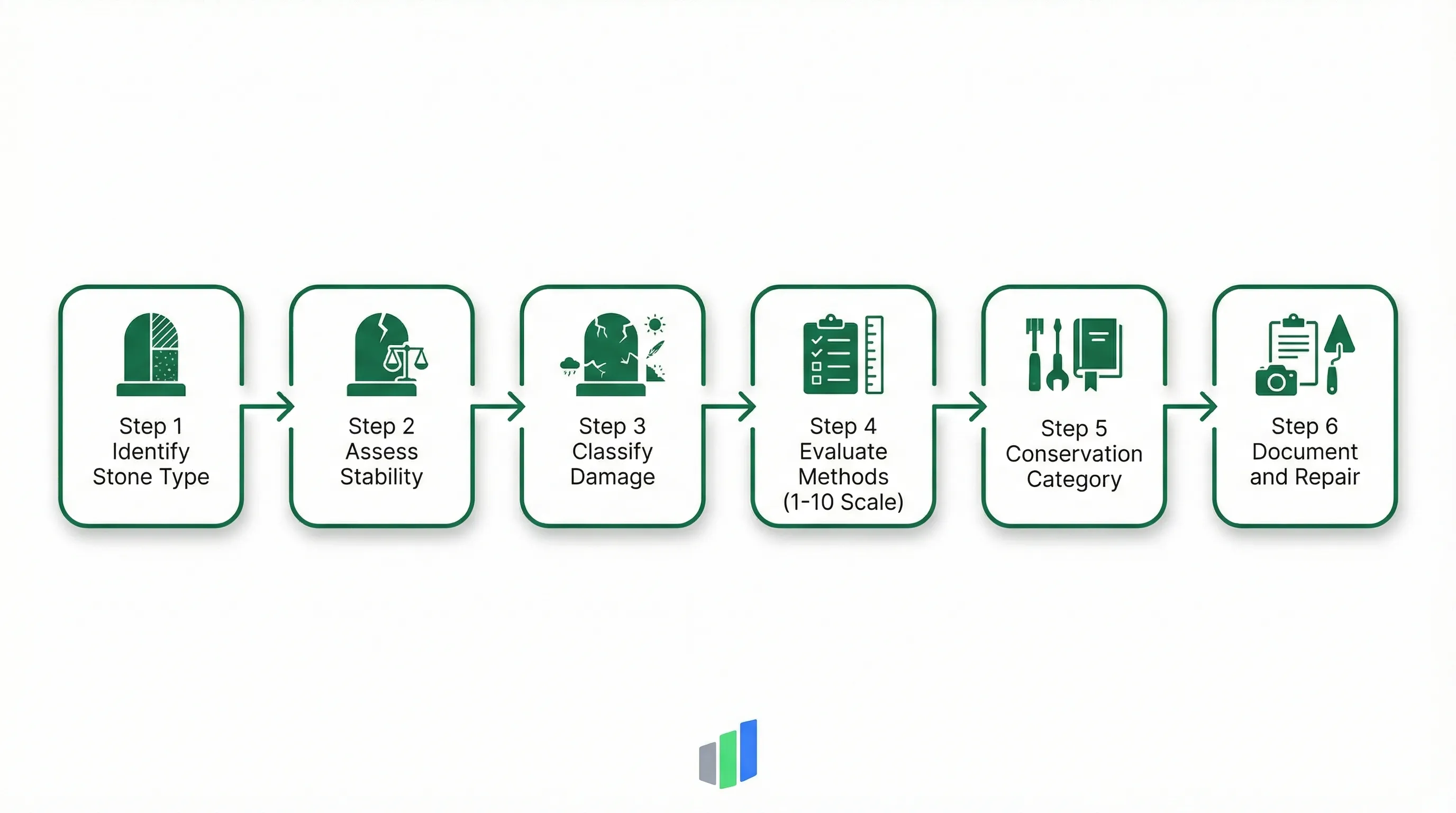
The CCUS framework places stone identification at the foundation of every conservation assessment because the stone type determines which cleaning agents, adhesives, and repair techniques are safe to use. A method that is perfectly appropriate for granite may cause irreversible damage to marble. The assessment begins with classifying the monument material into one of the three geological categories: igneous, sedimentary, or metamorphic rock. Granite, the most durable cemetery stone, is an intrusive igneous rock with coarse mineral crystals that is mechanically tough, acid-resistant, and exhibits minimal porosity. Granite monuments resist biological colonization and chemical weathering far better than softer stones, though they are not immune to long-term deterioration.
Sedimentary stones commonly found in cemeteries include sandstone and limestone. Sandstone is composed of sand-sized grains held together by a cement matrix, and its durability depends on grain composition and cementation type. Silica-cemented sandstone is highly resistant, while calcite-cemented varieties are vulnerable to acid rain. Limestone is a carbonate rock identified by its softness, mottled appearance, and susceptibility to chemical dissolution. Both sedimentary types show highly variable weathering characteristics depending on their specific composition and the local climate. Metamorphic stones include marble, slate, and gneiss. Marble, the most common metamorphic cemetery stone, is recrystallized limestone identified by its translucent glow and characteristic "sugaring" when weathered. Lower-grade marbles with poorly interlocked crystals are particularly susceptible to biological colonization by lichens and algae. Slate is chemically resistant but prone to delamination along its foliation planes.
In the digital form, the inspector selects the identified stone type from the classification system and records the Mohs hardness (a relative scale from 1 to 10), the observed porosity level, and any specific weathering patterns. CCUS emphasizes that every stone should be evaluated individually because even within the same stone type, composition and condition can vary dramatically between monuments. The stone identification directly informs which of the six preservation categories applies and constrains the permissible methods within each category.
For related memorial stability assessment frameworks used in the UK, see the ICCM Memorial Safety standard.
Try this CCUS form in Geocadra
We have a pre-built CCUS inspection template ready to go. Sign up and start your first condition assessment today.
Free 14-day trial. No credit card required.
STABILITY ASSESSMENT
Height-to-Width Ratio and Critical Angle Analysis
The CCUS stability assessment uses structural geometry and center-of-gravity calculations to predict whether a monument will slide or tip, and how much force is needed to destabilize it.
What distinguishes the CCUS stability methodology from subjective tilt evaluations is its reliance on quantified geometric analysis. Rather than relying on an inspector's visual impression of whether a monument "looks dangerous," CCUS requires the calculation of specific structural parameters that predict failure mode and failure threshold. The core metric is the height-to-width ratio, which determines the monument's dominant failure behavior. A monument with a height-to-width ratio below 2 is more likely to slide laterally under external force, while a monument with a ratio above 2 is more prone to tipping. A ratio of exactly 2 represents the transition point between sliding and tipping behavior. This distinction matters for conservation planning because sliding monuments and tipping monuments require different stabilization approaches.
The critical angle calculation extends this analysis by determining the maximum tilt a monument can sustain before its center of gravity passes beyond the base support edge. At the critical angle, any external force — wind, ground vibration, or human contact — will cause motion, either sliding or tipping depending on the height-to-width ratio. The tipping force formula (Weight multiplied by Bottom Foot divided by Height) quantifies how much lateral force is needed to initiate tipping from the monument's current position. Inspectors use this calculation to classify monuments into stability categories and prioritize intervention. Environmental risk factors that reduce stability over time include water saturation and freeze-thaw cycles, failing mortar between stacked components, the inherent material properties of different stone types (marbles and limestones deform gradually while granite breaks suddenly), and external vibrations from nearby traffic, aircraft, or severe weather events.
In the inspection form, the conservator records the monument dimensions (height, width, depth), the current lean angle if any, the calculated height-to-width ratio, and the estimated tipping force. These quantified measurements create an objective record that supports both immediate safety decisions and long-term trend monitoring. When a monument is reassessed after several years, the change in lean angle or stability metrics indicates whether deterioration is accelerating and whether preventive intervention is warranted. This approach parallels structural assessment methodologies used in other infrastructure domains.
The complete CCUS safety methodology and geometric analysis procedures are published on the CCUS Safety page.
EVALUATION SCALE
The CCUS 1-to-10 Method and Product Evaluation Framework
Every method, technique, and product recommended by CCUS is assessed against six standardized criteria on a 1-to-10 scale, creating an objective basis for conservation decisions.
The CCUS evaluation framework applies six standardized questions to every method, technique, and product used in cemetery preservation. Each criterion is scored on a 1-to-10 scale, where higher scores indicate more favorable attributes. This structured rating system transforms subjective conservation debates into quantifiable comparisons, enabling inspectors to select approaches based on documented evidence rather than personal preference. The first criterion, MSDS Compliance (Material Safety Data Sheet), assesses the health and safety risk associated with a product or method. A score of 1 indicates the highest risk to human health and safety, while a score of 10 represents the lowest risk. This criterion ensures that products used on cemetery monuments do not pose hazards to conservators, visitors, or the surrounding environment.
The second criterion, Testing History, evaluates the extent of scientific and field testing performed on the method or product. Products with extensive laboratory and real-world testing (score of 10) are preferred over those with minimal documented testing (score of 1). Longevity and Performance, the third criterion, rates the expected durability and effectiveness based on reliable field reports across multiple climatic conditions and stone types. Track Record and Widespread Use assesses how long the method or product has been used across multiple locations and by multiple practitioners. A high score indicates decades of successful application across diverse conditions, providing confidence in long-term outcomes.
Reversibility, the fifth criterion, is philosophically central to the CCUS approach. A score of 10 means the method or product can be fully reversed without any residual damage to the monument, preserving the option for future technological advances to improve upon today's conservation treatments. A score of 1 means the method is irreversible once applied. The final criterion, Cost and Training Requirements, assesses the financial and expertise barriers. Products that are affordable and require minimal specialized training score higher, making conservation accessible to volunteer groups and smaller cemetery organizations. The combined six-criterion profile provides a holistic assessment that balances safety, efficacy, durability, and accessibility for each recommended approach.
| Criterion | Scale | Low Score (1) | High Score (10) |
|---|---|---|---|
| MSDS Compliance | 1–10 | Highest health/safety risk | Lowest health/safety risk |
| Testing History | 1–10 | Minimal testing documented | Extensive lab and field testing |
| Longevity & Performance | 1–10 | Shortest lifespan, lowest performance | Most durable, best performance |
| Track Record | 1–10 | Worst track record, limited use | Decades of widespread success |
| Reversibility | 1–10 | Irreversible once applied | Fully reversible, no residual damage |
| Cost & Training | 1–10 | Highest cost, most training needed | Affordable, minimal training required |
All CCUS-recommended methods must score favorably across all six criteria. Products scoring low on Reversibility or MSDS Compliance are generally excluded regardless of other scores.
DAMAGE CLASSIFICATION
Monument Damage Types and Deterioration Mechanisms
CCUS identifies distinct damage categories that drive conservation decisions, from structural breaks to surface degradation and environmental weathering.
The CCUS damage classification system categorizes monument deterioration into structural, environmental, surface, and chemical damage types. Structural damage includes single breaks (a clean fracture into two pieces), multiple-piece breaks (complex jigsaw-like fragmentation), and delamination (layered separation along bedding planes, most common in sandstone and slate). Each structural damage type has specific repair protocols; a clean single break may be repaired with a two-part conservation epoxy and minimal infill, while a multiple-piece break requires careful fragment mapping, sequential bonding, and possibly internal pinning with fiberglass or stainless-steel dowels.
Environmental damage results from the interaction between stone material and climatic forces. Freeze-thaw damage occurs when water infiltrates porous stone, expands upon freezing, and progressively widens cracks over repeated cycles. This mechanism is the primary driver of deterioration in northern US cemeteries with sandstone and marble monuments. Acid rain dissolves calcite-cemented stones and creates characteristic pitting on limestone and marble surfaces. Biological growth by lichens, algae, and mosses accelerates deterioration by producing organic acids that etch the stone surface while their root structures penetrate surface pores. CCUS requires inspectors to document the type and severity of biological colonization, as it directly affects the cleaning method selection.
Surface degradation includes "sugaring" (the crystalline granular deterioration characteristic of weathered marble, where individual calcite crystals detach from the surface), staining from iron-bearing minerals or adjacent metallic fixtures, and inscription erosion that reduces the legibility of carved text. Chemical weathering encompasses all dissolution and chemical alteration processes, including the reaction of calcite with acidic precipitation. In the digital form, inspectors select all applicable damage types from the classification checklist, record the severity and extent for each, and document the condition with photographs. This systematic damage inventory drives the conservation plan by identifying which of the six CCUS preservation categories applies and which specific methods within those categories are appropriate given the stone type and damage profile.
For a comparable condition assessment approach to built infrastructure, see the NEN 2767 standard.
Browse all cemetery and memorial inspection standards in our standards directory.
QUESTIONS
Frequently Asked Questions
What is CCUS (Cemetery Conservators for United Standards)?
CCUS is a US 501(c)(3) nonprofit organization that establishes Do No Harm standards for cemetery monument preservation. It provides a framework covering six preservation categories — Cleaning, Tablet Sets, Slotted Bases, Multi-Piece Monuments, Repair, and Infill — with standardized evaluation criteria for all methods and products.
What does Do No Harm mean in cemetery preservation?
Do No Harm is the CCUS foundational principle requiring that all preservation methods meet two criteria: they must not cause short-term or long-term damage to the monument, and they must be non-permanent (reversible), allowing future technological improvements to be applied without undoing permanent interventions.
How does CCUS evaluate preservation methods and products?
CCUS uses a six-criterion evaluation framework scoring each method on a 1-to-10 scale across MSDS safety compliance, testing history, longevity and performance, track record of widespread use, reversibility, and cost and training requirements. Products must score favorably across all six criteria.
What stone types does the CCUS framework cover?
CCUS covers all common cemetery stone types organized by geological category: igneous rocks (granite), sedimentary rocks (sandstone, limestone), and metamorphic rocks (marble, slate, gneiss). Each stone type has different cleaning, repair, and stabilization protocols due to varying hardness, porosity, and chemical composition.
How does CCUS assess monument stability?
CCUS uses geometric analysis including the height-to-width ratio (above 2 indicates tipping risk, below 2 indicates sliding risk), critical angle calculation using center of gravity, and the tipping force formula (weight times base width divided by height). These quantified metrics replace subjective visual impressions.
What repair products does CCUS approve for broken headstones?
CCUS mandates conservation-grade two-part epoxies such as Akemi Akepox 2030, Tenax Domo 10, and Rivo products for structural repairs. Hardware-store adhesives, caulking compounds, modern Portland cement, and non-breathable sealants are explicitly prohibited as they trap moisture and accelerate stone deterioration.
Is CCUS certification required for cemetery preservation work?
CCUS certification is not legally mandated but is considered the recognized standard of practice for US cemetery preservation. The organization offers annual hands-on training workshops covering the six basic preservation categories, and many cemetery managers and historical societies require CCUS-aligned methods for volunteer conservation projects.
In practice
See how the round runs in Geocadra
The solution page shows this inspection regime on real open data: the import, the form, the round, the record per asset and the export.
Playground checks, headstone tests and green-space acceptances on a map, with every round appended to the siteOpen the solution page: Municipalities & Public SpaceTRY IT FREE
Digitize your CCUS inspections
Replace paper forms and spreadsheets with structured digital inspections, built for standards like CCUS.
No credit card requiredFree trial included