

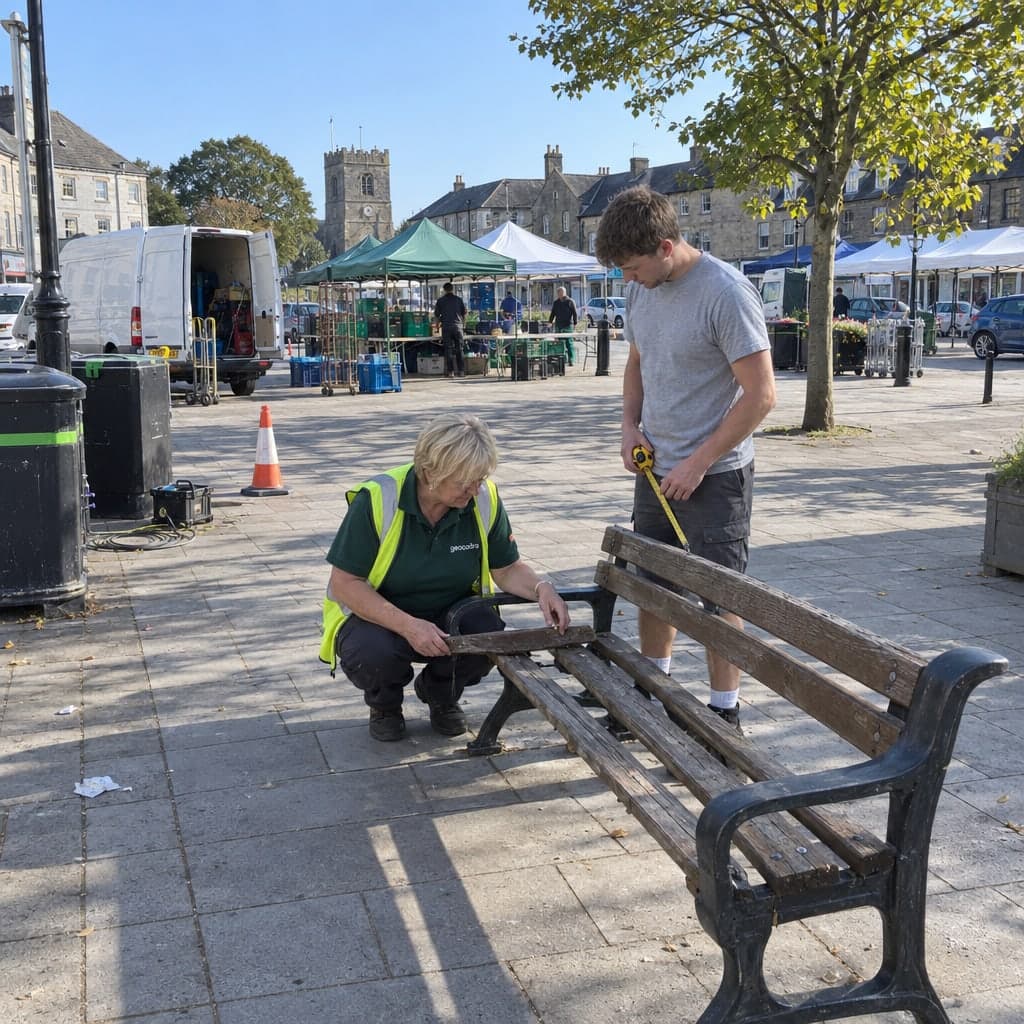
UK MoJ Memorial Safety Inspection
The UK standard for burial ground memorial stability testing with visual survey, 25 kg hand test, and three-tier risk classification.
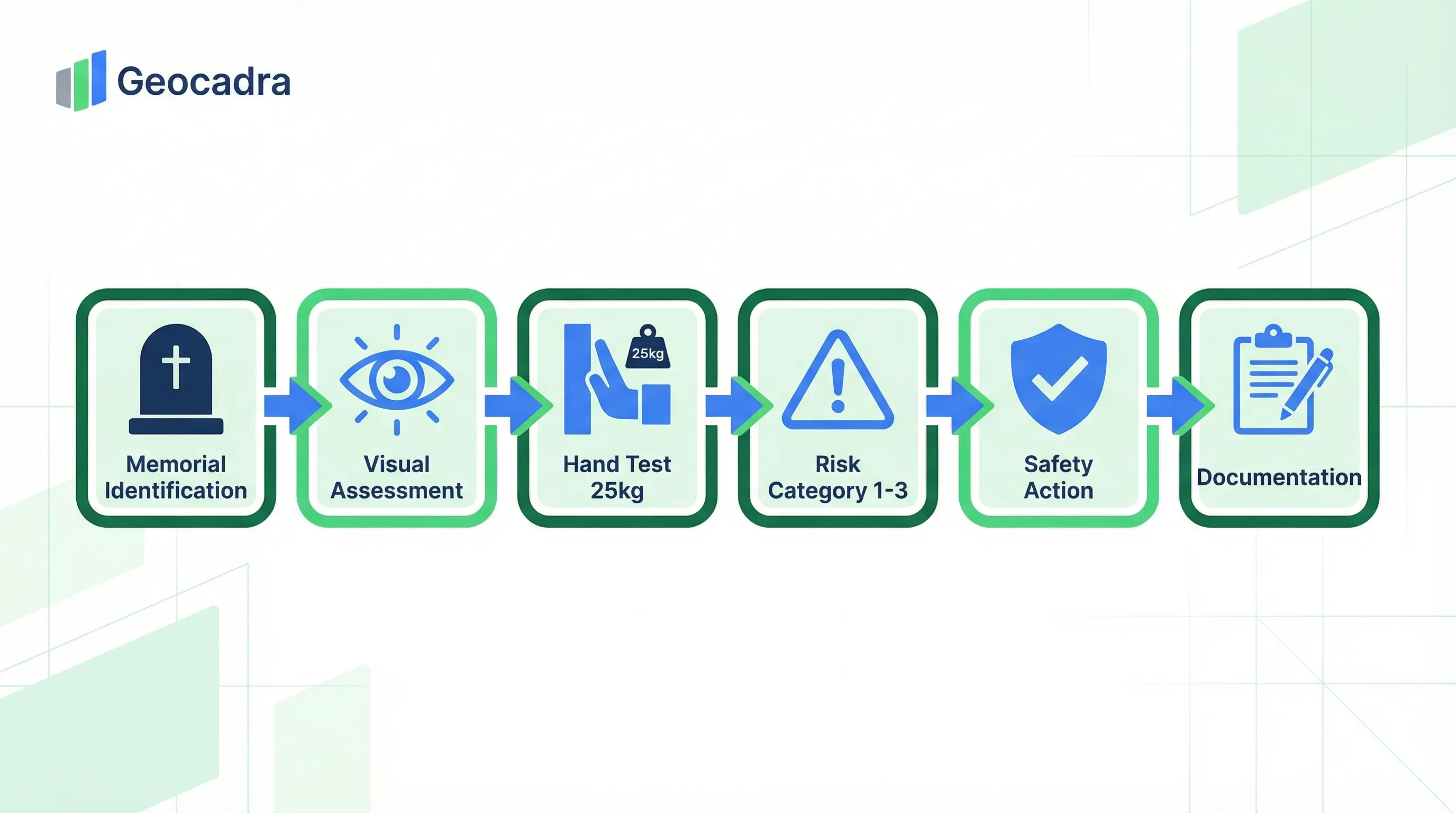
The Ministry of Justice guidance "Managing the Safety of Burial Ground Memorials" (2009) establishes a proportionate, risk-based framework for inspecting headstones and memorials across England and Wales. It replaces earlier blanket policies of laying memorials flat with a structured two-stage process: a visual condition survey followed by a 25 kg hand test. Each memorial is assigned a Category 1 (Immediate Risk), Category 2 (Monitor), or Category 3 (Safe) classification that determines the remedial action and re-inspection interval. This guide covers the inspection methodology, memorial identification, stability testing, risk categorization, and the safety measures burial ground operators must document.

What is UK MoJ Memorial Safety?
The UK Ministry of Justice Memorial Safety Guidance (2009) is the national framework for inspecting the structural stability of headstones and memorials in burial grounds across England and Wales. It uses a two-stage process of visual assessment and 25 kg hand test to assign each memorial a three-tier risk category (1: Immediate Risk, 2: Monitor, 3: Safe).
- Full Name
- Managing the Safety of Burial Ground Memorials
- Issuing Body
- UK Ministry of Justice (MoJ)
- Current Revision
- 2009 Guidance (current)
INSPECTION PROCESS
Two-Stage Memorial Inspection Methodology
The MoJ guidance mandates a sequential process: visual assessment first, physical stability testing second.
The MoJ memorial safety inspection follows a proportionate, risk-based methodology that distinguishes it from earlier blanket approaches. Rather than applying a single mechanical test to every memorial regardless of size or condition, the 2009 guidance established a two-stage workflow designed to protect both public safety and the dignity of burial grounds. The first stage is a thorough visual condition survey that evaluates the memorial before any physical contact is made. The second stage is the 25 kg hand test, applied only when the visual survey confirms it is safe to do so.
During Stage 1 (Visual Assessment), the inspector records the memorial type, material, and height category before examining its structural condition. Four key parameters are evaluated: visual condition (Good through Very Poor), lean severity (Vertical through Dangerous Lean), joint condition (Intact through Loose/Separated), and foundation status (Stable through Rocking on Base). The inspector also logs any specific defects such as cracks, vegetation damage, vandalism, dowel failure, or loose components using a multi-select checklist. Critically, a "Safe to Hand Test?" determination must be made before proceeding. Memorials that are visually hazardous, show dangerous lean, or exceed 2.5 metres in height are excluded from the hand test.
During Stage 2 (Hand Test), the inspector applies a steady pushing force of approximately 25 kg to the upper third of the memorial. The test is performed by pushing away from the body, and the inspector records the test method used, any movement detected (None, Slight Locking, Significant, or Free Rocking), and the pass or fail result. A memorial passes if it withstands the 25 kg force without continuing to move. A memorial fails if it moves and would continue to fall under the applied force. For memorials too tall or too dangerous for the hand test, the inspector records "Visual Only" as the test method and refers the memorial for structural engineering assessment.
This sequential approach ensures that inspectors never apply force to a memorial that might collapse on contact. The visual survey acts as a safety gate, filtering out obviously dangerous memorials before physical testing begins. The methodology reflects the MoJ's core principle: while unstable memorials pose a real risk, the statistical likelihood of serious injury is low, so inspections must be proportionate and sensitive to the bereaved.
The MoJ guidance was published by the UK Ministry of Justice and is supported by the Institute of Cemetery and Crematorium Management (ICCM), which offers training programmes for cemetery inspectors.
THE 25 KG HAND TEST
How the Hand Test Works
The core stability check of MoJ compliance, applied to memorials between 625 mm and 2.5 m in height.
The 25 kg hand test is the primary stability determination under the MoJ guidance. The force threshold of approximately 25 kg (roughly 250 N) was chosen to represent a reasonable force that a person might exert when leaning against or pushing a memorial, particularly a child. It is not intended to replicate extreme forces such as storm winds or deliberate vandalism, but rather to identify memorials that are so unstable they could topple under everyday contact.
Height category determines whether the hand test applies. Memorials under 625 mm are classified as Low Risk and generally exempt from the hand test because even if they toppled, the falling distance and mass are unlikely to cause serious injury. Standard memorials between 625 mm and 1.5 m undergo the full hand test procedure. Memorials between 1.5 m and 2.5 m are classified as High and still receive the hand test, but with increased caution and awareness of the greater falling mass. Memorials exceeding 2.5 m are classified as Specialist Required, and a structural engineer must assess them. This height-based tiering ensures the testing process itself does not create a hazard for the inspector.
Movement outcomes are classified on a four-point scale. "None (Solid)" means the memorial did not move and passes the test. "Slight Movement (Locking)" means the memorial shifted but locked into position, typically because ground anchors or dowels engaged. This is a borderline result that may warrant monitoring. "Significant Movement" means the memorial moved noticeably and represents a fail. "Free Rocking" means the memorial rocks freely on its base and represents an immediate fail requiring urgent action. Mechanical verification devices (topple testers) are available as an alternative test method but are generally reserved for borderline cases or inspector training, not routine inspections.
For a related gravestone safety methodology under German regulations, see the BIV-Richtlinie gravestone safety standard, which applies a 300 N force test (approximately 30 kg) with a four-grade rating.
Try this MoJ Memorial Safety form in Geocadra
We have a pre-built MoJ Memorial Safety inspection template ready to go. Sign up and start your first condition assessment today.
Free 14-day trial. No credit card required.
RISK CLASSIFICATION
The Three-Tier Category System
Every inspected memorial is assigned one of three risk categories. The category drives both the immediate response and the re-inspection interval.
The MoJ risk classification system uses three categories that translate inspection findings into clear, actionable outcomes. Category 1 (Immediate Risk) means the memorial failed the hand test or is visually identified as an immediate danger of toppling and causing serious injury. The burial ground operator must make the memorial safe immediately, within 24 hours at most. Category 2 (Monitor) means the memorial is not an immediate danger but is not fully stable, for example a memorial with a slight lean that still passed the hand test, or one showing open joints that are not yet causing instability. Category 2 memorials are re-inspected annually and the grave owner is notified. Category 3 (Safe) means the memorial passed both the visual assessment and the hand test with no movement or significant defects. No action is required and the memorial enters the standard 5-year re-inspection cycle.
The three-tier system is deliberately simple. Earlier approaches sometimes used more granular scales that were difficult for non-specialist cemetery staff to apply consistently. The MoJ guidance prioritised clarity: every memorial falls into one of three bins, each with an unambiguous action requirement. This simplicity is a feature, not a limitation. It means a parish council volunteer and a professional cemetery manager apply the same standard.
| Category | Risk Level | Action Required | Re-inspection |
|---|---|---|---|
| 1 | Immediate Risk | Make safe immediately (stake and band, lay flat, or cordon off) | Within 24 hours |
| 2 | Monitor | Notify grave owner; no immediate action unless worsening | Every 12 months |
| 3 | Safe | No action required | Every 5 years |
Categories are assigned based on the combined outcome of visual assessment and hand test results. Memorials too tall for the hand test (over 2.5 m) are referred to a structural engineer for separate evaluation.
For more information on condition assessment methodologies for structures and infrastructure, see our standards directory, which summarizes related inspection standards and assessment methodologies.
SAFETY ACTIONS
Remedial Measures for Unstable Memorials
When a memorial fails the inspection, the burial ground operator must select and document an appropriate safety measure.
The MoJ guidance defines six remedial actions that burial ground operators may deploy, ranging from no intervention to professional engineering referral. The choice of action depends on the severity of instability, the size of the memorial, its heritage significance, and the sensitivity of the location. Actions are recorded in the inspection form alongside photographic evidence, creating an auditable trail that demonstrates the operator fulfilled their duty of care.
"No Action Required" applies to Category 3 memorials that passed all checks. "Warning Notice Applied" involves attaching a waterproof tag advising the public not to touch the memorial, used for Category 2 memorials with minor concerns. "Cordoned Off" uses tape or fencing to prevent public access, typically for large memorials awaiting specialist assessment. "Stake and Band Support" is the most common temporary measure for Category 1 memorials: a wooden stake driven into the ground adjacent to the memorial with a strap securing the headstone upright. This preserves the memorial in situ while preventing toppling.
"Laid Flat / Pocketed" is considered a last resort under the 2009 guidance. Earlier cemetery safety campaigns in the early 2000s drew significant public backlash for wholesale laying-flat of memorials, which the bereaved perceived as desecration. The MoJ guidance explicitly states that laying flat should only be used when no other temporary measure will keep the public safe. "Pocketing" refers to sinking the base deeper into the ground to effectively shorten the memorial and make it a monolith, reducing the toppling risk without removing it from its upright position. "Referred to Engineer" applies to memorials exceeding 2.5 m or to complex multi-part structures (mausoleums, vaults, obelisks) where a stonemason or structural engineer must assess the remediation options.
| Action | Typical Use | Description |
|---|---|---|
| No Action Required | Category 3 | Memorial passed all checks; no intervention needed. |
| Warning Notice | Category 2 | Waterproof tag advising the public not to touch or lean on the memorial. |
| Cordoned Off | Category 1 (large) | Tape or fencing preventing public access, pending specialist assessment. |
| Stake and Band | Category 1 | Wooden stake and strap securing the memorial upright as temporary support. |
| Laid Flat / Pocketed | Category 1 (last resort) | Memorial lowered to ground or base sunk deeper; used only when no other measure suffices. |
| Referred to Engineer | Over 2.5 m / complex | Professional structural assessment for large or multi-part memorials. |
Laying flat is a last resort under MoJ guidance. Stake and band is the preferred temporary measure for Category 1 headstones.
DIGITAL WORKFLOW
Digitize MoJ Memorial Inspections with Geocadra
Traditional memorial inspections rely on paper forms and spreadsheet logs. Geocadra replaces that workflow with structured digital capture.
Structured inspection forms
Pre-built MoJ-compliant form templates with drop-downs for memorial type, material, height category, visual condition, lean severity, and hand test results. Inspectors select from predefined options, ensuring consistent data capture across all burial grounds.
Conditional logic and safety gates
The "Safe to Hand Test?" toggle controls section visibility. When set to No, the hand test section is hidden and the inspector is guided directly to risk classification, preventing accidental testing of dangerous memorials.
Photo-linked evidence records
Every memorial inspection is tied to geotagged evidence photos (front view, lean angle, defect close-ups) and a GPS location. Reviewers see exactly which memorial was inspected and its precise condition, not just a row in a spreadsheet.
Automatic re-inspection scheduling
Based on the assigned risk category, Geocadra calculates and schedules the next inspection date: 24 hours for Category 1, 1 year for Category 2, and 5 years for Category 3, maintaining a rolling inspection programme without manual diary management.
QUESTIONS
Frequently Asked Questions
What is the UK MoJ Memorial Safety Guidance?
The MoJ guidance "Managing the Safety of Burial Ground Memorials" (2009) is the UK national framework for inspecting headstone and memorial stability in burial grounds across England and Wales, using a visual assessment and a 25 kg hand test to classify memorials into three risk categories.
What force is applied during the memorial hand test?
The standard hand test applies approximately 25 kg (around 250 N) of steady pushing force to the upper third of the memorial. This represents a reasonable everyday contact force, such as a person leaning against the stone, rather than extreme wind or impact loads.
What are the three MoJ risk categories?
Category 1 means immediate risk requiring the memorial to be made safe within 24 hours. Category 2 means the memorial should be monitored and re-inspected annually. Category 3 means the memorial is safe and enters the standard 5-year re-inspection cycle.
Which memorials are exempt from the hand test?
Memorials under 625 mm in height are generally exempt because their low mass and falling distance are unlikely to cause serious injury. Memorials exceeding 2.5 m are also excluded from the hand test due to inspector safety, and must be assessed by a structural engineer.
How often should memorial safety inspections be performed?
The MoJ guidance recommends a rolling 5-year inspection cycle for the full burial ground. Category 1 memorials require immediate follow-up within 24 hours after remediation. Category 2 memorials are re-inspected every 12 months until their status changes.
What is the difference between the MoJ guidance and the BIV-Richtlinie?
The MoJ guidance applies in England and Wales and uses a 25 kg hand test with three risk categories. The German BIV-Richtlinie applies a 300 N (approximately 30 kg) force test and assigns a four-grade stability rating (I through IV). Both follow a two-stage visual-then-physical methodology.
Is laying memorials flat still recommended?
The 2009 MoJ guidance explicitly discourages blanket laying-flat of memorials. It is classified as a last resort, to be used only when no other temporary measure (such as stake and band) can keep the public safe. Pocketing the base is preferred over fully laying flat.
In practice
See how the round runs in Geocadra
The solution page shows this inspection regime on real open data: the import, the form, the round, the record per asset and the export.
Playground checks, headstone tests and green-space acceptances on a map, with every round appended to the siteOpen the solution page: Municipalities & Public SpaceTRY IT FREE
Digitize your MoJ Memorial Safety inspections
Replace paper forms and spreadsheets with structured digital inspections, built for standards like MoJ Memorial Safety.
No credit card requiredFree trial included