EN 1176 Playground Inspection
The European standard for playground equipment safety inspection, entrapment testing, and impact-absorbing surfacing.
EN 1176 is the primary European safety standard for publicly accessible playground equipment. Spanning seven parts, it covers general safety requirements, equipment-specific rules for swings, slides, cableways, carousels, and rockers, plus guidance on installation, inspection, maintenance, and operation. Complemented by EN 1177 for impact-absorbing surfacing, the standard establishes a comprehensive safety framework used across the EU, UK, and aligned nations. Every playground operator must implement three tiers of inspection to remain compliant: routine visual checks, operational inspections, and annual main inspections conducted by competent persons.

What is EN 1176?
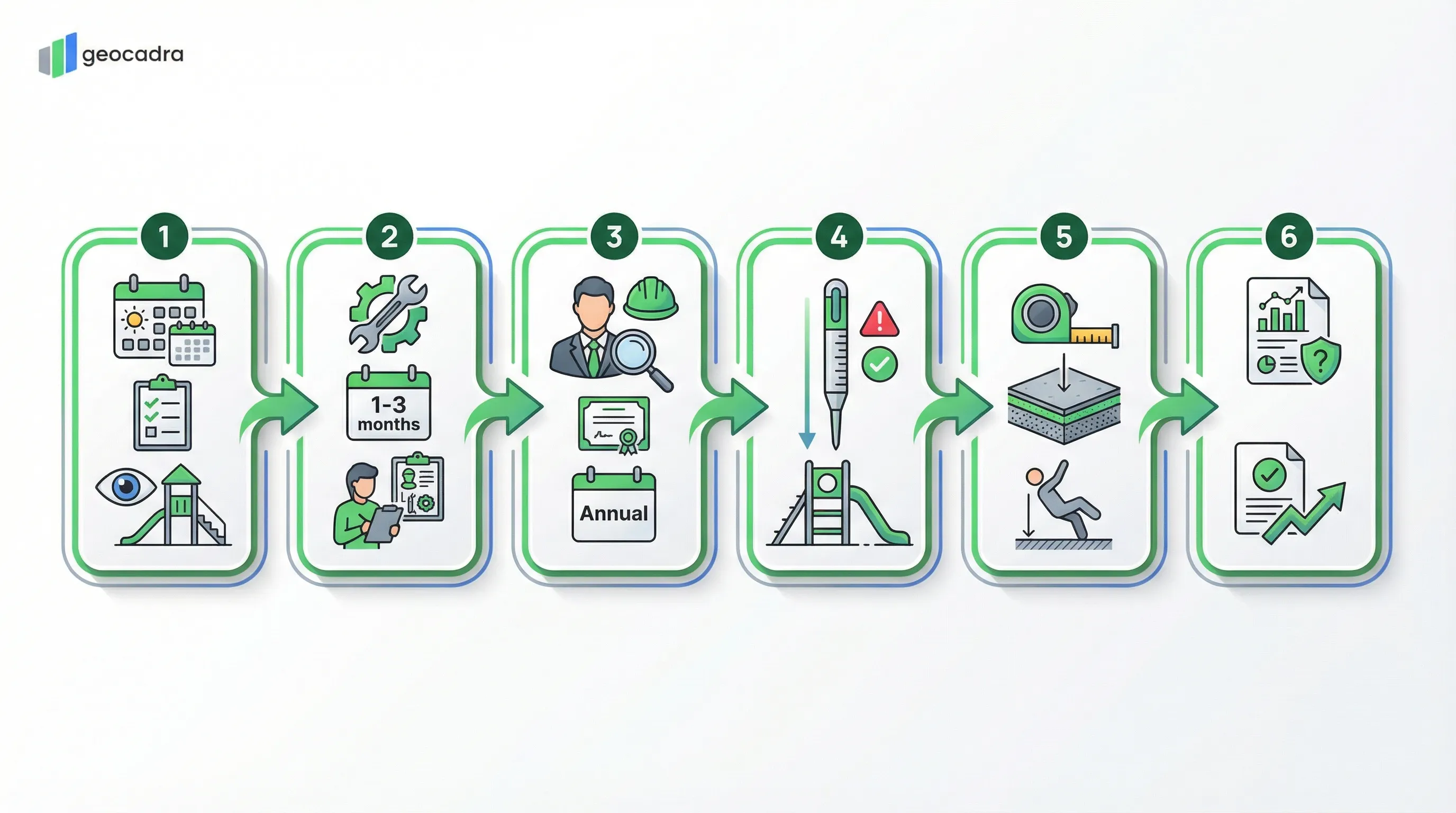
EN 1176 is the European safety standard for playground equipment inspection, covering structural integrity, entrapment testing, and impact-absorbing surfacing across Parts 1 through 7. It defines three inspection tiers: routine visual, operational, and annual main inspections, each with increasing scope and rigor.
- Full Name
- Playground Equipment and Surfacing (EN 1176 Parts 1-7 / EN 1177)
- Issuing Body
- CEN (European Committee for Standardization)
- Current Revision
- EN 1176:2017 / EN 1177:2018
INSPECTION TIERS
Three Levels of Playground Inspection Under EN 1176-7
EN 1176 Part 7 defines three inspection tiers with increasing depth and frequency, each targeting different hazard categories.
EN 1176 Part 7 establishes a tiered inspection regime designed to catch hazards at different stages of development. The three tiers are not alternatives: a compliant playground management programme must implement all three at appropriate intervals. Each tier builds on the previous one, with routine inspections occurring most frequently and annual inspections providing the most comprehensive assessment.
The Routine Visual Inspection is the most frequent check, recommended daily or weekly depending on site usage. Its purpose is to identify obvious hazards that could result from vandalism, weather damage, or normal use since the last inspection. The inspector walks the site looking for broken or missing components, sharp edges, litter, glass, and any condition that presents an immediate danger. This tier requires no special tools and can be performed by trained site staff. In the digital form, the inspector selects "Routine Visual" as the Inspection Type and completes the Site Details and a simplified Equipment Inspection for each item.
The Operational Inspection occurs at one-to-three-month intervals and checks equipment function and stability in greater detail. The inspector tests moving parts such as swing bearings, carousel axles, and cableway trolleys for wear, excessive noise, or seized operation. Fixings and hardware are checked for looseness, and structural members are examined for surface corrosion or rot that may not be immediately visible. Loose-fill surfacing depth is verified against the minimum requirement for the equipment's Critical Fall Height.
The Annual Main Inspection is the most comprehensive tier and should be performed by a competent person with specific knowledge of EN 1176 requirements. It covers full structural integrity assessment, foundation condition, dimensional compliance checks, and formal entrapment testing using standardized probes. The annual inspection generates the baseline condition record against which all subsequent routine and operational findings are measured. Post-Installation inspections follow the same scope as annual inspections and must be completed before any new or relocated equipment enters public use.
ENTRAPMENT TESTING
Head, Finger, and Clothing Entrapment Under EN 1176
Entrapment testing is the single most critical safety check in EN 1176 — it prevents the most severe injury mechanism on playgrounds: strangulation from head or neck entrapment.
EN 1176 Part 1 defines specific entrapment hazards and the test probes used to verify compliance. Entrapment is the most dangerous failure mode on a playground because it can result in strangulation or asphyxiation within minutes. The standard addresses three distinct entrapment categories, each with its own test methodology and pass/fail criteria.
Head and neck entrapment is tested using Probes C, D, and E. These rigid test probes simulate the torso and head dimensions of children in different age groups. The principle is binary: an opening must either be too small for the head to enter, or large enough for the entire body to pass through freely. Any gap that allows the head to enter but prevents withdrawal creates an entrapment hazard. In the digital form, the Entrapment Check field captures the result as Pass, Fail (Head/Neck), or N/A for routine visual inspections where probe testing is not performed. A Head/Neck failure is always classified as a safety-critical finding requiring immediate equipment closure.
Finger entrapment applies to openings at heights above one metre. The standard specifies that gaps between 8 mm and 25 mm at accessible heights constitute finger entrapment hazards because a child's finger can enter but may not withdraw under load or panic. The inspector tests these gaps using calibrated 8 mm and 25 mm finger probes. Openings below 8 mm or above 25 mm are considered safe. The form records this as Pass (8mm/25mm probes) or Fail (8-25mm entrapment zone).
Clothing and toggle entrapment covers protrusions, hooks, and gaps that can catch drawstrings, hoods, or toggles on children's clothing. The toggle test uses a standardized cord with a rigid toggle to check slides, fireman's poles, barrier tops, and roof edges. A toggle failure indicates that a child descending or moving past the feature could have their clothing caught, creating a strangulation or fall hazard. This test is particularly relevant for slide exits, overhead barriers, and any feature where downward movement occurs. The European standard for children's clothing (EN 14682) complements this by restricting cords and toggles, but playground operators cannot control what children wear, making equipment-side compliance essential.
The entrapment testing methodology is defined in EN 1176-1, Clause 4.2 (CEN).
Try this EN 1176 form in Geocadra
We have a pre-built EN 1176 inspection template ready to go. Sign up and start your first condition assessment today.
Free 14-day trial. No credit card required.
SURFACING
Impact-Absorbing Surfacing and Critical Fall Height (EN 1177)
EN 1177 defines the impact attenuation requirements for playground surfacing, directly linked to each equipment item's Critical Fall Height.
EN 1177 is the companion standard to EN 1176 and governs the impact-absorbing properties of playground surfacing. Every playground surface must attenuate the impact of a fall from the equipment's Critical Fall Height (CFH) to levels below the Head Injury Criterion (HIC) threshold of 1000 and a peak deceleration (g-max) below 200g. These values represent the biomechanical limits beyond which a head impact is likely to cause life-threatening injury.
The form captures surface type from six categories: Wet Pour (Rubber), Rubber Tiles, Loose Fill Bark/Mulch, Loose Fill Sand, Grass/Topsoil, and Grass Mats. Each surface type has different impact attenuation characteristics and maintenance requirements. Wet pour and rubber tiles provide consistent, predictable performance but degrade through UV exposure and heavy traffic. Loose-fill materials such as bark or sand offer excellent impact absorption when maintained at adequate depth, but displacement through play, wind, and rain means regular top-up is essential. The standard requires a minimum depth of 200 mm plus an additional 100 mm displacement allowance for loose-fill materials, meaning the installed depth must be at least 300 mm to maintain compliance after use.
Surface condition is assessed on a four-level scale in the digital form: Good, Fair (Monitor), Poor (Action Required), and Critical (Close Area). A Critical rating indicates that the surface has deteriorated to a point where it can no longer adequately absorb impact for the installed equipment's fall height, requiring immediate area closure. Common degradation modes include wet pour rubber cracking and debonding from the sub-base, rubber tiles lifting at edges, loose fill being displaced below minimum depth, and grass surfaces becoming compacted or waterlogged. The inspector also records trip hazards, which frequently occur at the boundary between impact-absorbing surfacing and surrounding hard surfaces such as paths and kerbs.
Critical Fall Height compliance is the bridge between EN 1176 equipment requirements and EN 1177 surfacing requirements. The CFH of each piece of equipment determines the minimum performance specification for the surfacing beneath it. For example, a slide platform at 2.5 metres requires surfacing tested and certified to attenuate falls from at least 2.5 metres. In the form, Fall Height Compliance is recorded as Pass or Fail for each equipment item, linking the equipment's installed height to the surfacing performance data. A failure here is one of the most common findings in annual inspections, often caused by retrospective changes to equipment height without corresponding surfacing upgrades.
Surfacing test methods and HIC thresholds are specified in EN 1177:2018 (European Standards). locale === 'en' ? 'For Australian playground safety requirements, see the ' : 'Zu australischen Spielplatzsicherheitsanforderungen siehe die '} locale === 'en' ? 'AS 4685 standard' : 'AS 4685-Norm'}. locale === 'en' ? 'Explore all available inspection standards in the ' : 'Alle verfügbaren Inspektionsnormen finden Sie in der '} locale === 'en' ? 'standards library' : 'Normenbibliothek'}.
RISK ASSESSMENT
The 5x5 Risk Matrix for Playground Equipment
EN 1176 inspections use a 5x5 risk matrix combining Likelihood and Severity to produce a Risk Score that drives action priorities.
The risk assessment framework used in EN 1176 inspections follows the industry-standard 5x5 matrix model endorsed by RPII (Register of Play Inspectors International) and comparable European bodies. Every defect or hazard identified during an inspection is evaluated on two dimensions: Likelihood (the probability that the hazard will lead to an accident) and Severity (the potential consequence if an accident occurs). The product of these two values yields a Risk Score from 1 to 25, which maps to one of three action thresholds.
In the digital form, the inspector selects Risk Likelihood from 1 (Very Low) to 5 (Very High) and Risk Severity from 1 (Minor) to 5 (Critical) for each equipment item where a defect is identified. A Likelihood of 5 means an accident is virtually certain if the equipment remains in use, while a Severity of 5 represents the potential for death, brain damage, or life-changing injury. The Risk Score is calculated as the product of these two values.
| Rating | Level | Description |
|---|---|---|
| 1 | Very Low | No significant probability of an accident; effectively zero risk under normal use |
| 2 | Low | Very unlikely to happen; would require a rare combination of factors |
| 3 | Moderate | Could happen; foreseeable misuse or minor wear creates a plausible scenario |
| 4 | High | Likely to happen; an evident hazard is exposed to frequent use |
| 5 | Very High | Accident is virtually certain if the equipment remains in use |
| Rating | Level | Description |
|---|---|---|
| 1 | Minor | Scratches, bruises, or minor comfort issues with no medical attention required |
| 2 | Moderate | Minor cuts or sprains; medical attention unlikely to be required |
| 3 | Serious | Broken bone, deep laceration, or dental injury; hospital visit likely |
| 4 | Very Serious | Major fracture, loss of consciousness, or potential for permanent damage |
| 5 | Critical | Death, brain damage, or life-changing injury |
| Score Range | Risk Level | Required Action |
|---|---|---|
| 1 - 5 | Low | Monitor during subsequent inspections; no immediate action required |
| 6 - 12 | Medium | Action required within scheduled maintenance cycle (typically 1-3 months) |
| 15 - 25 | High | Urgent action required; immobilize or close equipment immediately |
Risk Score = Likelihood x Severity. Scores of 13 and 14 are not possible in a 5x5 matrix and fall into the Medium range by convention.
QUESTIONS
Frequently Asked Questions
What is EN 1176?
EN 1176 is the European safety standard for playground equipment, published in seven parts covering general requirements, swings, slides, cableways, carousels, rockers, and inspection guidance. It is complemented by EN 1177 for impact-absorbing surfacing and applies across the EU, UK, and aligned nations.
What are the three EN 1176 inspection tiers?
EN 1176 Part 7 defines three tiers: Routine Visual (daily/weekly, checking for obvious hazards), Operational (1-3 months, testing function and stability), and Annual Main (yearly, comprehensive compliance assessment including entrapment testing and structural integrity checks by a competent person).
What is entrapment testing in EN 1176?
Entrapment testing checks for openings that could trap a child's head, fingers, or clothing. Head/neck entrapment is tested with Probes C, D, and E; finger entrapment uses 8 mm and 25 mm probes for gaps above 1 metre height; and clothing entrapment uses a standardized toggle test on slides, poles, and barriers.
What is Critical Fall Height (CFH)?
Critical Fall Height is the maximum height from which a child can fall from a piece of playground equipment. EN 1177 requires that the surfacing beneath each item must attenuate impacts from at least the CFH, keeping the Head Injury Criterion (HIC) below 1000 and peak deceleration below 200g.
How is the risk score calculated in an EN 1176 inspection?
The risk score is calculated by multiplying Likelihood (1-5) by Severity (1-5), producing a score from 1 to 25. Scores of 1-5 are Low risk (monitor), 6-12 are Medium risk (scheduled maintenance), and 15-25 are High risk requiring immediate equipment closure or immobilization.
Is EN 1176 legally mandatory?
EN 1176 is not directly enacted as law in most countries, but it is referenced by national regulations and duty-of-care legislation. In the UK, the Health and Safety at Work Act and the Occupiers' Liability Act effectively require compliance. EU member states adopt it through national standards bodies (e.g., BS EN 1176 in the UK, DIN EN 1176 in Germany).
What is the difference between EN 1176 and ASTM F1487?
EN 1176 is the European playground safety standard, while ASTM F1487 is the North American equivalent. Both address similar hazards but differ in entrapment probe dimensions, fall height thresholds, and test methodology. Equipment designed for European markets follows EN 1176; North American installations follow ASTM F1487 and CPSC guidelines.
In practice
See how the round runs in Geocadra
The solution page shows this inspection regime on real open data: the import, the form, the round, the record per asset and the export.
Playground checks, headstone tests and green-space acceptances on a map, with every round appended to the siteOpen the solution page: Municipalities & Public SpaceTRY IT FREE
Digitize your EN 1176 inspections
Replace paper forms and spreadsheets with structured digital inspections, built for standards like EN 1176.
No credit card requiredFree trial included