IPWEA PN 10.1 Park Asset Inspection
The Australasian standard for condition assessment of park furniture using the IIMM 1-to-5 grading scale.
IPWEA Practice Note 10.1 is the primary industry standard in Australia and New Zealand for inventorying and assessing the condition of public park assets. Developed by the Institute of Public Works Engineering Australasia, it provides a consistent framework for grading park furniture — seats, benches, tables, shelters, bins, bollards, BBQs, and signage — on a 1-to-5 condition scale aligned with the International Infrastructure Management Manual (IIMM). This guide covers the condition grading system, defect classification, failure mode analysis, score confidence levels, priority-based action planning, and remaining useful life estimation.
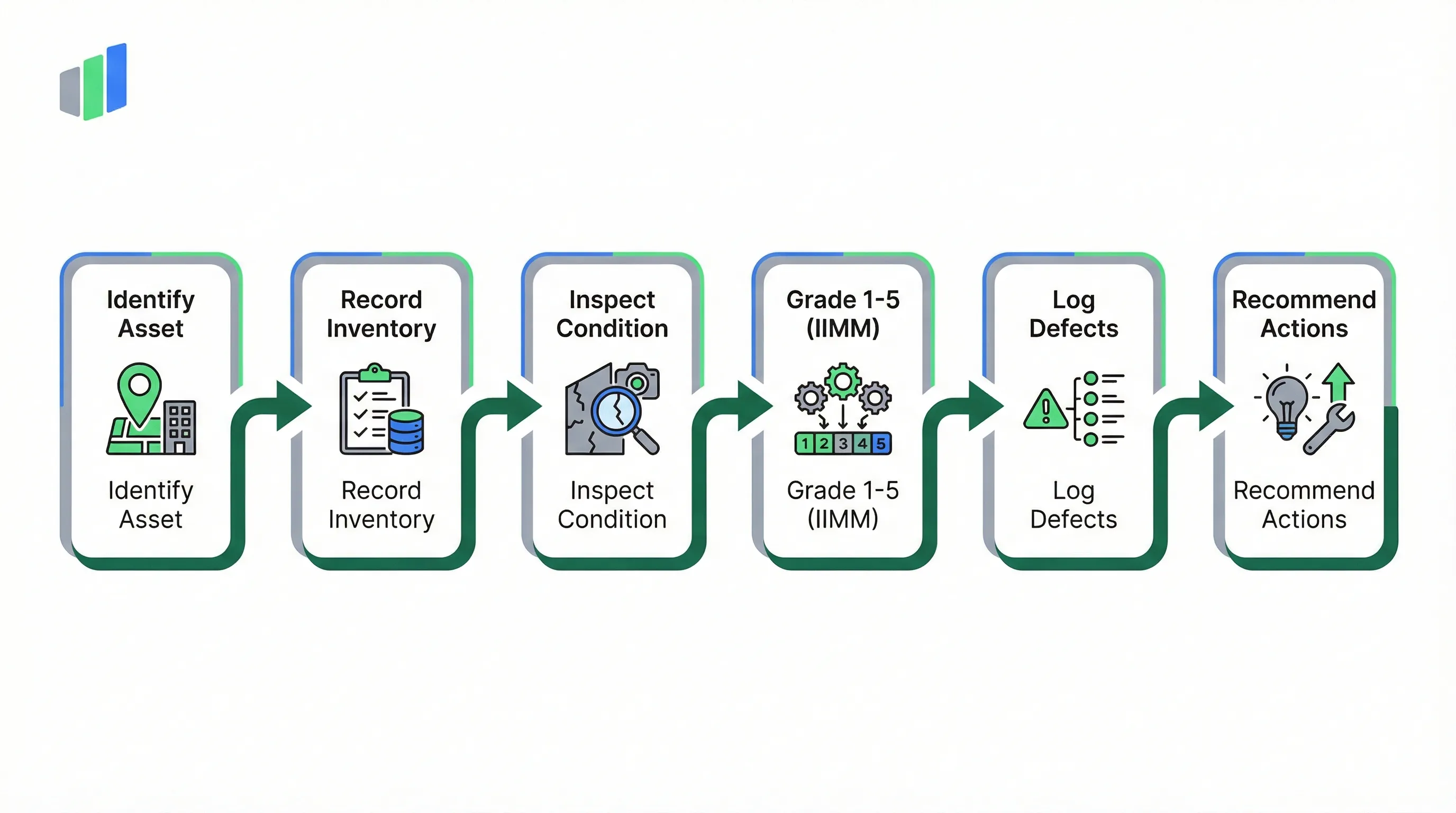
What is IPWEA PN 10.1?
IPWEA Practice Note 10.1 is the Australasian standard for inventorying and assessing the condition of public park assets such as seats, shelters, bins, and signage. Using the IIMM 1-to-5 grading scale, inspectors assign a Condition Grade from 1 (Very Good) to 5 (Very Poor) based on physical deterioration, failure mode, and remaining useful life to inform capital renewal planning.
- Full Name
- Practice Note 10.1 — Parks Management: Inventories, Condition & Performance Assessment
- Issuing Body
- Institute of Public Works Engineering Australasia (IPWEA)
- Current Revision
- IPWEA PN 10.1 (IIMM Edition 6)
CONDITION GRADING
The IIMM 1-to-5 Condition Grading Scale for Park Assets
The core of every IPWEA PN 10.1 inspection is the Condition Grade — a single number from 1 to 5 that places the asset on its lifecycle curve and directly feeds into financial depreciation calculations and capital renewal forecasts.
IPWEA Practice Note 10.1 uses the internationally recognized IIMM (International Infrastructure Management Manual) condition grading scale, standardized across Australia and New Zealand for all public infrastructure asset classes. The scale runs from Grade 1 (Very Good) to Grade 5 (Very Poor), with each grade corresponding to a specific remaining useful life band and a defined level of intervention. Grade 1 represents an asset in new or near-new condition — no visible defects, no deterioration, and 95 to 100 percent of its design life remaining. A freshly installed powder-coated steel bench with intact fixings and no surface marks would receive Grade 1. No maintenance action is required.
Grade 2 (Good) describes an asset with minor defects only — slight weathering of timber surfaces, minor scratches on metalwork, or superficial dirt accumulation. The structure is sound and 75 to 95 percent of its useful life remains. At most, the asset needs cleaning or minor touch-up. Grade 3 (Fair) is the critical maintenance threshold: significant wear is evident, such as peeling paint, minor surface rust on galvanized steel, or visibly worn timber. The asset is functionally sound but its appearance has degraded noticeably. Maintenance is needed to return it to a higher level of service, and 50 to 75 percent of its useful life remains. This is the grade where proactive intervention yields the best return — restoring the coating system at Grade 3 prevents the accelerated deterioration that occurs once protective barriers fail.
Grade 4 (Poor) signals substantial deterioration — rotting timber, structural rust, loose fittings, or missing components. Functionality is impaired and the asset is barely serviceable with only 20 to 50 percent of its life remaining. Major repair or replacement must be scheduled in the near term. Grade 5 (Very Poor) means the asset has failed or is about to fail. It may present a safety hazard — structural collapse risk, sharp exposed edges, or missing structural elements. Immediate replacement or removal is required, and less than 20 percent of the design life remains. In practice, a Grade 5 park bench might have severe rot in multiple legs, be unstable when loaded, or have splintered timber that could injure a user. The IPWEA grading system is designed to be consistent across asset classes so that a Grade 3 bench and a Grade 3 shelter convey the same relative lifecycle position, enabling portfolio-level capital planning across an entire parks network.
| Grade | Label | Description | Remaining Life |
|---|---|---|---|
| 1 | Very Good | New or near-new condition. No visible defects or deterioration. No maintenance required. | 95–100% |
| 2 | Good | Minor defects only. Superficial wear and tear. Structure is sound. Minor maintenance may be required. | 75–95% |
| 3 | Fair | Significant wear evident (peeling paint, minor rust, worn timber). Functionally sound but maintenance needed. | 50–75% |
| 4 | Poor | Substantial deterioration (rotting timber, structural rust, loose fittings). Barely serviceable. Major repair or replacement required. | 20–50% |
| 5 | Very Poor | Unserviceable or failed. Safety hazard possible. Immediate replacement or removal required. | <20% |
The IIMM 1-to-5 scale is standardized across all Australian and New Zealand infrastructure asset classes. Each grade corresponds to a remaining useful life band used for financial depreciation and capital renewal forecasting.
The IIMM grading framework is also used in the NEN 2767 condition assessment, which uses a comparable multi-level approach for building and infrastructure assets.
ASSET INVENTORY
Park Furniture Types, Materials, and Mounting Classifications
Before condition can be assessed, the asset must be correctly identified and classified. IPWEA PN 10.1 requires a structured inventory that captures asset type, primary material, and mounting method — data that drives depreciation rates and expected useful life calculations.
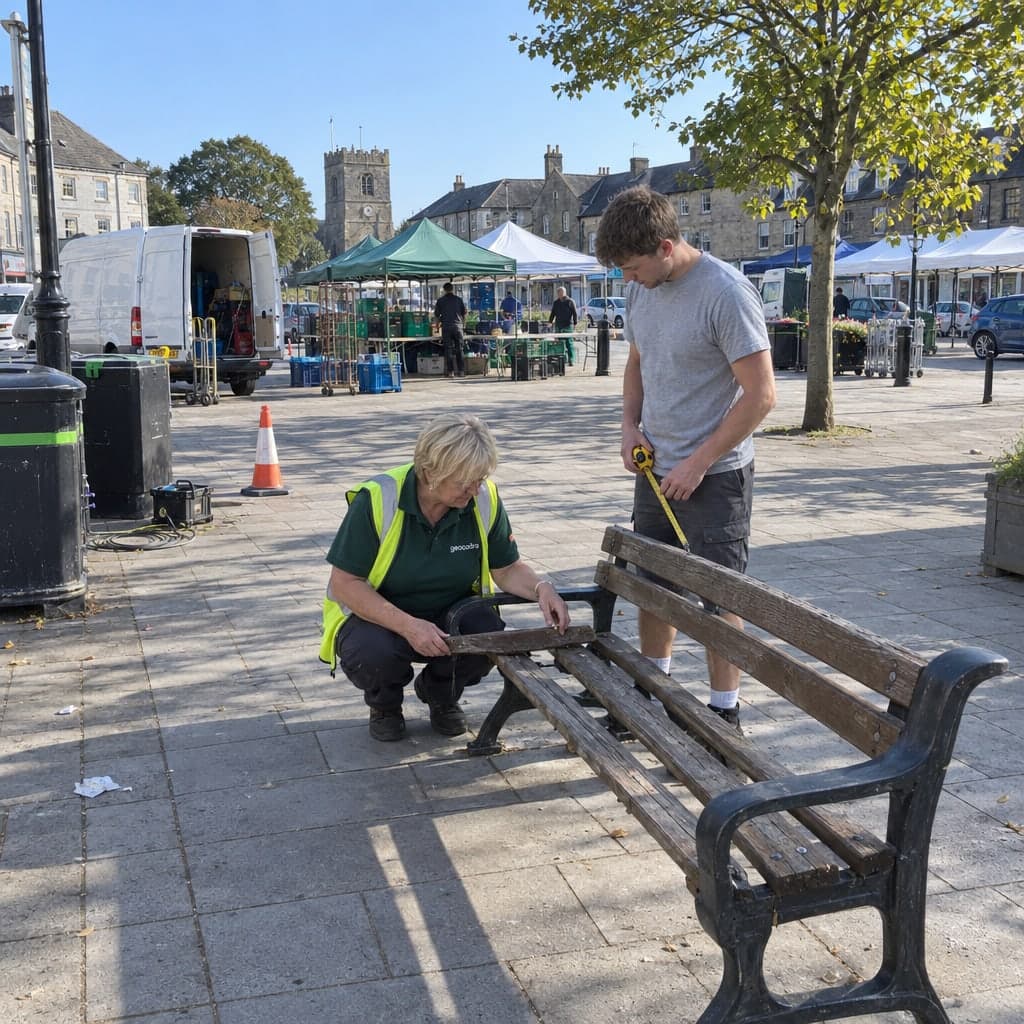
The form captures nine distinct park furniture asset types, each with different deterioration profiles and expected useful lives. Seats (with back) and Benches (no back) are the most numerous park assets in most councils, typically constructed from timber slats on steel frames. Tables and Picnic Settings combine seating and table surfaces, often in high-use areas near playgrounds and waterways where exposure to food waste and moisture accelerates deterioration. Bin Enclosures house waste receptacles and are subject to impact damage, corrosion from waste leachate, and frequent vandalism. BBQ units incorporate gas or electric heating elements alongside structural metalwork, requiring assessment of both the structural frame and the functional cooking components. Shelters and Gazebos are the most complex park furniture assets, often comprising a roof structure, supporting posts, a concrete slab, and integrated furniture — IPWEA recommends component-level grading for these larger structures rather than a single overall condition score.
Signage covers interpretive signs, wayfinding signage, regulatory notices, and park identification boards. Bollards serve as vehicle barriers and delineators along paths and park boundaries. The primary material classification is critical because it determines the expected deterioration curve and useful life. Timber assets typically have a 15-to-25-year useful life depending on species, treatment, and climate exposure — they are vulnerable to rot, decay, splitting, and UV degradation. Galvanized steel resists corrosion but can fail at welds and fixings; powder-coated steel is more aesthetically durable but susceptible to coating failure once the surface is breached. Aluminium is lightweight and corrosion-resistant but can fatigue at stress points. Concrete furniture is extremely durable but heavy and prone to cracking from ground movement. Plastic and composite materials resist rot and corrosion but can become brittle under prolonged UV exposure.
The mounting type — in-ground concreted, surface-mounted bolted, or freestanding — affects both the inspection approach and the deterioration pattern. In-ground concreted installations are the most secure but impossible to inspect at the soil interface, where corrosion in steel or rot in timber often begins unseen. Surface-mounted bolted assets can be inspected fully but may loosen over time due to ground movement or vandalism. Freestanding assets require no fixings assessment but are vulnerable to displacement. In the form, the inspector selects the Asset Type, Primary Material, and Mounting Type from standardized dropdown fields, with an optional Manufacturer text field for warranty tracking.
The IPWEA standard is maintained by the Institute of Public Works Engineering Australasia (IPWEA), which provides training programs and asset management guidance.
Try this IPWEA PN 10.1 form in Geocadra
We have a pre-built IPWEA PN 10.1 inspection template ready to go. Sign up and start your first condition assessment today.
Free 14-day trial. No credit card required.
DEFECTS & FAILURE MODES
Material-Specific Defects and Why Assets Deteriorate
IPWEA PN 10.1 distinguishes between what is wrong with an asset (the defect) and why it went wrong (the failure mode). This dual classification enables councils to target not just the repair but the root cause — shifting maintenance from reactive to predictive.
The defect catalog in the form defines six primary defect types that cover the deterioration patterns of all park furniture materials. Rot and Decay is the dominant failure mechanism for timber assets — it begins at moisture traps such as end-grain exposure, ground contact points, and joints where water pools. Advanced rot compromises structural integrity and can cause sudden failure under load, making it the most critical defect for timber seats and benches. Corrosion and Rust affects all ferrous metals — galvanized steel, powder-coated steel, and exposed fixings. Corrosion typically initiates at coating damage points, weld seams, and contact zones between dissimilar metals (galvanic corrosion). In coastal environments, salt spray dramatically accelerates metal deterioration, and assets within 500 meters of the shoreline may lose a full condition grade within 3 to 5 years of installation.
Cracking and Splintering occurs in timber (UV-induced surface checking, split grain from moisture cycling), concrete (settlement cracking, freeze-thaw damage), and plastic composites (UV embrittlement). Loose Fixings and Instability is a safety-critical defect — a bench or table that rocks, shifts, or has missing bolts presents an immediate hazard. This defect is particularly common in surface-mounted assets subjected to repeated lateral loading and in timber assets where the wood around the fixing has deteriorated. Graffiti and Vandalism covers deliberate damage including spray paint, carving, burning, and forced removal of components. While often cosmetic, severe vandalism — such as a missing seat slat or bent structural member — transitions into a functional or safety defect. Paint and Coating Failure is the leading indicator of future structural deterioration: once the protective barrier fails, the underlying material is exposed to moisture, UV, and biological attack, and condition degrades rapidly.
Each defect is classified by severity across three levels. Low (Cosmetic) severity means the defect affects appearance but not function — surface rust staining, minor graffiti, or superficial paint peeling. Medium (Functional) severity indicates the defect impairs the asset's intended use — a wobbly bench, a sign that cannot be read due to fading, or a bin enclosure door that does not close properly. High (Safety) severity means the defect presents a risk of injury — exposed sharp edges, structural instability, protruding fixings, or collapse potential. The failure mode classification answers the why: Normal Wear and Tear (the expected lifecycle deterioration), Vandalism or Damage (deliberate or accidental external force), Environmental or Weathering (UV, moisture, salt, biological attack), Design or Installation Defect (premature failure due to inadequate specification or workmanship), or None (the asset is sound). This root-cause tracking enables councils to identify systemic issues — for example, if a high percentage of assets fail due to design defects, the specification for new installations needs revision.
| Severity | Impact | Examples | Typical Action |
|---|---|---|---|
| Low | Cosmetic only | Surface rust staining, minor graffiti, superficial paint peeling | Schedule routine maintenance |
| Medium | Functional impact | Wobbly bench, illegible sign, bin door malfunction | Minor repair within 3 months |
| High | Safety hazard | Structural instability, sharp edges, collapse risk, protruding fixings | Immediate make-safe or removal |
Defect severity directly informs the Priority classification. High-severity defects with safety implications must trigger High or Immediate priority actions.
Similar defect-based assessment approaches are found in the AS 4685 playground inspection, which covers the same parks and recreation domain.
ACTIONS & PRIORITY
Recommended Actions and Time-Based Priority Classification
Every inspection concludes with a recommended action and a priority timeframe. IPWEA PN 10.1 links these directly to the condition grade and defect severity, creating an auditable decision chain from field observation to work order.
The recommended action field provides five intervention levels that map to the asset lifecycle. No Action Required applies to Grade 1 assets with no defects. Monitor means the asset has a noted defect or is approaching a maintenance threshold but no physical work is needed yet — the inspector flags it for re-assessment at the next inspection cycle. This is the appropriate action for Grade 2 assets with cosmetic defects or Grade 3 assets where deterioration is progressing slowly. Routine Maintenance (Clean/Paint) covers restorative work that extends the asset's life without replacing components — pressure washing, repainting, re-staining timber, or clearing vegetation growth. This is the primary intervention for Grade 3 assets and represents the most cost-effective point in the lifecycle to intervene.
Minor Repair involves fixing or replacing individual components — tightening loose bolts, replacing a missing seat slat, welding a broken bracket, or patching a concrete crack. Replace/Renew is the final intervention: the asset has reached the end of its useful life and must be removed and replaced. This action corresponds to Grade 4 and Grade 5 assets where the cost of repair exceeds the value of the remaining asset life. The priority classification adds a time dimension to the action. Low Priority schedules work within 12 months — suitable for cosmetic maintenance and non-urgent repairs on assets that remain functional and safe. Medium Priority requires action within 3 months — used for functional impairments that affect service quality but do not present immediate danger.
High Priority demands action within 1 week and is reserved for defects that present a near-term safety risk — a bench with one severely rotted leg, a shelter post with visible structural cracking, or a bollard leaning at a dangerous angle. Immediate Priority means the inspector must make the asset safe today — by barricading it, removing it from service, or physically securing the hazard. IPWEA PN 10.1 includes an implicit validation rule: if the Condition Grade is 5 (Very Poor / Unserviceable), the Priority must be High or Immediate. An asset graded as failed cannot sit in a low-priority queue — it either presents a safety risk requiring urgent action or it must be removed from the asset register entirely. This validation logic ensures that inspection data drives timely operational response rather than accumulating as deferred maintenance backlog.
| Action | Applies To | Description |
|---|---|---|
| No Action Required | Grade 1 | Asset is in excellent condition. No intervention needed. |
| Monitor | Grade 1–2 | Defect noted but no physical work required. Re-assess at next cycle. |
| Routine Maintenance | Grade 2–3 | Clean, repaint, re-stain, or clear vegetation. Extends asset life without component replacement. |
| Minor Repair | Grade 3–4 | Fix or replace individual components (bolts, slats, brackets). Restores function. |
| Replace / Renew | Grade 4–5 | Asset has reached end of life. Remove and replace entirely. |
The recommended action is selected by the inspector based on the overall Condition Grade and the specific defects observed. Work orders are generated from the action and priority combination.
For further information on the IIMM framework, refer to the NAMS.AU Asset Management Program, which maintains the IIMM guidelines and condition assessment standards.
CONFIDENCE & REMAINING LIFE
Score Confidence and Remaining Useful Life Estimation
Not all condition grades carry equal certainty. IPWEA PN 10.1 requires inspectors to declare the confidence level of their assessment and estimate the asset's remaining useful life in years — two parameters that directly affect financial forecasting accuracy.
The Score Confidence field acknowledges a practical reality: not every inspection is conducted under ideal conditions, and not every inspector has the same level of expertise with every asset type. High confidence indicates a detailed, hands-on inspection where the inspector physically examined the asset, tested fixings, probed timber for rot, and visually confirmed all surfaces. This is the default for field inspections and provides the most reliable data for depreciation calculations. Medium confidence indicates a visual estimation — the inspector observed the asset from a reasonable distance and made a professional judgment but did not perform hands-on testing. This is common for rapid portfolio assessments where hundreds of assets must be graded in a single day. Low confidence marks a desktop or guess-based assessment — the grade was assigned from photographs, aerial imagery, or age-based assumptions without a site visit.
The confidence level has direct implications for financial asset management. Australian accounting standards (AASB 116 and AASB 13) require that asset valuations reflect the condition of the asset, and the confidence level determines how much weight an auditor can place on the inspection data. A portfolio where 80 percent of grades are High confidence supports robust financial reporting; a portfolio dominated by Low confidence grades may trigger an audit requirement for physical re-inspection. The Estimated Remaining Useful Life (RUL) field captures the inspector's estimate of how many years the asset can continue to serve its function before replacement is required. For park furniture, typical useful lives range from 10 to 15 years for untreated timber, 15 to 25 years for treated timber, 20 to 30 years for galvanized steel, 25 to 40 years for aluminium, and 40 to 60 years for concrete. The RUL estimate, combined with the condition grade, feeds directly into council long-term financial plans and asset management plans as required under Australian Local Government Acts.
| Level | Method | Use Case | Financial Reliability |
|---|---|---|---|
| High | Detailed hands-on inspection | Standard field inspection with physical testing | Suitable for audited financial statements |
| Medium | Visual estimation from proximity | Rapid portfolio surveys, drive-by assessments | Acceptable with documented methodology |
| Low | Desktop / guess-based | Photo review, age-based assumption, no site visit | May trigger audit requirement for re-inspection |
Australian accounting standards (AASB 116, AASB 13) require asset valuations to reflect condition. The confidence level determines how much weight auditors place on inspection data for financial reporting.
All condition data feeds into council asset management plans. For additional inspection-based standards, browse the standards directory.
QUESTIONS
Frequently Asked Questions
What is IPWEA Practice Note 10.1?
IPWEA Practice Note 10.1 is the Australasian industry standard for inventorying and assessing the condition of public park assets. Published by the Institute of Public Works Engineering Australasia, it provides a consistent framework for grading park furniture on the IIMM 1-to-5 condition scale to inform capital renewal planning and maintenance scheduling.
How does the IIMM 1-to-5 condition grading scale work?
The scale assigns each asset a grade from 1 (Very Good — new condition, 95-100% life remaining) to 5 (Very Poor — failed or about to fail, less than 20% life remaining). Each grade corresponds to a specific remaining useful life band and triggers a defined level of maintenance intervention, from no action at Grade 1 to immediate replacement at Grade 5.
What types of park assets does IPWEA PN 10.1 cover?
The standard covers all public park furniture including seats, benches, tables, picnic settings, bin enclosures, BBQ units, shelters and gazebos, signage, and bollards. For complex assets like large shelters, IPWEA recommends component-level grading rather than a single overall score to capture the condition of roofs, posts, slabs, and integrated furniture separately.
What is the difference between condition and performance in IPWEA PN 10.1?
Condition measures the physical state of materials — whether timber is rotting, metal is corroding, or fixings are loose. Performance measures how well the asset serves its intended purpose — a bench might be physically sound (good condition) but located where no one uses it or too low for elderly users (poor performance). Both inform asset management decisions.
How often should park assets be inspected under IPWEA PN 10.1?
IPWEA recommends a routine condition assessment cycle of 1 to 4 years depending on the asset class, risk profile, and local council policy. High-use assets in coastal or vandalism-prone areas may warrant annual inspection, while low-risk assets in sheltered locations can follow a 3-to-4-year cycle. Reactive inspections are triggered by damage reports.
Is IPWEA PN 10.1 mandatory for Australian councils?
While IPWEA PN 10.1 itself is an industry guideline rather than legislation, Australian Local Government Acts require councils to maintain asset management plans with condition data. The IIMM grading framework referenced by PN 10.1 is the accepted standard for satisfying these statutory requirements and Australian accounting standards for infrastructure asset valuation.
What is Score Confidence in an IPWEA inspection?
Score Confidence indicates how the condition grade was determined. High confidence means a detailed hands-on field inspection. Medium confidence indicates visual estimation from proximity. Low confidence marks a desktop or guess-based assessment. The confidence level affects the reliability of the data for financial reporting under Australian accounting standards (AASB 116 and AASB 13).
In practice
See how the round runs in Geocadra
The solution page shows this inspection regime on real open data: the import, the form, the round, the record per asset and the export.
Playground checks, headstone tests and green-space acceptances on a map, with every round appended to the siteOpen the solution page: Municipalities & Public SpaceTRY IT FREE
Digitize your IPWEA PN 10.1 inspections
Replace paper forms and spreadsheets with structured digital inspections, built for standards like IPWEA PN 10.1.
No credit card requiredFree trial included