SF Park Maintenance Standards
San Francisco's binary pass/fail compliance system for park cleanliness, safety, and condition across 14 feature categories.
The San Francisco Park Maintenance Standards, established under Proposition C (2003) and revised in FY2015, define the cleanliness, condition, and safety requirements for every public park in the city. Unlike scored condition assessment standards, the SF system uses a strict binary evaluation: every element either meets or fails its defined threshold. This guide covers the 14 park features, the park classification system that determines litter thresholds, the pass/fail criteria for lawns, hardscapes, playgrounds, restrooms, and athletic fields, and the 91% citywide compliance target that drives maintenance accountability.
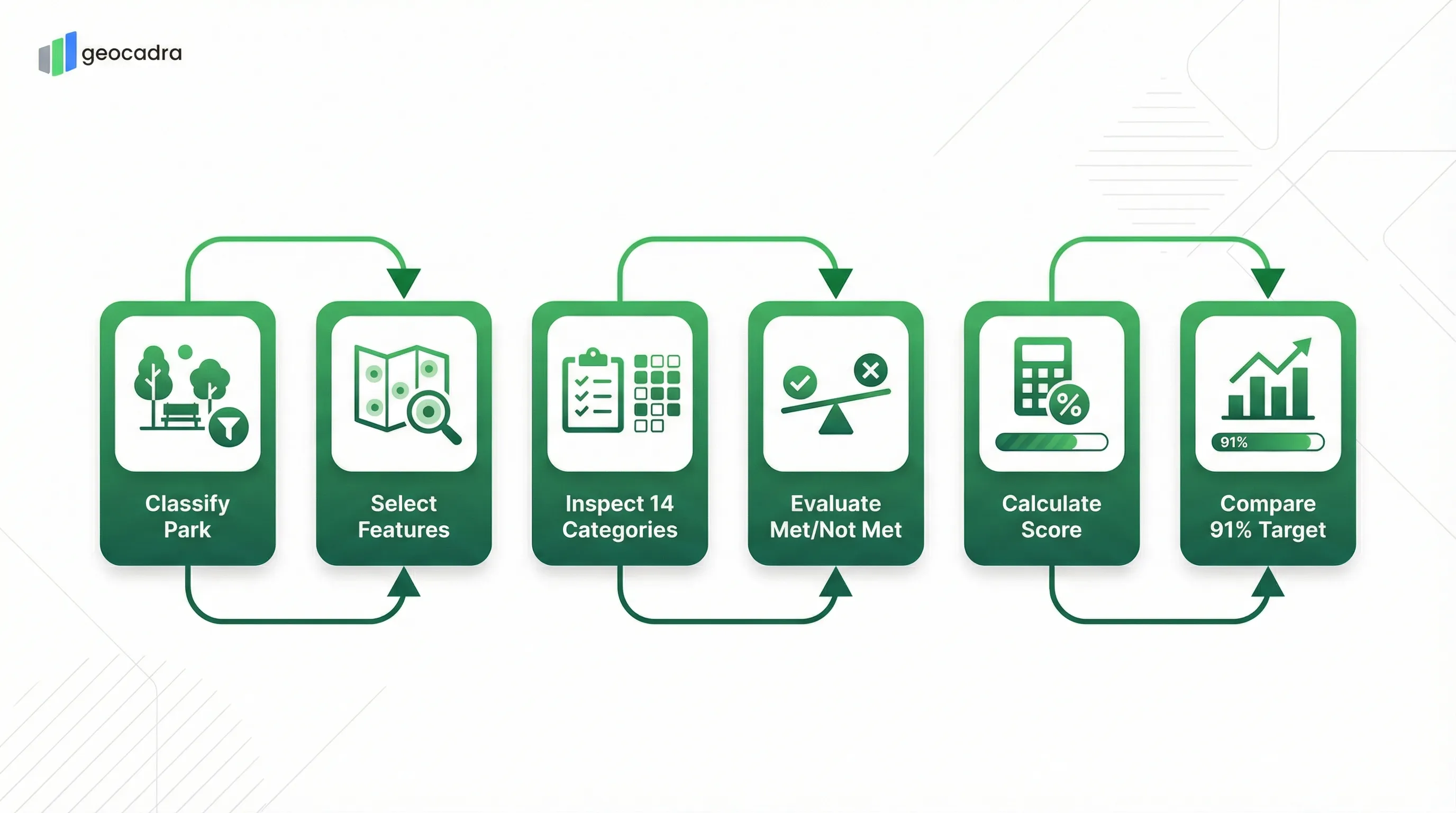
What is SF Park Maintenance Standards?
The San Francisco Park Maintenance Standards (Proposition C, 2003 / Revised FY2015) are the city's mandated compliance framework for evaluating public park cleanliness, safety, and condition. Each element within 14 park features is rated as Met (Pass) or Not Met (Fail) using rigid quantitative thresholds, producing a percentage-based compliance score with a citywide target of 91%.
- Full Name
- San Francisco Park Maintenance Standards (Proposition C)
- Issuing Body
- SF Controller's Office (City Services Auditor) & Recreation and Parks Department
- Current Revision
- Revised FY2015
COMPLIANCE SYSTEM
The Binary Met/Not Met Evaluation Framework
The SF Park Maintenance Standards use a strict binary compliance system with no partial scores. Every element is either Met (Pass) or Not Met (Fail), and results aggregate to a percentage-based park score.
The San Francisco Park Maintenance Standards are fundamentally different from most infrastructure inspection frameworks. Where standards like NEN 2767 or DIN 1076 assign graded scores on multi-point scales, the SF system uses a rigid binary evaluation: every element within a park feature either meets its defined threshold or it does not. There are no partial scores, no intermediate ratings, and no subjective judgment calls about severity levels. A lawn is either compliant or non-compliant on each of its seven sub-elements, and the outcome is strictly determined by measurable, quantitative criteria.
This binary approach was a deliberate design choice mandated by Proposition C, the 2003 ballot measure that created the SF Park Maintenance Standards. The intent was to eliminate subjectivity from park condition reporting and create a system where any trained inspector would reach the same conclusion. A litter count is either above or below the threshold. Turf height is either above or below 4.5 inches. Graffiti is either present or absent. This objectivity allows the City Services Auditor to produce statistically valid compliance reports that hold the Recreation and Parks Department accountable to a measurable standard.
The final score for each park is calculated as the percentage of total applicable standards that were met. If a park has 40 applicable elements and 36 pass, the park scores 90%. The citywide target is 91%, established by the Board of Supervisors as the minimum acceptable maintenance level. This target applies across all park types and all three feature categories: Landscaped and Hardscaped Areas, Recreational Areas, and Amenities and Structures. Parks scoring below 91% trigger review by RPD management, and persistent underperformance drives resource allocation decisions for maintenance crews, equipment, and capital improvement projects.
A similar binary compliance methodology is found in ASTM F1487 playground equipment safety inspections, where equipment elements are individually evaluated against fixed safety thresholds.
PARK CLASSIFICATION
How Park Type Determines Compliance Thresholds
Not all parks are held to identical litter thresholds. The SF standards classify parks into four types, each with different area-based cleanliness criteria that reflect realistic maintenance expectations.
Park classification is the first field an inspector completes because it directly controls the strictness of litter-count standards applied throughout the rest of the inspection. The four classifications are Mini Park, Neighborhood Park, Regional Park, and Civic Plaza/Square. Each classification defines different inspection sample areas and allowable litter counts that reflect the realistic maintenance burden for parks of that scale and use intensity.
Mini Parks and Civic Plazas use a 25-by-25-foot sample area with a maximum of 5 pieces of litter before failing the cleanliness standard. These smaller, high-visibility spaces are expected to maintain a higher standard because they serve concentrated foot traffic in dense urban neighborhoods and are typically maintained by dedicated crews. Neighborhood Parks and Regional Parks use a larger 100-by-100-foot sample area with a maximum of 10 pieces of litter. The larger sample area accounts for the greater acreage and the practical reality that larger parks accumulate debris more quickly across their expanded footprint.
Critically, the classification-based thresholds apply only to general litter counts. Certain failure conditions are universal regardless of park type: the presence of any needles, broken glass, condoms, or animal feces in any sample area constitutes an automatic failure. These hazardous items carry a zero-tolerance policy across all four park classifications because they represent immediate health and safety risks to park visitors, particularly children. In the digital form, the inspector selects the Park Classification field before proceeding to feature-specific assessments, ensuring that the correct litter thresholds are applied contextually throughout the inspection.
| Park Type | Sample Area | Max Litter Count | Context |
|---|---|---|---|
| Mini Park | 25' x 25' | 5 pieces | Small urban spaces, pocket parks, high foot traffic density |
| Neighborhood Park | 100' x 100' | 10 pieces | Community parks serving surrounding residential areas |
| Regional Park | 100' x 100' | 10 pieces | Large destination parks serving multiple neighborhoods |
| Civic Plaza/Square | 25' x 25' | 5 pieces | Public squares, civic gathering spaces, downtown plazas |
Hazardous items (needles, broken glass, condoms, feces) trigger automatic failure regardless of park classification or count.
Details on the City of San Francisco's park standards are available from the SF Controller's Office (City Services Auditor), which conducts independent park evaluations.
Try this SF Park Maintenance form in Geocadra
We have a pre-built SF Park Maintenance inspection template ready to go. Sign up and start your first condition assessment today.
Free 14-day trial. No credit card required.
14 PARK FEATURES
Three Categories and 14 Park Features Under SF Standards
The SF Park Maintenance Standards organize inspections into three categories covering all physical aspects of a park. Each category contains multiple park features (PF), and each feature has its own set of binary pass/fail elements.
The 14 park features are the organizational backbone of every SF park inspection. They are grouped into three categories that reflect the distinct maintenance disciplines responsible for different park assets. Understanding this structure is essential because the compliance percentage is calculated across all applicable features, meaning a failure in a restroom element weighs equally against a failure in a lawn element.
The first category, Landscaped and Hardscaped Areas, covers the four features that define the park's physical landscape: Lawns (PF 1) with seven elements covering cleanliness, color, density, drainage, edging, mowing height, and holes; Ornamental Beds (PF 2) with four elements for cleanliness, plant health, pruning, and weediness; Trees (PF 3) with three elements for limbs, plant health, and vine management; and Hardscapes and Trails (PF 4) with five elements covering cleanliness, drainage, graffiti, surface quality, and weediness. This category typically accounts for the largest share of total elements in a park inspection because most parks have extensive lawn and hardscape areas.
The second category, Recreational Areas, includes playgrounds (PF 8) with eight elements, turf athletic fields (PF 6) with up to eight elements depending on whether the turf is natural or synthetic, and courts (PF 5) with elements for surface condition and fencing. The third category, Amenities and Structures, covers Restrooms (PF 10) with nine elements, Waste Receptacles (PF 12) with four elements, Benches (PF 11), Picnic Areas (PF 9), and additional features for water features, lighting, and fencing. Not every park contains every feature. A mini park may have only lawns, hardscapes, and waste receptacles, while a regional park may have all 14 features present. The digital form handles this through conditional sections where the inspector selects which features are present at the site before beginning element-level assessments.
| Category | Features | Typical Elements |
|---|---|---|
| Landscaped & Hardscaped | PF 1 Lawns, PF 2 Ornamental Beds, PF 3 Trees, PF 4 Hardscapes & Trails | Cleanliness, Color, Density, Drainage, Edging, Mowing, Holes, Plant Health, Pruning, Weediness, Graffiti, Surface Quality |
| Recreational Areas | PF 5 Courts, PF 6 Athletic Fields, PF 7 Dog Play Areas, PF 8 Children's Play Areas | Cleanliness, Fencing, Equipment Function, Equipment Integrity, Graffiti, Painting, Signage, Surface Quality |
| Amenities & Structures | PF 9 Picnic Areas, PF 10 Restrooms, PF 11 Benches, PF 12 Waste Receptacles, PF 13 Water Features, PF 14 Lighting | Cleanliness, Functionality, Graffiti, Lighting, Odor, Painting, Signage, Supplies, Fullness, Condition |
Not every park contains all 14 features. Inspectors select only the features present at the specific site. N/A is available for elements that do not apply.
The SF Recreation and Parks Department manages over 220 parks across the city. For more information, visit the official RPD website.
PASS/FAIL CRITERIA
Quantitative Failure Thresholds for Key Park Elements
Every pass/fail determination in the SF standards is backed by a specific, measurable threshold. These quantitative criteria eliminate inspector subjectivity and ensure consistent evaluation across all parks.
The precision of the SF Park Maintenance Standards lies in their failure thresholds. Rather than asking inspectors to judge whether a lawn looks "good" or "acceptable," the standard defines exact numeric boundaries. Turf color fails if less than 80% of the area is green. Turf density fails if less than 80% of the area is free of bare spots. Lawn height fails if grass exceeds 4.5 inches, roughly ankle height. Holes fail if they exceed 6 inches in diameter or depth, or if multiple gopher mounds impede normal use of the area. These thresholds transform what could be a subjective visual assessment into a repeatable measurement that any trained inspector can apply consistently.
Hardscape and trail criteria follow the same quantitative approach. Surface quality fails if trip hazards exceed 0.5 inches in height differential, or if cracks and holes exceed 2 inches in width or depth. Drainage fails if standing water covers more than 5% of the paved area. Weediness fails if weeds are present in more than 5% of the paved surface. Graffiti operates under a zero-tolerance policy: any visible graffiti on hardscapes constitutes an automatic failure. This zero-tolerance approach extends to all features where graffiti is assessed, including playgrounds, restrooms, athletic fields, and benches.
Playground and recreational area criteria add safety-specific dimensions. Playground equipment integrity fails if rust, rot, splinters, loose bolts, or sharp edges are present on more than 20% of equipment. Equipment functionality fails if less than 80% of equipment is operational. Playground surface quality has particularly strict requirements: sand must not be compacted and must maintain a minimum depth of 12 inches, while rubber surfacing fails if it is missing or shows a vertical drop greater than 0.25 inches. Fencing fails if holes, protrusions, or gaps at the base are present. For turf athletic fields, functionality has a higher threshold of 90% for goals, backstops, and bleachers to be operational.
Restroom standards represent the most element-dense feature, with nine distinct pass/fail criteria. Cleanliness fails if more than 3 pieces of litter are present, if toilets or sinks are dirty, or if any biohazards are detected. Supplies fail if soap, toilet paper, or towels are missing. Odor fails if a strong offensive smell is present. Lighting fails if less than 90% of lights are operational. These restroom standards reflect the outsized impact that restroom condition has on public perception of park maintenance quality. The SF standards recognize that restrooms are often the single feature most likely to generate resident complaints and maintenance work orders.
| Feature | Element | Failure Condition |
|---|---|---|
| Lawns (PF 1) | Color | Less than 80% of turf area is green |
| Lawns (PF 1) | Height / Mowed | Turf exceeds 4.5 inches (ankle height) |
| Lawns (PF 1) | Holes & Hazards | Holes > 6" diameter/depth or gopher mounds impeding use |
| Hardscapes (PF 4) | Surface Quality | Trip hazards > 0.5" height; cracks/holes > 2" wide/deep |
| Hardscapes (PF 4) | Graffiti | Any graffiti visible (zero tolerance) |
| Playgrounds (PF 8) | Surface Quality | Sand compacted or < 12" deep; rubber missing or drop > 0.25" |
| Playgrounds (PF 8) | Equipment Integrity | Rust, rot, splinters on > 20% of equipment; loose bolts; sharp edges |
| Restrooms (PF 10) | Supplies | No soap, toilet paper, or towels available |
Failure conditions are cumulative: a park can fail multiple elements within a single feature. Each failure reduces the overall compliance percentage.
For complementary playground safety standards, see the EN 1176 playground safety standard and the standards directory for additional inspection standards.
DIGITAL WORKFLOW
Digitize SF Park Maintenance Inspections with Geocadra
SF Park Maintenance inspections require consistent binary evaluations across dozens of elements per park, with conditional logic based on park classification and feature presence. Geocadra replaces paper checklists with structured digital workflows purpose-built for compliance auditing.
Classification-driven threshold logic
The inspector selects the Park Classification (Mini Park, Neighborhood Park, Regional Park, or Civic Plaza) at the start of the inspection. This selection automatically applies the correct litter-count thresholds throughout all subsequent feature assessments, eliminating the need for inspectors to memorize or look up classification-specific criteria in the field.
Conditional feature sections
Not every park has all 14 features. The digital form presents only the features present at the specific site, configured through repeatable sections. A mini park inspection may show only Lawns, Hardscapes, and Waste Receptacles, while a regional park loads all 14 feature sections. Each feature instance can be duplicated for parks with multiple zones, restrooms, or athletic fields.
Mandatory fail documentation
When an inspector marks any element as Not Met (Fail), the form requires a comment explaining the failure and optionally accepts photo evidence. This defect documentation feeds directly into work order generation and provides the evidence chain needed for compliance reporting to the City Services Auditor.
Automated compliance scoring
The form automatically calculates the percentage of applicable standards met for each park. Inspectors see a real-time compliance score as they complete each feature section, immediately identifying whether the park meets or falls below the 91% citywide target before leaving the site.
QUESTIONS
Frequently Asked Questions
What are the San Francisco Park Maintenance Standards?
The SF Park Maintenance Standards are the city's mandated compliance framework, established under Proposition C (2003), for evaluating the cleanliness, safety, and condition of public parks. Every element within 14 park features is rated as Met (Pass) or Not Met (Fail) using quantitative thresholds, producing a percentage-based compliance score against a 91% citywide target.
How is the SF park compliance score calculated?
The compliance score is the percentage of total applicable standards met. If a park has 40 applicable elements and 36 pass, the park scores 90%. N/A elements are excluded from both the numerator and denominator. The citywide target is 91%, established by the Board of Supervisors as the minimum acceptable maintenance level.
What is the difference between Mini Park and Regional Park thresholds?
Mini Parks and Civic Plazas use a 25-by-25-foot sample area with a maximum of 5 pieces of litter. Neighborhood Parks and Regional Parks use a 100-by-100-foot sample area with a maximum of 10 pieces. Hazardous items (needles, glass, feces) trigger automatic failure regardless of park type.
What happens when a park fails the 91% standard?
Parks scoring below 91% trigger review by RPD management. Persistent underperformance drives resource allocation decisions including additional maintenance crew assignments, equipment deployment, and prioritization for capital improvement projects. The City Services Auditor publishes quarterly compliance reports tracking park-level performance.
How often are SF park maintenance inspections performed?
The City Services Auditor conducts independent evaluations on a quarterly cycle, sampling parks across all districts. RPD also performs internal inspections on a more frequent schedule. The combined inspection data feeds into annual performance reports mandated by Proposition C and published by the Controller's Office.
What elements are inspected for playground compliance?
Playground inspections (PF 8) cover eight elements: cleanliness, fencing integrity, equipment functionality (80% operational minimum), graffiti (zero tolerance), equipment integrity (rust, rot, splinters), painting condition, signage legibility, and surface quality (sand depth of 12 inches minimum, rubber surfacing drop of 0.25 inches maximum).
What is the zero-tolerance graffiti policy in SF parks?
Any visible graffiti on hardscapes, playground equipment, restrooms, athletic fields, benches, or signage constitutes an automatic failure for that element. There is no threshold or allowance. This policy applies uniformly across all park classifications and all 14 feature categories where graffiti is assessed.
In practice
See how the round runs in Geocadra
The solution page shows this inspection regime on real open data: the import, the form, the round, the record per asset and the export.
Playground checks, headstone tests and green-space acceptances on a map, with every round appended to the siteOpen the solution page: Municipalities & Public SpaceTRY IT FREE
Digitize your SF Park Maintenance inspections
Replace paper forms and spreadsheets with structured digital inspections, built for standards like SF Park Maintenance.
No credit card requiredFree trial included