Matheny & Clark Tree Hazard Evaluation
The foundational 12-point summation system for evaluating tree failure risk in urban environments.
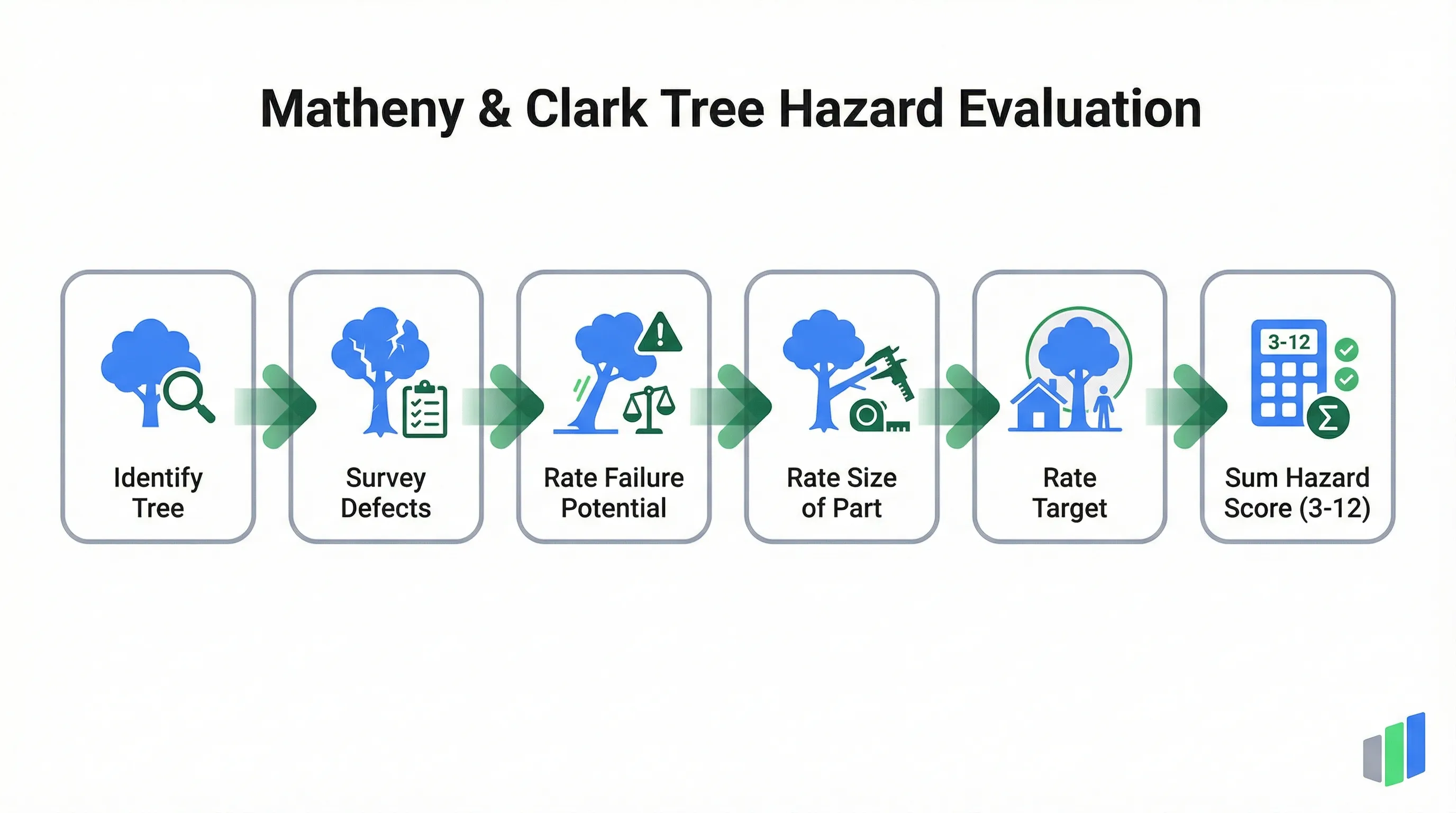
The Matheny & Clark Tree Hazard Evaluation is the foundational quantitative system for assessing tree-related hazards in North American urban forestry. Developed in 1994 by Nelda Matheny and James Clark, it provides a simple yet powerful scoring framework: three independent ratings — Failure Potential, Size of Part, and Target Rating — are each scored from 1 to 4 and summed to produce a Hazard Rating between 3 and 12. This numeric hierarchy allows municipalities, utilities, and arborists to rank trees across an entire urban canopy by risk priority, directing pruning and removal budgets to the trees most likely to cause harm.

What is Matheny & Clark?
The Matheny & Clark Tree Hazard Evaluation (1994) is a summation-based risk assessment system that produces a Hazard Rating from 3 to 12 by adding three independent scores: Failure Potential (1–4), Size of Part (1–4), and Target Rating (1–4). It was the industry standard for tree risk assessment in North American urban forestry from 1994 until the introduction of ISA TRAQ in 2011.
- Full Name
- Tree Hazard Evaluation (A Photographic Guide to the Evaluation of Hazard Trees in Urban Areas, 2nd Edition)
- Issuing Body
- ISA (International Society of Arboriculture) — Matheny & Clark
- Current Revision
- 2nd Edition, 1994
HAZARD RATING
The 12-Point Hazard Rating Formula
The core innovation of Matheny & Clark is a single numeric score that quantifies tree risk as the sum of three independently rated components.
The Matheny & Clark Hazard Rating is calculated by summing three scores: Failure Potential + Size of Part + Target Rating = Hazard Rating (3–12). This additive model was a deliberate design choice by the original authors — by treating each component as an independent 1-to-4 integer, the system produces a linear hierarchy where every additional point of risk increases priority by the same increment. A tree with a Hazard Rating of 10 is unambiguously higher priority than one rated 7, regardless of which components contributed the score. This simplicity is the method's greatest strength for municipal tree management: it allows a city forester to sort an inventory of 10,000 trees by a single numeric column and allocate pruning and removal budgets from the top down. Unlike qualitative matrix systems that produce categorical outputs (Low, Moderate, High), the 12-point scale provides granular differentiation — a tree scoring 9 can be distinguished from one scoring 8, enabling precise budget allocation when resources are limited.
The total score range of 3 to 12 divides naturally into four action thresholds that guide management decisions. Trees scoring 3–4 represent low hazard — structurally sound trees in low-use areas that require only routine monitoring on a standard maintenance cycle. Scores of 5–7 indicate moderate hazard where defects are present but failure is not imminent; these trees benefit from increased inspection frequency, scheduled pruning, or installation of support systems. The high hazard range of 8–9 signals that significant structural defects coincide with frequently or constantly occupied target zones, demanding priority mitigation within a defined timeframe. Extreme hazard scores of 10–12 require immediate abatement — typically removal, structural cabling and bracing, or target restriction — because the combination of imminent failure potential, large part size, and constant target occupancy creates an unacceptable risk. In the digital form, the inspector selects each component from a dropdown and the Total Hazard Score field calculates the sum automatically, enforcing the valid 3–12 range and eliminating the arithmetic errors that plagued paper-based field workflows.
| Score Range | Hazard Level | Recommended Action |
|---|---|---|
| 10–12 | Extreme Hazard | Immediate abatement required. Failure imminent near constant-use target. Remove tree or restrict access. |
| 8–9 | High Hazard | Priority action within defined timeframe. Significant defects near high-use targets. Prune, cable, or remove. |
| 5–7 | Moderate Hazard | Increased monitoring frequency. Defects present but failure not imminent. Schedule pruning or mitigation. |
| 3–4 | Low Hazard | Routine monitoring on standard maintenance cycle. No significant defects or low-value targets. |
COMPONENTS
Failure Potential, Size of Part, and Target Rating
Each of the three components captures one independent dimension of risk — the likelihood of structural failure, the physical magnitude of the failing part, and the occupancy of the target zone.
The Matheny & Clark method deliberately separates tree risk into three orthogonal dimensions, ensuring that each factor contributes independently to the final score. Failure Potential evaluates the tree's structural condition: an arborist examines roots, trunk, and crown for defects such as decay, cavities, cracks, codominant stems, included bark, and root plate instability, then assigns a rating from 1 (no significant defects, failure unlikely) to 4 (failure imminent or already in progress). This assessment is informed by the Visual Defect Inventory completed earlier in the inspection but is ultimately a professional judgment — two trees with identical defect checklists may receive different Failure Potential ratings based on species-specific wood properties, defect interaction patterns, and site wind exposure. In the form, the Failure Potential field presents four options that correspond directly to the rating scale, and the inspector selects the one that best characterizes the most critical failure scenario observed.
Size of Part rates the physical magnitude of the tree component most likely to fail, measured by diameter in inches. A small branch under 6 inches (rating 1) poses minimal energy even if it falls on a target, while a whole-tree failure exceeding 30 inches diameter (rating 4) represents catastrophic impact capable of destroying structures and causing fatalities. This component ensures that a large, structurally sound tree near a target is rated differently from a small, severely defective one — mass and impact energy matter independently of structural condition. Target Rating assesses how often people or high-value property occupy the potential impact zone beneath or adjacent to the tree. An identical defect on an identical tree scores differently depending on whether it overhangs a wilderness trail visited once a week (rating 1) or a school playground occupied eight hours a day (rating 4). This component connects the biological assessment to the human consequence, making the final Hazard Rating a true risk metric — combining probability, magnitude, and exposure — rather than merely a condition score.
| Rating | Level | Description |
|---|---|---|
| 1 | Low | No significant structural defects observed. Failure unlikely under normal conditions. |
| 2 | Medium | Minor defects present. Failure not expected under normal weather but possible in severe storms. |
| 3 | High | Significant structural defects. Failure probable during storm events or possible under normal conditions. |
| 4 | Severe | Critical defects present. Failure is imminent or already in progress (e.g., active uprooting). |
| Rating | Diameter | Description |
|---|---|---|
| 1 | < 6 in (15 cm) | Small branches. Impact limited to minor property damage or minor injury. |
| 2 | 6–18 in (15–45 cm) | Medium limbs. Capable of causing significant property damage or serious injury. |
| 3 | 18–30 in (45–75 cm) | Major scaffold branches or co-dominant stems. High-energy impact potential. |
| 4 | > 30 in (75 cm) | Whole tree or massive trunk section. Catastrophic damage and fatality risk. |
| Rating | Use Level | Examples |
|---|---|---|
| 1 | Occasional Use | Undeveloped woodland trails, rural roads, infrequently visited natural areas. |
| 2 | Intermittent Use | Picnic areas, day-use parking lots, secondary residential roads. |
| 3 | Frequent Use | Arterial roads, active parks, playgrounds, collector streets. |
| 4 | Constant Use | Residences, schools, hospitals, high-traffic commercial zones, utility lines. |
Try this Matheny & Clark form in Geocadra
We have a pre-built Matheny & Clark inspection template ready to go. Sign up and start your first condition assessment today.
Free 14-day trial. No credit card required.
DEFECT CHECKLIST
Systematic Visual Defect Assessment by Tree Zone
Before scoring, the inspector conducts a 360-degree ground-level visual survey, documenting structural defects across three anatomical zones — roots, trunk, and crown.
The Matheny & Clark method requires a Level 2 Basic Visual Assessment — a systematic 360-degree walk-around inspection conducted from ground level without invasive testing tools. The inspector examines the tree from the root collar upward, progressing through three anatomical zones, and documents every observable structural defect using the form's multi-select checklists. This defect inventory serves as the evidentiary basis for the Failure Potential rating: the type, severity, location, and combination of defects observed determine whether the tree receives a 1, 2, 3, or 4 for that component. The checklist approach ensures that inspectors follow a consistent observation sequence regardless of experience level, reducing the risk of overlooking a critical zone. Each defect zone in the digital form presents a predefined list of indicators drawn directly from the original 1994 ISA evaluation form, with an option for photo documentation of each finding.
Root & Collar Zone
The inspector examines the base of the tree for signs of subsurface instability. Key indicators include dead or decayed roots visible at the soil surface, fungal fruiting bodies (conks or mushrooms) at the root collar — which signal active decay organisms compromising the anchoring system — root plate lifting or soil heaving that suggests the root anchorage is failing, and girdling roots that constrict vascular flow and structurally weaken the root plate. A buried root collar, often caused by grade changes, mulch volcano accumulation, or fill soil, prevents visual assessment of this critical structural transition zone and should be noted as a limiting condition in the inspection record.
Trunk Zone
Trunk defects are among the most consequential in the Matheny & Clark system because the trunk bears the full mechanical load of the crown. The inspector checks for codominant stems — two stems of roughly equal size originating from the same point — which create a structural weak point, especially when combined with included bark (bark trapped between the stems preventing wood-to-wood union). Cavities and internal decay reduce the load-bearing cross-section of the trunk; their significance depends on the ratio of sound wood to total diameter and the cavity's position relative to the lean direction. Excessive lean, whether corrected (compensated by reaction wood growth) or uncorrected (progressively worsening), indicates a potential whole-tree failure mode that elevates Failure Potential to 3 or 4.
Crown & Branch Zone
The crown assessment identifies branch-level failure risks that determine the Size of Part and Failure Potential ratings. Dead wood and hanging branches (hangers) represent immediate strike hazards that exist regardless of weather conditions. Excessive end weight — disproportionate foliage mass concentrated at branch tips, often the result of improper lion-tailing pruning — increases lever arm forces and breakage risk during wind and ice loading events. Weak branch attachments, particularly those with included bark or narrow crotch angles below 45 degrees, are failure-prone connection points where branches are most likely to separate from the trunk. The inspector also assesses overall crown indicators such as progressive dieback, sparse or chlorotic foliage, and asymmetric loading that compound structural risk.
For a comprehensive overview of all supported inspection methods, visit the standards library.
APPLICATION
When and Why to Use Matheny & Clark
Although ISA TRAQ has become the modern qualitative standard, the 12-point Matheny & Clark system remains in active use across hundreds of U.S. municipalities and legacy management contracts.
The Matheny & Clark 12-point system was the dominant tree risk assessment method in the United States from its publication in 1994 until approximately 2011, when the International Society of Arboriculture introduced the Tree Risk Assessment Qualification (TRAQ) as a qualitative replacement. TRAQ uses a likelihood-by-consequences matrix that produces categorical risk levels (Low, Moderate, High, Extreme), aligning with broader risk management frameworks like ISO 31000 and ANSI A300 Part 9. Despite this transition, Matheny & Clark remains in active, widespread use for several compelling practical reasons that keep the 12-point system relevant in modern arboriculture.
First, many municipal tree ordinances and utility vegetation management contracts were written around the 12-point numeric score and have not been updated. A city that references "Hazard Rating 8 or above requires priority abatement within 30 days" in its municipal code cannot switch to TRAQ without a legislative or contractual revision — a process that can take years. Second, the numeric scoring system provides a linear ranking that is inherently sortable — a property that qualitative categories do not share without additional weighting rules. For large-scale urban tree inventory programs where thousands of trees must be prioritized against a fixed annual budget, the ability to sort by a single integer column and draw a budget cutoff line remains operationally superior to categorical groupings. Third, the method's simplicity makes it well-suited to training programs and community-based volunteer tree monitoring efforts where participants may not hold ISA Certified Arborist credentials. The complete inspection form captures species identification, DBH (Diameter at Breast Height in inches), age class, vigor class, site characteristics, and a structured defect checklist alongside the three-component hazard evaluation, producing a comprehensive tree record that serves both risk management and long-term canopy inventory purposes.
The form also captures recommended abatement actions — Prune, Remove, Cable/Brace, Monitor, or None — linking the hazard score directly to a management response. This closed-loop design ensures that every inspection produces an actionable output, not just a score. The abatement recommendation, combined with the numeric hazard priority, feeds directly into work order systems and capital planning models.
The standard is published through the International Society of Arboriculture (ISA).
QUESTIONS
Frequently Asked Questions
What is the Matheny & Clark Tree Hazard Evaluation?
The Matheny & Clark Tree Hazard Evaluation (1994) is a quantitative tree risk assessment system that produces a Hazard Rating from 3 to 12 by summing three independently scored components: Failure Potential, Size of Part, and Target Rating, each rated on a 1-to-4 scale.
How is the 12-point Hazard Rating calculated?
The inspector rates Failure Potential (1–4), Size of Part (1–4), and Target Rating (1–4) based on visual assessment. The three scores are summed to produce a total Hazard Rating between 3 (lowest risk) and 12 (highest risk), which determines the urgency of abatement.
What is the difference between Failure Potential and Size of Part?
Failure Potential rates how likely a tree or branch is to fail structurally based on observed defects. Size of Part rates the physical diameter of the component most likely to fail. A small branch with severe decay scores high on Failure Potential but low on Size of Part.
What is a Target Rating in tree hazard assessment?
The Target Rating evaluates how frequently people or valuable property occupy the area where a failing tree or branch could strike. It ranges from 1 (occasional use, like a woodland trail) to 4 (constant use, like a residence or school).
What is the difference between Matheny & Clark and ISA TRAQ?
Matheny & Clark uses a numeric 3-to-12 summation score for linear ranking and budget prioritization. ISA TRAQ, introduced in 2011, uses a qualitative likelihood-by-consequences matrix producing categorical risk levels. TRAQ aligns with modern ISO risk frameworks; Matheny & Clark offers simpler numeric sorting.
Is the Matheny & Clark system still used today?
Yes. Many U.S. municipalities, utility contracts, and tree inventory programs still reference the 12-point Hazard Rating in their ordinances and contract specifications. Its numeric scoring remains valuable for large-scale prioritization where linear sorting by a single integer is needed.
What qualifications are needed for a tree hazard evaluation?
While no formal certification exists specifically for Matheny & Clark, practitioners are typically ISA Certified Arborists trained in tree biomechanics and visual defect recognition. Many municipalities require ISA certification as a minimum contract qualification for tree risk assessors.
In practice
See how the round runs in Geocadra
The solution page shows this inspection regime on real open data: the import, the form, the round, the record per asset and the export.
Regular tree checks, biotope mapping and ecological surveys on a map, with every visit appended to the tree or the siteOpen the solution page: Trees, Habitats & EcologyTRY IT FREE
Digitize your Matheny & Clark inspections
Replace paper forms and spreadsheets with structured digital inspections, built for standards like Matheny & Clark.
No credit card requiredFree trial included