RI-EBW-PRÜF Bridge Inspection
The procedural guideline for recording and rating bridge defects under DIN 1076 using the S-V-D methodology.
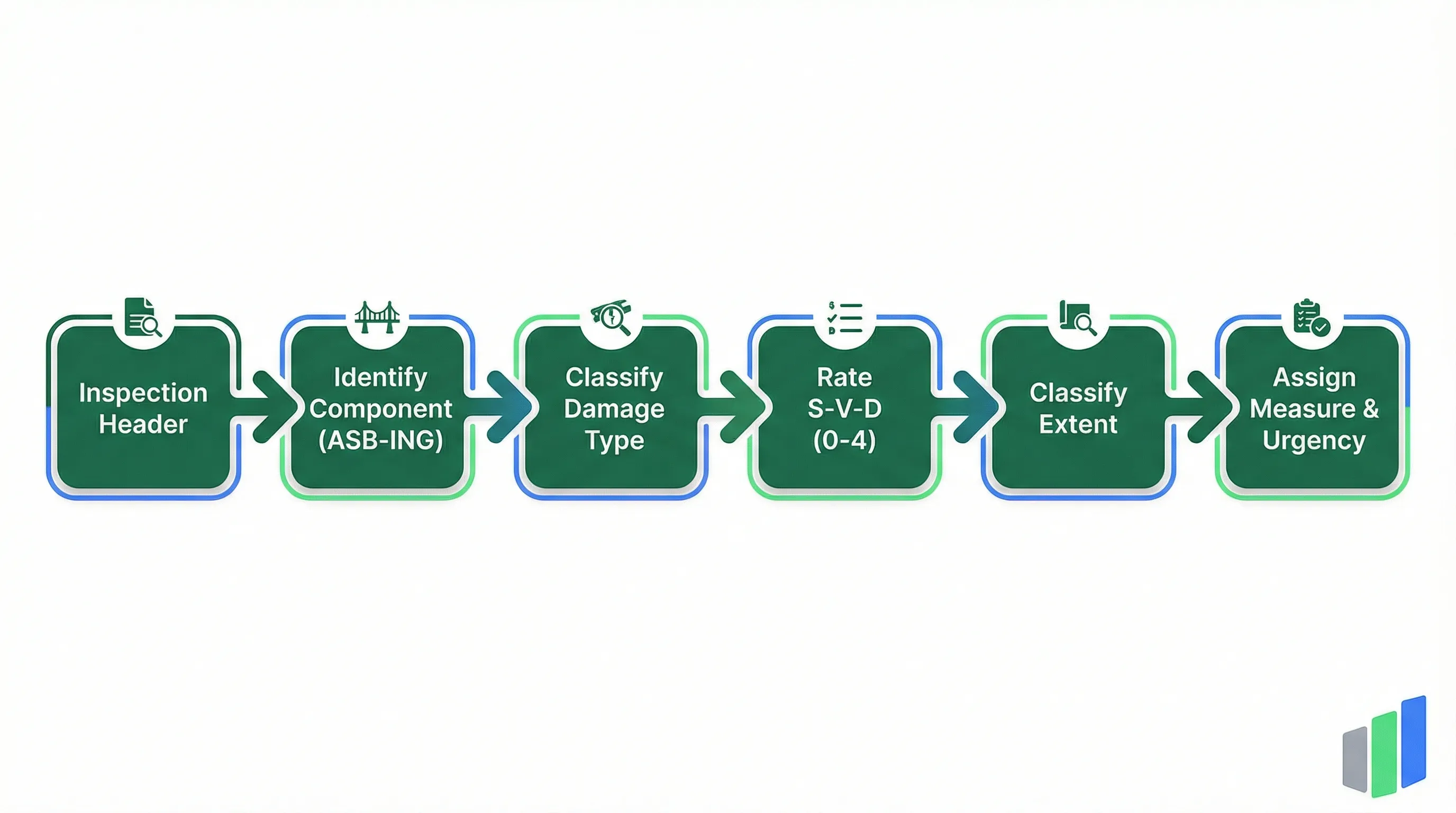
RI-EBW-PRÜF is the hands-on procedural guideline that governs how inspectors actually record and rate defects during a DIN 1076 bridge inspection. While DIN 1076 defines when and what to inspect, RI-EBW-PRÜF specifies exactly how each defect is documented in the field: which component group it belongs to, what damage type to classify it as, how to rate its impact on Stability (S), Traffic Safety (V), and Durability (D), and what recommended measure to assign. This guide covers the complete RI-EBW-PRÜF form structure, the damage catalog, the three-axis rating workflow, extent classification, and the action recommendation system that feeds into SIB-Bauwerke.
What is RI-EBW-PRUF?
RI-EBW-PRÜF is the German procedural guideline for uniformly recording and rating bridge defects under DIN 1076. Each defect is classified by ASB-ING component group and damage type, then rated on three axes — Stability (S), Traffic Safety (V), and Durability (D) — on a 0-to-4 scale, with results feeding into the SIB-Bauwerke database.
- Full Name
- Richtlinie zur einheitlichen Erfassung, Bewertung, Aufzeichnung und Auswertung von Ergebnissen der Bauwerksprüfungen nach DIN 1076
- Issuing Body
- Bundesanstalt für Straßenwesen (BASt)
- Current Revision
- RI-EBW-PRÜF 2017
FORM STRUCTURE
Anatomy of the RI-EBW-PRÜF Inspection Form
The RI-EBW-PRÜF form is divided into two distinct levels: a single inspection header that captures environmental context, and a repeatable defect record block that constitutes the core data entry unit.
The Inspection Header (Prüfungskopf) is completed once per inspection event and establishes the operational context for every defect that follows. The first and most consequential field is the Prüfungsart (Inspection Type), which determines the scope of the entire inspection. Inspectors select from five options: Hauptprüfung H1 and H2 are the comprehensive six-year main inspections requiring hand-close access to all components; Einfache Prüfung (E) is the three-year mid-cycle visual assessment; Sonderprüfung (S) is triggered by specific events like floods or vehicle impacts; and Besichtigung (B) is a quick-status visual check. The inspection type selection cascades into downstream requirements -- a Hauptprüfung mandates full S-V-D ratings for every defect found, while a Besichtigung may only require general status notes.
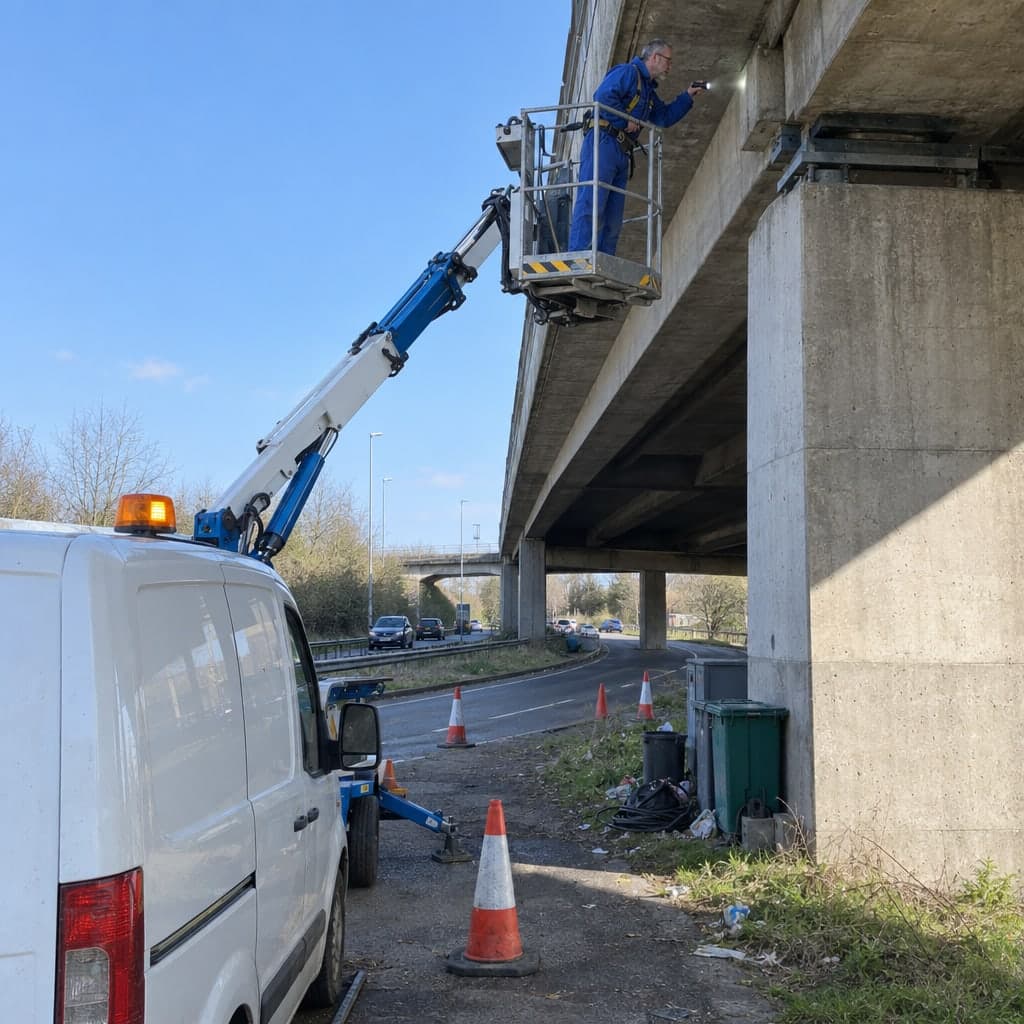
Additional header fields capture Witterung (Weather) as a five-option dropdown (Sonnig, Bewölkt, Regen, Schnee, Nebel), Temperatur in degrees Celsius, Besichtigungsgeräte (Access Equipment) as a multi-select covering aerial lifts, under-bridge inspection units, boats, scaffolding, ladders, and drones, and a Verkehrseinschränkung (Traffic Restriction) toggle indicating whether lane closures or full closures were in effect during the inspection. These fields serve as evidence that the inspection was conducted under documented conditions -- critical for auditing hand-close compliance during Main Inspections.
The Defect Record (Schadensblatt) is the repeatable core of the form. A single bridge Main Inspection routinely generates 20 to 50 or more individual defect records. Each record is self-contained: it identifies the component, describes and classifies the damage, rates it on three axes, and assigns a recommended measure. The form design groups defect fields into four logical sub-blocks -- Identification (where and what), Documentation (description, photos, quantities), Assessment (S-V-D ratings), and Measures (action recommendations and tracking flags) -- mirroring the ASB-ING data structure that the SIB-Bauwerke database expects.
Inspection standards are maintained by the Federal Highway Research Institute (BASt), which publishes the RI-EBW-PRUF guideline on behalf of the Federal Ministry.
DAMAGE CATALOG
The RI-EBW-PRÜF Damage Catalog: Defect Types and Component Groups
The damage catalog is what makes RI-EBW-PRÜF a procedural standard rather than just an assessment framework. It defines the standardized vocabulary of defect types and maps them to nine ASB-ING component groups, ensuring that inspectors across Germany describe the same physical phenomenon with the same terminology.
Every defect record begins with the Bauteilgruppe (Component Group) field, which positions the damage within the ASB-ING structural hierarchy. The nine groups for bridges are: Überbau (Superstructure) for main girders, slabs, arches, and trusses; Unterbau (Substructure) for piers, abutments, and wing walls; Gründung (Foundation) for pile caps, spread footings, and deep foundations; Lager (Bearings) for the mechanical connections between superstructure and substructure; Fahrbahnübergänge (Expansion Joints) for deck movement accommodation devices; Kappen (Caps) for reinforced concrete edge beams carrying railings and walkways; Beläge (Pavements/Coatings) for wearing surfaces and waterproofing membranes; Geländer (Railings/Barriers) for traffic safety installations; and Entwässerung (Drainage) for scuppers, pipes, and channels. The component group selection is mandatory and directly determines which catalog entries are contextually appropriate.
The Schadensart (Damage Type) field provides the standardized defect classification. RI-EBW-PRÜF defines eight core damage types that apply across material classes: Riss (Crack) is the most frequently recorded defect, with implications ranging from cosmetic surface cracking to structural fatigue cracks in prestressed concrete. Abplatzung (Spalling) indicates concrete cover has broken away, often exposing reinforcement. Kiesnest (Honeycombing) reveals poor concrete compaction during construction. Korrosion (Corrosion) affects steel components, bearings, reinforcement bars, and prestressing tendons. Ausblühung (Efflorescence) signals water migration through concrete, depositing calcium carbonate on the surface. Feuchtigkeit (Dampness) indicates waterproofing membrane failure or inadequate drainage. Hohlstelle (Void/Delamination) is detected by hammer-tapping and indicates internal concrete degradation. Bewuchs (Vegetation) in joints, drainage outlets, or masonry can mask underlying structural defects and accelerate deterioration.
The Material/Baustoff field adds a critical context layer. The same crack in reinforced concrete (Stahlbeton) carries different implications than in prestressed concrete (Spannbeton) -- where any crack may indicate tendon failure -- or in steel (Stahl), where it suggests fatigue. The five material options -- Stahlbeton, Spannbeton, Stahl, Mauerwerk (Masonry), and Holz (Timber) -- allow the inspector to qualify the damage type with the substrate material, enabling more precise S-V-D rating and more targeted repair recommendations. Together, the component group, damage type, material, and free-text Bauteil/Ort (Component/Location) field form the defect identification block that uniquely locates and classifies every finding.
| Damage Type | German | Description | Typical S-V-D Impact |
|---|---|---|---|
| Crack | Riss | Linear fracture in concrete, steel, or masonry; width and pattern determine severity | S: 0-4 depending on location; D: usually high |
| Spalling | Abplatzung | Concrete cover broken away, potentially exposing reinforcement to corrosion | S: 1-3; V: high if overhead; D: 2-4 |
| Honeycombing | Kiesnest | Porous concrete from poor compaction during construction; reduces cover depth | S: 1-2; D: 2-3 |
| Corrosion | Korrosion | Oxidation of steel components, reinforcement, or bearings; progressive damage | S: 1-4; D: 3-4 |
| Efflorescence | Ausblühung | White calcium deposits indicating water migration through concrete | S: 0; D: 1-2 |
| Dampness | Feuchtigkeit | Visible moisture indicating waterproofing failure or drainage issues | S: 0-1; D: 2-3 |
| Void | Hohlstelle | Internal delamination detected by hammer-tapping; indicates concrete degradation | S: 1-3; V: high if on deck; D: 2-4 |
| Vegetation | Bewuchs | Plant growth in joints, drainage, or masonry; masks defects and accelerates damage | S: 0-1; D: 1-3 |
Typical S-V-D ranges are indicative. Actual ratings depend on component group, material, location, and extent of the specific defect instance.
For an overview of the overarching DIN 1076 framework and inspection types, see the DIN 1076 Bridge Inspection page.
Try this RI-EBW-PRUF form in Geocadra
We have a pre-built RI-EBW-PRUF inspection template ready to go. Sign up and start your first condition assessment today.
Free 14-day trial. No credit card required.
S-V-D RATING WORKFLOW
How to Apply the Three-Axis Defect Rating in Practice
The S-V-D rating is the core assessment act in every RI-EBW-PRÜF inspection. Unlike single-grade systems, it requires the inspector to independently evaluate each defect across three distinct impact dimensions before assigning a recommended measure.
Standsicherheit (S) -- Stability -- evaluates whether the defect compromises the bridge's ability to carry its design loads. The rating scale runs from 0 (Kein Einfluss -- no influence) through 1 (Geringer Einfluss -- minor influence, safety factors fully maintained), 2 (Beeinträchtigt -- impaired but stability clearly present), 3 (Nicht mehr voll gegeben -- not fully ensured, safety factors reduced, restriction required soon) to 4 (Nicht mehr gegeben -- stability no longer given, immediate closure or support required). In practice, S-ratings of 3 or 4 are reserved for defects in primary load-bearing elements: cracks in prestressed main girders, section loss in steel truss members, or tilted bearings that redistribute loads unpredictably. A crack in a non-structural cap typically receives S:0 or S:1 regardless of its visual severity.
Verkehrssicherheit (V) -- Traffic Safety -- assesses whether the defect poses a risk to road users, pedestrians, cyclists, or maintenance workers. The scale uses slightly different descriptors: 0 (Kein Einfluss), 1 (Kaum Einfluss -- hardly any influence), 2 (Geringfügig -- slightly impaired), 3 (Beeinträchtigt -- impaired, warning signs required immediately), and 4 (Nicht mehr gegeben -- safety no longer given, immediate closure). V-ratings are driven by the defect's proximity to users: spalling from the underside above a footpath, a damaged railing, a pothole at an expansion joint, or missing drainage grates all score high on V even if the bridge structure is sound. A V:4 finding triggers the same immediate response as an S:4 -- the affected area or the entire bridge must be closed to traffic.
Dauerhaftigkeit (D) -- Durability -- captures the defect's effect on the bridge's remaining service life. Early-stage corrosion, waterproofing failures, blocked drainage, and efflorescence may pose no immediate threat to stability or safety but will progressively degrade the structure if left unaddressed. The D-rating runs from 0 through 1 (Geringer Einfluss), 2 (Beeinträchtigt), 3 (Mittelfristig beeinträchtigt -- impaired in the medium term, repair required shortly) to 4 (Nicht mehr gegeben -- durability no longer given, rapid deterioration expected). A critical validation rule in RI-EBW-PRÜF states that D must always be greater than or equal to S -- because any defect that compromises structural stability inherently damages durability, but not every durability problem threatens stability. Violating this rule in the form produces a validation error, forcing the inspector to reconsider the rating.
| Value | Stability (S) | Traffic Safety (V) | Durability (D) |
|---|---|---|---|
| 0 | No influence on structural capacity | No influence on user safety | No influence on service life |
| 1 | Minor influence -- safety factors fully maintained | Hardly any influence -- safety fully given | Minor influence -- long-term effect only |
| 2 | Impaired -- stability clearly present | Slightly impaired -- safety still given | Impaired -- damage progression likely |
| 3 | Not fully ensured -- restriction required soon | Impaired -- warning or restriction required immediately | Impaired medium-term -- repair required shortly |
| 4 | Stability no longer given -- immediate closure or support | Safety no longer given -- immediate closure | Durability no longer given -- rapid deterioration |
Validation rule: D must be >= S for every defect. A defect that impairs stability always impairs durability, but not vice versa.
The same S-V-D methodology is also applied in the DIN 1076 retaining wall inspection. Similar multi-dimensional rating approaches are found in the NEN 2767 condition assessment, which uses severity, intensity, and extent as three dimensions of defect assessment.
EXTENT & MEASURES
Extent Classification, Recommended Measures, and the EP-Vormerkung Flag
After rating each defect on the S-V-D axes, the inspector classifies the defect's spatial extent and assigns a recommended measure. These two fields close the loop between assessment and action planning.
The Schadensausbreitung (Extent) field captures the spatial distribution of the defect using three classifications: Punktuell (Spot/Local) for isolated, localized damage such as a single pothole or a confined spalling zone; Flächig (Area/Widespread) for damage that covers a significant surface area such as map cracking across a deck slab or widespread dampness through a membrane; and Linienförmig (Linear) for damage that follows a line, such as a longitudinal crack along a girder or corrosion along a drainage channel. The extent classification is not merely descriptive -- it serves as a modifier in the algorithmic Zustandsnote calculation performed by the SIB-Bauwerke system. A D:2 defect classified as Flächig (widespread) contributes more to the overall condition grade than the same D:2 defect classified as Punktuell (localized), because the spatial extent amplifies the impact on the component group and ultimately on the entire structure.
| Classification | German | Description | Effect on Zustandsnote |
|---|---|---|---|
| Spot/Local | Punktuell | Isolated, localized damage (e.g., single pothole, confined spalling zone) | Lowest extent modifier -- minimal amplification of S-V-D ratings |
| Area/Widespread | Flächig | Damage covering a significant surface area (e.g., map cracking, widespread dampness) | High extent modifier -- amplifies contribution to component group grade |
| Linear | Linienförmig | Damage following a line (e.g., longitudinal crack along girder, corrosion along channel) | Moderate extent modifier -- between spot and area in amplification effect |
The extent classification feeds into the SIB-Bauwerke algorithm as a weighting factor when calculating the overall Zustandsnote (Condition Grade 1.0-4.0).
The Maßnahmenempfehlung (Recommended Measure) field translates assessment into action. RI-EBW-PRÜF defines six standardized response levels: Keine Maßnahme (No Action) for trivial findings; Beobachtung (Monitor) for defects that warrant tracking but no intervention; Unterhaltung (Maintenance) for defects addressable through routine upkeep; Instandsetzung (Repair) for defects requiring targeted structural repair; Erneuerung (Renewal) for components requiring full replacement; and Sofortmaßnahme (Immediate Action) for any finding where an S:4 or V:4 rating indicates that stability or traffic safety is no longer given. When the inspector selects Sofortmaßnahme, a conditional field appears: the Sofortmaßnahmen eingeleitet? (Immediate Action Taken?) toggle, which records whether emergency measures such as propping, load restriction signs, or closure barriers were implemented on site during the inspection.
| Measure | German | When Applied |
|---|---|---|
| No action | Keine Maßnahme | Trivial findings with no impact on any axis (all ratings 0). |
| Monitor | Beobachtung | Defect noted but requires no intervention; re-check at next cycle. |
| Maintenance | Unterhaltung | Minor defect addressable through routine upkeep (e.g., clearing drainage, sealing small cracks). |
| Repair | Instandsetzung | Targeted structural repair required (e.g., concrete patch, bearing replacement). |
| Renewal | Erneuerung | Component or system requires full replacement (e.g., complete joint renewal). |
| Immediate action | Sofortmaßnahme | Any S:4 or V:4 finding -- closure, propping, or load restriction required on site. |
When Sofortmaßnahme is selected, the form activates the "Immediate Action Taken?" toggle to record whether emergency measures were implemented during the inspection.
The EP-Vormerkung (Simple Inspection Flag) is a tracking mechanism unique to the RI-EBW-PRÜF workflow. When toggled on for a defect, it marks that defect for specific re-examination during the next Einfache Prüfung (Simple Inspection), which occurs three years after the Main Inspection. This is particularly valuable for defects rated at moderate severity -- an S:1, D:2 crack that does not yet warrant repair but could progress to a more serious condition. Without the EP-Vormerkung, such defects risk being overlooked during the less intensive Simple Inspection because the inspector might not systematically re-examine every previously logged finding. The flag creates a targeted checklist that bridges the gap between the comprehensive Main Inspection and the focused Simple Inspection, ensuring continuity of defect monitoring across the six-year inspection cycle.
All condition grades and measures are recorded in the SIB-Bauwerke database system. For more details, see the standards directory.
DIGITAL WORKFLOW
Digitize RI-EBW-PRÜF Bridge Inspections with Geocadra
RI-EBW-PRÜF inspections produce complex, multi-defect datasets with strict structural requirements -- component group classification, three-axis ratings, extent modifiers, photo documentation, and action tracking. Geocadra replaces paper-based workflows with a structured digital form purpose-built for the RI-EBW-PRÜF methodology.
Structured defect blocks with built-in validation
Each defect record captures component group, material, damage type, location, description, S-V-D ratings, extent, photos, and recommended measures in a repeatable block. The D >= S validation rule is enforced automatically, and the form will not accept a defect record with incomplete mandatory fields -- eliminating the data quality issues that plague paper-based inspection forms.
ASB-ING component group alignment
Dropdown fields map directly to the nine ASB-ING bridge component groups -- Superstructure, Substructure, Foundation, Bearings, Expansion Joints, Caps, Pavements, Railings, and Drainage -- ensuring that exported data integrates with SIB-Bauwerke without manual recoding or translation between field terminology and database keys.
EP-Vormerkung tracking across inspection cycles
The EP-Vormerkung toggle creates a persistent flag that carries forward to the next Simple Inspection, generating a targeted re-inspection checklist. Inspectors performing the three-year mid-cycle assessment can filter for flagged defects, ensuring that progressing damage is not overlooked in the less intensive visual assessment.
Geotagged photo evidence per defect
Every defect record requires mandatory photo documentation. Images are geotagged and linked to the specific defect entry, building the evidence chain that DIN 1076 Main Inspections require. Context fields for weather, temperature, traffic restrictions, and access equipment complete the inspection audit trail.
QUESTIONS
Frequently Asked Questions
What is RI-EBW-PRÜF?
RI-EBW-PRÜF is the German procedural guideline for uniformly recording, rating, and evaluating bridge defects during DIN 1076 inspections. It defines the standardized form structure, damage catalog, three-axis S-V-D rating system (0-4), and recommended measures used by structural inspectors across all German federal and state road authorities.
What is the difference between RI-EBW-PRÜF and DIN 1076?
DIN 1076 is the overarching standard that mandates when and what to inspect -- defining inspection types (H1, H2, E, S, B) and the six-year cycle. RI-EBW-PRÜF is the implementation guideline that specifies how to record and rate each defect found during those inspections, including the S-V-D rating methodology, damage catalog, and data structures for SIB-Bauwerke.
What does the D >= S validation rule mean in RI-EBW-PRÜF?
The rule states that the Durability (D) rating must always be greater than or equal to the Stability (S) rating for any given defect. The logic is that any defect which compromises structural load-bearing capacity inherently shortens the service life of the component, but a durability issue (like efflorescence) does not necessarily threaten stability.
What is the EP-Vormerkung flag used for?
The EP-Vormerkung (Simple Inspection Flag) marks a defect for targeted re-examination during the next Einfache Prüfung (Simple Inspection), which occurs three years after the Main Inspection. It bridges the gap between comprehensive and mid-cycle inspections, ensuring that moderate-severity defects are not overlooked in the less intensive visual assessment.
How many defect records does a typical bridge inspection produce?
A Hauptprüfung (Main Inspection) of a bridge typically generates 20 to 50 or more individual defect records, each with its own component group, damage type, S-V-D rating, extent classification, photos, and recommended measure. Complex or deteriorated bridges may produce significantly more records.
What triggers a Sofortmaßnahme (Immediate Action) in RI-EBW-PRÜF?
A Sofortmaßnahme is triggered whenever a defect receives an S:4 (stability no longer given) or V:4 (traffic safety no longer given) rating. The inspector must implement emergency measures on site -- such as propping, load restriction signs, or closure barriers -- and document whether these actions were taken using the "Immediate Action Taken?" toggle in the form.
How does the defect extent classification affect the Zustandsnote?
The extent classification (Punktuell, Flächig, Linienförmig) serves as a weighting modifier in the SIB-Bauwerke algorithm. A widespread (Flächig) defect with a D:2 rating contributes more to the overall Condition Grade than the same D:2 rating for a localized (Punktuell) defect, because the spatial distribution amplifies the impact on the component group.
In practice
See how the round runs in Geocadra
The solution page shows this inspection regime on real open data: the import, the form, the round, the record per asset and the export.
Main and routine inspections of bridges, walls, roads and signs on a map, with every inspection appended to the structureOpen the solution page: Bridges, Roads & StructuresTRY IT FREE
Digitize your RI-EBW-PRUF inspections
Replace paper forms and spreadsheets with structured digital inspections, built for standards like RI-EBW-PRUF.
No credit card requiredFree trial included