RI-EBW-PRÜF Retaining Wall Inspection
The procedural guideline for defect-by-defect retaining wall inspections under RI-EBW-PRÜF with S-V-D ratings, damage catalog mapping, and measures.
RI-EBW-PRÜF (Richtlinie zur einheitlichen Erfassung, Bewertung, Aufzeichnung und Auswertung von Ergebnissen der Bauwerksprüfungen nach DIN 1076) is the operational regulation that defines exactly how inspectors record, rate, and report defects on German retaining walls. While DIN 1076 establishes what must be inspected and how often, RI-EBW-PRÜF prescribes the per-defect data structure, the three-axis S-V-D severity scale, the damage catalog references, and the measure recommendations that feed into the national SIB-Bauwerke database. This guide walks through the complete form structure, field-by-field logic, and practical workflow for retaining wall inspections.
What is RI-EBW-PRUF?
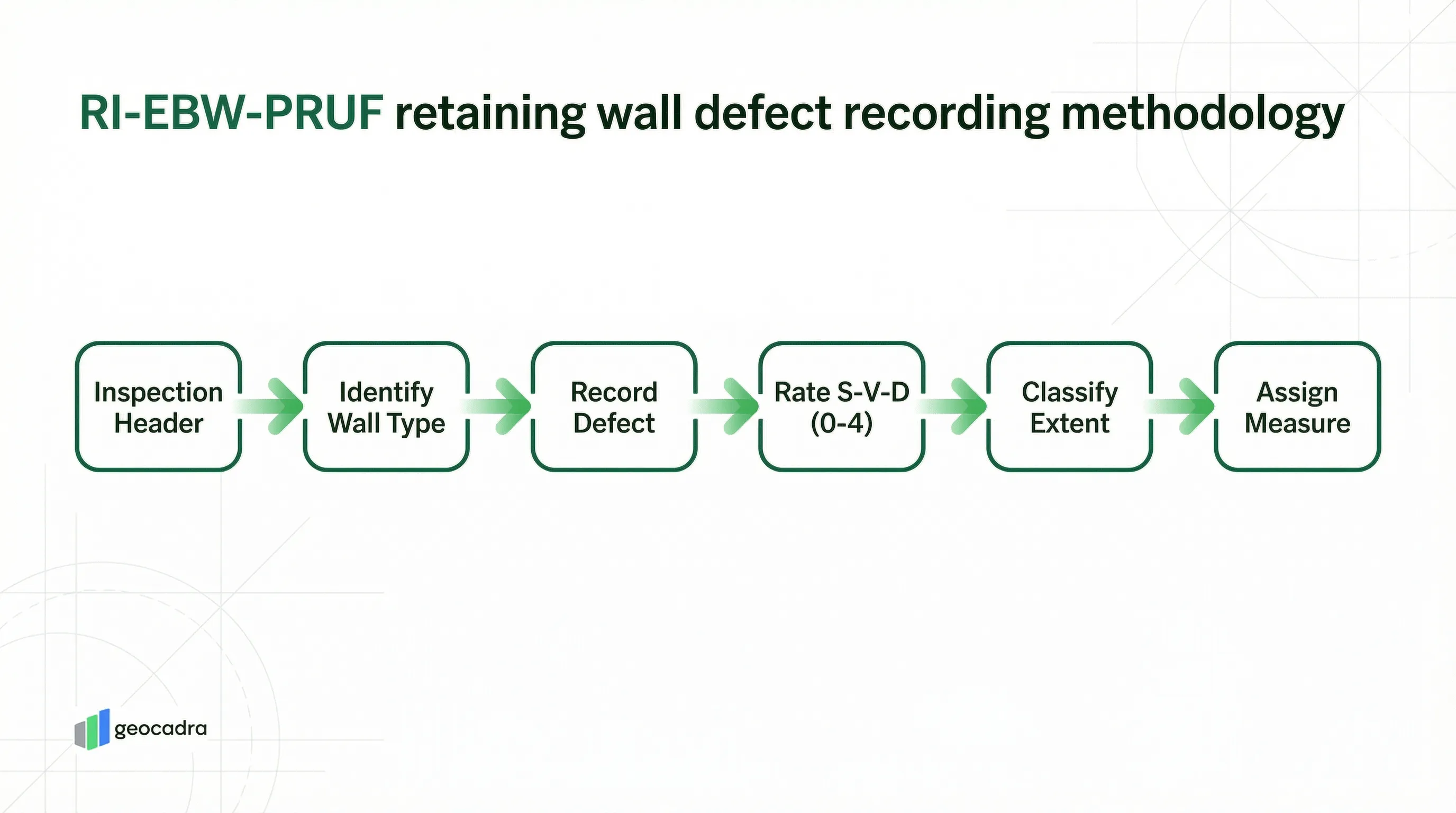
RI-EBW-PRÜF is the German procedural guideline for recording and evaluating defects on civil engineering structures under DIN 1076. For retaining walls, it mandates a per-defect inspection loop where each Einzelschaden is located, described, mapped to the Schadensbeispielkatalog, quantified by extent, and rated 0-to-4 on three axes: Stability (S), Traffic Safety (V), and Durability (D).
- Full Name
- Richtlinie zur einheitlichen Erfassung, Bewertung, Aufzeichnung und Auswertung von Ergebnissen der Bauwerksprüfungen nach DIN 1076
- Issuing Body
- Bundesanstalt für Straßenwesen (BASt)
- Current Revision
- 2017
FORM STRUCTURE
How Is the RI-EBW-PRÜF Retaining Wall Form Organized?
Three sections capture context, individual defects, and recommended actions.
The RI-EBW-PRÜF inspection form for retaining walls is divided into three hierarchical sections that mirror the inspection workflow from context gathering through defect documentation to action planning. Unlike generic checklist formats, this structure is designed around the fundamental unit of German structural inspection: the Einzelschaden (individual damage record). Every inspection begins with a single header section, passes through a repeatable defect-recording loop, and ends with an overall assessment.
Section 1, Bauwerksdaten & Konstruktion (Structure Data & Construction), captures the inspection context. The inspector selects the Bauwerksart (structure type) from eleven standardized wall categories defined in ASB-ING, records the Prüfart (inspection type) to distinguish between a six-yearly Hauptprüfung, a three-yearly Einfache Prüfung, an event-triggered Sonderprüfung, or an annual Besichtigung, and logs weather and temperature conditions that may affect visibility or defect appearance. This header is recorded exactly once per inspection.
Section 2, Schadenserfassung (Damage Recording), is the repeatable core. Each defect instance captures location, material, description, catalog reference, extent, S-V-D ratings, a recheck flag, and photographic evidence. A single retaining wall inspection typically contains anywhere from zero defects (for a structure in excellent condition) to dozens of individual damage records. Section 3, Gesamtbewertung & Maßnahmen (Overall Evaluation & Measures), collects the inspector summary text and one or more recommended measures, each with a type classification and urgency level.
This three-part architecture ensures that every piece of field data maps directly to a column in the SIB-Bauwerke national database. The repeatable defect group (minInstances: 0, maxInstances: unlimited) is the structural feature that distinguishes RI-EBW-PRÜF from simpler pass/fail checklists. Each Einzelschaden instance is an independent data record that feeds into the algorithm computing the overall Zustandsnote (condition grade) of the structure.
For the overarching standard framework, see the DIN 1076 retaining wall inspection, which establishes inspection intervals, responsibilities, and the general inspection scope.
DEFECT RECORDING
The Einzelschaden Defect Loop: Per-Damage Data Capture
Each defect is an independent record with twelve structured fields.
The Einzelschaden (individual damage) loop is the procedural core of RI-EBW-PRÜF. Unlike inspection methods that aggregate findings by component or zone, RI-EBW-PRÜF treats every discrete defect as its own data record. A crack in Block 3 and a corrosion patch at 5 meters from the wall start are two separate Einzelschaden entries, each with their own component assignment, material classification, catalog reference, extent quantification, and S-V-D rating triple. This granularity is not optional — aggregating multiple defects into a single record would violate the standard and produce incorrect Zustandsnote calculations.
The recording sequence within each defect follows a logical progression. First, the inspector assigns the Bauteilgruppe (component group) from eight categories specific to retaining walls: Bauwerk (structure general), Gründung (foundation), Unterbau (substructure), Anker (anchors), Entwässerung (drainage), Kappen/Abdeckungen (caps and copings), Geländer/Schutzeinrichtung (railings and safety barriers), and Sonstige (other). Each component group narrows the set of applicable damage catalog entries.
Next comes Baustoff (material) selection from six options: Beton (concrete), Stahlbeton (reinforced concrete), Mauerwerk (masonry), Stahl (steel), Holz (timber), and Stein/Naturstein (natural stone). The material field is mandatory because the same visual symptom — a crack, for example — has different structural implications in reinforced concrete versus masonry versus natural stone. The damage description (Schadensbeschreibung) and location text (Ortsangabe) are free-text fields that provide the human-readable context, while the Schadensbeispiel-Nr. (catalog ID) links the observation to the standardized damage catalog maintained by BASt.
Extent quantification uses a mandatory three-level classification: Vereinzelt (isolated), Bereichsweise (in areas), and Flächendeckend (extensive/widespread). Optionally, the inspector can add a precise numeric measurement with a unit (meters, square meters, cubic meters, or pieces). The EP-Kennzeichnung (recheck flag) is a boolean toggle that marks whether this specific defect should be re-examined at the next Einfache Prüfung cycle — a critical planning field that ensures deteriorating conditions are tracked across inspection intervals. Finally, photo documentation provides visual evidence for later review and SIB-Bauwerke archival.
The damage example catalog is maintained by the Federal Highway Research Institute (BASt) and is integrated into the SIB-Bauwerke database.
Try this RI-EBW-PRUF form in Geocadra
We have a pre-built RI-EBW-PRUF inspection template ready to go. Sign up and start your first condition assessment today.
Free 14-day trial. No credit card required.
S-V-D RATING
How Does the S-V-D Rating Work for Individual Wall Defects?
Three independent 0-to-4 axes rate every defect for stability, traffic safety, and durability.
The S-V-D rating is the quantitative heart of RI-EBW-PRÜF. Every Einzelschaden receives three independent ratings on a 0-to-4 integer scale: S for Standsicherheit (structural stability), V for Verkehrssicherheit (traffic safety), and D for Dauerhaftigkeit (durability). A rating of 0 means the defect has no influence on that criterion; a rating of 4 indicates that the criterion is fully compromised — the structure has lost stability, traffic safety is no longer given, or durability is exhausted. These three values are the raw inputs that the SIB-Bauwerke algorithm uses to compute the overall Zustandsnote.
The S-axis (Standsicherheit) assesses whether the defect compromises the structural load-bearing capacity of the wall. A rating of S=1 indicates a local component-level effect with no systemic risk. S=2 signals the first impairment of structural function, where tolerances or limit states are being approached. S=3 represents a significant impairment where the stability of the structure is measurably compromised and urgent intervention is needed. S=4 means stability is lost — there is an acute danger of collapse, and the structure must be closed or propped immediately.
The V-axis (Verkehrssicherheit) evaluates risks to road users, pedestrians, or adjacent property. For retaining walls, V-ratings are particularly important where the wall borders a road, footpath, or railway. A V=2 rating triggers a warning requirement; V=3 demands usage restrictions; V=4 requires immediate closure or barricading. The D-axis (Dauerhaftigkeit) captures the rate of ongoing deterioration. D=1 indicates a slow, long-term degradation; D=2 signals medium-term impairment requiring planned repair; D=3 warns of rapid short-term deterioration; D=4 means the component has reached the end of its serviceable life. A key validation rule in RI-EBW-PRÜF is that D should generally be greater than or equal to S, because a defect that compromises structural stability has, by definition, already exhausted some durability.
| Rating | S — Stability | V — Traffic Safety | D — Durability |
|---|---|---|---|
| 0 | No influence on stability | No influence on traffic safety | No influence on durability |
| 1 | Minor local influence on component | Minor influence | Long-term minor influence |
| 2 | Initial impairment of stability | Slight impairment (warning required) | Medium-term impairment |
| 3 | Significant impairment of stability | Impaired (restriction required) | Short-term impairment, rapid deterioration |
| 4 | Destruction / No stability | No safety (immediate closure) | Durability exhausted |
Each defect receives three independent ratings. Typical validation: D >= S. Ratings feed into the SIB-Bauwerke algorithm for overall Zustandsnote calculation.
The same S-V-D methodology also applies to DIN 1076 bridge inspections. A conceptually similar multi-axis approach is found in the NEN 2767 condition assessment, which uses severity, intensity, and extent as three dimensions.
WALL TYPES & COMPONENTS
Which Retaining Wall Types and Component Groups Does RI-EBW-PRÜF Cover?
Eleven wall types and eight component groups structure the inspection scope.
RI-EBW-PRÜF applies to all retaining walls (Stützwände) along federal, state, and municipal roads that meet the DIN 1076 height threshold — typically 1.50 m visible height for supporting walls and 2.00 m for other functions. The form captures the Bauwerksart (structure type) from eleven categories defined in the ASB-ING data model. These range from the most common cantilever walls (Winkelstützwand, WStW) through gravity walls (Schwergewichtswand, SGW), gabion walls (Gabione, Gab), sheet pile walls (Spundwand, SpW), solid walls (Massivwand, MW), ribbed walls (Rippenwand, RiW), natural stone walls (Natursteinwand, NStW), bored pile walls (Pfahlwand, PfW), soldier pile walls (Trägerwand, TrW), diaphragm walls (Schlitzwand, SchlW), and reinforced earth walls (Bewehrte Erde).
Each wall type has distinct failure modes. A cantilever wall (WStW) made of reinforced concrete is susceptible to flexural cracking at the stem-footing junction and carbonation-induced reinforcement corrosion. A gabion wall (Gab) might show mesh wire corrosion, basket deformation, or fill material washout. A sheet pile wall (SpW) is prone to section loss from corrosion in the splash zone and interlock failure. The structure type selection directly influences which entries in the Schadensbeispielkatalog are applicable and which S-V-D rating ranges are realistic for a given symptom.
The eight Bauteilgruppe (component group) categories divide each wall into inspectable zones. Bauwerk (structure general) covers overall geometry, alignment, and settlement. Gründung (foundation) addresses base slab conditions, scour, and undermining. Unterbau (substructure) covers the wall stem and structural body. Anker (anchors) is specifically relevant for tied-back walls and sheet piles. Entwässerung (drainage) includes weep holes, drainage channels, and filter systems — a frequent source of defects in retaining walls where blocked drainage leads to hydrostatic pressure buildup. Kappen/Abdeckungen (caps and copings) protects the wall crown. Geländer/Schutzeinrichtung (railings and safety barriers) captures the condition of fall protection and vehicle restraint systems mounted on or above the wall.
| Code | German Name | English Name |
|---|---|---|
| WStW | Winkelstützwand | Cantilever Wall |
| SGW | Schwergewichtswand | Gravity Wall |
| Gab | Gabione | Gabion Wall |
| SpW | Spundwand | Sheet Pile Wall |
| MW | Massivwand | Solid Wall |
| RiW | Rippenwand | Ribbed Wall |
| NStW | Natursteinwand | Natural Stone Wall |
| PfW | Pfahlwand | Bored Pile Wall |
| TrW | Trägerwand | Soldier Pile Wall |
| SchlW | Schlitzwand | Diaphragm Wall |
| Bew. Erde | Bewehrte Erde | Reinforced Earth |
Structure type codes follow the ASB-ING data model. Gabion walls with visible height above 1.5 m (supporting) or 2.0 m (non-supporting) are explicitly included in the inspection scope.
For further details on the ASB-ING data structure, refer to the Federal Ministry for Digital and Transport (BMDV), which publishes the ASB guidelines.
MEASURES & URGENCY
How Are Recommended Measures and Urgency Levels Assigned?
Eight measure types and four urgency levels translate findings into action.
The Gesamtbewertung & Maßnahmen (Overall Evaluation & Measures) section closes the inspection loop by translating observed defects into actionable recommendations. After completing all Einzelschaden records, the inspector writes a Prüftext (inspection summary) and assigns one or more Maßnahmenempfehlungen (recommended measures). Each measure has two mandatory attributes: a type classification and an urgency level. This dual structure ensures that maintenance planners know both what needs to be done and how quickly it must happen.
The eight measure types span the full spectrum from routine upkeep to emergency response. Unterhaltung (maintenance) covers regular preventive work like vegetation clearing, joint resealing, or drainage cleaning. Instandsetzung (repair) addresses active damage that requires material restoration — concrete patching, crack injection, or corrosion protection renewal. Erneuerung (renewal) means full replacement of a component that has reached end of life. Verstärkung (strengthening) applies when the load-bearing capacity must be increased beyond its original design, often triggered by changed traffic loads or updated standards. Warnhinweis (warning sign) is a temporary safety measure. Nutzungseinschränkung (usage restriction) imposes load limits, lane closures, or pedestrian exclusions. Sondergutachten (special expert opinion) flags situations where the inspector identifies a condition that exceeds their assessment competence and requires specialist investigation.
The four urgency levels determine the response timeline. Umgehend (immediate) triggers Sofortmaßnahmen — emergency actions such as road closures, temporary propping, or barrier installation that must begin within hours or days. Kurzfristig (short-term) requires action within weeks to months. Mittelfristig (medium-term) allows planning within the next one to three years, typically aligned with budget cycles. Langfristig (long-term) defers action to the next major maintenance window, usually three to six years. A measure of type Nutzungseinschränkung with urgency Umgehend is the most severe combination — it means the wall has failed a safety criterion and the adjacent road or path must be restricted immediately.
| German | English | Typical Trigger |
|---|---|---|
| Unterhaltung | Maintenance | Minor wear, vegetation growth, dirty drainage |
| Instandsetzung | Repair | Active cracking, spalling, corrosion damage |
| Erneuerung | Renewal | Component end-of-life, irreparable deterioration |
| Verstärkung | Strengthening | Insufficient load capacity for current use |
| Warnhinweis | Warning Sign | Falling debris risk, uneven surfaces |
| Nutzungseinschränkung | Usage Restriction | S >= 3 or V >= 3 ratings |
| Sondergutachten | Special Expert Opinion | Conditions beyond inspector competence |
| Sonstige | Other | Non-standard situations requiring documentation |
Each measure also receives an urgency level: Umgehend (immediate), Kurzfristig (short-term), Mittelfristig (medium-term), or Langfristig (long-term).
All measures and urgency levels are recorded in the standards directory -referenced SIB-Bauwerke system.
QUESTIONS
Frequently Asked Questions
What is RI-EBW-PRÜF for retaining walls?
RI-EBW-PRÜF is the German procedural guideline that operationalizes DIN 1076 for structural inspections. For retaining walls, it defines the per-defect recording method, the S-V-D rating system (0-4 scale for Stability, Traffic Safety, and Durability), the damage catalog mapping, and the recommended measure framework.
How does RI-EBW-PRÜF differ from DIN 1076 for retaining walls?
DIN 1076 establishes the scope, inspection intervals, and general requirements for monitoring civil engineering structures. RI-EBW-PRÜF provides the detailed procedural rules: how to structure each defect record, which fields to capture, how to assign S-V-D ratings, and how results feed into the SIB-Bauwerke database. DIN 1076 says what to inspect; RI-EBW-PRÜF says exactly how.
What is the Einzelschaden defect loop in RI-EBW-PRÜF?
The Einzelschaden (individual damage) loop is the repeatable data record at the core of every RI-EBW-PRÜF inspection. Each defect is captured as an independent record with component group, material, location, description, catalog ID, extent, S-V-D ratings, recheck flag, and photo documentation.
What does the EP-Kennzeichnung recheck flag mean?
The EP-Kennzeichnung (Einfache Prüfung marking) is a boolean flag on individual defect records. When set, it indicates that this specific defect must be re-examined at the next Einfache Prüfung (simple inspection, every 3 years), ensuring deteriorating conditions are tracked between major inspection cycles.
How many retaining wall types does RI-EBW-PRÜF recognize?
The form captures eleven structure types from the ASB-ING data model: cantilever walls (WStW), gravity walls (SGW), gabion walls (Gab), sheet pile walls (SpW), solid walls (MW), ribbed walls (RiW), natural stone walls (NStW), bored pile walls (PfW), soldier pile walls (TrW), diaphragm walls (SchlW), and reinforced earth walls.
What is the relationship between S-V-D ratings and the Zustandsnote?
The per-defect S-V-D ratings (0-4 integers) are the raw inputs. The SIB-Bauwerke algorithm processes all Einzelschaden records for a structure and calculates the overall Zustandsnote (condition grade) on a 1.0-to-4.0 continuous scale. The inspector records the individual ratings; the system computes the aggregate grade.
What urgency levels exist for recommended measures?
RI-EBW-PRÜF defines four urgency levels: Umgehend (immediate, requiring emergency action within hours or days), Kurzfristig (short-term, weeks to months), Mittelfristig (medium-term, one to three years), and Langfristig (long-term, aligned with the next major maintenance window of three to six years).
In practice
See how the round runs in Geocadra
The solution page shows this inspection regime on real open data: the import, the form, the round, the record per asset and the export.
Main and routine inspections of bridges, walls, roads and signs on a map, with every inspection appended to the structureOpen the solution page: Bridges, Roads & StructuresTRY IT FREE
Digitize your RI-EBW-PRUF inspections
Replace paper forms and spreadsheets with structured digital inspections, built for standards like RI-EBW-PRUF.
No credit card requiredFree trial included