
USACE Levee Safety Inspection
The federal standard for levee system integrity assessment and rehabilitation eligibility under Public Law 84-99.
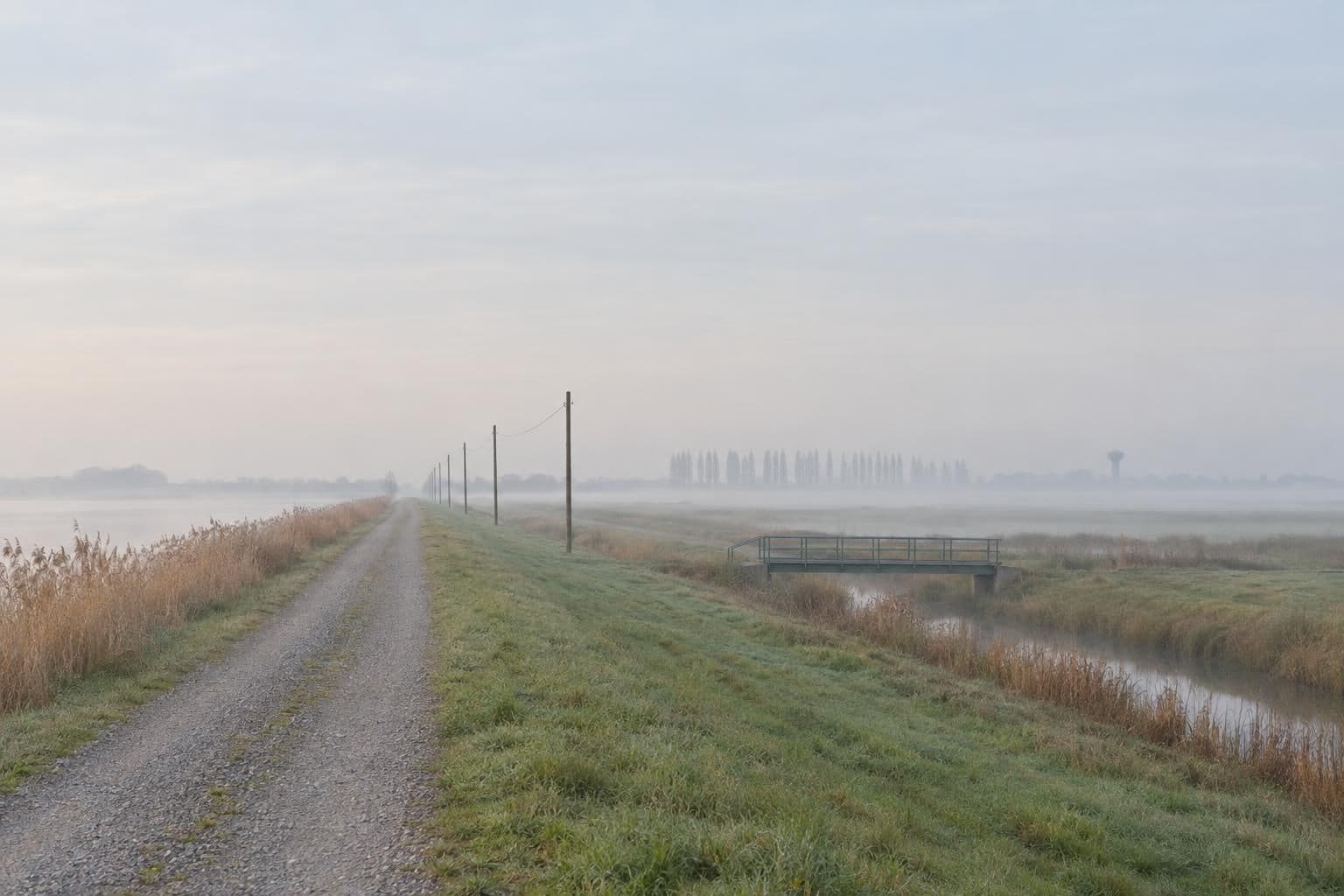
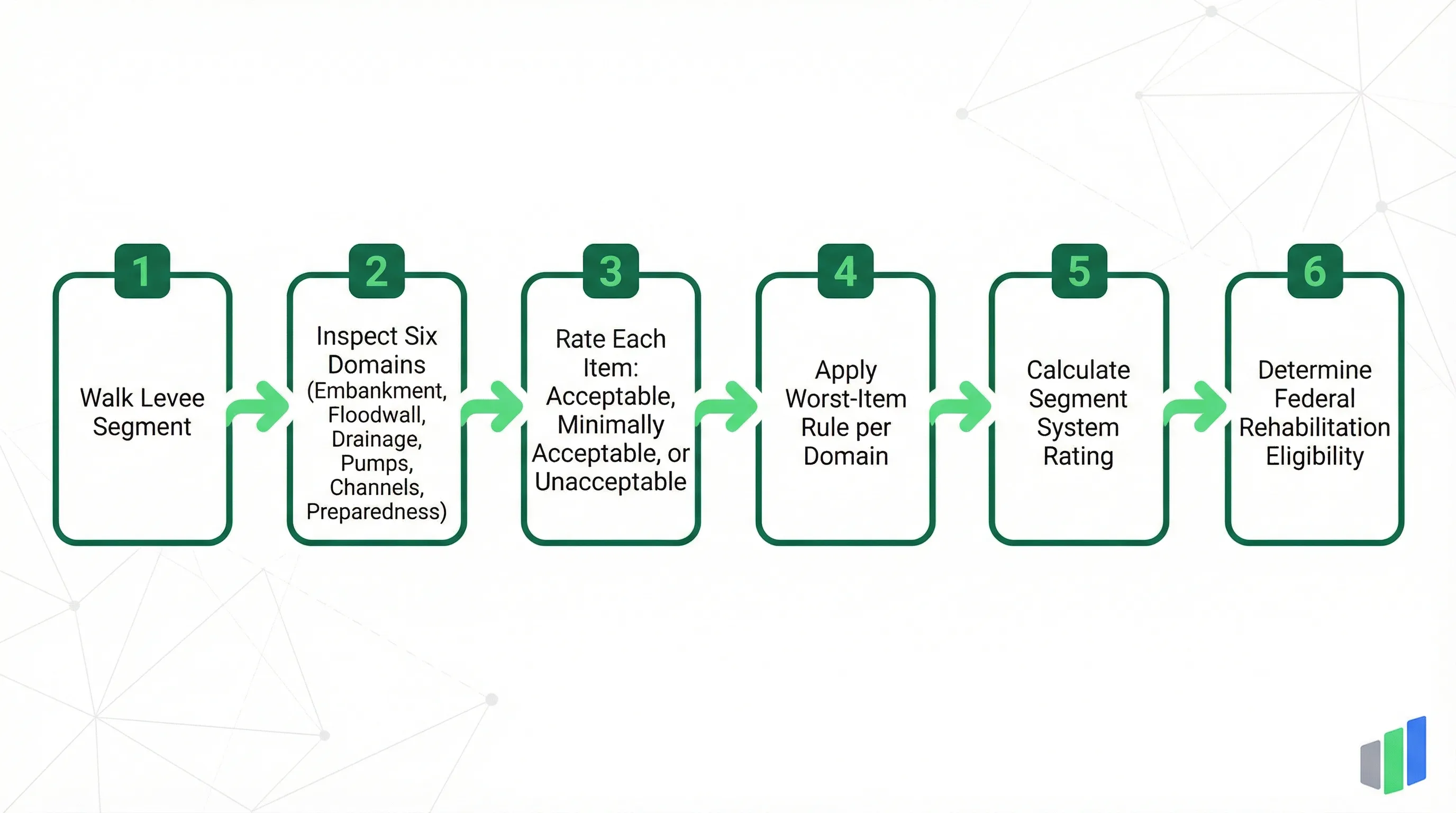
The USACE Levee Safety Program defines how the United States evaluates the flood risk posed by its levee infrastructure. Inspectors walk every segment of a levee system and rate each component — from embankment sod cover to pump station electrical systems — using a three-tier Acceptable, Minimally Acceptable, or Unacceptable scale. A single Unacceptable finding on any item can downgrade an entire system, directly affecting its eligibility for federal rehabilitation assistance. The checklist covers six inspection domains: general preparedness, levee embankments, floodwalls, interior drainage, pump stations, and flood damage reduction channels.
What is USACE Levee Safety?
The USACE Levee Safety Program inspection checklist is the U.S. Army Corps of Engineers standard for evaluating levee systems under Public Law 84-99. Each inspection item receives an Acceptable (A), Minimally Acceptable (M), or Unacceptable (U) rating that rolls up into a segment-level system rating determining federal rehabilitation eligibility.
- Full Name
- Flood Damage Reduction Segment / System Inspection Report
- Issuing Body
- U.S. Army Corps of Engineers (USACE)
- Current Revision
- Levee Safety Program / PL 84-99
RATING SCALE
The A/M/U Inspection Rating Scale
Every checklist item receives one of four ratings — Acceptable, Minimally Acceptable, Unacceptable, or Not Applicable — that directly determines the levee segment's eligibility for federal assistance.
The USACE Levee Safety Program uses a rigid four-value rating scale that applies uniformly to every inspection item across all six checklist sections. Unlike numerical scoring systems that produce a continuous range, the A/M/U system is categorical: each item either meets the standard, falls short but remains functional, fails to meet the standard, or does not apply to the segment under inspection. This simplicity is deliberate. The rating is not an engineering judgment call with room for interpolation — it is a compliance determination. An item rated Acceptable (A) means the inspector has confirmed that the component is in satisfactory condition with no deficiencies and will function as intended during the next flood event. A Minimally Acceptable (M) rating signals one or more minor deficiencies that require corrective maintenance but will not seriously impair performance during the next flood event. An Unacceptable (U) rating indicates serious deficiencies that would compromise the system during a flood. The fourth option, Not Applicable (N/A), is used when a feature does not exist in the segment — for example, a segment with no pump station marks all pump station items as N/A. The critical behavioral rule is that certain general preparedness items — specifically Emergency Supplies and Equipment and Flood Preparedness and Training — do not permit the Unacceptable option at all. For these items, the only valid ratings are Acceptable, Minimally Acceptable, or Not Applicable, reflecting that these are programmatic readiness checks rather than physical deficiency assessments.
| Rating | Code | Definition | Implication |
|---|---|---|---|
| Acceptable | A | The item is in satisfactory condition with no deficiencies and will function as intended during the next flood event. | No action required. Meets all performance criteria. |
| Minimally Acceptable | M | One or more minor deficiencies exist that need correction. The deficiency will not seriously impair functioning during the next flood event. | Maintenance required. If uncorrected for more than 2 years, may escalate the system rating to Unacceptable. |
| Unacceptable | U | Serious deficiencies exist that need correction. The deficiency will seriously impair functioning as intended during the next flood event. | Threatens system integrity. Triggers loss of federal rehabilitation eligibility. |
| Not Applicable | N/A | The item does not exist in this levee segment (e.g., no pump station is present). | Excluded from rating aggregation. |
Some general preparedness items (Emergency Supplies, Flood Preparedness) do not allow the Unacceptable rating. Their valid options are A, M, and N/A only.
INSPECTION DOMAINS
Six Domains of Levee System Inspection
A complete USACE levee inspection evaluates six distinct domains — from organizational readiness to mechanical pump equipment — each with its own set of checklist items.
The USACE inspection checklist is organized into six sections, each addressing a different component category of a levee system. Not all sections apply to every segment: Sections 3 through 6 are toggled on or off depending on which physical assets exist within the segment boundary. This modular structure means a simple earthen levee with no structures might only require Sections 1 and 2, while a complex urban flood protection system could require all six. Section 1 (General Items) is mandatory for every inspection and evaluates the levee sponsor's organizational readiness: whether current Operations and Maintenance manuals exist, whether emergency supplies and equipment are staged, and whether personnel have completed flood preparedness training. Section 2 (Levee Embankments) is the primary structural section, covering 15 inspection items from vegetation and sod cover through slope stability, erosion, settlement, cracking, animal burrow damage, seepage, and revetment condition. Section 3 (Floodwalls) applies where concrete floodwall structures are present and covers surface condition, structural settlement, monolith joints, and seepage. Section 4 (Interior Drainage System) addresses the culverts, gate wells, and discharge areas that manage water on the protected side of the levee. Section 5 (Pump Stations) is the most extensive, with 21 checklist items spanning mechanical equipment, electrical systems, fuel systems, and structural condition. Section 6 (Flood Damage Reduction Channels) covers paved or unpaved channels that form part of the flood control system.
Section 1: General Items (3 Items)
Organizational readiness checks: O&M manuals, emergency supplies and equipment, and flood preparedness training. Required for every inspection. Two of these three items cannot receive an Unacceptable rating — they are limited to A, M, and N/A.
Section 2: Levee Embankments (15 Items)
The core physical inspection covering vegetation and sod cover, encroachments, closure structures, slope stability, erosion and bank caving, settlement, depressions, rutting, cracking, animal control, culverts, riprap revetments, non-riprap revetments, underseepage relief wells, and seepage. This section evaluates the earthen structure that forms the primary flood barrier.
Section 3: Floodwalls (9 Items)
Concrete floodwall inspection covering vegetation, encroachments, closure structures (stop logs and gates), concrete surfaces, tilting/sliding/settlement, foundation condition, monolith joints, underseepage relief systems, and seepage. Toggled off when no floodwalls exist in the segment.
Section 4: Interior Drainage (15 Items)
Interior drainage system checks for vegetation and obstructions, encroachments, ponding areas, fencing, concrete surfaces, structural settlement, foundations, monolith joints, culverts, sluice/slide gates, flap gates, trash racks, other metallic items, riprap revetments, and non-riprap revetments.
Section 5: Pump Stations (21 Items)
The most comprehensive section, covering records, manuals, safety compliance, communications, plant building, fencing, pumps, motors/engines/gear reducers, sumps, mechanical trash rakes, non-mechanical trash racks, fuel systems, power source, electrical systems, megger testing, enclosures/panels/conduit, intake/discharge pipelines, sluice gates, flap gates, cranes, and other metallic items.
Section 6: Channels (11 Items)
Flood damage reduction channel inspection: vegetation and obstructions, shoaling (sediment deposition), encroachments, erosion, concrete surfaces, tilting/sliding/settlement, foundations, slab and monolith joints, flap gates, riprap revetments, and non-riprap revetments.
The inspection program is administered by the U.S. Army Corps of Engineers Levee Safety Program.
Try this USACE Levee Safety form in Geocadra
We have a pre-built USACE Levee Safety inspection template ready to go. Sign up and start your first condition assessment today.
Free 14-day trial. No credit card required.
SCORING LOGIC
How Item Ratings Roll Up to System Ratings
The USACE scoring logic is strict: a single Unacceptable item can downgrade an entire levee system, and an uncorrected Minimally Acceptable item escalates after two years.
The USACE Levee Safety Program uses a segment-based aggregation model. A levee system may consist of multiple segments, each potentially operated by a different local sponsor. The system rating is determined by the lowest-rated segment — a single failing segment brings down the entire system. Within each segment, the aggregation follows three rules. First, if every item is rated Acceptable (or N/A), the segment rating is Acceptable. Second, if one or more items are rated Minimally Acceptable and no Unacceptable items exist (or if Unacceptable items are present but an engineering determination concludes they will not prevent performance), the segment rating is Minimally Acceptable. Third, if one or more items are rated Unacceptable and would prevent the system from performing as intended, or if any Minimally Acceptable item has persisted uncorrected for more than two years, the segment rating is Unacceptable.
This two-year escalation rule is one of the most consequential features of the USACE inspection framework. It means that a Minimally Acceptable finding is not simply a lower-priority version of Acceptable — it is a ticking clock. If the levee sponsor does not correct the deficiency within two inspection cycles (typically two years for annual routine inspections), the finding automatically escalates to Unacceptable regardless of whether the physical condition has worsened. The practical effect is that an M rating on a single item — even something as seemingly minor as vegetation management — can eventually cause the entire system to lose federal rehabilitation eligibility under Public Law 84-99. This mechanism incentivizes proactive maintenance and ensures that minor deficiencies are not indefinitely deferred.
The inspection framework defines two types of assessments that feed into this system. A Routine Inspection (RI) is a visual inspection conducted annually to verify proper operation and maintenance. A Periodic Inspection (PI) is a more comprehensive evaluation conducted every five years by a multidisciplinary team that includes a professional engineer to assess operational adequacy and structural stability. Both inspection types use the same A/M/U checklist, but the Periodic Inspection involves deeper analysis and often produces more detailed findings. In the digital form, every item rated M or U requires an accompanying observation remark documenting the specific deficiency — this conditional validation ensures that no sub-standard rating exists without a justification record.
For infrastructure standards that use numerical condition scoring instead of categorical ratings, see the NEN 2767 condition assessment standard. Browse all inspection standards in the standards library.
EMBANKMENT ITEMS
Levee Embankment Inspection Checklist Items
The embankment section is the most critical domain for earthen levees, covering 15 items from vegetation cover to subsurface seepage.
Section 2 of the USACE inspection checklist addresses the earthen embankment — the physical structure that constitutes the primary flood barrier. With 15 rated items, it is the second largest section after pump stations and the most universally applicable, since every levee segment includes an embankment. The items are ordered to follow a logical walk-through from surface conditions to structural integrity to subsurface behavior. Vegetation and Sod Cover evaluates whether the embankment surface has adequate grass coverage to resist erosion during overtopping or wave action; bare soil patches, deep-rooted woody growth, or excessive weed cover all warrant an M or U rating. Encroachments addresses unauthorized structures, vehicles, equipment, or materials placed on or against the levee that could interfere with flood fighting, inspection, or structural performance. Slope Stability covers evidence of slide failures, bulging, or movement on the levee slopes. Erosion and Bank Caving evaluates evidence of surface wash, rill formation, or bank undercutting on the riverside. Settlement, Depressions, and Rutting each target distinct forms of embankment deformation — vertical subsidence, localized surface lows, and traffic-induced ruts that could concentrate flow during overtopping.
Animal Control is a uniquely important item in levee inspection: burrowing animals such as muskrats, nutria, groundhogs, and beavers can create through-going seepage pathways in the embankment that dramatically increase the risk of internal erosion and piping during high water. An active animal burrow on a levee is not a nuisance pest problem — it is a structural integrity threat. The Culverts and Discharge Pipes item evaluates pipes that penetrate the embankment, checking for joint separation, corrosion, and backfill settlement around the pipe exterior. Riprap Revetments and other bank protection systems are assessed for displacement, loss of toe material, and vegetation growth that may indicate insufficient stone coverage. The final two items — Underseepage Relief Wells and Seepage — address subsurface water behavior. Relief wells are active dewatering systems that reduce hydraulic pressure beneath the levee foundation; they must be regularly tested and maintained. Seepage observations document any evidence of water movement through or under the embankment, from damp spots and sand boils to active flow. Seepage is the single most dangerous condition for an earthen levee because it can initiate piping failure within hours during a flood event.
| # | Item | What the Inspector Evaluates |
|---|---|---|
| 1 | Unwanted Vegetation Growth | Woody growth, deep-rooted plants, trees or brush that could compromise embankment integrity or obstruct inspection access. |
| 2 | Sod Cover | Adequacy of grass coverage to resist erosion during overtopping or wave action. Bare spots, thin areas, or dead vegetation. |
| 3 | Encroachments | Unauthorized structures, vehicles, equipment, or materials on or against the levee that could interfere with flood operations. |
| 4 | Closure Structures | Operable gates and barriers at levee openings: condition, accessibility, availability of closure materials. |
| 5 | Slope Stability | Evidence of slides, bulging, sloughing, or lateral movement on levee slopes. |
| 6 | Erosion / Bank Caving | Surface wash, rill formation, gully development, or bank undercutting on the riverside. |
| 7 | Settlement | Vertical subsidence of the embankment crest or body below the design profile elevation. |
| 8 | Depressions / Rutting | Localized surface lows or traffic-induced ruts that could concentrate flow during overtopping. |
| 9 | Cracking | Longitudinal, transverse, or desiccation cracks in the embankment surface or slopes. |
| 10 | Animal Control | Burrows from muskrats, nutria, groundhogs, beavers, or other animals that create seepage pathways. |
| 11 | Culverts / Discharge Pipes | Pipes penetrating the embankment: joint separation, corrosion, backfill settlement, blockage. |
| 12 | Riprap Revetments & Bank Protection | Stone displacement, loss of toe material, vegetation growth indicating insufficient coverage. |
| 13 | Revetments Other Than Riprap | Condition of articulated concrete mats, gabions, sheet piling, or other non-stone bank protection. |
| 14 | Underseepage Relief Wells / Toe Drainage | Functionality of active dewatering systems: flow capacity, screen condition, pump operation. |
| 15 | Seepage | Evidence of water movement through or under the embankment: damp spots, sand boils, active flow. |
Each item is rated A (Acceptable), M (Minimally Acceptable), U (Unacceptable), or N/A. An observation remark is required for any item not rated Acceptable.
QUESTIONS
Frequently Asked Questions
What is the USACE Levee Safety inspection?
The USACE Levee Safety inspection is a standardized checklist used by the U.S. Army Corps of Engineers to evaluate levee systems under Public Law 84-99. Inspectors rate each component as Acceptable, Minimally Acceptable, or Unacceptable, and the lowest-rated item determines the overall segment and system rating.
What do the A, M, and U ratings mean?
Acceptable (A) means the item is in satisfactory condition with no deficiencies. Minimally Acceptable (M) indicates minor deficiencies that need correction but will not impair flood performance. Unacceptable (U) means serious deficiencies exist that would compromise the system during a flood event.
How often are USACE levee inspections performed?
Routine Inspections (RI) are conducted annually as visual walk-throughs. Periodic Inspections (PI) are performed every five years by a multidisciplinary team including a professional engineer. Both use the same A/M/U checklist, but Periodic Inspections involve deeper engineering analysis.
What happens if a levee segment receives an Unacceptable rating?
An Unacceptable segment rating means the levee system may lose eligibility for federal rehabilitation assistance under Public Law 84-99. The sponsor must correct the deficiency to restore eligibility. A single U-rated item can downgrade the entire system because the system rating equals the lowest segment rating.
Can a Minimally Acceptable rating escalate to Unacceptable?
Yes. If an item rated Minimally Acceptable is not corrected within two years, the USACE standard automatically escalates the segment rating to Unacceptable regardless of whether the physical condition has worsened. This two-year rule incentivizes timely maintenance.
What is the difference between a Routine Inspection and a Periodic Inspection?
A Routine Inspection is an annual visual assessment verifying proper operation and maintenance. A Periodic Inspection occurs every five years with a multidisciplinary team including a licensed professional engineer, evaluating both operational adequacy and structural stability at greater depth.
How many items does the USACE levee inspection checklist include?
The complete checklist has up to 74 rated items across six sections: General Items (3), Levee Embankments (15), Floodwalls (9), Interior Drainage (15), Pump Stations (21), and Channels (11). Not all sections apply to every segment — only sections with physically present features are evaluated.
In practice
See how the round runs in Geocadra
The solution page shows this inspection regime on real open data: the import, the form, the round, the record per asset and the export.
Main and routine inspections of bridges, walls, roads and signs on a map, with every inspection appended to the structureOpen the solution page: Bridges, Roads & StructuresTRY IT FREE
Digitize your USACE Levee Safety inspections
Replace paper forms and spreadsheets with structured digital inspections, built for standards like USACE Levee Safety.
No credit card requiredFree trial included