VDI 6200 Building Inspection
The German guideline for regular structural safety inspections of buildings using Damage Consequence Classes, Robustness Classes, and S-V-D defect rating.
VDI 6200 (Standsicherheit von Bauwerken) is the authoritative German guideline for the regular structural inspection of buildings. Unlike DIN 1076, which governs civil engineering structures such as bridges, VDI 6200 addresses Hochbau -- vertical structures including residential, commercial, industrial, and public buildings. This guide covers the classification system using Damage Consequence Classes (CC) and Robustness Classes (RC), the tiered inspection levels from walk-throughs to detailed expert examinations, the three-axis S-V-D defect rating system, the overall Condition Grade (Zustandsnote) from 1.0 to 4.0, and the Building Logbook (Bauwerksbuch) documentation requirements.
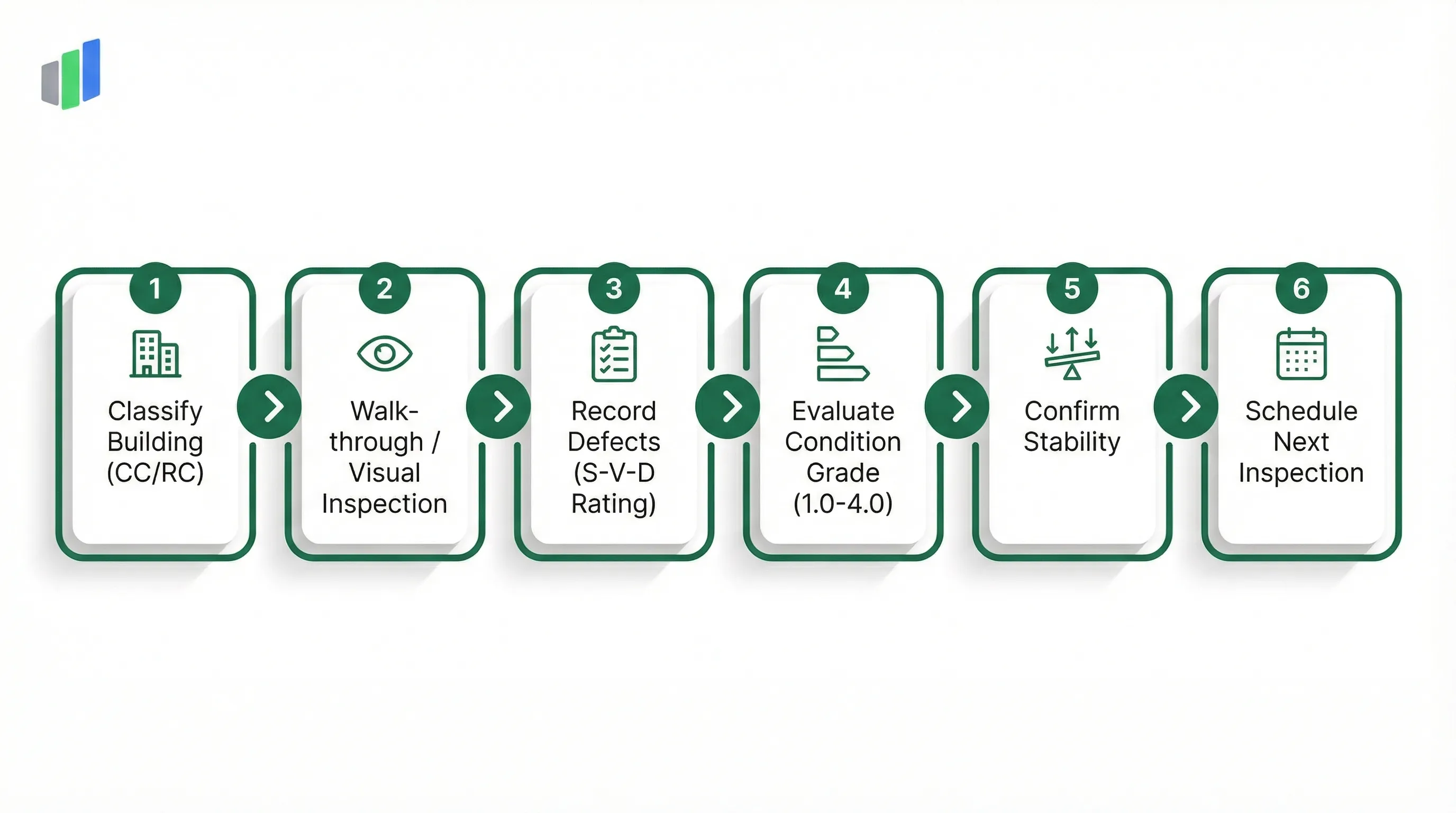
What is VDI 6200?
VDI 6200 (Standsicherheit von Bauwerken) is the German guideline for regular structural safety inspections of buildings. It classifies structures by Damage Consequence Class (CC 1-3) and Robustness Class (RC 1-4) to determine inspection intervals, and requires defects to be rated on three axes -- Stability (S), Traffic Safety (V), and Durability (D) -- producing a Condition Grade (Zustandsnote) from 1.0 to 4.0.
- Full Name
- Standsicherheit von Bauwerken -- Regelmäßige Überprüfung
- Issuing Body
- Verein Deutscher Ingenieure (VDI)
- Current Revision
- VDI 6200:2010-02
BUILDING CLASSIFICATION
Damage Consequence Classes (CC) and Robustness Classes (RC) Under VDI 6200
VDI 6200 introduces a two-dimensional classification system that determines how rigorously and how frequently a building must be inspected. The combination of Consequence Class and Robustness Class drives the entire inspection regime.
The Damage Consequence Class (Schadensfolgeklasse, CC) categorizes buildings by the potential severity of a structural failure. CC 1 covers low-consequence structures such as agricultural buildings, storage sheds, and single-storey buildings with spans under six metres where a collapse would endanger few or no occupants. CC 2 encompasses medium-consequence structures -- the majority of buildings encountered in practice, including office buildings, industrial halls, residential blocks, and multi-storey structures with spans exceeding twelve metres. CC 3 applies to high-consequence buildings where failure could result in mass casualties or major societal impact: assembly halls, stadiums, concert venues, hospitals, schools, and high-rise residential towers. The CC directly determines the maximum allowable inspection interval and the minimum qualification level of the inspector.
The Robustness Class (Robustheitsklasse, RC) evaluates a structure's inherent ability to redistribute loads following local damage or loss of a single element. RC 1 describes structures with low robustness -- statically determinate systems with no redundancy and the potential for brittle failure, such as single-span precast concrete frames or timber portal frames. RC 2 covers structures with medium robustness that have some system reserves through statical indeterminacy, allowing partial load redistribution if one element fails. RC 3 denotes highly robust structures with significant redundancy and plastic reserves -- cast-in-place reinforced concrete frames with continuous beams and moment connections fall into this category. RC 4 is reserved for structures explicitly designed for accidental actions, impact scenarios, and progressive collapse prevention. The lower the robustness, the shorter the inspection interval must be, because a single undetected defect could trigger disproportionate failure.
In the digital form, the inspector selects both the Damage Consequence Class and the Robustness Class at the start of the inspection. These two parameters together define the inspection scope: a CC 3 / RC 1 building -- for example, a large assembly hall with a statically determinate long-span roof -- demands the most rigorous and most frequent detailed inspections, while a CC 1 / RC 4 structure requires only periodic walk-throughs. The Building Type field (Bauwerksart) helps classify the structure: residential, office, industrial, assembly, school, or other. For further guidance on the classification methodology, refer to the technical publications of the Verein Deutscher Ingenieure (VDI).
| Class | German | Consequence Level | Examples |
|---|---|---|---|
| CC 1 | Niedrige Folgen | Low consequences | Agricultural buildings, storage sheds, single-storey structures with spans < 6 m |
| CC 2 | Mittlere Folgen | Medium consequences | Office buildings, industrial halls, residential blocks, spans > 12 m |
| CC 3 | Hohe Folgen | High consequences | Assembly halls, stadiums, hospitals, schools, high-rise residential |
The Damage Consequence Class determines the maximum inspection interval and the minimum inspector qualification. Higher CC values require more frequent and more detailed inspections.
| Class | German | Robustness Level | Structural Characteristics |
|---|---|---|---|
| RC 1 | Niedrig | Low -- No redundancy | Statically determinate, brittle failure mode, single load path |
| RC 2 | Mittel | Medium -- System reserves | Statically indeterminate, partial load redistribution possible |
| RC 3 | Hoch | High -- Redundancy | Continuous beams, moment connections, plastic reserves |
| RC 4 | Sehr hoch | Very high | Designed for accidental actions and progressive collapse prevention |
Lower robustness classes require shorter inspection intervals because a single undetected defect could trigger disproportionate structural failure.
For further guidance on the classification methodology, refer to the Association of German Engineers (VDI), which publishes and maintains the guideline.
INSPECTION LEVELS
Four Tiers of Building Inspection Under VDI 6200
VDI 6200 defines a hierarchy of inspection levels that differ in scope, expertise requirements, and depth of assessment. The level selected depends on the building classification and the specific inspection trigger.
The Begehung (Walk-through) is the most basic inspection level, typically performed by the building owner or custodian at regular intervals. It does not require engineering expertise and focuses on visible changes: new cracks in walls, water stains on ceilings, tilting of structural elements, unusual sounds, or doors and windows that no longer close properly. The walk-through serves as an early warning system -- if anything unusual is noted, it triggers a higher-level inspection. VDI 6200 recommends annual walk-throughs for all building classes, though the responsible owner may choose more frequent checks for high-consequence structures.
The Inspektion (Visual Inspection) is performed by a qualified expert -- a structural engineer or a professional with equivalent qualifications. The inspector visually examines all accessible structural elements, identifies defects, and assesses whether the building's structural safety is maintained. This level does not typically require destructive testing or special access equipment, but the inspector must be able to reach and evaluate all primary load-bearing elements: foundations (where visible), walls, columns, beams, floor slabs, roof structures, and connections. Every defect found is documented with photographs and rated using the S-V-D system. For standard CC 2 / RC 2-3 buildings, visual inspections are typically required every five to ten years.
The Eingehende Überprüfung (Detailed Inspection) is the most thorough level, reserved for high-consequence structures, buildings with known problems, or situations where the visual inspection reveals concerns that require deeper investigation. It is performed by a Sachverständiger (special expert) and may include material testing, core sampling, cover meter surveys, crack monitoring instrumentation, and structural recalculation. In the digital form, the inspector selects the Prüfungsart (Inspection Level) as the first classification field, which sets the expected scope and mandatory documentation depth for the entire assessment. The fourth level -- Ad-hoc or Event-based inspection -- is triggered by extraordinary circumstances such as storms, earthquakes, floods, fires, explosions, or the discovery of severe structural deficiencies during renovation work. It requires immediate assessment regardless of the scheduled inspection cycle.
Similar tiered inspection systems are found in the DIN 1076 bridge inspection, which defines five inspection types from visual checks to special inspections.
Try this VDI 6200 form in Geocadra
We have a pre-built VDI 6200 inspection template ready to go. Sign up and start your first condition assessment today.
Free 14-day trial. No credit card required.
S-V-D DEFECT RATING
Three-Axis Defect Assessment: Stability, Safety, and Durability
Each defect found during a VDI 6200 inspection is rated on three independent protection goals. This three-axis approach produces a nuanced risk profile for every finding rather than a single severity score.
Standsicherheit (S) -- Stability -- evaluates how the defect affects the building's structural load-bearing capacity. A crack in a main load-bearing wall receives a far higher S-rating than the same crack type in a non-structural partition, because it directly threatens the primary load path. Corrosion of steel connections in an industrial hall's roof truss or spalling that exposes reinforcement in a ceiling slab both score high on the S-axis because they reduce the effective cross-section of critical structural members. An S-rating of 4 means stability is critically impaired or lost -- the building or affected section cannot safely carry its design loads and immediate propping, evacuation, or partial closure is required. An S-rating of 0 means the defect has absolutely no impact on the structure's load-bearing capacity.
Verkehrssicherheit (V) -- User Safety -- evaluates whether the defect poses a risk to occupants, visitors, or passers-by. For buildings, this axis covers falling facade elements, loose cladding panels, unstable balcony railings, crumbling balcony soffits, and overhead hazards from spalling concrete in parking garages or stairwells. A loose balcony overhang that could fall onto a pedestrian path scores high on V even if the building's overall stability is unaffected. Dauerhaftigkeit (D) -- Durability -- captures the defect's impact on the building's long-term service life. Efflorescence on basement walls, moisture penetration through the roof structure, early-stage timber rot, and surface corrosion of exposed steel members may not threaten stability today but accelerate deterioration and shorten the remaining useful life. In practice, D is almost always greater than or equal to S: any defect that impairs stability necessarily impairs durability, but many durability issues have no immediate stability consequence.
In the form, each defect entry requires the inspector to select the Component Group (Bauteilgruppe) -- Foundation/Cellar, Walls/Columns, Floors/Ceilings, Roof Structure, Facade/Cladding, or Balconies/Overhangs -- followed by the Material (concrete, masonry, steel, timber, or other) and the Defect Type (crack, spalling, corrosion, deformation, moisture, rot/insect damage, or loose connection). The inspector then assigns independent S, V, and D ratings on a 0-to-4 scale, selects a Recommended Action (no action, monitor, routine maintenance, repair, further investigation, or immediate propping/closure), and sets the Priority (immediate, short-term, medium-term, or long-term). Mandatory photo evidence documents every finding. This structured approach ensures consistent evaluation across different inspectors and buildings.
| Value | Stability (S) | User Safety (V) | Durability (D) |
|---|---|---|---|
| 0 | No impact on structural capacity | No impact on user safety | No impact on service life |
| 1 | Minor impact -- component level only, routine maintenance | Hardly any impact -- safety fully given | Minor impact -- long-term effect only |
| 2 | Moderate impact -- component failure possible, tolerances reached | Slightly impaired -- safety still given | Moderate impact -- damage progression likely |
| 3 | High impact -- structure affected, tolerances exceeded, short-term repair needed | Impaired -- restrictions or barriers required immediately | High impact -- accelerated deterioration expected |
| 4 | Critical -- stability no longer given, immediate propping or closure | Safety no longer given -- immediate evacuation or closure | Durability no longer given -- component failure imminent |
Each defect receives independent ratings for all three axes. The overall Condition Grade is derived from the maximum S, V, and D values across all defects.
The same S-V-D methodology is applied in the DIN 1076 retaining wall inspection. An alternative multi-dimensional rating approach is found in the NEN 2767 condition assessment, which uses severity, intensity, and extent as three dimensions of defect assessment.
CONDITION GRADE
The Zustandsnote: Overall Building Condition Grade 1.0--4.0
The Zustandsnote synthesizes all individual defect S-V-D ratings into a single number between 1.0 (Very Good) and 4.0 (Unsatisfactory), providing a clear and comparable metric for the structural condition of the entire building.
VDI 6200 historically did not define its own grading mathematics. In practice, the building inspection community adopted the numeric rating scale from RI-EBW-PRÜF -- the same system used for bridges and civil engineering structures under DIN 1076. The Zustandsnote is not a simple arithmetic average of individual defect ratings. Instead, the evaluating engineer considers the maximum S, V, and D values found across all defects, the extent and distribution of damage patterns, and the interaction between multiple defects that may individually appear minor but collectively indicate systemic problems. A single S:4 finding on a primary load-bearing column -- even if spatially limited -- can push the entire building's grade to 3.5--4.0 because stability is critically impaired. Conversely, widespread D:2 findings across a roof membrane (many areas with moderate durability concern) may aggregate to a higher grade than an isolated D:2 finding, because the extent signals systemic waterproofing failure rather than a localized defect.
The Stability Confirmed field is the most critical binary assessment in the entire inspection. After evaluating all defects and assigning the Zustandsnote, the inspector must explicitly confirm whether structural safety (Standsicherheit) is maintained for the building as a whole. A building can receive a relatively poor grade of 2.5 for durability issues while still having confirmed stability. Conversely, a single critical finding on a primary structural member can result in stability not being confirmed even if most of the building is in good condition. When stability is not confirmed, the consequences are immediate and severe: the building or affected areas must be evacuated, propped, or closed until an engineering assessment and remedial measures restore structural safety. The inspector also sets the Next Inspection Due date, which is driven by the CC/RC classification and the severity of findings.
| Grade | German | English | Meaning |
|---|---|---|---|
| 1.0--1.4 | Sehr guter Zustand | Very Good | No defects or only trivial findings. Structural safety and durability fully intact. No action required. |
| 1.5--1.9 | Guter Zustand | Good | Minor defects. Durability slightly affected long-term. Safety intact. Routine maintenance sufficient. |
| 2.0--2.4 | Befriedigender Zustand | Satisfactory | Safety intact. Durability or single components impaired. Medium-term repair needed. |
| 2.5--2.9 | Ausreichender Zustand | Sufficient | Safety still intact but significant wear. Durability impaired. Repair required. |
| 3.0--3.4 | Nicht ausreichender Zustand | Inadequate | Stability and/or safety heavily impaired. Durability no longer given. Immediate repairs required. |
| 3.5--4.0 | Ungenügender Zustand | Unsatisfactory | Stability and/or safety may not be given. Immediate measures or closure necessary. |
The responsible engineer assigns the final grade based on engineering judgment. Grades of 3.0 and above trigger mandatory repair planning. Grades of 3.5--4.0 may require immediate closure or evacuation.
Recommended Actions
Based on the Condition Grade and defect pattern, the inspecting engineer selects a standardized recommended action.
| Action | German | When Applied |
|---|---|---|
| No action | Keine Maßnahme | Grade 1.0--1.4 -- building in very good condition. |
| Monitor | Beobachten | Grade 1.5--1.9 -- defect noted, re-check at next inspection cycle. |
| Routine maintenance | Instandhaltung | Grade 1.5--2.4 -- minor upkeep within regular maintenance cycles. |
| Repair | Instandsetzung | Grade 2.5--3.4 -- defects require targeted structural repair. |
| Further investigation | Vertiefte Untersuchung | When visual findings are inconclusive and deeper testing is needed. |
| Immediate propping/closure | Sofortmaßnahme/Sperrung | Any S:4 or V:4 finding -- immediate evacuation, propping, or closure. |
The recommended action is selected by the inspecting engineer based on the Condition Grade and the specific defect pattern. Priority classification (Immediate, Short-term, Medium-term, Long-term) determines the urgency of implementation.
All condition grades and measures are documented in the standards directory -compliant Building Logbook.
BUILDING LOGBOOK
The Bauwerksbuch: Mandatory Documentation Under VDI 6200
VDI 6200 requires the creation and maintenance of a Bauwerksbuch (Building Logbook) for every inspected structure. This logbook is the central documentation record that tracks the building's structural history across its entire service life.
The Bauwerksbuch is more than an inspection report -- it is a living document that accompanies the building from its initial construction through every modification, repair, and inspection cycle until eventual demolition. It contains the original structural calculations and design documentation, records of all construction modifications and retrofits, the complete inspection history with defect records and photographs, all condition grades assigned over time, and the recommended measures with their implementation status. VDI 6200 Blatt 1.1 (Draft 2024) introduces standardized templates for Bauwerksbuch documentation, aiming to harmonize the format across Germany. Prior to this, documentation formats varied significantly between federal states and individual engineering offices.
The General Checklist (Annex D) of VDI 6200 defines the high-level gatekeeper questions that must be answered before specific defect recording begins. These questions identify systemic risk factors that affect the entire building: Has the building's use changed since the last inspection? A conversion from office to archive significantly increases floor loads. Have structural modifications been made -- removed walls, new openings, added floors? Have additional loads been introduced -- heavy machinery, solar panels, green roofs, dense shelving? Have environmental conditions changed -- neighboring excavation, increased vibration from new road or rail, rising water table? Is the previous inspection report available for comparison? These binary checks serve as a filter: any "Yes" answer demands detailed investigation of the affected areas before the general defect survey proceeds.
In the digital form, the Bauwerksbuch requirements translate directly into structured data. The General Checklist section captures the Annex D gatekeeper questions as boolean fields (Change in Use, Structural Modifications, Added Loads, Environment Changes, Last Report Available). Each answer is timestamped and preserved across inspection cycles, building a longitudinal record. The defect registry creates traceable entries that can be compared between inspections -- the same crack documented in 2020 can be tracked through 2025 and 2030, with photographs showing progression or stability. The Summary/Conclusion field captures the inspector's expert narrative that contextualizes the numerical grade, and the mandatory digital signature establishes legal accountability. This transforms the Bauwerksbuch from a paper folder into a searchable, auditable digital asset.
For additional information on building inspection, refer also to TÜV SÜD, a leading inspection service provider offering VDI 6200-compliant building assessments.
QUESTIONS
Frequently Asked Questions
What is VDI 6200?
VDI 6200 (Standsicherheit von Bauwerken) is the German guideline for regular structural safety inspections of buildings. It classifies structures by Damage Consequence Class (CC 1--3) and Robustness Class (RC 1--4), defines four inspection levels from walk-throughs to detailed expert examinations, and requires defect rating on three axes: Stability (S), User Safety (V), and Durability (D).
What is the difference between VDI 6200 and DIN 1076?
VDI 6200 covers Hochbau (buildings/vertical structures) such as residential, commercial, and industrial buildings. DIN 1076 covers Ingenieurbauwerke (civil engineering structures) such as bridges, retaining walls, and tunnels along roads. Both use the S-V-D defect rating methodology and the 1.0--4.0 Zustandsnote scale, but they apply to fundamentally different structure types.
How are Damage Consequence Classes (CC) determined under VDI 6200?
The Damage Consequence Class is based on the potential severity of structural failure. CC 1 applies to low-consequence structures (agricultural, storage). CC 2 covers most standard buildings (offices, industrial halls, residential). CC 3 applies to high-consequence structures where failure could cause mass casualties (assembly halls, stadiums, hospitals, schools).
How often must VDI 6200 inspections be performed?
Inspection intervals depend on the combination of Consequence Class (CC) and Robustness Class (RC). Walk-throughs are recommended annually for all buildings. Visual inspections are typically required every five to ten years for standard CC 2 buildings. CC 3 structures with low robustness (RC 1) require the most frequent detailed inspections.
What is the Bauwerksbuch required by VDI 6200?
The Bauwerksbuch (Building Logbook) is a mandatory documentation record that tracks a building's structural history across its service life. It contains design documentation, modification records, the complete inspection history with defect records and photographs, all assigned condition grades, and recommended measures with their implementation status.
Who is qualified to perform VDI 6200 inspections?
Walk-throughs (Begehungen) can be performed by building owners or custodians. Visual inspections (Inspektionen) require a qualified structural engineer. Detailed inspections (Eingehende Überprüfungen) must be performed by a Sachverständiger (special expert) with proven expertise in structural assessment, materials testing, and the relevant construction types.
What happens when a VDI 6200 inspection finds stability is not confirmed?
When the inspector cannot confirm structural safety (Standsicherheit), the consequences are immediate: the building or affected areas must be evacuated, structurally propped, or fully closed until an engineering assessment and remedial measures restore safety. A stability rating of S:4 on any primary structural member triggers this outcome.
In practice
See how the round runs in Geocadra
The solution page shows this inspection regime on real open data: the import, the form, the round, the record per asset and the export.
Condition assessments, roof checks and statutory tests for public building portfolios, with every visit appended to the buildingOpen the solution page: Buildings & FacilitiesTRY IT FREE
Digitize your VDI 6200 inspections
Replace paper forms and spreadsheets with structured digital inspections, built for standards like VDI 6200.
No credit card requiredFree trial included