VTA Mattheck Tree Assessment
Biomechanical tree inspection based on the Axiom of Uniform Stress and the body language of trees.
Visual Tree Assessment (VTA) is the internationally recognized method for determining tree stability and breakage safety without initially wounding the tree. Developed by Prof. Dr. Claus Mattheck at the Karlsruhe Institute of Technology, VTA combines biological observation with engineering mechanics — reading the external growth responses that reveal internal structural defects.

What is VTA (Mattheck)?
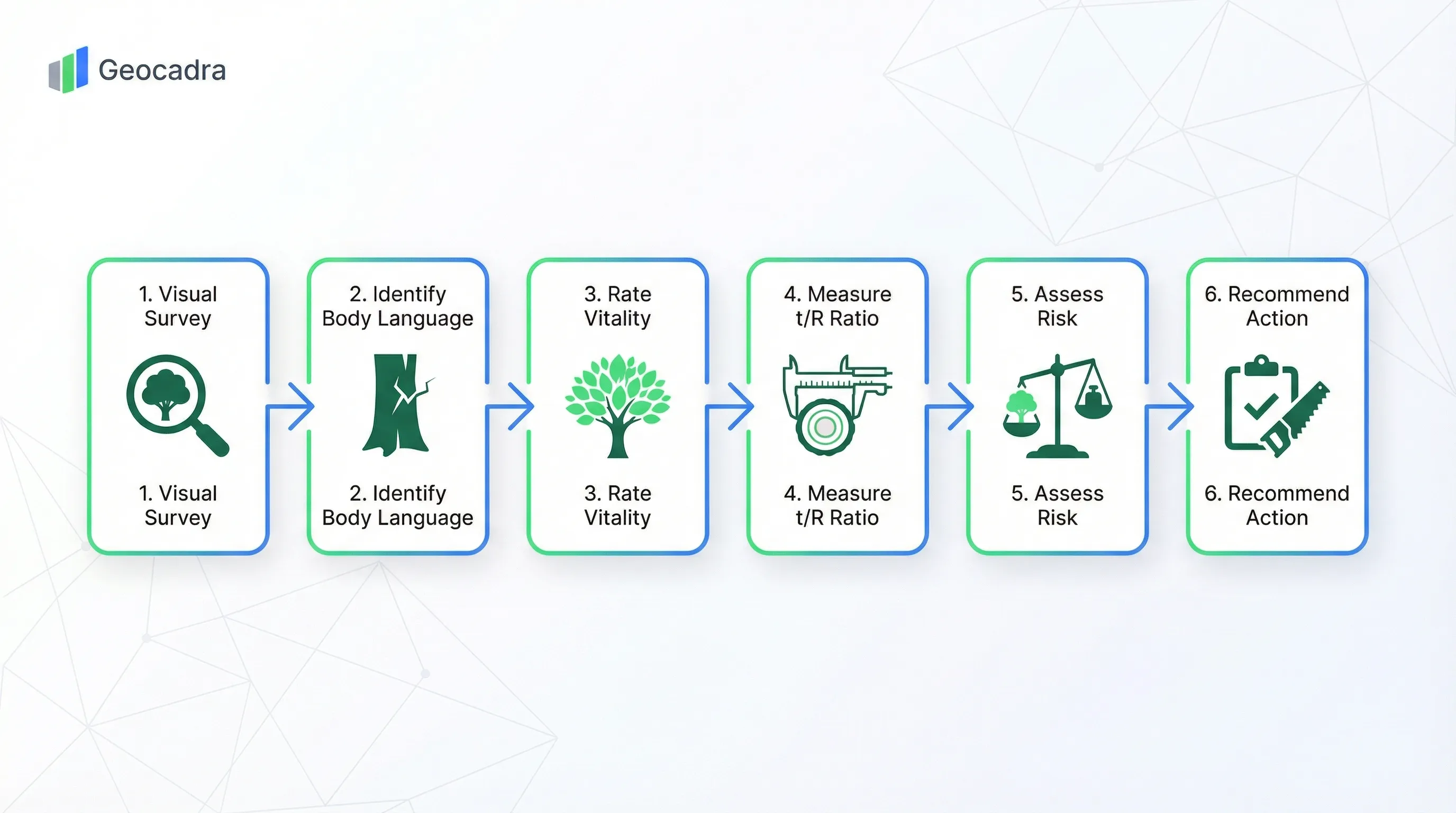
Visual Tree Assessment (VTA) is a biomechanical inspection method developed by Prof. Dr. Claus Mattheck at the Karlsruhe Institute of Technology (KIT). Based on the Axiom of Uniform Stress, VTA interprets reparative growth shapes — the body language of trees — to identify internal defects and applies the t/R wall-thickness rule to determine structural safety.
- Full Name
- Visual Tree Assessment (Mattheck)
- Issuing Body
- Karlsruhe Institute of Technology (KIT)
- Current Revision
- VTA methodology (continuously developed)
METHODOLOGY
The Three Phases of VTA
VTA follows a three-phase diagnostic protocol that progresses from non-invasive observation to instrumental confirmation only when visual symptoms demand it.
The escalation principle ensures trees are not unnecessarily wounded by drilling or probing — invasive testing occurs only where the body language suggests an internal defect. This makes VTA both efficient for large tree populations and respectful of tree biology.
Phase 1: Visual Inspection
The inspector examines the entire tree from root collar to crown tip, scanning for symptoms of structural distress — the body language of trees. These symptoms include bottle butts, ribs, bulges, shear cracks, hazard beams, and codominant stems. If no symptoms are found, the tree is declared structurally adequate and no further testing is needed. This makes Phase 1 both the most common and the most important step: the majority of trees in a population pass at this stage without requiring invasive follow-up.
Phase 2: Defect Confirmation
Triggered when Phase 1 identifies warning signs, the inspector uses diagnostic tools to measure the extent of the suspected defect. Simple methods include sounding with a mallet (hollow sounds indicate decay) and probing with a rod (soft resistance indicates rot). Advanced methods include resistograph drilling, which produces a density profile of the wood cross-section, and sonic tomography, which maps internal cavities by measuring sound wave travel times between sensors placed around the trunk.
Phase 3: Failure Criteria Assessment
Mattheck's biomechanical rules are applied to the Phase 2 data. The critical metric is the t/R ratio — the remaining sound wall thickness (t) divided by the total trunk radius (R) at the defect location. A t/R ratio below 0.30 indicates that the hollow exceeds 70% of the cross-section, placing the tree in the critical failure zone. The inspector also evaluates the H/D ratio (height divided by diameter at breast height), where values exceeding 50 indicate a slender tree prone to wind-induced buckling.
> The VTA methodology is extensively documented in Mattheck's publications through the Karlsruhe Institute of Technology (KIT), and is recognized as a reference methodology by the International Society of Arboriculture (ISA). />
VITALITY
Vitality Assessment (Roloff Scale)
VTA integrates Andreas Roloff's vitality classification to assess whether a tree retains the physiological capacity to produce compensatory growth in response to structural defects.
A vital tree can add wood where stress concentrates — a declining tree cannot. This distinction is critical because it determines whether observed body language represents successful repair or progressive failure. In the form, the inspector selects one of five vitality classes ranging from Class 0 (Exploration) to Dead. Class 0 indicates optimal vigor: the crown shows vigorous shoot extension, dense foliage reaching the outer periphery, and no dieback. These trees can actively respond to mechanical damage by growing repair wood — ribs over cracks, reinforced buttress roots, and callus tissue around wound margins. At Class 2 (Stagnation) and below, the tree's ability to add compensatory wood is significantly diminished — structural defects at this vitality level carry elevated risk because self-repair is no longer reliable. Species-specific growth patterns influence vitality assessment: fast-growing species like poplars maintain higher vitality classes longer but produce weaker wood, while slow-growing oaks decline more gradually but produce denser, more durable compensation growth.
| Class | Name | Crown Indicators |
|---|---|---|
| 0 | Exploration (Optimal) | Vigorous shoot growth, dense foliage to outer crown periphery, no dieback. Tree can actively produce repair wood. |
| 1 | Degeneration (Slight Decline) | Slightly reduced shoot growth, characteristic "claw" twig structures, foliage slightly retracted from periphery. |
| 2 | Stagnation (Reduced Growth) | Distinctly reduced shoots, "whip" or "brush" structures, visible gaps in crown canopy. |
| 3 | Resignation (Dieback) | No shoot extension, severe dieback, large dead scaffold branches, significant leaf loss. |
| Dead | No Vitality | Complete cessation of physiological activity. No capacity for structural self-repair. |
Vitality class directly affects risk assessment: a tree at Class 2+ with structural defects cannot reliably self-repair.
BODY LANGUAGE
The Body Language of Trees — Reading Defect Symptoms
Mattheck's defining innovation: trees governed by the Axiom of Uniform Stress produce visible external growth responses to internal defects. Reading these responses is the core VTA skill.
The concept of body language is what makes VTA unique among tree assessment methods. Rather than requiring immediate instrumental testing, VTA trains inspectors to interpret the tree's own structural adaptations. A tree that detects a stress concentration responds by adding wood to redistribute the load — producing visible bulges, ribs, and shape changes that an experienced inspector can read like a diagnostic report.
Root & Base Symptoms
The first inspection zone scans from ground level upward. A bottle butt — an abnormally swollen base — indicates the tree is compensating for internal hollowing or root decay by adding wood to the outer shell. Root plate heave, where the soil lifts on one side, signals progressive root failure and potential uprooting. Soil cracks radiating from the trunk base suggest root plate movement under wind loading. Fungal fruiting bodies at the base, particularly species like Meripilus giganteus or Ganoderma, confirm active decay of the root system. A basal cavity reduces the effective cross-section and must be measured for t/R evaluation.
Trunk Symptoms
Ribs and longitudinal seams indicate the tree is growing repair wood over an internal crack — the rib itself is a sign of active defect management. Bulges and localized swelling suggest the tree is reinforcing an area of concentrated stress, often around decay pockets. Open cavities allow direct observation and measurement of wall thickness. Longitudinal cracks may indicate frost damage or internal tension wood failure. Shear cracks — transverse or diagonal fractures — are among the most serious trunk symptoms because they indicate the wood fibers are failing under torsional or compressive loads.
Crown & Branch Symptoms
Hazard beams are branches showing longitudinal fiber splitting — a specific VTA term for the precursor to sudden branch failure caused by fiber buckling on the compression side of a bent limb. Codominant stems forming a V-crotch with included bark create a structural weakness where neither stem is adequately supported. Hangers and broken limbs are immediate fall hazards. Lion's tailing — excessive interior branch removal — concentrates wind load on branch tips. A banana or saber-shaped trunk indicates the tree has corrected a historical lean by growing reaction wood, which can itself become a structural vulnerability.
> For a comprehensive overview of all inspection standards, including complementary methods for infrastructure and buildings, visit our inspection standards hub. />
Try this VTA form in Geocadra
We have a pre-built VTA inspection template ready to go. Sign up and start your first condition assessment today.
Free 14-day trial. No credit card required.
BIOMECHANICS
Biomechanical Safety Thresholds
VTA Phase 3 centers on two quantitative ratios derived from engineering stress analysis and validated through decades of controlled tree-failure research.
These ratios transform subjective visual observations into objective safety assessments, providing the quantitative foundation for management decisions.
t/R Ratio (Wall Thickness Rule)
The t/R Ratio (Wall Thickness Rule) is the primary failure criterion in VTA. When a tree develops internal decay, the remaining sound wood forms a hollow cylinder. The critical question is whether this cylinder retains sufficient wall thickness to bear the bending loads imposed by wind. In the form, the inspector records the trunk radius R (in centimeters) and the sound wall thickness t (in centimeters), measured via resistograph drilling or sonic tomography. The critical t/R threshold of 0.30 is not arbitrary — Mattheck demonstrated that a hollow cylinder with t/R below 0.30 experiences stress concentrations at the inner surface that exceed the compressive strength of wood, causing the cylinder to flatten and fail under load. Some species with particularly brittle wood, such as horse chestnut, may fail at t/R values as high as 0.35.
H/D Ratio (Slenderness)
The H/D Ratio (Slenderness) provides a complementary assessment of wind stability. It divides total tree height in meters by the diameter at breast height in meters. Trees with H/D ratios below 50 have sufficient taper to resist wind-induced bending. Ratios exceeding 50 indicate a slender form prone to buckling or wind throw, particularly in trees that have grown in closed stands and lost their lower branches. When a high H/D ratio combines with a low t/R ratio, the risk assessment escalates because the tree is both slender and internally compromised.
| Ratio | Threshold | Status | Implication |
|---|---|---|---|
| t/R | > 0.33 | Safe | Adequate wall thickness. No structural concern, routine monitoring. |
| t/R | 0.30 – 0.33 | Caution | Reduced safety margin. Increase monitoring frequency, consider crown reduction. |
| t/R | < 0.30 | Critical | Failure risk exceeds threshold (>70% hollow). Crown reduction or removal required. |
| H/D | < 50 | Stable | Sufficient taper for wind resistance. Normal wind stability. |
| H/D | > 50 | Slender | Prone to wind throw or buckling. Elevated risk if combined with low t/R. |
The t/R threshold of 0.30 corresponds to approximately 70% hollowness — the point where the remaining shell cannot reliably withstand storm loading.
ASSESSMENT
Risk Assessment & Management Actions
The final VTA stage synthesizes all observations — vitality, body language, and biomechanical measurements — into a structured risk assessment that drives management decisions.
The form captures four linked determinations: failure potential, risk rating, recommended action, and re-inspection interval. Failure Potential evaluates whether the tree's structural defenses are succeeding or failing. Risk Rating then combines failure potential with target presence — the exposure context. A tree with "Probable" failure potential in a remote woodland is a fundamentally different risk from the same tree overhanging a school playground or busy road.
| Level | Description | Typical Indicators |
|---|---|---|
| Improbable | No significant defects | Tree passed Phase 1 cleanly. No body language symptoms, good vitality. |
| Possible | Defects present but compensated | Reparative growth visible and active. t/R > 0.33, vitality Class 0–1. |
| Probable | Defects exceed compensation | Open cavities, t/R < 0.30, advanced fungal colonization, vitality Class 2+. |
| Imminent | Active failure in progress | Propagating cracks, sudden lean change, root plate heave, recent major limb failure. |
Failure potential is combined with target presence to produce the overall risk rating.
| Action | When Applied | Purpose |
|---|---|---|
| None / Monitor | Low risk, no defects or fully compensated | Continue routine inspection cycle. |
| Phase 2 Inspection | Symptoms detected, extent unknown | Escalate to instrumental testing (resistograph, tomography). |
| Pruning (Deadwood) | Dead branches present above targets | Remove immediate fall hazards from the crown. |
| Crown Reduction | Compromised trunk, high lever arm | Shorten the crown to reduce wind loading on a weakened trunk. |
| Cabling / Bracing | Codominant stems, V-crotch unions | Provide supplemental structural support to weak junctions. |
| Fell / Remove | Extreme risk, no viable mitigation | Remove the tree when no other action can achieve acceptable safety. |
> VTA action recommendations follow the same risk-based logic as other condition assessment standards. For a comparison with the building-focused scoring approach, see the NEN 2767 condition assessment guide. />
QUESTIONS
Frequently Asked Questions
What is Visual Tree Assessment (VTA)?
VTA is a biomechanical tree inspection method developed by Prof. Dr. Claus Mattheck at the Karlsruhe Institute of Technology. It uses the visible growth responses of trees — their body language — to identify internal structural defects, then applies the t/R wall-thickness ratio to assess breakage safety without initially damaging the tree.
What is the t/R rule in VTA?
The t/R ratio divides the remaining sound wall thickness (t) by the trunk radius (R) at the defect location. A ratio above 0.33 indicates adequate structural safety. Below 0.30, the hollow exceeds approximately 70% of the cross-section, and the tree enters the critical failure zone where crown reduction or removal is typically recommended.
What is the difference between VTA Phase 1 and Phase 2?
Phase 1 is a purely visual inspection where the assessor scans the tree for body language symptoms — bulges, ribs, cracks, fungi. Phase 2 is triggered only if symptoms are found, and uses diagnostic instruments such as a resistograph or sonic tomograph to measure the internal extent of the suspected defect.
What does "body language of trees" mean in VTA?
Mattheck showed that trees redistribute growth to maintain uniform stress. When internal defects disturb this equilibrium, the tree produces visible compensatory shapes: bottle butts over root decay, ribs over cracks, bulges around decay pockets. VTA inspectors read these shapes to locate defects without invasive testing.
How often should VTA inspections be performed?
Re-inspection intervals depend on risk level. High-risk trees with known defects may require assessment every 6 months. Trees with compensated defects in moderate-risk settings are typically reinspected annually or every 18 months. Healthy trees in low-target areas can follow 3- to 5-year cycles.
Is VTA recognized as an international standard?
VTA is not a codified national standard like DIN or NEN but is internationally recognized as a leading tree assessment methodology. It is referenced in arboricultural best-practice guidelines in Germany, the UK, Australia, and North America, and is widely taught in ISA and European arborist certification programs.
In practice
See how the round runs in Geocadra
The solution page shows this inspection regime on real open data: the import, the form, the round, the record per asset and the export.
Regular tree checks, biotope mapping and ecological surveys on a map, with every visit appended to the tree or the siteOpen the solution page: Trees, Habitats & EcologyTRY IT FREE
Digitize your VTA inspections
Replace paper forms and spreadsheets with structured digital inspections, built for standards like VTA.
No credit card requiredFree trial included