



WRc MSCC5 Sewer Inspection
The UK standard for CCTV-based sewer defect coding and condition grading under BS EN 13508-2.
WRc MSCC5 is the definitive guide to sewer condition classification in the United Kingdom and Ireland. Published by the Water Research Centre (WRc), its 5th edition aligns fully with the European standard BS EN 13508-2, providing inspectors with a rigorous alphanumeric coding system for every defect or feature observed during CCTV surveys of gravity sewers and drains. The coded observations feed into the Sewer Risk Management (SRM) methodology, which automatically calculates structural and service condition grades on a 1-to-5 scale, enabling utilities to prioritise rehabilitation investment across their entire sewer network.

What is WRc MSCC5?
WRc MSCC5 (Manual of Sewer Condition Classification, 5th Edition) is the UK and Irish standard for coding sewer and drain defects during CCTV inspection. Aligned with BS EN 13508-2, it translates visual observations into alphanumeric codes that feed into the Sewer Risk Management grading system, producing separate structural and service condition grades from 1 (Acceptable) to 5 (Immediate).
- Full Name
- Manual of Sewer Condition Classification, 5th Edition
- Issuing Body
- Water Research Centre (WRc)
- Current Revision
- 5th Edition (MSCC5)
SURVEY HEADER
Survey Header and Pipe Attribute Fields
Every MSCC5 inspection starts with a header block that establishes the identity, location, and physical characteristics of the pipe segment being surveyed.
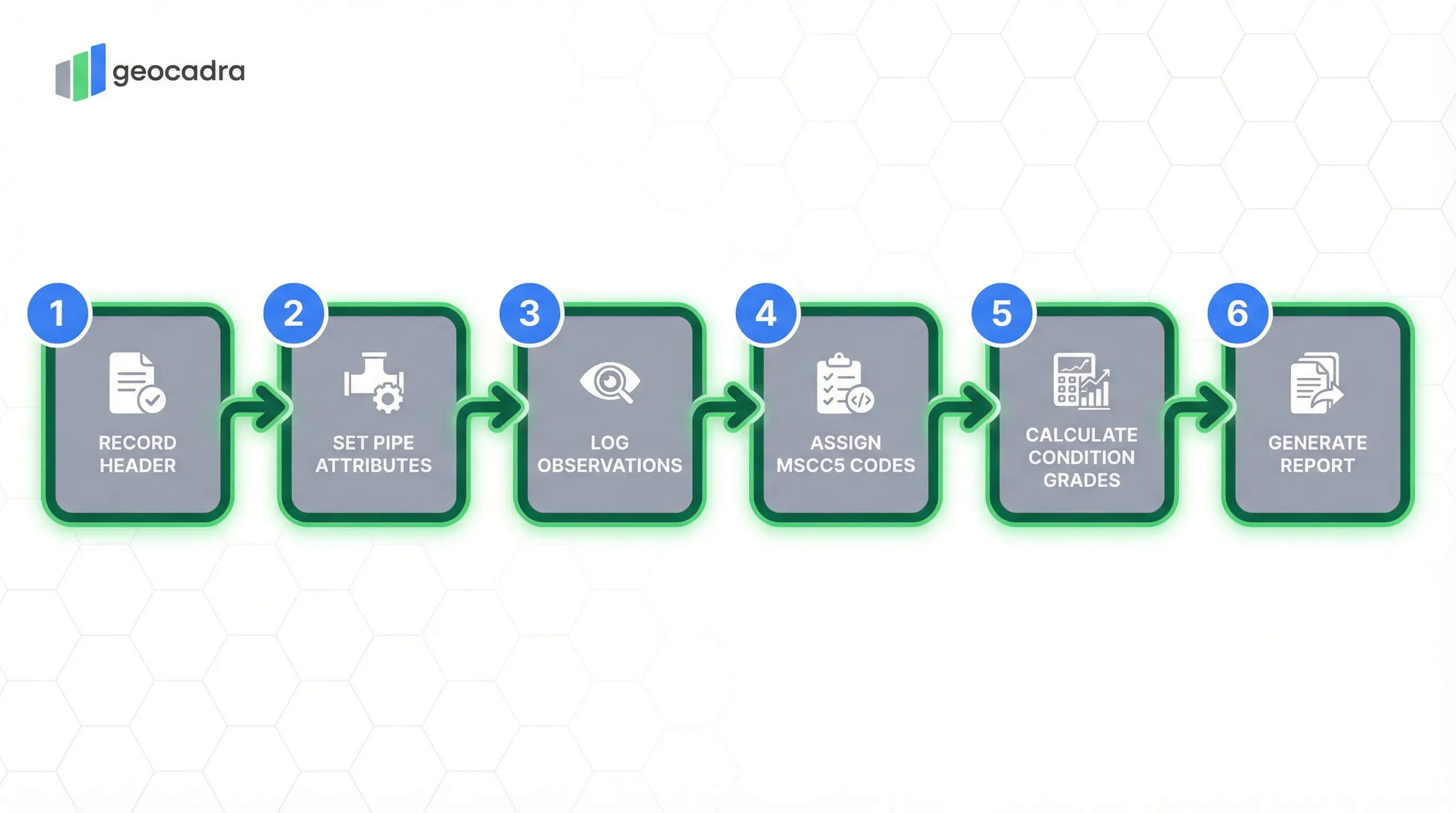
The MSCC5 survey header captures all contextual data about the pipe before the CCTV camera enters. A pipe segment is defined as the run between two access points, typically manhole to manhole. The Pipeline Length Reference (PLR) uniquely identifies the segment within the utility’s asset register, following a structured alphanumeric format. Start Node Ref and Finish Node Ref record the manhole IDs at each end, and the Direction of Survey field records whether the camera travels upstream or downstream relative to the flow direction.
Physical pipe attributes include Height/Diameter in millimetres, Shape (circular, rectangular, egg-shaped, oval, or other), and Material (vitrified clay, concrete, PVC, brick, ductile iron, or mixed). These baseline attributes are critical because several defect assessments depend on them — for example, deformation is measured as a percentage of the nominal diameter, and certain material-specific codes (such as missing mortar in brickwork) only apply to specific pipe materials. If the pipe material or shape changes mid-survey, the inspector must log a Change of Observation code at the transition point.
Environmental and operational fields complete the header: Location (Town/Village) and Location (Street) provide geographic context, Purpose of Inspection classifies the survey reason (routine inspection, investigating a known defect, post-repair verification, pre-adoption survey, or other), and the Pre-cleaned flag records whether the pipe received jetting or mechanical cleaning before the CCTV run. A pipe inspected without pre-cleaning may have debris obscuring structural defects, which directly affects the reliability of the condition grade. The MSCC5 XML specification enforces mandatory completion of PLR, node references, direction, diameter, and pre-cleaning status before any observations can be logged.
DEFECT CODES
The MSCC5 Defect Code Catalogue
MSCC5 organises all pipe observations into a structured alphanumeric catalogue derived from BS EN 13508-2, covering structural defects, service defects, and miscellaneous features.
The MSCC5 coding system is built on a two-letter (or three-letter) alphanumeric code for each observation type. Unlike systems that allow free-text descriptions, MSCC5 constrains every observation to a code from the official catalogue. This ensures that different inspectors, different contractors, and different software packages all produce records that can be compared and aggregated across an entire network. Each code belongs to one of three categories: structural defects that affect the physical integrity of the pipe wall, service defects that reduce flow capacity without necessarily compromising structure, and miscellaneous or construction features that document the pipe’s configuration.
Structural Defects
Structural defect codes describe physical damage to the pipe wall. Crack codes distinguish between Longitudinal (CL) and Circumferential (CC) orientations, which carry different structural implications — longitudinal cracks indicate bending stress from external loading, while circumferential cracks suggest differential settlement or traffic-induced shear. Fracture codes (FL, FC) escalate the severity: a fracture differs from a crack in that the pipe wall has visibly separated into distinct pieces. The Broken code (B) denotes a section where pipe material has been displaced or is missing entirely. Deformation (D) records cross-sectional distortion as a percentage of the nominal diameter, with thresholds at 5%, 10%, and 15% driving escalating condition grades. Joint Displacement Medium (JDM) captures misalignment at pipe joints, and Surface Damage codes (SW for wear, SC for spalling) document gradual material loss from the pipe interior.
Service Defects
Service defect codes address conditions that impair hydraulic performance. Root intrusion ranges from Fine Roots (RF) — individual root strands entering through a joint or crack — to Root Mass (RM), where a dense root ball significantly reduces cross-sectional area. The quantification field records the percentage of the pipe’s cross-section obstructed by roots, with each threshold tier triggering a higher service grade. Debris and silt (DES) codes document settled material, again quantified by percentage of blockage. Infiltration codes progress from Seeping (IS), where moisture is visible on the pipe wall, through Dripping and Running stages to Gushing, where groundwater enters the pipe under pressure. The volume of infiltration directly affects the service condition grade and signals potential structural compromise at the ingress point.
Miscellaneous and Construction Features
These codes document non-defect features that complete the pipe record. Connection (CX) logs lateral pipe connections entering the sewer — their position, condition, and diameter. Manhole (MH) marks the start and end access points. Water Level (WL) records the flow depth at the time of inspection, expressed as a percentage of the pipe diameter. These features are not scored for condition grading but provide essential context for hydraulic modelling and network mapping. The MSCC5 specification requires that connections and manholes be logged whenever encountered, even if no defect is present at those locations.
The complete MSCC5 coding catalogue and XML data specification are published by the Water Research Centre (WRc).
Try this WRc MSCC5 form in Geocadra
We have a pre-built WRc MSCC5 inspection template ready to go. Sign up and start your first condition assessment today.
Free 14-day trial. No credit card required.
CONDITION SCALE
Internal Condition Grades (ICG) — The 1-to-5 Scale
MSCC5 produces two separate condition grades for each pipe segment — Structural and Service — each on a 1-to-5 severity scale calculated from the coded defect observations.
A critical distinction in the MSCC5 methodology is that the inspector does not manually select a condition grade in the field. The inspector’s role is to identify and code each defect using the MSCC5 catalogue, record its quantification (percentage, millimetres, or clock reference), and note whether it is continuous or point-specific. The condition grade is then calculated automatically by the Sewer Risk Management (SRM) methodology, which maps each defect code and its quantification to a predetermined score. The pipe segment receives two independent grades: Structural (STR), reflecting physical integrity, and Service (SER), reflecting hydraulic performance. A pipe can have a good structural grade but a poor service grade (e.g., structurally sound but heavily silted), or vice versa. This dual-axis assessment gives asset managers a more nuanced view than a single composite score would provide.
Grade 1 (Acceptable) indicates cosmetic or negligible issues — light surface staining or minor wear with no functional impact. Grade 2 (Minimal) denotes slight deterioration such as surface wear or minor joint displacement under 5%, warranting long-term monitoring but no immediate intervention. Grade 3 (Moderate) covers defects that may require planned maintenance within 6 to 12 months, such as a fracture without accompanying deformation or root intrusion blocking less than 5% of the cross-section. Grade 4 (Poor) flags serious defects demanding action within 3 to 6 months — a broken pipe, deformation exceeding 5%, or heavy debris accumulation. Grade 5 (Immediate) represents the most critical findings: collapse, structural failure, or complete blockage requiring urgent intervention.
| Grade | Description | Severity | Typical Action |
|---|---|---|---|
| 1 | Acceptable | Minor cosmetic issues only. No defect of functional significance. | No action needed. |
| 2 | Minimal | Slight deterioration. Surface wear, displaced joint <5%. | Monitor long-term. |
| 3 | Moderate | Moderate defects. Fracture without deformation, roots <5%. | Repair within 6–12 months. |
| 4 | Poor | Serious defect. Broken pipe, deformation >5%, heavy silt. | Action required 3–6 months. |
| 5 | Immediate | Severe/collapsed. Pipe structurally failed or fully blocked. | Immediate urgent action. |
OBSERVATION LOG
Observation Log: Distance, Code, and Quantification
The observation log is the dynamic, repeatable core of every MSCC5 survey — each row captures a single defect or feature at a specific distance along the pipe.
As the CCTV camera advances through the pipe, the inspector logs each defect or feature as a new row in the observation log. Every entry records the Distance in metres from the start node (to one decimal place), the MSCC5 Code identifying the defect type, and optional Quantification fields. Quantification depends on the defect type: root intrusion and debris are quantified as a percentage of cross-sectional area (0–100%), joint displacement is measured in millimetres, and crack width is optionally recorded in millimetres. The Clock Reference field uses a four-digit HHMM format (derived from a 12-hour clock face viewed from the start node) to locate the defect circumferentially — 1200 for the crown, 0600 for the invert, and 0309 for a defect spanning from the 3 o’clock to 9 o’clock position.
A particularly important mechanism in the observation log is the Continuous Defect flag, which uses three states: Start (S), Finish (F), and Change (C). When a defect extends over a distance — for example, a longitudinal crack running from 5.0 m to 22.5 m — the inspector logs the first entry at 5.0 m with the Start flag and the defect code, and a second entry at 22.5 m with the Finish flag. If the defect changes character mid-span (e.g., a crack widens into a fracture at 15.0 m), the inspector uses the Change flag to mark the transition without closing and reopening the continuous defect. This three-state system prevents double-counting of extended defects while preserving the spatial extent data needed for accurate rehabilitation cost estimation. Each observation may also include a Remarks field (up to 50 characters) for context not captured by the code, and a Photos field for attaching CCTV stills or screenshots. Best practice under MSCC5 requires photographic evidence for all defects that contribute to the condition grade.
SRM SCORING
How SRM Converts Codes to Condition Grades
The Sewer Risk Management (SRM) manual provides the lookup tables that transform raw MSCC5 defect codes into the numerical scores behind each condition grade.
The separation between MSCC5 (coding) and SRM (scoring) is a fundamental design principle of the UK sewer assessment framework. MSCC5 tells the inspector how to describe what they see; SRM tells the engineer what it means. Each defect code in the MSCC5 catalogue has a corresponding entry in the SRM scoring tables. The SRM lookup assigns a numerical severity score to each code, modulated by the quantification value. For example, a Crack Longitudinal (CL) with no measurable opening might score 2, while the same CL code with visible displacement scores 10. Deformation (D) at 5% of diameter scores differently from deformation at 15%, with the score increasing in discrete steps at each threshold. These individual defect scores are then aggregated: all structural defect scores are summed to produce a total Structural Score, and all service defect scores are summed for a total Service Score. Each total score maps to a grade band — the higher the cumulative score, the worse the grade.
This automated scoring model has a major practical consequence: it eliminates subjective grading from the inspection process. Two inspectors coding the same defects identically will always produce the same condition grade, regardless of their personal judgment about the pipe’s condition. This objectivity is essential for utilities managing tens of thousands of kilometres of sewer network, where consistent grading drives capital investment decisions worth millions of pounds annually. In a digital workflow, the SRM scoring logic can be embedded directly into the inspection application, giving the inspector a real-time condition grade preview as they log observations. The digital form captures MSCC5 codes, distances, and quantifications; the backend applies SRM lookup tables; and the output is a pair of grades (Structural and Service) that feed directly into the utility’s asset management system. This closed-loop workflow is where standards like MSCC5 deliver their highest value — not merely as a documentation format, but as the input layer for automated decision support.
The SRM grading methodology is maintained alongside the MSCC5 coding standard by WRc.
MSCC5 is fully aligned with the European sewer coding standard EN 13508-2. Explore all available inspection standards in the standards library.
QUESTIONS
Frequently Asked Questions
What is WRc MSCC5?
WRc MSCC5 (Manual of Sewer Condition Classification, 5th Edition) is the UK and Irish standard for coding defects observed during CCTV inspection of gravity sewers and drains. It provides an alphanumeric defect catalogue aligned with BS EN 13508-2 and feeds into the SRM grading methodology to produce structural and service condition grades.
How are MSCC5 condition grades calculated?
The inspector codes defects using the MSCC5 catalogue but does not select a grade directly. The Sewer Risk Management (SRM) manual maps each defect code and its quantification to a numerical score. Structural and service scores are summed separately, and each total maps to a grade from 1 (Acceptable) to 5 (Immediate).
What is the difference between structural and service grades in MSCC5?
The Structural grade reflects physical pipe integrity — cracks, fractures, breaks, deformation, and collapse. The Service grade reflects hydraulic performance — root intrusion, debris, silt, and infiltration. A pipe can score well structurally but poorly for service, or vice versa, giving asset managers a two-dimensional condition view.
How does MSCC5 relate to EN 13508-2?
MSCC5 is the UK national application of the European standard BS EN 13508-2. EN 13508-2 defines the coding syntax and observation vocabulary. MSCC5 adopts this vocabulary and adds UK-specific application guidance, while the SRM manual provides the grading layer that EN 13508-2 deliberately omits.
What does the clock reference mean in an MSCC5 observation?
The clock reference uses a four-digit HHMM format to locate a defect on the pipe’s cross-section as viewed from the start node. 1200 is the crown (top), 0600 is the invert (bottom), 0300 is the right side, and 0900 is the left side. A range like 0309 means the defect spans from 3 o’clock to 9 o’clock.
Is MSCC5 mandatory for UK sewer inspections?
While not a statutory regulation, MSCC5 is the de facto industry requirement. UK water companies specify MSCC5 compliance in their inspection contracts, and the Sewerage Sector Guidance (SSG) references MSCC5 as the accepted methodology. Inspectors working for regulated utilities are expected to follow it.
What is the difference between MSCC5 and NASSCO PACP?
MSCC5 is the UK/Irish standard aligned with BS EN 13508-2, using metric units and SRM grading. NASSCO PACP is the North American standard using imperial units and its own 1-to-5 severity scale. Both are CCTV-based sewer defect coding systems, but their code catalogues and scoring methodologies differ.
In practice
See how the round runs in Geocadra
The solution page shows this inspection regime on real open data: the import, the form, the round, the record per asset and the export.
Lighting columns, poles, sewers and charge points inspected on a map, with every round appended to the assetOpen the solution page: Utilities & Public LightingTRY IT FREE
Digitize your WRc MSCC5 inspections
Replace paper forms and spreadsheets with structured digital inspections, built for standards like WRc MSCC5.
No credit card requiredFree trial included