ASTM E2018 Property Condition Assessment
The US standard for baseline property condition assessments in commercial real estate transactions.
ASTM E2018 is the industry-standard guide for Property Condition Assessments (PCAs) in commercial real estate due diligence. Published by ASTM International, it defines a systematic, non-destructive walk-through methodology that covers site improvements, structural frame, building envelope, roofing, mechanical, electrical, and plumbing systems, as well as interior finishes and regulatory compliance. The standard requires assessors to identify Material Physical Deficiencies and provide Opinions of Costs categorized as Immediate or Short-Term, with a de minimis reporting threshold of $3,000. Widely adopted by lenders, investors, and property managers across the United States, ASTM E2018 produces a Property Condition Report (PCR) that drives capital planning, acquisition negotiations, and reserve fund calculations.

What is ASTM E2018?
ASTM E2018 (Standard Guide for Property Condition Assessments) is the US baseline standard for evaluating commercial real estate. Assessors conduct a walk-through survey of site, structure, envelope, roofing, and MEP systems, rating each component as Good, Fair, or Poor and reporting Physical Deficiencies with Opinions of Costs above a $3,000 de minimis threshold.
- Full Name
- Standard Guide for Property Condition Assessments: Baseline Property Condition Assessment Process
- Issuing Body
- ASTM International
- Current Revision
- ASTM E2018-24
INSPECTION SCOPE
What Does an ASTM E2018 Assessment Cover?
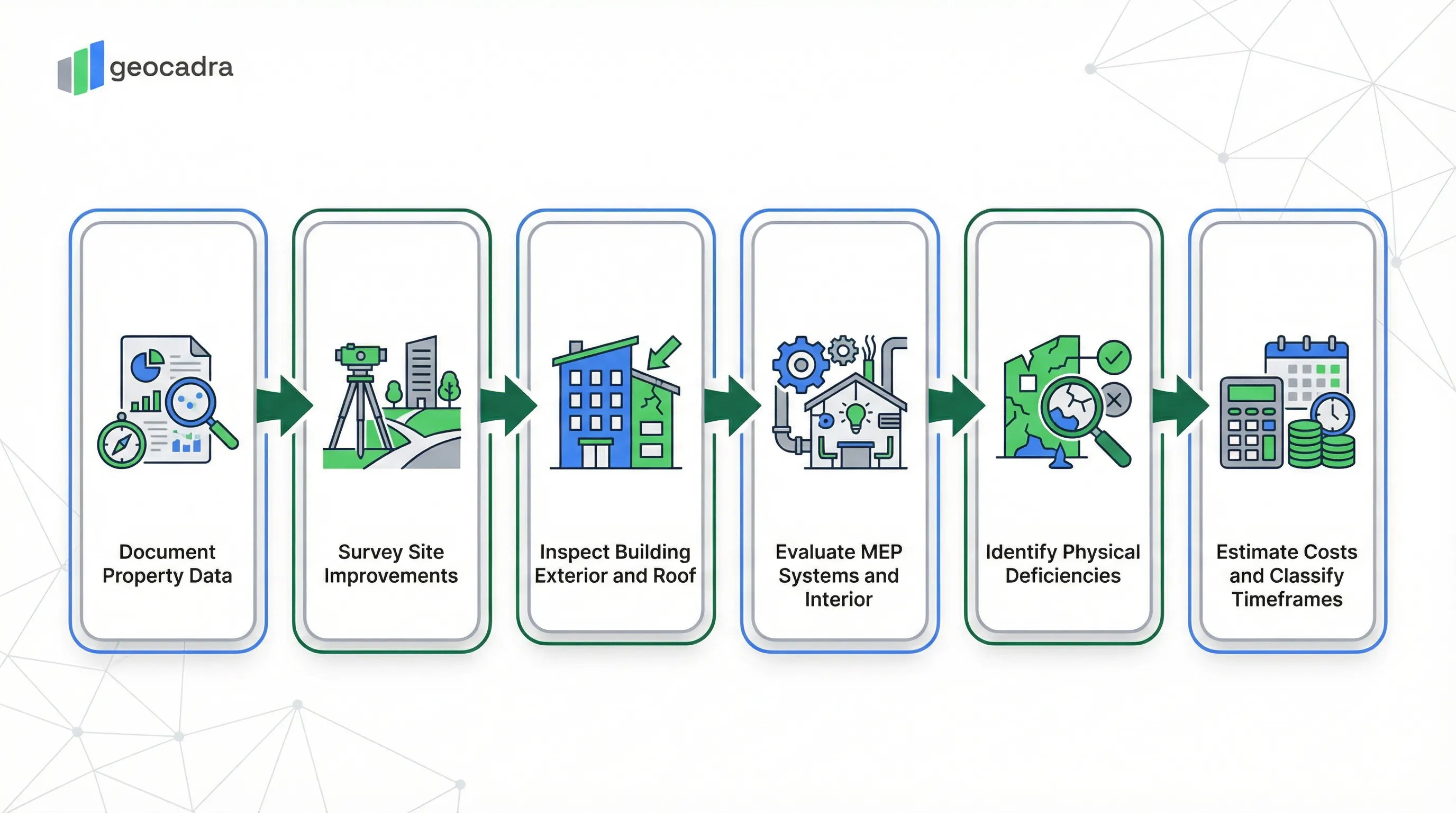
The PCA methodology follows a defined sequence of building system categories, each requiring visual observation and condition documentation.
ASTM E2018 structures the Property Condition Assessment around seven major building system categories that together provide a comprehensive snapshot of a commercial property. The assessment begins with the General Property and Site section, where the assessor records baseline data including Property Type (Office, Retail, Industrial, Multi-Family, Hospitality, or Mixed-Use), Year Built, and Gross Building Area in square feet. These data points establish the context for interpreting all subsequent findings and are required for the Executive Summary of the Property Condition Report.
The Site Improvements section evaluates everything outside the building footprint: paving condition, stormwater drainage systems (Surface Runoff, Catch Basins, or Retention/Detention Ponds), curbing, sidewalks, landscaping, site lighting, and fencing. The assessor rates each component using the standard Good/Fair/Poor scale. Poor-rated site elements often indicate deferred maintenance that can escalate rapidly, particularly paving deterioration and drainage failures that lead to foundation issues. The Building Exterior section covers the structural frame (Steel, Wood, Concrete, or Masonry framing), exterior cladding condition, and the complete roofing system. Roof assessment is especially critical because roofing deficiencies are among the most costly items in any PCA. The assessor identifies the Primary Roof Material (Built-up, Single-Ply TPO/EPDM/PVC, Asphalt Shingle, or Metal), rates its condition, and documents any active leaks observed during the walk-through.
The Systems and Interior section inventories the Mechanical, Electrical, and Plumbing (MEP) infrastructure. The assessor records the Primary HVAC Type (Packaged RTU, Split System, Chiller/Boiler, or PTAC/Unit Heater) and individually rates HVAC, Electrical, Plumbing, and General Interior conditions. This system-by-system approach ensures that no major building component is overlooked, making the PCA a reliable tool for identifying deferred maintenance across all building disciplines.
For detailed building condition scoring using a numeric scale, see the VDI 6200 building inspection standard.
CONDITION RATING
The Good / Fair / Poor Condition Rating Scale
Every system and component assessed under ASTM E2018 receives a standardized condition rating that directly determines whether it generates a reportable deficiency.
ASTM E2018-24 defines a three-tier condition rating scale applied uniformly across all building systems, from site paving to interior finishes. Unlike numeric scoring systems that produce graduated condition indexes, the ASTM E2018 approach classifies each component into one of three defined states plus an Unknown option for inaccessible areas. A rating of Good indicates that the component is in working condition and does not require immediate or short-term repairs above the agreed cost threshold. Good-rated systems are functioning as intended and show normal wear consistent with their age and usage. A rating of Fair means the component is in working condition but may require immediate or short-term repairs above the agreed threshold. Fair is the critical transitional state: the system functions today but the assessor has identified conditions that will likely generate costs during the evaluation period. Common Fair findings include aging HVAC equipment approaching end-of-useful-life, roof membranes with minor blistering or ponding, and exterior cladding with localized sealant failures.
| Rating | Working? | Repairs Needed? | Report Action |
|---|---|---|---|
| Good | Yes | No repairs above threshold | No deficiency reported |
| Fair | Yes | May require repairs above threshold | Deficiency may be reported |
| Poor | No / Impaired | Requires repairs substantially above threshold | Deficiency must be reported |
| Unknown | Not observed | Cannot determine | Documented as access limitation |
The agreed threshold is typically $3,000 (de minimis) per ASTM E2018-24 Section 10.3.1. Items below this threshold are excluded unless they represent life-safety issues or cluster above $10,000.
A rating of Poor indicates the component is not in working condition or requires immediate or short-term repairs substantially above the agreed threshold. Poor ratings always generate entries in the Physical Deficiencies section of the report because they represent material conditions that require capital expenditure. The Unknown rating applies when a component cannot be observed or accessed during the walk-through. Common reasons include snow-covered roofs, occupied tenant spaces, locked mechanical rooms, or below-grade conditions that require invasive investigation. Unknown ratings are documented in the Site Access Limitations narrative so the client understands the scope gap. In the form, each system component presents the assessor with these four options as a dropdown selection, ensuring consistent application across properties and assessors.
DEFICIENCY REPORTING
Physical Deficiencies: The Core Output of a PCA
The Physical Deficiencies section is where the PCA transforms from a visual survey into a financial planning tool, linking each observed defect to a recommended action and estimated cost.
What distinguishes ASTM E2018 from general building inspections is its structured approach to documenting Material Physical Deficiencies. Every deficiency identified during the walk-through is recorded as a discrete entry with five required data points: a Deficiency Title describing the specific problem (e.g., "RTU-2 Compressor Failure"), the Recommended Action (Repair, Replace, Install, Maintain/Monitor, or Further Study), the Timeframe classification (Immediate or Short-Term), the Estimated Cost in dollars, and Photo Evidence documenting the observed condition. This structured format ensures that the Property Condition Report delivers actionable financial data rather than narrative descriptions that require interpretation.
The Recommended Action field drives the remediation strategy. Repair applies when the existing component can be restored to working condition at reasonable cost. Replace indicates the component has reached end-of-useful-life or repair is not economically viable. Install applies when a required system or component is entirely absent, such as missing fire suppression in a building that now requires it under current code. Maintain/Monitor is used for conditions that are not yet deficiencies but require ongoing attention to prevent escalation, a critical distinction that helps property managers prioritize preventive maintenance. Further Study indicates that the observed condition requires specialist evaluation beyond the scope of the baseline PCA, such as structural engineering analysis or environmental testing.
The form allows an unlimited number of deficiency entries because commercial properties frequently have dozens of reportable items. Each entry is independently costed and classified, enabling the final report to produce a summary cost table that lenders and investors use to negotiate purchase price adjustments, set reserve fund requirements, and structure capital improvement budgets. For a complementary approach to building condition scoring using a six-point numeric scale, see the NEN 2767 condition assessment standard.
Try this ASTM E2018 form in Geocadra
We have a pre-built ASTM E2018 inspection template ready to go. Sign up and start your first condition assessment today.
Free 14-day trial. No credit card required.
COST THRESHOLDS
The $3,000 De Minimis Threshold and Cost Timeframes
ASTM E2018 defines specific financial thresholds that determine which findings merit reporting, preventing reports from being cluttered with minor maintenance items.
The de minimis threshold of $3,000 is one of the most important concepts in ASTM E2018-24. Defined in Section 10.3.1, this threshold establishes that individual deficiency items costing less than $3,000 to remedy should generally be excluded from the Property Condition Report. The rationale is practical: commercial properties always have minor maintenance items (a cracked tile, a stained ceiling tile, a loose handrail) that individually cost a few hundred dollars to fix. Including every such item would produce reports hundreds of pages long without adding meaningful decision-making value for lenders and investors.
However, the $3,000 threshold has two critical exceptions. First, items below $3,000 must be reported if they represent a life-safety issue, regardless of cost. A malfunctioning emergency exit sign that costs $200 to replace is still a reportable deficiency because it affects occupant safety. Second, clusters of similar items that individually fall below $3,000 but collectively exceed $10,000 must be aggregated and reported. For example, if a 50-unit apartment complex has deteriorated caulking around 40 window units at $150 each, the $6,000 total exceeds the cluster threshold and warrants a deficiency entry.
| Timeframe | Trigger Conditions | Typical Horizon |
|---|---|---|
| Immediate | Life-safety risk, code violation, or imminent system failure | Action required now |
| Short-Term | Deferred maintenance not posing immediate risk | 1–2 years (evaluation period) |
De minimis threshold: $3,000 per item. Items below threshold are excluded unless they pose life-safety risk or cluster above $10,000 collectively.
The Timeframe classification separates deficiencies into two urgency categories. Immediate Costs address conditions requiring urgent action: material existing or potential unsafe conditions posing imminent life-safety risk, material building or fire code violations, and physical deficiencies that if uncorrected will result in critical system failure or significant cost escalation. Short-Term Costs cover deferred maintenance items that do not warrant immediate attention but should be undertaken on a priority basis, typically within one to two years. This dual-timeframe system allows property managers to sequence capital expenditures effectively.
The complete standard is published by ASTM International.
ADA/FHA SCREENING
Tier I Accessibility Survey Under ASTM E2018
Every baseline PCA includes a standardized accessibility screening that checks for obvious ADA and Fair Housing Act compliance issues without requiring a full accessibility audit.
ASTM E2018-24 incorporates a Tier I (Visual) Accessibility Survey based on a Uniform Abbreviated Screening Checklist defined in the standard's appendices. This screening is not a full ADA compliance audit, which would require detailed measurements and expert analysis. Instead, it is a visual pass/fail check of the most commonly encountered accessibility requirements: designated accessible parking spaces, van-accessible spaces, curb cuts and ramps providing an accessible route from parking to entry, accessible main entrance width and threshold, at least one accessible public restroom stall, and elevator accessibility features including braille signage and audible signals.
For properties with residential units, the Fair Housing Act (FHA) screening adds two critical data points: whether the property's first occupancy date falls after March 13, 1991 (the FHA design and construction requirement trigger date), and whether the property contains four or more dwelling units. Properties meeting both criteria are subject to FHA accessibility design requirements regardless of whether they receive federal funding. The assessor documents any obvious non-compliance items in the Regulatory Notes field. Identified accessibility issues are flagged in the Site Improvements section of the form through the Observed ADA/FHA Issues field.
The accessibility screening results feed directly into the Physical Deficiencies section when non-compliance is observed. A property with no accessible parking, for example, generates an Immediate-timeframe deficiency entry because it represents a regulatory violation. This integration between the accessibility screening and the financial deficiency reporting ensures that compliance gaps are not buried in narrative text but appear prominently in the cost summary that drives acquisition decisions. For dedicated accessibility assessment methodology, see the ADA Accessibility inspection standard.
QUESTIONS
Frequently Asked Questions
What is ASTM E2018?
ASTM E2018 is the US baseline standard for Property Condition Assessments (PCAs) in commercial real estate. It defines a non-destructive walk-through methodology covering site, structure, envelope, roofing, and MEP systems. The assessor rates components as Good, Fair, or Poor and reports Physical Deficiencies with cost estimates above a $3,000 threshold.
What is the de minimis threshold in ASTM E2018?
The de minimis threshold is $3,000 per individual deficiency item. Repair costs below this amount are generally excluded from the Property Condition Report unless they pose a life-safety risk or belong to a cluster of similar items that collectively exceed $10,000. This prevents reports from being overwhelmed by minor maintenance items.
What is the difference between Immediate and Short-Term costs?
Immediate Costs address life-safety risks, code violations, or conditions that will cause critical system failure if uncorrected. Short-Term Costs cover deferred maintenance that should be addressed within one to two years but does not pose an imminent risk. Both categories appear in the Physical Deficiencies cost summary.
Does ASTM E2018 include an ADA compliance audit?
ASTM E2018 includes a Tier I (Visual) Accessibility Survey, which is an abbreviated screening checklist for obvious ADA and Fair Housing Act issues. It is not a full ADA compliance audit. The screening checks accessible parking, accessible routes, main entrance accessibility, restrooms, and elevator features.
Who typically performs an ASTM E2018 assessment?
PCAs are performed by qualified building assessors, typically licensed architects or engineers with experience in commercial building systems. Lenders, investors, and property managers commission PCAs during real estate transactions, refinancing, or portfolio condition reviews to identify capital expenditure requirements.
What property types does ASTM E2018 cover?
ASTM E2018 applies to all commercial property types including Office, Retail, Industrial, Multi-Family, Hospitality, and Mixed-Use buildings. The standard uses the same assessment methodology regardless of property type, though the applicable building systems vary by use (e.g., elevators in multi-story buildings).
What is the difference between ASTM E2018 and a home inspection?
ASTM E2018 is designed for commercial real estate due diligence and produces a financially oriented Property Condition Report with cost opinions. Home inspections follow standards like ASHI or InterNACHI and focus on residential systems. ASTM E2018 includes regulatory screening and applies a de minimis cost threshold that home inspections do not.
In practice
See how the round runs in Geocadra
The solution page shows this inspection regime on real open data: the import, the form, the round, the record per asset and the export.
Condition assessments, roof checks and statutory tests for public building portfolios, with every visit appended to the buildingOpen the solution page: Buildings & FacilitiesTRY IT FREE
Digitize your ASTM E2018 inspections
Replace paper forms and spreadsheets with structured digital inspections, built for standards like ASTM E2018.
No credit card requiredFree trial included