ASTM F1487 Playground Safety
The U.S. standard for public playground equipment safety, surfacing compliance, and hazard prioritization.
ASTM F1487 is the foundational safety specification for public playground equipment in the United States. It establishes precise dimensional requirements for use zones, entrapment openings, protrusion hazards, and protective surfacing — turning every piece of play equipment into a measurable compliance target. Combined with the NRPA/CPSI hazard priority system, it provides inspectors with a four-tier risk framework that drives immediate closures, scheduled repairs, and routine maintenance across parks, schools, and childcare facilities.

What is ASTM F1487?
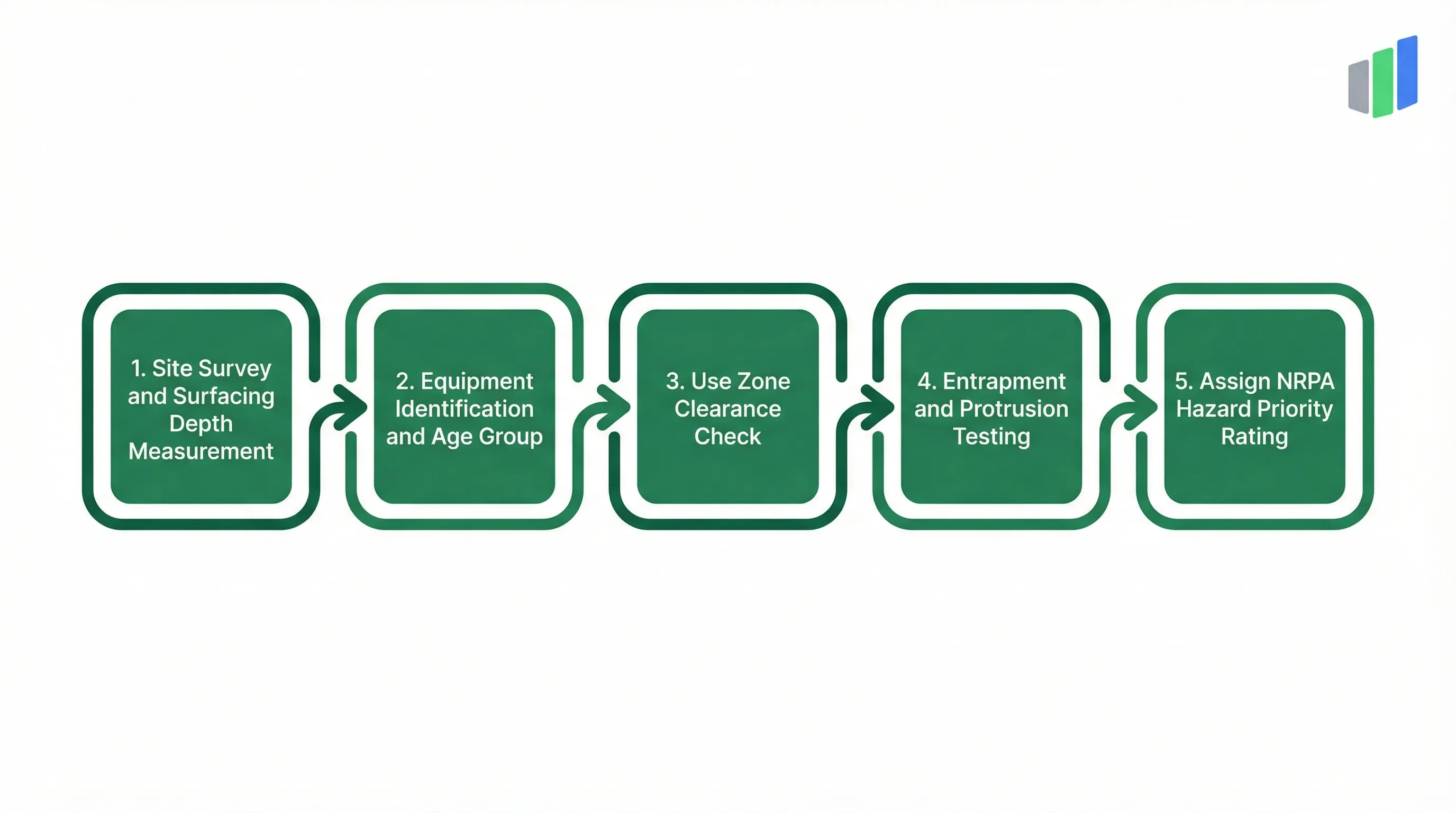
ASTM F1487 (Standard Consumer Safety Performance Specification for Playground Equipment for Public Use) is the primary U.S. standard for public playground safety. It defines use zone clearances, entrapment openings, protrusion limits, protective surfacing requirements, and a four-level NRPA hazard priority rating from Critical to Non-Compliant.
- Full Name
- Standard Consumer Safety Performance Specification for Playground Equipment for Public Use
- Issuing Body
- ASTM International
- Current Revision
- ASTM F1487-24
PROTECTIVE SURFACING
Site Conditions and Protective Surfacing Requirements
Every ASTM F1487 audit begins with the ground beneath the equipment — the protective surfacing system is the single most important injury-prevention element on a playground.
Protective surfacing is the first line of defense against head injuries, the most serious playground-related trauma. ASTM F1487 requires that every piece of equipment with a designated play surface above 30 inches have impact-attenuating surfacing within the use zone. The companion standard ASTM F1292 (Standard Specification for Impact Attenuation of Surfacing Materials) defines the drop-test methodology and the threshold of 200g peak acceleration — the maximum deceleration a child's head can sustain without risk of life-threatening injury. The form captures the Protective Surfacing Type, which determines the inspection methodology: loose-fill materials like Engineered Wood Fiber (EWF), wood chips, and sand require depth measurements, while unitary surfaces like poured-in-place rubber, rubber tiles, and synthetic turf require visual condition assessments.
For loose-fill surfaces, the inspector records the Measured Loose-Fill Depth at multiple points within the use zone. The minimum depth required depends on the equipment's Critical Fall Height — for fall heights up to 7 feet, a 9-inch depth of EWF is typically sufficient, while fall heights up to 10 feet require 12 inches of compressed depth. Over time, loose-fill material migrates away from high-traffic areas (under swings, at slide exits) and compacts, reducing its shock-absorbing capacity. The Surfacing Compaction field captures whether the material remains loose and uncompacted (optimal), is moderately compacted, or has become excessively compacted or hardened — a condition where even adequate depth no longer provides the required impact attenuation. Frozen loose-fill material performs as a hard surface and must be flagged as non-compliant during cold weather inspections.
Beyond surfacing performance, the site assessment covers Drainage Condition, which directly affects surfacing integrity — standing water accelerates decomposition of organic loose fill, while erosion can displace surfacing material entirely. The inspector documents Observed Trip Hazards including exposed concrete footings, tree roots, surfacing debris, and containment borders that protrude above the walking surface. Finally, the Age Appropriateness Signage check verifies that the playground is properly labeled for its intended age group (2-to-5 years, 5-to-12 years, or both), as required by ASTM F1487 Section 7. Signage is more than informational — it establishes the dimensional compliance baseline, because guardrail heights, step spacing, and platform access requirements differ between age groups.
ASTM F1487 Protective Surfacing Types
Surfacing Type
Category
Key Inspection Points
| Surfacing Type | Category | Key Inspection Points |
|---|---|---|
| Engineered Wood Fiber (EWF) | Loose-Fill | Depth measurement at high-traffic areas, compaction level, drainage displacement |
| Wood Chips / Mulch | Loose-Fill | Depth measurement, decomposition state, mold growth in wet climates |
| Sand | Loose-Fill | Depth measurement, foreign object contamination, animal waste, compaction |
| Poured-in-Place Rubber | Unitary | Surface cracking, UV degradation, seam separation, drainage pooling |
| Rubber Tiles | Unitary | Tile displacement, edge curling, joint gaps, surface wear |
| Synthetic Turf | Unitary | Infill migration, seam integrity, pile matting, temperature warnings |
| Grass / Dirt | Non-Compliant | Not acceptable as impact-attenuating surfacing under ASTM F1292 |
Impact attenuation testing methodology is detailed in the companion standard ASTM F1292.
EQUIPMENT AUDIT
Per-Equipment Inspection and Structural Assessment
Each piece of playground equipment receives an individual audit covering structural integrity, hardware condition, Critical Fall Height compliance, and use zone adequacy.
The ASTM F1487 comprehensive audit inspects every piece of playground equipment as an individual asset. The repeatable Equipment Inventory section begins with an Equipment ID/Tag for unique identification and an Equipment Type classification — the form distinguishes between composite play structures, single-axis swings, multi-axis (tire) swings, standalone slides, climbers and horizontal ladders, rotating equipment, and see-saws or spring rockers. Each type has specific dimensional requirements under ASTM F1487, which is why the type classification drives the compliance checks that follow.
The Intended Age Group field is not merely demographic — it determines which dimensional standards apply to that specific piece of equipment. For children aged 2 to 5, guardrails must be at least 29 inches high, platform access must not exceed a 12-inch step height, and sliding poles are prohibited entirely. For the 5-to-12 age group, guardrail heights increase to 38 inches, step spacing relaxes, and more challenging climbing elements are permitted. Equipment designated for toddlers (6 to 23 months) under the companion standard ASTM F2373 has the most restrictive dimensional requirements. Mismatched signage and equipment design is itself a compliance violation — a platform with 30-inch guardrails on equipment signed for 2-to-5 year olds is technically compliant, but the same guardrail height on equipment signed for all ages (2-to-12) fails the 5-to-12 requirement.
The Critical Fall Height (CFH) is the maximum height from which a child could fall from the equipment to the ground. This measurement is the bridge between the equipment audit and the surfacing assessment: the CFH determines the minimum surfacing depth and use zone extent required beneath that equipment. Use Zone Compliance checks whether the clear area around the equipment meets the minimum 6-foot radius (more for swings, slides, and rotating equipment). The form flags three outcomes: Compliant (6-foot-plus clearance in all directions), Insufficient Clearance (the zone exists but is undersized), and Prohibited Overlap (the use zone of one piece of equipment overlaps another, creating a collision hazard). Use zone violations are among the most common findings in playground audits and carry high injury potential.
Structural Integrity and Hardware & Fasteners assessments complete the physical inspection. The inspector evaluates the equipment for surface rust, deep corrosion or rot, cracks and splintering, and broken or missing components. Hardware checks focus on fastener tightness, missing fasteners, and the critical S-hook gap measurement — ASTM F1487 requires that S-hooks on swing chains be closed to a gap of no more than 0.04 inches (approximately the thickness of a dime). Open S-hooks are a leading cause of finger entrapment injuries. Three boolean hazard flags round out the equipment record: Protrusion/Entanglement Hazards Found, Head/Neck Entrapment Hazards Found, and Crush/Shear Points Found. Each affirmative flag triggers a mandatory defect photo and a Priority 1 or Priority 2 hazard entry in the summary section.
The Australian equivalent for playground equipment safety is the AS 4685 standard.
Try this ASTM F1487 form in Geocadra
We have a pre-built ASTM F1487 inspection template ready to go. Sign up and start your first condition assessment today.
Free 14-day trial. No credit card required.
HAZARD PRIORITY
The NRPA/CPSI Hazard Priority Rating Scale
Every identified hazard is classified into one of four priority levels that determine the urgency and type of corrective action required.
The ASTM F1487 standard itself does not define a risk rating system — it defines pass/fail compliance criteria. The risk classification layer comes from the NRPA (National Recreation and Park Association) Certified Playground Safety Inspector (CPSI) program, which overlays a four-level Hazard Priority Rating onto ASTM F1487 findings. This priority system is the de facto industry standard in the United States for translating binary compliance results into actionable maintenance and capital planning priorities.
The priority rating combines two dimensions: the probability that the hazard will cause an injury and the severity of the potential injury. A condition that is both highly probable and potentially fatal (such as an entrapment hazard on an elevated climber) receives Priority 1, while a condition that is unlikely to cause injury and violates only the letter of the standard (such as a minor signage omission) receives Priority 4. The intermediate levels — Priority 2 for serious but non-disabling injury potential and Priority 3 for minor or low-probability hazards — provide the gradient that maintenance teams need to allocate limited budgets effectively.
| Priority | Severity | Required Action | Examples |
|---|---|---|---|
| Priority 1 — Critical | Potential for permanent disability, loss of life, or loss of body part | Immediate correction; remove from service if repair not possible same day | Head entrapment on elevated climber, unanchored equipment, severe entanglement hazard |
| Priority 2 — Serious | Potential for serious but non-disabling injury | Repair as soon as possible | Inadequate surfacing depth at critical fall height, sharp protrusion, minor crush points |
| Priority 3 — Minor | Slight injury potential or low probability of occurrence | Correct during routine maintenance | Loose handhold not yet detached, minor S-hook wear, surface rust on non-structural element |
| Priority 4 — Non-Compliant | Does not meet strict letter of standard but poses minimal demonstrable risk | Monitor or correct during major renovation | Missing age-group signage, slight dimensional deviation in barrier height |
In the digital form, the Hazard & Non-Compliance Summary section links each identified hazard to the Related Equipment ID from the equipment audit, assigns the Hazard Priority Rating, captures a free-text Hazard Description, and records the Recommended Action. The action options — Remove Equipment, Repair Immediately, Replace Component, and Monitor — align directly with the priority levels: Priority 1 findings typically require equipment removal or immediate repair, while Priority 4 findings may only need monitoring until the next scheduled renovation. Every hazard entry requires a Defect Photo for documentation and liability purposes. The structured linking of hazard records to specific equipment items creates a traceable audit trail from finding to corrective action.
Understanding the priority scale is essential for playground operators because it directly impacts legal liability. U.S. courts have consistently held that awareness of a Priority 1 hazard without prompt corrective action constitutes negligence. The CPSI program teaches that Priority 1 conditions must be addressed within the same day — if immediate repair is not possible, the equipment must be taken out of service by barricading or removing it. This urgency framework is why the digital form enforces the priority classification as a required field for every logged hazard.
The CPSI certification and playground safety training is administered by the National Recreation and Park Association (NRPA).
ENTRAPMENT & PROTRUSION
How Entrapment and Protrusion Hazards Are Tested
ASTM F1487 mandates specific test probes and gauges to identify entrapment, protrusion, and entanglement hazards — the three categories of hazard most strongly associated with fatal playground injuries.
Head and neck entrapment is the single most dangerous playground hazard because it can result in strangulation and death within minutes. ASTM F1487 defines entrapment as any opening that could trap a child's head or torso. The critical dimension range is between 3.5 inches and 9.0 inches — openings smaller than 3.5 inches cannot admit a child's torso, and openings larger than 9.0 inches allow a child's head to pass through freely. Any opening within this range creates a trap where a child's body or feet can pass through but the head cannot, leading to suspension by the neck. Inspectors test for entrapment using standardized head and torso probes: the small head probe (representing a young child's skull) is applied to all accessible openings. If the probe passes partially through but cannot complete the transit, the opening fails the entrapment test.
Protrusion hazards are evaluated using a different set of gauges. A protrusion is any projection from the equipment surface that could snag clothing, catch a drawstring, or impale a child during a fall. ASTM F1487 classifies protrusions by their geometry: bolts extending more than two threads beyond the nut, hook openings that can catch fabric, exposed rod ends, and sharp edges or corners. The protrusion gauge test places a standardized template against the equipment surface — any projection that extends beyond the face of the gauge fails the test. The distinction between protrusion and entanglement is important: a protrusion that cannot catch fabric may still fail as a laceration hazard if it has sharp edges, while a smooth but protruding bolt may catch a hood drawstring and create an entanglement/strangulation risk.
Crush and shear points represent the third major hazard category. These occur on moving equipment — swings, see-saws, merry-go-rounds, and any element with hinged or rotating parts. A crush point exists where two surfaces move toward each other with enough force to compress a child's finger, hand, or limb. A shear point exists where two surfaces slide past each other closely enough to cut. The form's three boolean flags — Protrusion/Entanglement Hazards Found, Head/Neck Entrapment Hazards Found, and Crush/Shear Points Found — are intentionally binary because any positive finding in these categories is automatically a Priority 1 or Priority 2 hazard. There is no "minor entrapment" — if a head probe fails, the equipment must be taken out of service immediately.
The testing methodology distinguishes ASTM F1487 comprehensive audits from routine visual inspections. A daily walk-through can spot a missing bolt or broken chain, but it cannot identify an entrapment opening that has developed due to wood shrinkage, a protrusion created by a loosened bolt, or a crush point caused by worn bearings on a swing hanger. These hazards require physical measurement with calibrated probes and gauges, which is why the comprehensive audit is performed by a trained CPSI rather than general maintenance staff. Explore all available inspection standards in the standards library.
QUESTIONS
Frequently Asked Questions
What is ASTM F1487?
ASTM F1487 is the primary U.S. safety specification for public playground equipment. It defines dimensional requirements for use zones, entrapment openings, protrusion limits, and protective surfacing, covering equipment intended for children aged 2 to 12 years in parks, schools, and childcare facilities.
Is ASTM F1487 mandatory or voluntary?
ASTM F1487 is technically a voluntary consensus standard published by ASTM International. However, it is widely adopted as the legal standard of care by municipalities, school districts, and courts. Most U.S. playground injury lawsuits reference ASTM F1487 compliance as the benchmark for reasonable safety.
What is the difference between ASTM F1487 and CPSC Pub 325?
ASTM F1487 is a detailed technical specification with precise dimensional requirements and test methods. CPSC Publication 325 (Public Playground Safety Handbook) is a general guidance document published by the Consumer Product Safety Commission. F1487 is more specific and is the standard used for compliance audits.
What is a Critical Fall Height in playground inspection?
Critical Fall Height (CFH) is the maximum height from which a child could fall from a piece of playground equipment. It determines the required depth and type of protective surfacing. For example, a slide platform at 6 feet requires surfacing tested to attenuate impacts from a 6-foot fall per ASTM F1292.
How are hazard priorities assigned in a playground audit?
The NRPA/CPSI framework uses a four-level system. Priority 1 (Critical) covers life-threatening hazards requiring immediate action. Priority 2 (Serious) covers significant injury risks. Priority 3 (Minor) covers low-probability hazards for routine maintenance. Priority 4 (Non-Compliant) covers technical violations with minimal risk.
What qualifications are needed to perform an ASTM F1487 audit?
Comprehensive ASTM F1487 audits are typically performed by Certified Playground Safety Inspectors (CPSI) trained through the National Recreation and Park Association (NRPA). The certification covers test probe usage, dimensional measurement techniques, hazard identification, and priority classification.
What is the difference between ASTM F1487 and AS 4685?
ASTM F1487 is the U.S. playground equipment safety standard, while AS 4685 is the Australian/New Zealand equivalent based on ISO 8124 and EN 1176. Both address entrapment, fall heights, and surfacing, but differ in dimensional thresholds, age group definitions, and risk rating methodology.
In practice
See how the round runs in Geocadra
The solution page shows this inspection regime on real open data: the import, the form, the round, the record per asset and the export.
Playground checks, headstone tests and green-space acceptances on a map, with every round appended to the siteOpen the solution page: Municipalities & Public SpaceTRY IT FREE
Digitize your ASTM F1487 inspections
Replace paper forms and spreadsheets with structured digital inspections, built for standards like ASTM F1487.
No credit card requiredFree trial included