CIRIA C753 SuDS Inspection
The UK framework for maintaining sustainable drainage systems through structured performance inspection.
CIRIA C753, The SuDS Manual, is the authoritative guide for planning, designing, constructing, and maintaining Sustainable Drainage Systems in the United Kingdom. Chapter 32 and Appendix B define a structured maintenance inspection regime that moves beyond simple pass/fail checks to an interventional assessment model. This guide covers the three-tier maintenance hierarchy, the A-to-E condition rating scale, performance assessment criteria across ten SuDS component types, the defect logging methodology, and how to digitize the entire inspection workflow with Geocadra.
What is CIRIA C753?
CIRIA C753 (The SuDS Manual) is the UK standard for planning, design, construction, and maintenance of Sustainable Drainage Systems. Its inspection framework (Chapter 32 / Appendix B) classifies maintenance into three tiers — Regular, Occasional, and Remedial — and uses an A-to-E condition rating to drive prioritised intervention for SuDS components such as swales, bioretention systems, permeable pavements, and ponds.
- Full Name
- The SuDS Manual
- Issuing Body
- Construction Industry Research and Information Association (CIRIA)
- Current Revision
- CIRIA C753 (2015)
OVERVIEW
How CIRIA C753 SuDS Inspections Work
CIRIA C753 provides the definitive inspection methodology for Sustainable Drainage Systems in the UK. Unlike traditional piped drainage that is either flowing or blocked, SuDS components are living systems whose performance depends on the interaction of hydraulic function, vegetation health, structural integrity, and water quality treatment. The inspection regime defined in Chapter 32 and Appendix B of the manual recognises this complexity by requiring inspectors to assess multiple performance dimensions for each component.
The standard covers ten distinct SuDS component types: swales, bioretention systems, permeable pavements, detention basins, ponds and wetlands, filter drains, infiltration trenches, soakaways, green roofs, and attenuation tanks. Each component type has specific maintenance schedules and inspection criteria, though the overall framework applies universally. An inspector begins by identifying the component type and its primary function — which may include infiltration, attenuation, conveyance, water quality treatment, or amenity and biodiversity value.
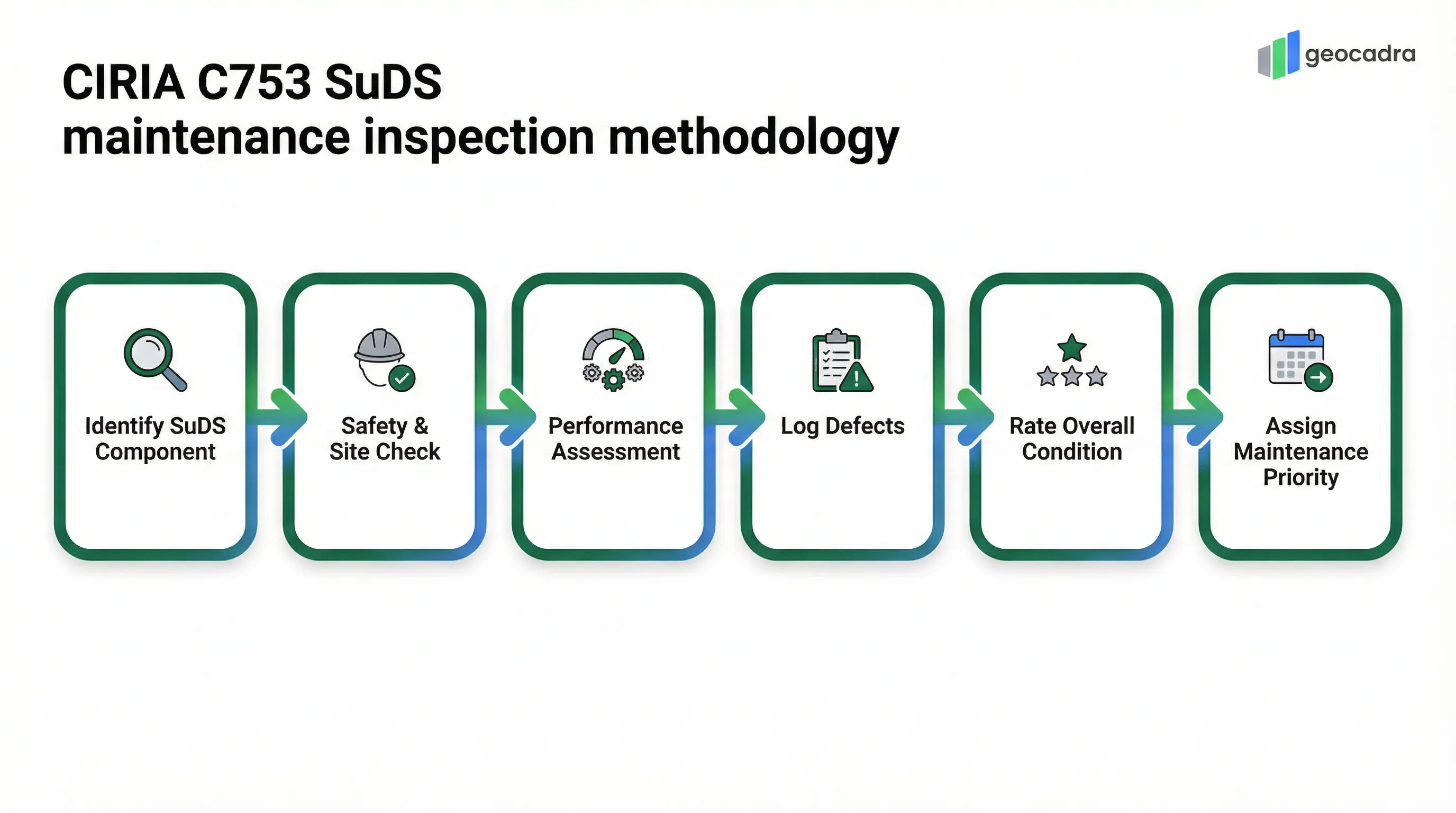
The inspection workflow follows the form structure defined in Appendix B (Table B.25): starting with asset identification and safety checks, moving through a detailed performance and condition assessment, logging specific defects where found, and concluding with an overall condition rating and prioritised maintenance actions. This structured approach ensures that every SuDS asset is evaluated consistently, regardless of which inspector carries out the work.
The standard is published by the Construction Industry Research and Information Association (CIRIA) and is the primary reference for SuDS practice in England and Wales.
CONDITION SCALE
The A-to-E Condition Rating Scale
Each SuDS component receives an overall condition rating from A (Good) to E (Critical). This rating drives maintenance priority and budget allocation across the drainage portfolio.
CIRIA C753 does not mandate a strict numerical scoring algorithm like NEN 2767. Instead, it uses a performance-based assessment where the inspector evaluates multiple factors — sediment accumulation, hydraulic performance, vegetation condition, structural integrity, litter and debris, and pollution evidence — and then assigns an overall condition rating that reflects the asset's ability to deliver its design function. The five-point scale maps directly to the standard's three-tier maintenance hierarchy: ratings A and B trigger only routine scheduled maintenance, rating C triggers occasional maintenance such as silt removal or vegetation thinning, rating D triggers remedial work to repair defects, and rating E triggers urgent immediate action.
A key distinction from other asset condition standards is that the CIRIA C753 rating is explicitly interventional. The rating does not just describe the current state — it prescribes the required response. An inspector who assigns a rating of D is simultaneously declaring that remedial maintenance is required, which in turn triggers a specific set of available actions from the maintenance schedule tables in the manual (e.g., Table 22.1). This direct link between assessment and action is what makes the framework practical for operational teams managing large portfolios of SuDS assets.
| Rating | Condition | Description |
|---|---|---|
| A | Good | Asset functioning as designed. No maintenance required beyond the standard schedule. |
| B | Satisfactory | Minor cosmetic issues or normal accumulation. Routine maintenance sufficient. |
| C | Fair | Performance reduced but still functional. Occasional maintenance required (e.g. silt removal). |
| D | Poor | Asset struggling to function or structurally damaged. Remedial work required. |
| E | Critical | Asset failed, blocked, or causing flooding. Urgent immediate action required. |
Ratings map directly to the CIRIA C753 three-tier maintenance hierarchy: Routine (A/B), Occasional (C), Remedial (D), Urgent (E).
Similar performance-based condition rating systems are found in the CROW KOR visual quality standard, which also uses image-based assessment for public space infrastructure assets.
Try this CIRIA C753 form in Geocadra
We have a pre-built CIRIA C753 inspection template ready to go. Sign up and start your first condition assessment today.
Free 14-day trial. No credit card required.
MAINTENANCE HIERARCHY
The Three-Tier Maintenance Model
CIRIA C753 organises all SuDS maintenance into three distinct tiers, each with defined trigger conditions, typical tasks, and frequency expectations.
The three-tier maintenance hierarchy is the core operational concept in CIRIA C753. It provides a structured decision framework that converts inspection findings into specific maintenance actions. Each tier has different resource requirements, cost implications, and urgency levels, allowing asset managers to plan budgets and allocate teams effectively across large SuDS portfolios.
Regular Maintenance
Routine tasks performed on a fixed schedule regardless of condition findings. These include grass cutting along spillways and access paths, litter and debris removal, clearing leaf litter from inlets, and general visual checks. Regular maintenance is preventative — it stops minor accumulations from becoming performance-affecting blockages. Typical frequencies range from monthly (litter picking) to seasonal (grass cutting). In the inspection form, actions like "Cut grass (Spillways/Access)", "Remove litter/debris", and "Cut meadow grass" fall into this tier.
Occasional Maintenance
Infrequent tasks triggered by specific conditions observed during inspection. These include removing sediment from inlets and forebays, thinning vegetation, pruning trees that obstruct flow paths, scarifying or spiking infiltration surfaces, and sweeping permeable pavements. Occasional maintenance is condition-responsive — it addresses accumulations or growth that have reached a threshold affecting hydraulic performance. A SuDS component rated C (Fair) typically requires one or more occasional maintenance actions.
Remedial Maintenance
Corrective work to repair specific defects or damage identified during inspection. Remedial tasks include repairing erosion or bank collapse, clearing inlet or outlet blockages, repairing pipework or concrete structures, and replacing failed permeable paving blocks. Remedial maintenance is defect-driven — it requires a work order, specialist resources, and often a follow-up inspection to confirm the repair has restored performance. Components rated D (Poor) or E (Critical) require remedial intervention.
The maintenance schedule tables are detailed in Chapter 22 of the SuDS Manual, available through susdrain, the CIRIA-supported knowledge network.
PERFORMANCE ASSESSMENT
Six Performance Dimensions for SuDS
The core of a CIRIA C753 inspection is the multi-dimensional performance assessment. Each dimension captures a different aspect of SuDS function.
Unlike single-metric condition assessments, CIRIA C753 requires the inspector to evaluate six distinct performance dimensions for every SuDS component. This multi-dimensional approach reflects the reality that a swale can have excellent vegetation but critical sediment blockage, or a permeable pavement can be structurally sound but hydraulically impaired due to clogging. Each dimension is assessed independently before the inspector synthesises them into a single overall condition rating.
Sediment Accumulation
Assessed on a four-point scale from "None Visible" through "Minor (Within tolerance)" and "Significant (>50% capacity)" to "Critical (Inlet/Outlet blocked)". Where sediment is present, the inspector records the depth in millimetres. Sediment is the primary failure mode for most SuDS components — forebays are specifically designed as sacrificial sediment traps to protect the main body of the system.
Hydraulic Performance
Evaluated as "Good Flow", "Poor Infiltration", "Ponding (where not designed)", or "Channelling/Erosion visible". This dimension captures whether the component is actually managing water as intended. Ponding in a swale (designed to convey) is a defect; ponding in a detention basin (designed to store) is expected. The inspector must understand the component's design intent to assess this correctly.
Vegetation Condition
Rated as "Satisfactory", "Overgrown", "Sparse/Dying", or "Invasive Species Present". Vegetation plays a critical hydraulic role in many SuDS components — grass in swales slows flow and traps sediment, plants in bioretention systems provide uptake and filtration. If invasive species are identified, the inspector records species details for targeted removal planning.
Litter & Debris
Classified from "None" through "Minor (Aesthetic only)" and "Major (Potential Blockage)" to "Hazardous Waste". While minor litter is primarily an amenity concern, major accumulations can block inlets, reduce storage volume, and impair water quality treatment. Hazardous waste findings trigger an immediate escalation response.
Structural Integrity
Assessed as "Good Condition", "Minor Damage (Spalling/Cracks)", "Major Damage (Collapse/Displacement)", or "Vandalism". This dimension is most critical for engineered components like attenuation tanks, permeable pavement sub-bases, and headwall structures. Structural failure can result in sudden, uncontrolled flooding.
Pollution Evidence
A multi-select assessment covering oil or petrol sheen, sewage odour, discolouration, algae bloom, and silt plumes. Pollution indicators suggest that the SuDS component is receiving contaminated inflow or that its water quality treatment function has been overwhelmed. Pollution findings often require investigation upstream of the SuDS asset itself.
For underground drainage assets requiring coded defect assessment, see the EN 13508-2 sewer inspection standard. Browse all available inspection standards in the standards directory.
DIGITAL WORKFLOW
Digitize CIRIA C753 Inspections with Geocadra
Paper-based SuDS inspection checklists are slow to complete, difficult to consolidate across portfolios, and create data gaps that undermine maintenance planning. Geocadra replaces that workflow with a structured digital process.
Component-specific inspection forms
Pre-built CIRIA C753 templates with dropdown selectors for all ten SuDS component types, performance dimensions, and defect categories. Inspectors select from standardised options — never free-typing condition descriptions — ensuring consistent, comparable data across every asset in the portfolio.
Photo-linked defect logging
Every defect record is tied to geotagged photographs and a map location. When an inspector logs erosion at a specific inlet headwall, the photo, GPS coordinates, severity level, and comments are captured in a single linked record — not scattered across a paper form and a phone gallery.
Automatic maintenance action mapping
Based on the inspector's condition rating and observed defects, Geocadra maps findings to the CIRIA C753 maintenance hierarchy and presents the appropriate action options from the manual's maintenance schedule tables. The connection between assessment and response is built into the workflow.
Portfolio-level trend analysis
Track condition ratings and maintenance actions over time across your entire SuDS estate. Identify components trending from B to C before they reach D, prioritise capital maintenance budgets based on data rather than complaints, and demonstrate compliance with adoption agreements to the adopting body.
QUESTIONS
Frequently Asked Questions
What is CIRIA C753?
CIRIA C753, known as The SuDS Manual, is the UK standard for planning, designing, constructing, and maintaining Sustainable Drainage Systems. Published by the Construction Industry Research and Information Association, it provides the definitive guidance on SuDS maintenance inspection, using a three-tier maintenance hierarchy and an A-to-E condition rating scale.
What SuDS component types does CIRIA C753 cover?
The standard covers ten component types: swales, bioretention systems, permeable pavements, detention basins, ponds and wetlands, filter drains, infiltration trenches, soakaways, green roofs, and attenuation tanks. Each type has specific maintenance schedules, though the overall inspection framework applies to all.
How does the CIRIA C753 condition rating work?
Inspectors evaluate six performance dimensions — sediment, hydraulic performance, vegetation, litter, structural integrity, and pollution — then assign an overall A-to-E rating. A means good (routine maintenance only), C means fair (occasional maintenance needed), and E means critical (urgent action required).
What is the difference between Regular, Occasional, and Remedial maintenance in CIRIA C753?
Regular maintenance includes routine scheduled tasks like grass cutting and litter removal. Occasional maintenance covers condition-triggered tasks such as silt removal or vegetation thinning. Remedial maintenance addresses specific defects like erosion repair, blockage clearance, or structural damage that require a dedicated work order.
Is CIRIA C753 a legally mandatory standard in the UK?
CIRIA C753 is not statutory legislation, but it is the de facto standard referenced by planning authorities, SuDS Approving Bodies (SABs), and water companies across England and Wales. Adoption agreements for new developments typically require maintenance to follow C753 schedules, making compliance effectively mandatory.
How often should CIRIA C753 SuDS inspections be performed?
Routine visual inspections are typically conducted monthly or quarterly. Full condition assessments following the Appendix B checklist are normally performed annually, with additional post-event inspections after heavy rainfall or flooding. Components rated D or E may require more frequent monitoring until remedial work is completed.
Can CIRIA C753 be applied outside the United Kingdom?
While CIRIA C753 is a UK publication, its methodology has been adopted and adapted internationally. Countries without their own SuDS maintenance standard frequently reference C753 as best practice. The inspection framework and maintenance hierarchy are applicable to any sustainable drainage system regardless of jurisdiction.
In practice
See how the round runs in Geocadra
The solution page shows this inspection regime on real open data: the import, the form, the round, the record per asset and the export.
Lighting columns, poles, sewers and charge points inspected on a map, with every round appended to the assetOpen the solution page: Utilities & Public LightingTRY IT FREE
Digitize your CIRIA C753 inspections
Replace paper forms and spreadsheets with structured digital inspections, built for standards like CIRIA C753.
No credit card requiredFree trial included