CROW KOR Visual Quality
The Dutch standard for visual quality assessment of public green spaces using Beeldmeetlat image rulers and A+ to D grading.
The CROW Kwaliteitscatalogus Openbare Ruimte (KOR) 2023 is the definitive Dutch standard for monitoring the visual quality of public spaces. Unlike technical inspections that focus on structural integrity, the CROW KOR Beeldkwaliteit assessment (known as a schouw) evaluates the aesthetic and functional appearance of green assets based on user perception. This guide covers the five-level A+ to D grading scale, the Beeldmeetlat reference system for planting beds, lawns, hedges, and trees, numeric defect thresholds for weed coverage, litter counts, and bare patches, and the 2023 updates that changed how dead weeds and tree shoots are classified.
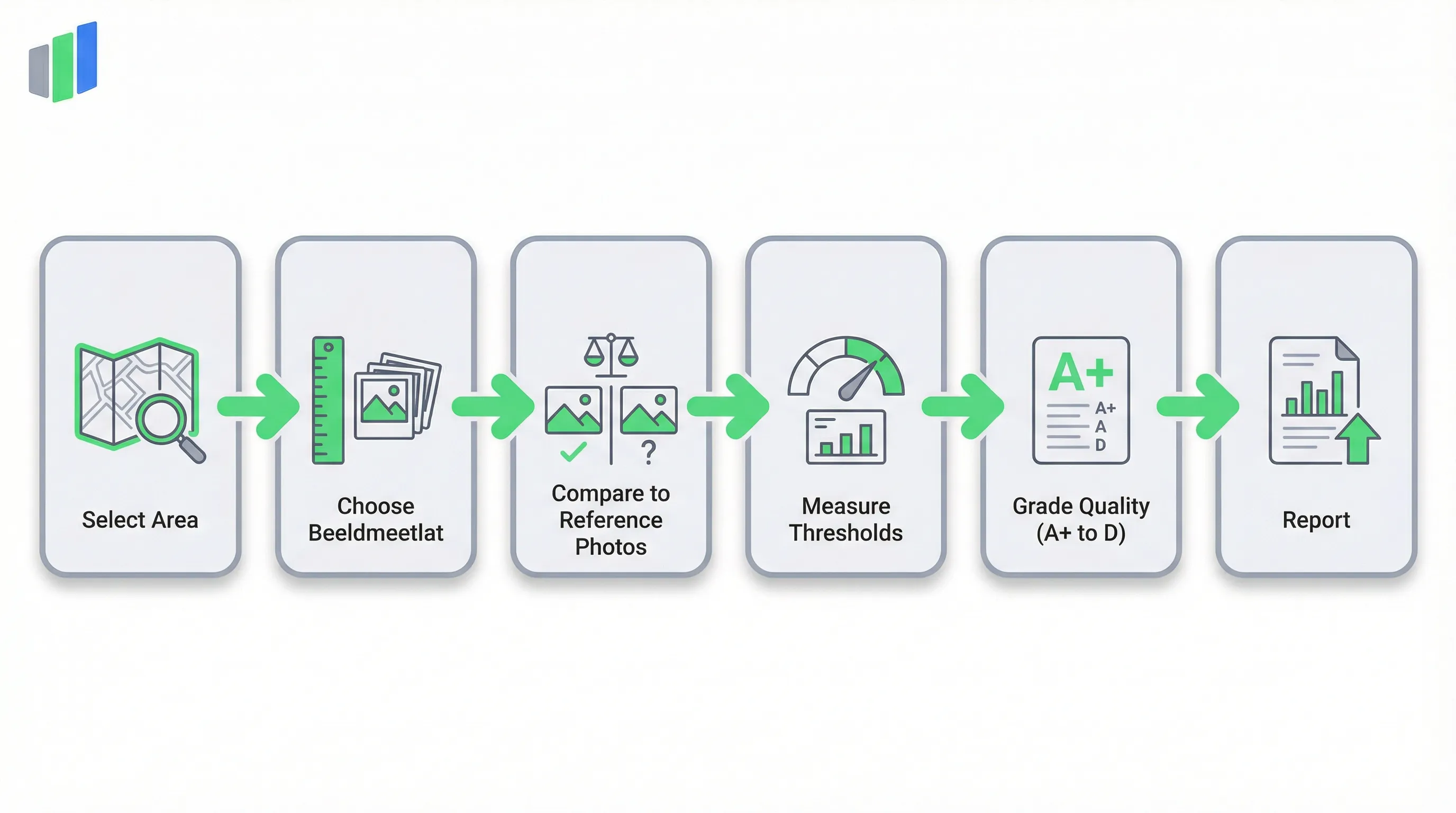
What is CROW KOR?
CROW KOR 2023 (Kwaliteitscatalogus Openbare Ruimte) is the Dutch national standard for visual quality assessment of public green spaces. Inspectors compare planting beds, lawns, hedges, and trees against photographic Beeldmeetlat (image ruler) references, assigning a grade from A+ (Very High) to D (Very Poor) based on measurable thresholds for weed coverage, litter, bare patches, and pruning condition.
- Full Name
- Kwaliteitscatalogus Openbare Ruimte (KOR) — Beeldkwaliteit Groen
- Issuing Body
- CROW (Dutch knowledge platform for infrastructure)
- Current Revision
- CROW KOR 2023
QUALITY SCALE
The Five-Level A+ to D Visual Quality Scale
CROW KOR grades every green asset on a five-point visual quality scale from A+ (Zeer Goed) to D (Slecht). The observed quality level determines whether the asset meets the contractually agreed target — the central question in result-based green space maintenance.
The CROW KOR quality scale defines five distinct levels of visual quality for public green spaces. Level A+ (Zeer Goed — Very Good) represents an as-new condition with virtually no visible defects: no weeds, no litter, no bare patches, and vegetation maintained to a precise silhouette. This level is rarely used as a contract target because maintaining it requires continuous, high-frequency intervention. Level A (Goed — Good) permits minor deviations — a small amount of weeds, occasional litter, and slight growth beyond the ideal pruning line. It is the standard for representative public spaces such as city centers, memorial parks, and civic building surroundings where visual appearance directly affects public perception.
Level B (Voldoende — Sufficient) is the most commonly specified contract level in Dutch municipalities. It represents a functional, adequately maintained condition where defects are present but controlled within acceptable limits. Weed coverage may reach up to 30% in planting beds, some coarse litter is tolerable, and hedge pruning may show some regrowth. Most Dutch result-based maintenance contracts (Beeldbestekken) set Level B as the minimum standard, making it the critical threshold for compliance assessment. When an inspector determines that the observed quality meets or exceeds the target level, the area is marked as compliant (Voldoet). When it falls below the target, the area is non-compliant (Voldoet niet), triggering corrective action from the maintenance contractor.
Level C (Matig — Moderate) indicates visible maintenance backlog: weeds cover a significant portion of planting beds, litter is clearly noticeable, hedges have lost their defined shape, and bare patches are spreading in lawns. While the asset is still functional, the visual quality falls below what most municipalities consider acceptable for public-facing spaces. Level D (Slecht — Poor) represents severe decline — weed overgrowth dominates, vegetation is dying or dead, litter accumulates, and the space no longer serves its aesthetic or recreational function. A D rating often signals that capital destruction has begun: soil structure degrades without ground cover, root zones become exposed, and replanting becomes necessary rather than simple maintenance recovery.
| Level | Dutch | English | Description |
|---|---|---|---|
| A+ | Zeer Goed | Very Good | As new — virtually no defects. No weeds, no litter, precise vegetation form. Highest maintenance intensity. |
| A | Goed | Good | Well maintained with minor deviations. Very low weed presence, minimal litter, neat pruning. Typical for representative areas. |
| B | Voldoende | Sufficient | Functional, basic maintenance level. Controlled weed presence, some litter, slight regrowth on hedges. The most common contract standard. |
| C | Matig | Moderate | Visible maintenance backlog. Significant weed coverage, noticeable litter, hedges losing shape, bare patches spreading. |
| D | Slecht | Poor | Severe decline. Weed overgrowth, dying vegetation, litter accumulation, capital destruction beginning. Replanting may be required. |
The Target Quality Level (Ambitie) is set per contract — typically A or B for most Dutch municipalities. The Observed Quality Level is compared against the target to determine compliance (Voldoet / Voldoet niet).
A related technical condition assessment is provided by the NEN 2767 condition assessment standard, which measures technical defects rather than visual quality.
BEELDMEETLAT SYSTEM
How the Beeldmeetlat Image Rulers Work
The Beeldmeetlat (Image Quality Ruler) is the defining feature of the CROW KOR methodology. Each asset type has its own Beeldmeetlat — a combination of photographic reference images and numeric threshold tables that together define what each quality level looks like in practice.
Unlike condition assessment standards that rely on individual defect ratings aggregated into a score, the CROW KOR system works by pattern matching: the inspector compares the observed state of an area to reference photographs that illustrate each quality level for that specific asset type. The Beeldmeetlat for Beplanting (Planting Beds) shows what Level A, B, C, and D look like for ground cover, shrubs, and perennial plantings — with corresponding threshold values for weed coverage percentage, high weed count per 100 square metres, bare patch percentage, and coarse litter count. The Beeldmeetlat for Gazon (Lawn) focuses on grass height, weed invasion, bare patches, and mowing regularity. For Hagen (Hedges), the reference shifts to the Snoeibeeld (Pruning Image) — whether the hedge has a sharp, well-defined silhouette (Strak), shows some shoot regrowth (Enige uitlopers), or has become ragged and shapeless (Rafelig).
The asset type selector (Beeldmeetlat field) in the form determines which set of reference criteria applies to the current inspection. When the inspector selects Beplanting, the relevant threshold fields become active: weed coverage percentage, high weed count, bare patches, and litter. When Hagen is selected, the pruning image selector and overhang length field appear instead. For Bomen (Trees), the assessment focuses on tree shoots (Waterlot) — whether the trunk and root zone show no shoots, a few shoots, limited shoot growth, or heavy shoot proliferation — as well as the condition of the Boomspiegel (tree pit). This conditional field logic ensures the inspector only records parameters relevant to the specific asset type, reducing data entry errors and aligning measurements with the correct Beeldmeetlat reference.
The five asset types covered by the green Beeldmeetlat are Beplanting (Planting Beds), Gazon (Lawn), Hagen (Hedges), Bomen (Trees), and Onkruid op Verharding (Weeds on Paving). Each has distinct measurement parameters and threshold values. A critical principle of the CROW KOR methodology is that the Beeldmeetlat is normative — the photographic references and numeric thresholds are not guidelines but binding definitions of what each level means. In result-based contracts, a dispute about whether a planting bed meets Level B is resolved by comparing it against the Beeldmeetlat thresholds, not by subjective judgment. This objectivity is what makes the system suitable for contractual enforcement: the inspector measures weed coverage, counts high weeds, and checks against the threshold table — if weed coverage exceeds 30% in a planting bed, it cannot be rated Level B regardless of overall visual impression.
The official CROW KOR documentation is maintained by CROW, the Dutch knowledge platform for infrastructure, traffic, spatial planning, and public space.
Try this CROW KOR form in Geocadra
We have a pre-built CROW KOR inspection template ready to go. Sign up and start your first condition assessment today.
Free 14-day trial. No credit card required.
DEFECT THRESHOLDS
Numeric Thresholds for Weeds, Litter, and Bare Patches
Each CROW KOR quality level is defined by specific numeric thresholds per defect indicator. These thresholds are normalized per 100 square metres for counting indicators and expressed as percentages for coverage indicators.
The weed assessment in CROW KOR combines two measurements: Bedekking (Coverage) as a percentage of the inspection area covered by weeds, and a count of high weeds exceeding a height threshold (typically 20 or 30 centimetres depending on asset type) per 100 square metres. For Beplanting (Planting Beds), Level A+ requires 0% weed coverage and zero high weeds. Level B — the most common contract standard — permits up to 30% weed coverage and up to 20 high weeds per 100 square metres. Level D is triggered when coverage exceeds 40% or the high weed count surpasses 30 per 100 square metres. The inspector records the Weed Coverage percentage and the High Weeds Count in the digital form, and the system compares these values against the target level thresholds to determine compliance.
| Level | Weed Coverage % | High Weeds (>30cm) per 100m² | Description |
|---|---|---|---|
| A+ | 0% | 0 | No weeds present — as-new planting condition. |
| A | ≤ 5% | ≤ 10 | Little weeds — minor and barely noticeable. |
| B | ≤ 30% | ≤ 20 | Limited weeds — controlled within functional limits. |
| C | ≤ 40% | ≤ 30 | Reasonable amount — visible maintenance backlog. |
| D | > 40% | > 30 | Many weeds — severe overgrowth, functional decline. |
Per CROW KOR 2023, dead or thermally treated weeds count towards weed coverage. Thresholds are normalized per 100 m².
Kale Plekken (Bare Patches) are measured as a percentage of the inspection surface where ground cover or grass has died, been trampled, or failed to establish. For planting beds, Level A+ allows 0% bare surface, Level B allows up to 10%, and Level D is reached when more than 25% of the surface is bare. Bare patches are particularly significant in ground cover plantings because they expose soil to erosion, facilitate weed establishment, and indicate either plant mortality or inadequate initial planting density. In the form, the inspector records bare patch percentage in the Kale Plekken field.
| Level | Bare Surface % |
|---|---|
| A+ | 0% |
| A | ≤ 5% |
| B | ≤ 10% |
| C | ≤ 25% |
| D | > 25% |
Bare patches indicate plant mortality, trampling, or failed establishment. They accelerate soil erosion and weed colonization.
Zwerfafval Grof (Coarse Litter) is counted as items larger than 10 centimetres per 100 square metres. Level A+ requires zero coarse litter, Level B allows up to 10 items, and Level D is reached when more than 25 items are found per 100 square metres. Coarse litter includes bottles, cans, food packaging, and other refuse visible from normal walking distance. The standard also defines Zwerfafval Fijn (Fine Litter) as items smaller than 10 centimetres, counted per square metre. The combination of weed coverage, bare patches, and litter count provides a multi-indicator assessment that prevents a single clean metric from masking poor overall quality — a planting bed might have zero litter but 40% weed coverage, which still results in a D rating.
| Level | Coarse Litter Count per 100m² |
|---|---|
| A+ | 0 |
| A | ≤ 3 |
| B | ≤ 10 |
| C | ≤ 25 |
| D | > 25 |
Coarse litter is defined as items larger than 10 cm. Fine litter (<10 cm) is counted per m² using separate thresholds.
For more detail on threshold values, refer to the standards directory or the official CROW publication.
KOR 2023 UPDATES
Key Changes in the CROW KOR 2023 Revision
The 2023 revision of the CROW KOR introduced significant changes that affect how inspectors assess green spaces. Understanding these updates is essential for anyone conducting or auditing Beeldkwaliteit inspections under current contracts.
The most impactful change in CROW KOR 2023 is the reclassification of dead and thermally treated weeds. In previous editions, weeds that had been treated with hot water, steam, or flame — leaving brown, dead plant material on the surface — were not counted as "weeds" because they posed no biological growth threat. The 2023 revision reverses this: dead weeds are now considered visually disturbing and must be included in the weed coverage percentage. This has direct contractual implications — a maintenance contractor who treats weeds with thermal methods but does not remove the dead plant material may still fail the compliance check if the combined coverage of living and dead weeds exceeds the threshold. Inspectors must now record whether dead or treated weeds are present using the dedicated field in the form, and factor them into the overall weed coverage assessment.
The second major change consolidates tree shoot terminology. Previously, the standard distinguished between Stamopschot (trunk shoots) and Wortelopschot (root shoots) as separate indicators. The 2023 revision merges these into a single indicator called Waterlot, which captures all shoot growth regardless of its origin point on the tree. In the form, the inspector selects from four levels: Geen (None), Weinig (Little), Beperkt (Limited), or Veel (Much). This simplification reduces assessment ambiguity — inspectors no longer need to determine whether a shoot originates from the trunk base or the root flare, which was often difficult to establish in practice and led to inconsistent recordings.
The third significant change affects hedge assessment methodology. Instead of evaluating hedge maintenance based on pruning frequency (how many times per year the hedge was cut), the 2023 revision introduces the Snoeibeeld (Pruning Image/Silhouette) concept. The inspector evaluates the current visual state of the hedge against three reference conditions: Strak (Sharp/Tight) — a cleanly pruned, well-defined silhouette; Enige uitlopers (Some shoots) — moderate regrowth beyond the pruning line; and Rafelig (Ragged) — a shapeless, poorly defined form. Combined with the Overhang Length measurement in centimetres, this approach assesses the result of maintenance rather than the process, aligning with the overall result-based philosophy of the CROW KOR system.
The BVC standard for tree safety inspection complements the CROW KOR tree assessment with a detailed safety examination that goes beyond visual quality grading.
Many municipalities use the KOR system within Beeldbestekken contracts, as outlined in practice by the Association of Netherlands Municipalities (VNG).
DIGITAL WORKFLOW
Digitize CROW KOR Beeldkwaliteit Assessments
CROW KOR Beeldkwaliteit inspections are high-volume, repeated assessments — a single municipality may conduct hundreds of schouwen per year across parks, streets, and neighbourhoods. Digital forms streamline the process and ensure contractual traceability.
Conditional field logic per asset type
The form adapts to the selected Beeldmeetlat: choosing Beplanting activates weed coverage, bare patches, and litter fields; choosing Hagen activates pruning image and overhang length; choosing Bomen activates the Waterlot shoot indicator. Inspectors only see fields relevant to the asset being assessed, reducing errors and speeding up data entry in the field.
Target vs. observed compliance calculation
The inspector sets the contractual target level (Ambitie) and records the observed quality level. The system automatically determines whether the area is compliant (Voldoet) or non-compliant (Voldoet niet), building the audit trail required for result-based contracts. Non-compliant findings generate action items for the maintenance contractor.
Photo-linked evidence with action tracking
Reference photos are mandatory for every assessment, providing visual proof of the observed condition. The action required field lets inspectors flag specific corrective measures — weeding, pruning, cleaning, or repair — creating a direct workflow from inspection finding to maintenance task assignment.
Multi-asset inspections per location
A single green space location often contains multiple asset types — lawn, planting beds, hedges, and trees — each requiring a separate quality assessment. The form supports repeatable assessment blocks so the inspector can rate each asset type individually within one location inspection, capturing the full quality picture of the site.
QUESTIONS
Frequently Asked Questions
What is CROW KOR Beeldkwaliteit?
CROW KOR Beeldkwaliteit is the Dutch national standard for visual quality assessment of public green spaces. Inspectors compare the observed condition of planting beds, lawns, hedges, and trees against standardized Beeldmeetlat (image ruler) references and assign a grade from A+ (Very Good) to D (Very Poor) based on measurable defect thresholds.
What does the A+ to D scale mean in CROW KOR?
The five-point scale ranges from A+ (as new, no defects) through A (good, minor deviations), B (sufficient, the most common contract target), and C (moderate, visible backlog) to D (poor, severe decline with possible capital destruction). The observed level is compared against the contractual target level to determine compliance.
What is a Beeldmeetlat?
A Beeldmeetlat (Image Quality Ruler) is a reference tool specific to each asset type that combines photographic examples with numeric threshold tables. It defines what each quality level (A+ through D) looks like for that asset — for example, the Beplanting Beeldmeetlat specifies maximum weed coverage percentages and litter counts per quality level.
Do dead weeds count in CROW KOR 2023?
Yes. The 2023 revision explicitly states that dead, chemically treated, or thermally treated weeds count as present weeds because they are visually disturbing. This means a maintenance contractor who treats weeds without removing the dead plant material may still exceed the weed coverage threshold and fail the compliance assessment.
What is the most common contract level for green space maintenance?
Level B (Voldoende/Sufficient) is the most commonly specified target level in Dutch municipal result-based maintenance contracts (Beeldbestekken). It represents a functional, adequately maintained condition where defects are present but controlled within defined limits — for example, up to 30% weed coverage in planting beds.
How is CROW KOR used in result-based contracts?
In Beeldbestekken (result-based contracts), the municipality specifies a target quality level (usually B or A) per area. Inspectors conduct periodic schouwen (visual assessments) using the CROW KOR Beeldmeetlat. If the observed level falls below the target, the contractor must perform corrective maintenance at their own cost.
What is the difference between CROW KOR and NEN 2767?
CROW KOR assesses visual quality (Beeldkwaliteit) of public spaces using an A+ to D scale based on user perception and photographic references. NEN 2767 assesses the technical condition of built elements using a 1-to-6 score based on registered defects rated by severity, intensity, and extent. They serve different purposes and are often used for different asset types.
In practice
See how the round runs in Geocadra
The solution page shows this inspection regime on real open data: the import, the form, the round, the record per asset and the export.
Playground checks, headstone tests and green-space acceptances on a map, with every round appended to the siteOpen the solution page: Municipalities & Public SpaceTRY IT FREE
Digitize your CROW KOR inspections
Replace paper forms and spreadsheets with structured digital inspections, built for standards like CROW KOR.
No credit card requiredFree trial included