

CPSC 325 Playground Safety
The U.S. federal guideline for field-level playground hazard identification and priority-based risk management.
CPSC Publication 325 is the standard of care for public playground safety in the United States. Published by the Consumer Product Safety Commission, it provides the field-level inspection framework that owner-operators, maintenance teams, and Certified Playground Safety Inspectors (CPSI) rely on to identify life-threatening hazards, assess protective surfacing, and prioritize corrective actions. While ASTM F1487 defines manufacturing specifications, CPSC 325 is the hands-on guide for evaluating existing playground conditions in the real world.

What is CPSC 325?
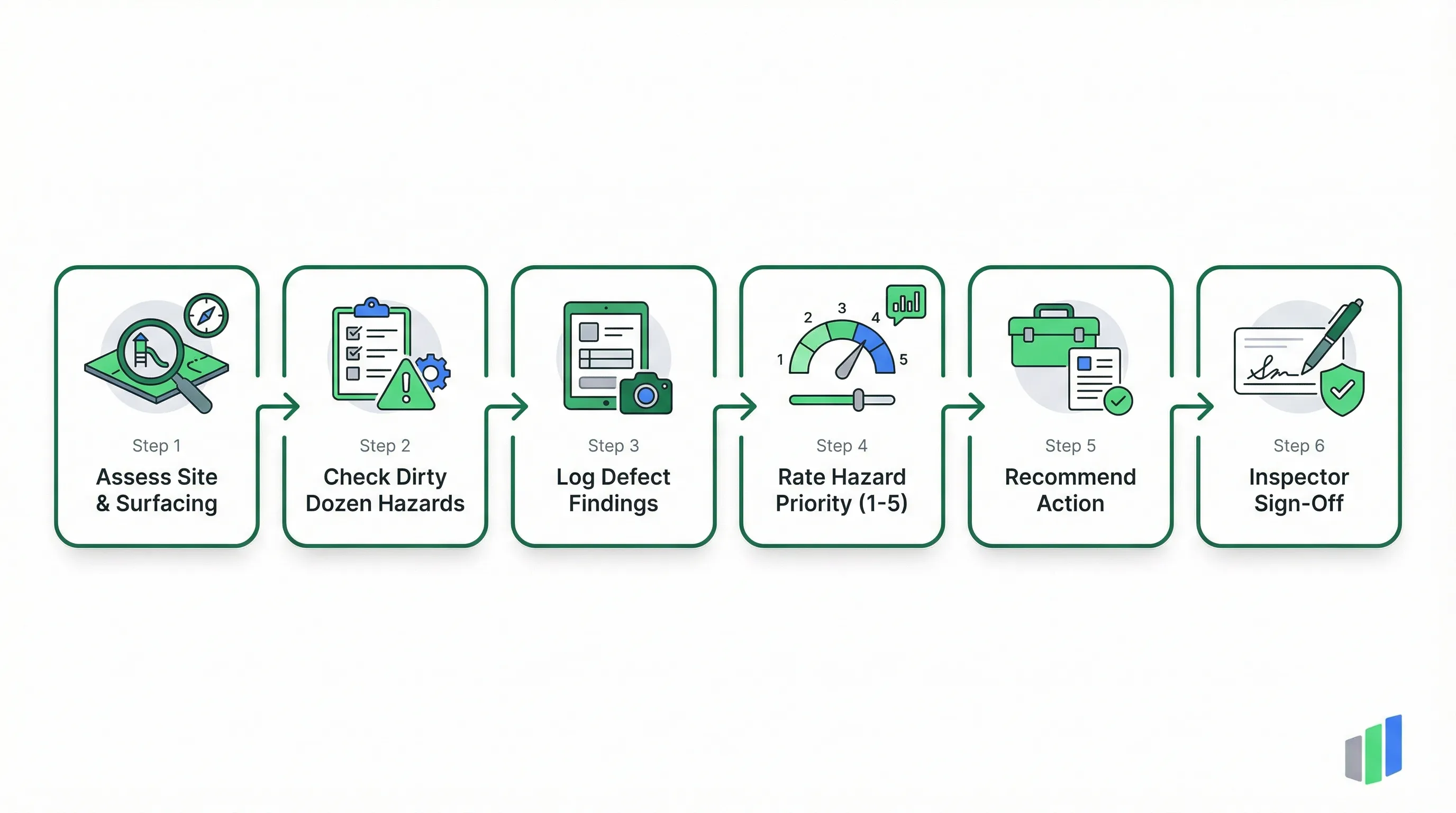
CPSC Publication 325 (Public Playground Safety Handbook) is the primary U.S. federal guideline for playground hazard identification. It defines a field inspection workflow covering protective surfacing, the Dirty Dozen hazard categories, and a five-level Hazard Priority Rating (1-5) used by CPSI-certified inspectors nationwide.
- Full Name
- Public Playground Safety Handbook
- Issuing Body
- U.S. Consumer Product Safety Commission (CPSC)
- Current Revision
- CPSC Publication 325 (2015 Edition)
PROTECTIVE SURFACING
Site Conditions and Protective Surfacing Assessment
The CPSC 325 inspection begins with the ground beneath the equipment, because inadequate surfacing is the leading contributor to serious playground injuries.
Protective surfacing is the single most critical safety factor on any playground. CPSC Publication 325 identifies falls to the surface as the cause of approximately 79% of all playground-related injuries treated in emergency rooms. The handbook requires that every piece of equipment with a designated play surface above 30 inches for school-age children (or above 20 inches for preschoolers) have impact-attenuating surfacing within the use zone. The companion standard ASTM F1292 provides the laboratory test method, but CPSC 325 is the field guide that inspectors use to evaluate whether the installed surfacing actually performs as required under real-world conditions.
The inspection form captures the Surfacing Material Type, which determines the specific checks that follow. Loose-fill materials such as Engineered Wood Fiber (EWF), wood chips, sand, and pea gravel require depth measurement at multiple points within the use zone. The minimum recommended depth is 9 inches for most loose-fill materials at fall heights up to 7 feet, increasing to 12 inches for fall heights up to 10 feet. Over time, loose fill compacts, migrates away from high-traffic areas beneath swings and at slide exits, and decomposes, reducing its shock-absorbing capacity. The Surfacing Condition multi-select captures these real-world degradation patterns: compacted material, displaced kick-out zones, debris or foreign objects, and mold or moss growth. Unitary surfaces like poured-in-place rubber, rubber tiles, and synthetic turf require visual assessment for cracking, seam separation, and drainage pooling rather than depth checks.
Beyond the surfacing material itself, the site assessment covers Play Area Drainage and Use Zone Obstructions. Standing water accelerates decomposition of organic loose fill and creates slip hazards, while erosion can displace surfacing material entirely. CPSC 325 requires a minimum 6-foot use zone around all equipment, free of obstructions such as fences, benches, trees, or other equipment. Weather conditions at the time of inspection are recorded because frozen ground and frozen loose-fill materials perform as hard surfaces with no impact attenuation, a critical factor for inspections conducted during winter months.
CPSC 325 Protective Surfacing Types and Inspection Points
Surfacing Type
Category
Key Inspection Points
| Surfacing Type | Category | Key Inspection Points |
|---|---|---|
| Engineered Wood Fiber (EWF) | Loose-Fill (Compliant) | Depth measurement, compaction level, drainage displacement, decomposition state |
| Wood Chips / Mulch | Loose-Fill (Compliant) | Depth measurement, decomposition, mold growth, foreign objects |
| Sand | Loose-Fill (Compliant) | Depth measurement, contamination, animal waste, compaction |
| Pea Gravel | Loose-Fill (Compliant) | Depth measurement, displacement into drainage, scatter beyond containment |
| Poured-in-Place Rubber | Unitary (Compliant) | Surface cracking, UV degradation, seam separation, drainage pooling |
| Rubber Tiles | Unitary (Compliant) | Tile displacement, edge curling, joint gaps, surface wear |
| Synthetic Turf | Unitary (Compliant) | Infill migration, seam integrity, pile matting, temperature |
| Asphalt / Concrete | Non-Compliant | Not acceptable as impact-attenuating surfacing under any condition |
| Grass / Dirt | Non-Compliant | Not acceptable; does not meet ASTM F1292 impact attenuation requirements |
Impact attenuation testing methodology is detailed in the companion standard ASTM F1292 (available via ASTM International).
THE DIRTY DOZEN
The Dirty Dozen: CPSC Hazard Categories
CPSC 325 organizes playground hazards into a set of critical categories commonly referred to as the Dirty Dozen, which form the backbone of every field safety checklist.
The Dirty Dozen is the informal but universally recognized name for the core hazard categories that CPSC Publication 325 instructs inspectors to evaluate on every playground visit. Each category represents a distinct mechanism of serious injury or death, and the inspection form captures a binary safe/hazard determination for each one. A "No (Hazard Present)" finding for any category triggers a mandatory entry in the Hazard Findings Log with a priority rating, photographic evidence, and recommended corrective action. This binary structure is intentional: there is no "partially safe" determination for head entrapment or crush points.
Sharp Points and Edges covers exposed metal burrs, delaminated plastic, splintered wood, and any surface that could cause lacerations. Protrusions and Entanglement addresses bolt ends extending more than two threads beyond the nut, open S-hooks that can catch drawstrings or clothing, and any projection that could snag a child during movement. Head Entrapment is the most critical category: openings between 3.5 inches and 9 inches can trap a child's head while the body passes through, creating a strangulation risk. Crush and Shear Points occur on moving equipment where two surfaces converge with sufficient force to compress a finger, hand, or limb. Trip Hazards include exposed concrete footings, protruding tree roots, and containment borders above the walking surface.
Hardware Security verifies that all fasteners, connectors, and caps are tight, present, and functioning. A loose bolt on a swing hanger or a missing cap on a protruding fastener transforms a compliant connection into a Priority 1 or Priority 2 hazard. Lead and Peeling Paint checks are especially important on older playground equipment manufactured before the CPSC ban on lead paint. Any evidence of peeling, flaking, or rust indicates a potential exposure risk that must be documented. Guardrails and Barriers must be present and secure on all platforms above 30 inches for school-age children and above 20 inches for preschool-age children. Equipment Spacing ensures a minimum 6-foot separation between structures to prevent collision injuries when children move between pieces of equipment.
The checklist structure makes the Dirty Dozen assessment rapid and systematic. An experienced CPSI can complete the general hazard sweep in 10 to 15 minutes per playground, identifying which categories require detailed findings entries. This two-tier approach, where a quick pass/fail sweep feeds a detailed findings log, is what distinguishes CPSC 325 from more granular per-equipment standards like ASTM F1487. The CPSC framework is designed for regular operational inspections by trained staff, not only for comprehensive annual audits by certified professionals.
For the detailed per-equipment manufacturing specification that complements CPSC 325, see the ASTM F1487 playground safety standard.
Try this CPSC 325 form in Geocadra
We have a pre-built CPSC 325 inspection template ready to go. Sign up and start your first condition assessment today.
Free 14-day trial. No credit card required.
HAZARD PRIORITY
The 1-to-5 Hazard Priority Rating Scale
Every defect found during a CPSC 325 inspection is classified using a five-level Hazard Priority Rating that determines the urgency of corrective action.
The Hazard Priority Rating system is the risk classification methodology taught by the National Recreation and Park Association (NRPA) Certified Playground Safety Inspector (CPSI) program. It assigns every identified defect a priority from 1 (highest, life-threatening) to 5 (compliant, no action needed). The scale combines two dimensions: the probability that the condition will cause an injury and the severity of the potential injury. A condition that is both highly probable and potentially fatal, such as a head entrapment opening on an elevated climber, receives Priority 1. A condition that is unlikely to cause injury and poses no demonstrable risk, such as minor cosmetic paint wear, receives Priority 5.
Understanding the five-level scale is critical for playground operators because it directly maps to legal liability and budget allocation. U.S. courts have consistently held that awareness of a Priority 1 hazard without prompt corrective action constitutes negligence. The CPSI program teaches that Priority 1 conditions must be addressed within the same day: if immediate repair is not possible, the equipment must be taken out of service by barricading, locking, or physical removal. Priority 2 findings require repair as soon as possible, typically within days. Priority 3 defects are corrected during routine maintenance cycles. Priority 4 conditions are monitored and addressed when resources allow. This graduated urgency framework transforms a raw list of defects into an actionable maintenance work order.
| Priority | Classification | Required Action | Examples |
|---|---|---|---|
| 1 - High | Life-threatening or permanent disability | Immediate correction; remove from service if repair not possible same day | Head entrapment opening, exposed concrete footing in fall zone, severe entanglement hazard |
| 2 - Medium | Serious but non-disabling injury | Repair as soon as possible (ASAP) | Broken swing chain, insufficient surfacing depth, loose hardware on overhead climbers |
| 3 - Low | Minor or non-disabling injury | Repair when time permits (routine maintenance) | Trip hazard outside immediate use zone, protruding bolt (short), minor finish damage |
| 4 - Minimal | Non-compliant but minimal injury potential | Monitor; address during scheduled renovation | Worn paint, minor surface rust, non-obscene graffiti |
| 5 - Compliant | Meets CPSC/ASTM requirements | No action needed | Component in good working order; passes all applicable safety checks |
The CPSI certification and playground safety training is administered by the National Recreation and Park Association (NRPA).
FINDINGS & ACTIONS
The Repeatable Findings Log: From Observation to Work Order
CPSC 325 inspections produce a structured findings log where each defect is documented, classified, and linked to a specific corrective action, creating a traceable audit trail.
The Hazard Findings Log is the core output of every CPSC 325 inspection. Unlike the binary Dirty Dozen checklist, which provides a rapid site-wide sweep, the findings log documents each individual defect with enough detail to serve as both a maintenance work order and a legal compliance record. Every entry captures five data points: the Defect Category (surfacing, hardware, structure, finish/paint, moving parts, general hazards, or vandalism), the Specific Component affected (slide bedway, swing chain/seat, S-hook, fastener, handrail, platform, climber rung, concrete footing, or border/edging), a free-text Finding Description, the Hazard Priority Rating (1 through 5), and a photographic record of the defect.
The Recommended Action field completes the loop from observation to corrective response. The four action levels align with the priority scale: "Remove immediately" for Priority 1 conditions that cannot be repaired on-site, "Repair ASAP" for Priority 2 findings requiring prompt professional attention, "Repair when time permits" for Priority 3 items that can enter the routine maintenance queue, and "Monitor" for Priority 4 conditions that need tracking but not immediate intervention. This structured linkage between priority and action eliminates ambiguity: a maintenance supervisor reviewing the inspection report knows exactly what to do, in what order, and with what urgency.
The repeatable structure of the findings log is essential because a single playground inspection typically produces between 3 and 15 individual defect entries. A composite play structure might have a loose fastener (Priority 3), insufficient surfacing depth at the slide exit (Priority 2), and an exposed concrete footing within the use zone (Priority 1), all on the same piece of equipment. Each defect receives its own entry with its own priority, photo, and action recommendation. This granularity enables maintenance teams to allocate resources precisely: the Priority 1 footing gets immediate attention, the Priority 2 surfacing is scheduled for the following week, and the Priority 3 fastener enters the next routine maintenance cycle.
The photographic documentation requirement serves both operational and legal purposes. Operationally, maintenance crews who were not present during the inspection can see exactly what the inspector observed. Legally, the timestamped photo paired with the priority rating and recommended action creates a defensible compliance record. If a Priority 1 finding is documented and corrected within the required timeframe, the operator can demonstrate due diligence. Explore all available playground and park inspection standards in the standards library.
DIGITAL WORKFLOW
Digitize CPSC 325 Inspections with Geocadra
Traditional CPSC 325 inspections rely on paper checklists and manual photo logs. Geocadra replaces that workflow with a structured digital process that enforces completeness and produces instant reports.
Pre-built Dirty Dozen checklist
The nine-point safety checklist is pre-configured with pass/fail toggles for each hazard category. Inspectors tap through the assessment systematically, and any "Hazard Present" finding automatically prompts a detailed defect entry with mandatory fields for category, component, priority, photo, and action.
Photo-linked defect records with GPS
Every defect photo is automatically geotagged and time-stamped, tied to the specific findings log entry. Reviewers see exactly where each hazard exists on the playground, not just a description in a spreadsheet row. This location data also supports trend analysis across multiple inspections of the same site.
Enforced priority classification
The Hazard Priority Rating (1-5) is a required field on every defect entry, eliminating the common paper-form problem of unrated findings. The recommended action field enforces the priority-to-action mapping, ensuring that Priority 1 findings always carry a "Remove immediately" or "Repair ASAP" directive.
Instant PDF reports with inspector sign-off
The digital signature and general comments section completes the inspection record. Geocadra generates a timestamped PDF report immediately upon completion, ready for distribution to maintenance supervisors, risk managers, and regulatory files without manual transcription.
QUESTIONS
Frequently Asked Questions
What is CPSC Publication 325?
CPSC Publication 325 is the Public Playground Safety Handbook published by the U.S. Consumer Product Safety Commission. It provides field-level guidance for identifying playground hazards, assessing protective surfacing, and prioritizing corrective actions using a five-level Hazard Priority Rating (1-5) system.
What is the difference between CPSC 325 and ASTM F1487?
CPSC 325 is a general field inspection guide for owner-operators and inspectors to assess existing playground conditions. ASTM F1487 is a detailed technical specification with precise dimensional requirements and test methods for playground equipment manufacturing and compliance audits. CPSC 325 references ASTM F1487 but is broader in scope.
What are the Dirty Dozen playground hazards?
The Dirty Dozen is the informal name for the core hazard categories in CPSC 325: sharp points/edges, protrusions/entanglement, head entrapment, crush/shear points, trip hazards, hardware security, lead/peeling paint, guardrails/barriers, and equipment spacing. Each is checked as a binary safe/hazard determination during field inspections.
Is CPSC 325 legally mandatory?
CPSC 325 is technically a voluntary federal guideline, not a regulation. However, it is widely adopted as the legal standard of care by municipalities, school districts, and courts. Many U.S. playground injury lawsuits reference CPSC 325 compliance as the benchmark for reasonable safety, making it effectively mandatory for liability protection.
How does the Hazard Priority Rating (1-5) work?
Priority 1 (High) covers life-threatening hazards requiring same-day action. Priority 2 (Medium) covers serious injuries requiring ASAP repair. Priority 3 (Low) covers minor hazards for routine maintenance. Priority 4 (Minimal) covers non-compliant but low-risk conditions to monitor. Priority 5 (Compliant) means no hazard exists.
What qualifications are needed for CPSC 325 inspections?
Routine CPSC 325 inspections can be performed by trained maintenance staff. Comprehensive safety audits are typically performed by Certified Playground Safety Inspectors (CPSI) trained through the National Recreation and Park Association (NRPA), who learn probe testing, dimensional measurement, and priority classification.
How often should CPSC 325 inspections be performed?
CPSC 325 recommends a tiered approach: routine visual inspections at least monthly (weekly for high-use sites), with comprehensive safety audits annually. Equipment with known Priority 3 or Priority 4 findings should be re-inspected at shorter intervals to track condition changes before they escalate.
In practice
See how the round runs in Geocadra
The solution page shows this inspection regime on real open data: the import, the form, the round, the record per asset and the export.
Playground checks, headstone tests and green-space acceptances on a map, with every round appended to the siteOpen the solution page: Municipalities & Public SpaceTRY IT FREE
Digitize your CPSC 325 inspections
Replace paper forms and spreadsheets with structured digital inspections, built for standards like CPSC 325.
No credit card requiredFree trial included