

DIN 32984 Tactile Indicators
The German standard for tactile ground surface indicators ensuring safe navigation for blind and visually impaired pedestrians.
DIN 32984:2023 defines the requirements for tactile walking surface indicators (Bodenindikatoren) in German public spaces. Published by the Deutsches Institut für Normung (DIN), it establishes precise geometric dimensions for rib and dome profiles, mandates a minimum Michelson luminance contrast of K >= 0.4, and prescribes specific element types for guidance, attention, and hazard warning functions. The standard applies to outdoor public areas, building interiors, and railway platforms, forming the backbone of barrier-free wayfinding infrastructure across Germany.
What is DIN 32984?
DIN 32984 (Bodenindikatoren im öffentlichen Raum) is the German standard for tactile ground surface indicators that guide blind and visually impaired pedestrians. It specifies profile geometry, luminance contrast, and element arrangement for ribs and domes across outdoor, indoor, and railway environments.
- Full Name
- Bodenindikatoren im öffentlichen Raum (Ground Surface Indicators in Public Areas)
- Issuing Body
- DIN (Deutsches Institut für Normung e.V.)
- Current Revision
- DIN 32984:2023-04
INDICATOR TYPES
Indicator Types and Their Functions (Bodenindikatoren)
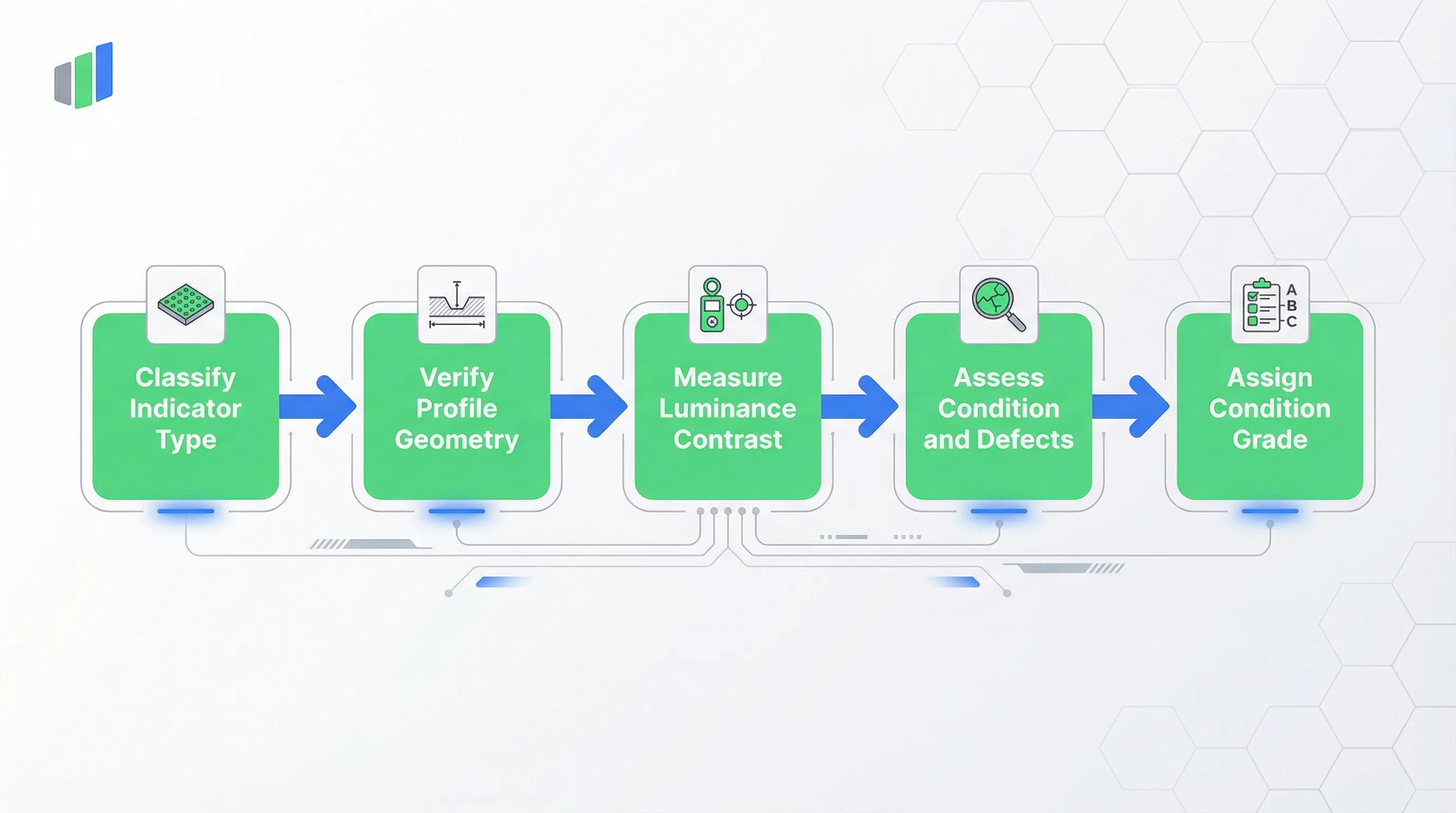
DIN 32984 defines six distinct indicator types, each with a specific wayfinding function and mandatory profile structure.
DIN 32984 organizes tactile ground surface indicators into six functional types, each serving a distinct role in the wayfinding chain for blind and visually impaired pedestrians. The standard strictly maps each function to either a rib profile (Rippenstruktur) or a dome profile (Noppenstruktur), ensuring that users can distinguish guidance from warning signals through touch alone. This functional differentiation is the foundational principle of the entire standard and determines every downstream requirement for geometry, dimensions, and arrangement.
Rib-profiled indicators are used for directional guidance. The Leitstreifen (Guidance Strip) is the primary navigation element, installed as a continuous strip along pedestrian routes to provide a detectable walking line. Ribs run parallel to the direction of travel, allowing a cane or foot to follow the path intuitively. The Richtungsfeld (Directional Field) uses the same rib structure but in a wider format at decision points, confirming the intended direction of travel after a turn or crossing. The Auffindestreifen (Finding Strip) is a short rib section placed perpendicular to the walking direction, leading from a guidance strip to a specific point of interest such as a pedestrian crossing button, a door, or a transit stop.
Dome-profiled indicators serve attention and warning functions. The Aufmerksamkeitsfeld (Attention Field) alerts the user to a change in the environment, such as the start of a staircase, an entrance, or a change of level. The Abzweigefeld (Branching Field) marks a junction where two or more guidance paths diverge, signaling the need to make a directional decision. The Sperrfeld (Blocking Field) is the most safety-critical element, installed at platform edges, roadway boundaries, and hazardous drop-offs to warn users of an immediate danger zone. In the inspection form, the Indicator Function dropdown captures which of these six types is being assessed, as it determines the applicable dimensional requirements and arrangement rules.
For the broader German framework on barrier-free construction that references DIN 32984, see the DIN 18040 accessibility standard.
GEOMETRY
Profile Geometry and Dimensional Compliance
Precise profile dimensions are the core technical requirement of DIN 32984, ensuring tactile detectability by cane and underfoot for all users.
DIN 32984 specifies exact dimensional envelopes for both rib and dome profiles, with different tolerances for outdoor and indoor installations. For outdoor rib profiles (Rippenstruktur), the standard mandates a height of 4.0 to 5.0 mm, a top width of 5 to 15 mm, and a center-to-center spacing of 30 to 50 mm. Indoor rib installations permit a reduced height range of 3.0 to 4.0 mm and wider spacing of 25 to 60 mm, acknowledging that indoor environments typically involve lighter footwear and lower ambient noise that improves tactile perception. The cross-sectional profile must be trapezoidal (Trapezprofil), which was formally established as the only compliant shape after the 2011 revision removed the previously permitted sinusoidal profile.
Dome profiles (Noppenstruktur) require a minimum height of 4.5 mm for outdoor installations. The 2020/2023 revision of DIN 32984 established diagonal arrangement as the standard pattern for domes, replacing the previously common orthogonal grid. Diagonal arrangement improves detectability because the offset pattern creates a more consistent tactile signal regardless of the approach direction. In the inspection form, the Profile Shape field records whether the installed element uses the compliant trapezoidal shape or a non-compliant sinusoidal or rounded variant. The Dome Arrangement field captures whether the diagonal standard pattern is used.
| Parameter | Outdoor | Indoor | Unit |
|---|---|---|---|
| Rib Height | 4.0 – 5.0 | 3.0 – 4.0 | mm |
| Rib Width (top) | 5 – 15 | 5 – 15 | mm |
| Rib Spacing (c-c) | 30 – 50 | 25 – 60 | mm |
| Dome Height | ≥ 4.5 | ≥ 3.5 | mm |
| Dome Spacing (c-c) | ~60 (diagonal) | ~50 (diagonal) | mm |
| Profile Shape | Trapezoidal | Trapezoidal | — |
Sinusoidal profiles were removed from the standard in 2011 and are classified as non-compliant. Railway platform installations follow Deutsche Bahn (DB) specifications that may differ from public space requirements.
The Flushness Inspection (Ebenheitsprüfung) verifies that the indicator element is flush with the surrounding pavement surface. An edge height difference exceeding 4 mm constitutes a trip hazard under German accessibility law and is flagged as a critical defect. The Rib Height and Dome Height fields record the measured values in millimeters, allowing comparison against the standard thresholds. These measurements should be taken at multiple points along a guidance strip to account for installation variation and wear patterns. A profile that has worn below the minimum height threshold no longer provides reliable tactile feedback and must be classified as non-compliant regardless of its original installation quality.
LUMINANCE CONTRAST
Visual Contrast Requirements (Leuchtdichtekontrast)
DIN 32984 mandates a minimum Michelson luminance contrast of K >= 0.4 between tactile indicators and the surrounding pavement, serving users with residual vision.
DIN 32984 requires a minimum luminance contrast ratio of K >= 0.4 between the tactile indicator and its surrounding surface, calculated using the Michelson contrast formula: K = (L_max - L_min) / (L_max + L_min). This formula differs from the Weber contrast used in some international accessibility standards, making direct comparison of contrast values between DIN 32984 and standards like ISO 23599 unreliable without conversion. The Michelson formula produces values from 0 (no contrast) to 1 (maximum contrast), with the 0.4 threshold representing the minimum at which users with partial sight can reliably detect the indicator under typical lighting conditions.
In practice, achieving K >= 0.4 requires careful material and color selection. White indicators on dark asphalt or anthracite indicators on light concrete typically meet the threshold. Yellow indicators, while common on railway platforms, require verification against the specific substrate. Stainless steel indicators pose the greatest contrast challenge because their reflectance varies with viewing angle and lighting conditions. The inspection form captures the Indicator Color and Substrate Color fields to document the pairing, and the Visual Contrast Check field records whether the combination passes, fails, or requires measured values from a luminance meter.
When the luminance contrast falls below K = 0.4, DIN 32984 provides a remediation mechanism through the Begleitstreifen (Accompanying Strip). This is a contrasting border strip installed alongside the tactile indicator to enhance visual detectability. A 30 cm wide strip serves as a visual aid only, while a 60 cm wide strip is required when both tactile and visual contrast are insufficient. The Accompanying Strip Present field in the form records whether this element exists, and the Strip Width field captures the installed dimension. The presence of a Begleitstreifen does not waive the geometric profile requirements — both tactile detectability and visual contrast must be addressed, either through the indicator itself or through the combination of indicator and accompanying strip.
The luminance contrast formula and measurement methodology are detailed in the DIN 32984:2023 standard document at DIN Media.
Try this DIN 32984 form in Geocadra
We have a pre-built DIN 32984 inspection template ready to go. Sign up and start your first condition assessment today.
Free 14-day trial. No credit card required.
CONDITION RATING
The 1-to-5 Condition Grade Scale (Zustandsbewertung)
The DIN 32984 inspection form produces a five-level condition grade that combines structural integrity, profile wear, soiling, and contrast assessment.
The condition rating for DIN 32984 tactile indicators uses a 1-to-5 grading scale aligned with the German Schulnotensystem (school grading system) commonly applied in infrastructure condition assessment. Grade 1 (Sehr Gut / Very Good) represents new-condition elements with full profile height exceeding 4.5 mm, luminance contrast K >= 0.7, and no visible defects. Grade 2 (Gut / Good) indicates minor aesthetic wear with geometry still fully compliant and contrast K >= 0.5. Grade 3 (Befriedigend / Satisfactory) marks the transition where profile height approaches minimum tolerance and contrast nears the K = 0.4 threshold — tactile function is preserved but scheduled maintenance becomes necessary.
| Grade | German | English | Description | Action |
|---|---|---|---|---|
| 1 | Sehr Gut | Very Good | New condition, no deviations. Height > 4.5 mm, K ≥ 0.7. | None |
| 2 | Gut | Good | Minor wear or aesthetic defects. Geometry fully compliant, K ≥ 0.5. | Monitor |
| 3 | Befriedigend | Satisfactory | Clear wear, height nearing minimum. K ≈ 0.4. Tactile function preserved. | Scheduled maintenance |
| 4 | Ausreichend | Sufficient | Significant wear, height at limit. K < 0.4. Tactile function impaired. | Repair needed soon |
| 5 | Mangelhaft | Defective | Safety hazard: loose tiles, worn smooth (< 3 mm), no contrast. | Immediate action |
The grade is determined holistically based on structural integrity, profile wear, soiling, and contrast. A critical failure in any single dimension can result in Grade 5 regardless of other parameters.
Grade 4 (Ausreichend / Sufficient) signals significant deterioration where profile height is at absolute minimum limits and contrast has dropped below K = 0.4. The tactile function is impaired but the element remains partially usable. Repair or replacement planning should begin immediately. Grade 5 (Mangelhaft / Defective) indicates a safety hazard: profiles worn smooth below 3 mm, loose or missing tiles creating trip hazards, or complete loss of visual contrast. Elements rated Grade 5 require immediate action, which may include temporary closure of the guidance path, installation of warning signage, or emergency replacement. In the form, the inspector sets the DIN Grade based on the combined assessment of structural integrity, profile wear, and soiling level fields.
The grade reflects a holistic assessment rather than a simple arithmetic formula. An indicator with excellent profile height but complete loss of contrast due to heavy soiling may still receive Grade 4 or 5, because visual detectability is independently critical for users with residual vision. Similarly, a well-contrasted indicator with a single loose tile creating a trip hazard warrants Grade 5 regardless of its geometric compliance. This multi-dimensional approach ensures that the rating captures the real-world usability of the tactile guidance system for its intended users.
For related infrastructure grading approaches in Germany, see the DIN 1076 bridge inspection standard.
DEFECT CATALOG
Defect Types and Safety-Critical Thresholds
The DIN 32984 inspection identifies specific defect types with defined thresholds that determine when a tactile indicator transitions from functional to hazardous.
The defect catalog for DIN 32984 inspections captures four primary defect types, each tied to a specific safety threshold that distinguishes acceptable deterioration from a condition requiring intervention. Trip Hazard (Stolperfalle) is triggered when the edge height difference between the indicator and the surrounding pavement exceeds 4 mm. This 4 mm threshold originates from German accessibility regulations and represents the maximum edge height that wheelchair users and people with mobility aids can safely traverse. In the form, the Flushness Inspection boolean field provides a quick pass/fail check, while the defect log allows detailed documentation of specific trip hazard locations.
Gap Too Wide (Fugenbreite) addresses the spacing between individual indicator elements. Excessive gaps reduce the tactile continuity of a guidance strip and can catch cane tips or narrow shoe heels. Incorrect Orientation (Falsche Ausrichtung) is a compliance defect specific to rib-profiled elements where the rib direction does not match the intended direction of travel. A Leitstreifen whose ribs run perpendicular rather than parallel to the walking direction provides a fundamentally different tactile signal and can mislead a blind pedestrian into a hazardous area. This defect is typically identified during initial acceptance inspections but can also occur after repair work when tiles are reinstalled in the wrong orientation.
| Defect Type | German Term | Threshold | Impact |
|---|---|---|---|
| Trip Hazard | Stolperfalle | Edge > 4 mm | Safety risk for wheelchair and mobility aid users |
| Gap Too Wide | Zu breite Fuge | Per assessment | Cane tips catch, reduced tactile continuity |
| Incorrect Orientation | Falsche Ausrichtung | Ribs not parallel to travel | Misleading directional signal for blind users |
| Water Pooling | Wasseraufstau | Standing water present | Eliminates tactile and visual detectability |
Each defect entry in the form requires a location note and mandatory photo evidence. Multiple defects can be logged per inspection to document conditions along an entire guidance route.
Water Pooling (Wasseraufstau) indicates a drainage failure where water accumulates on or around the indicator surface. Standing water eliminates both tactile and visual detectability: the profile ridges become submerged, and surface reflections destroy contrast. In cold weather, pooled water freezes into an ice layer that completely masks the indicator. The defect log in the form allows multiple defect entries per inspection, each with a location note and mandatory photo evidence. This repeatable structure enables inspectors to document conditions along an entire guidance route — for example, logging a trip hazard at meter 10, heavy soiling at meter 25, and incorrect orientation at a junction at meter 40, all within a single inspection record.
DIN 32984 is published and maintained by DIN (Deutsches Institut für Normung).
QUESTIONS
Frequently Asked Questions
What is DIN 32984?
DIN 32984 (Bodenindikatoren im öffentlichen Raum) is the German standard for tactile ground surface indicators used to guide blind and visually impaired pedestrians. It defines profile geometry, luminance contrast, and arrangement rules for ribs and domes in public spaces, buildings, and railway platforms.
What is the minimum contrast required by DIN 32984?
DIN 32984 requires a minimum Michelson luminance contrast of K >= 0.4 between the tactile indicator and surrounding pavement. The formula is K = (L_max - L_min) / (L_max + L_min). When contrast falls below 0.4, an accompanying strip (Begleitstreifen) can compensate for the deficit.
What is the difference between ribs and domes in DIN 32984?
Ribs (Rippenstruktur) provide directional guidance — their parallel lines indicate the direction of travel. Domes (Noppenstruktur) serve attention and warning functions, alerting users to hazards, junctions, or changes in the environment. Each profile type is mapped to specific indicator functions.
What changed in the 2023 revision of DIN 32984?
The 2023 revision established diagonal dome arrangement as the standard pattern, replacing the previously common orthogonal grid. It also provided stricter definitions for crossing point layouts and refined dimensional requirements for indoor installations to improve consistency across environments.
Is DIN 32984 mandatory in Germany?
DIN 32984 is referenced by DIN 18040 (barrier-free construction) which is legally binding through German state building codes (Landesbauordnungen). While DIN 32984 itself is a technical standard, its requirements become mandatory when DIN 18040 compliance is required for public buildings and spaces.
How often should DIN 32984 indicators be inspected?
There is no fixed inspection cycle mandated by the standard itself. Most German municipalities inspect tactile guidance systems annually as part of their road safety obligation (Verkehrssicherungspflicht). High-traffic areas like railway platforms or major intersections may require more frequent checks.
What qualifies as a trip hazard under DIN 32984?
An edge height difference exceeding 4 mm between the tactile indicator and surrounding pavement constitutes a trip hazard. This threshold comes from German accessibility regulations and represents the maximum edge that wheelchair users and people with mobility aids can safely traverse.
In practice
See how the round runs in Geocadra
The solution page shows this inspection regime on real open data: the import, the form, the round, the record per asset and the export.
Playground checks, headstone tests and green-space acceptances on a map, with every round appended to the siteOpen the solution page: Municipalities & Public SpaceTRY IT FREE
Digitize your DIN 32984 inspections
Replace paper forms and spreadsheets with structured digital inspections, built for standards like DIN 32984.
No credit card requiredFree trial included