



DIN 79008 Bike Parking
The German standard for safety, spacing compliance, and condition assessment of stationary bicycle parking infrastructure.
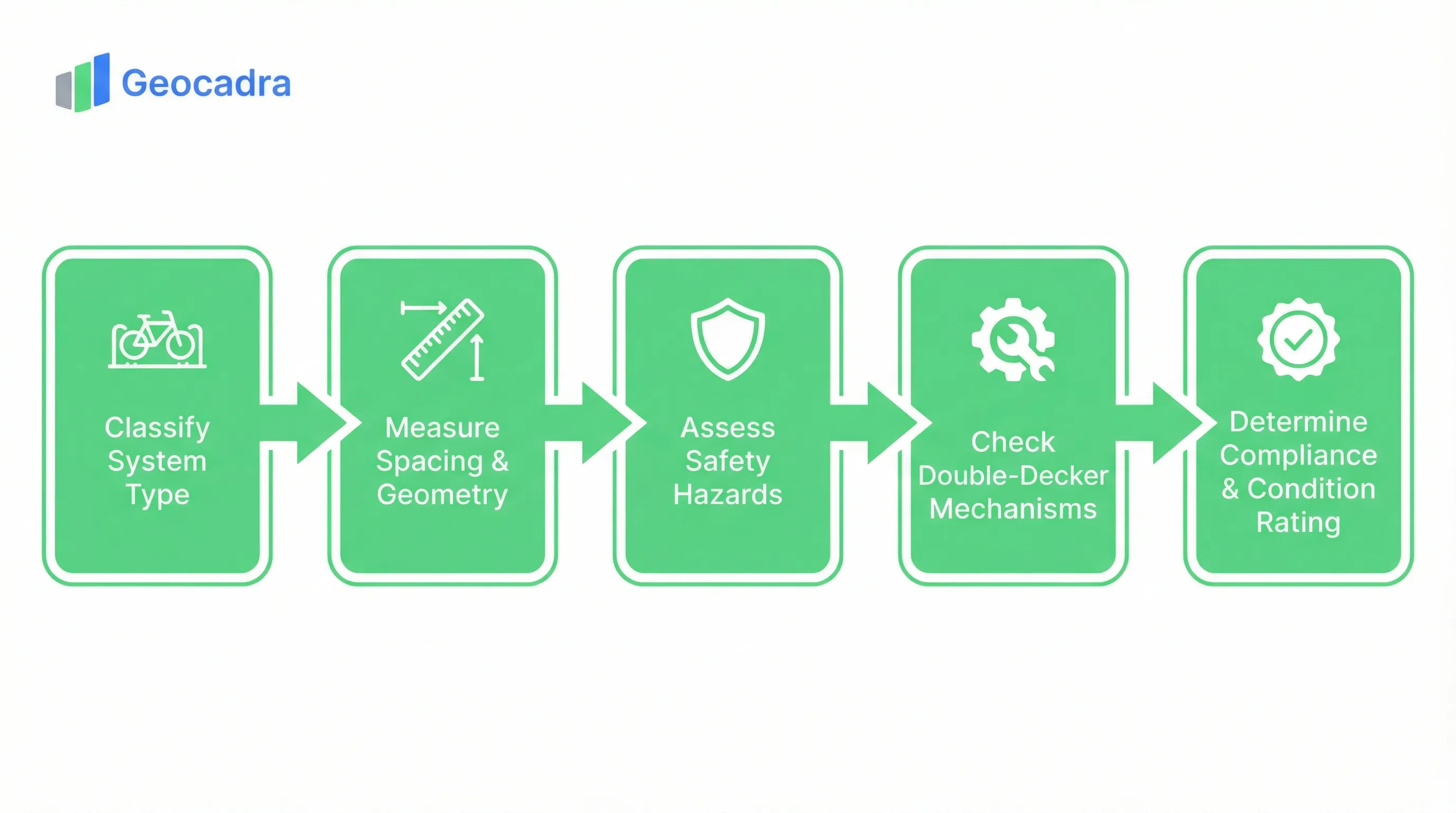
DIN 79008 is the definitive German standard governing stationary bicycle parking systems. Published by the Deutsches Institut für Normung (DIN) and widely adopted by the ADFC (Allgemeiner Deutscher Fahrrad-Club), it replaced the earlier ADFC Technical Guideline TR 6102 in 2016. The standard is split into two parts: DIN 79008-1 covers requirements for geometry, safety, theft protection, and usability, while DIN 79008-2 defines the corresponding test methods. As German cities invest heavily in cycling infrastructure under national mobility plans, DIN 79008 compliance has become a key benchmark for municipalities, architects, and facility operators when procuring, installing, and maintaining bicycle parking facilities. The digital inspection form captures system classification, geometric spacing measurements, safety hazard checks, and a final compliance and condition assessment.

What is DIN 79008?
DIN 79008 (Stationäre Fahrradparksysteme) is the German standard for stationary bicycle parking systems. It defines safety, spacing, and theft-protection requirements for rack types including lean-to brackets, front-wheel holders, double-deckers, and bicycle boxes, producing a compliance rating and 1-to-5 condition score.
- Full Name
- Stationäre Fahrradparksysteme — Anforderungen und Prüfverfahren (DIN 79008-1/-2)
- Issuing Body
- DIN (Deutsches Institut für Normung)
- Current Revision
- DIN 79008:2016
SYSTEM CLASSIFICATION
Bicycle Parking System Types Under DIN 79008
Every DIN 79008 inspection starts by classifying the parking system, which determines which geometric and safety requirements apply.
DIN 79008 recognizes five distinct system types (Bauarten) for stationary bicycle parking: Lean-to Brackets (Anlehnbügel), Front Wheel Holders (Vorderradhalter), Double-Deckers (Doppelstockparker), Bicycle Boxes (Fahrradboxen), and Combined Systems. Each type has fundamentally different geometric envelopes, safety hazard profiles, and theft-protection capabilities, which is why the system type selection is the very first field in the inspection form and drives downstream validation logic.
| System Type | German Term | Frame Locking | Key Consideration |
|---|---|---|---|
| Lean-to Bracket | Anlehnbügel | Frame + Wheel | DIN-preferred design, supports frame at two points |
| Front Wheel Holder | Vorderradhalter | Wheel Only | Risk of rim damage (Felgenkiller), often non-compliant |
| Double-Decker | Doppelstockparker | Frame + Wheel | Requires lifting assistance, damping, and rail safety checks |
| Bicycle Box | Fahrradbox | Enclosed | Highest theft protection, individual access mechanism required |
| Combined System | Kombiniertes System | Varies | Mixed types in one installation, each type assessed separately |
DIN 79008 requires that the bicycle frame must be lockable (Anschließmöglichkeit). Systems permitting only wheel locking are rated Non-Compliant under Section 7.2.
The Lean-to Bracket (Anlehnbügel) is the DIN-preferred design because it supports the bicycle frame at two points, prevents rim damage, and provides a secure locking point for both frame and wheel. Front Wheel Holders (Vorderradhalter) grip only the front wheel and are frequently flagged as non-compliant because they apply lateral force to the rim, a phenomenon colloquially known as Felgenkiller (rim bender). DIN 79008-1 Section 6.9 explicitly warns against designs that risk rim damage. Double-Decker systems (Doppelstockparker) maximize capacity in constrained spaces such as train stations and parking garages, but introduce additional safety requirements around lifting mechanisms, pull-out damping, and upper rail locking. Bicycle Boxes (Fahrradboxen) offer the highest theft protection and weather shielding but require individual access mechanisms that must comply with entrapment safety rules.
The DIN Classification field further divides installations into Object Area (Objektbereich) for public and high-traffic locations, and Residential Area (Wohnbereich) for private or secure environments. Object Area installations face stricter requirements for structural anchoring, corrosion resistance, and vandalism protection because they are exposed to higher usage intensity and less controlled access. The Installation Method field records whether the system is embedded in concrete (Einbetoniert), base-plate bolted (Aufgedübelt), or free-standing/weighted (Freiaufstellung). Embedded concrete mounting provides the highest structural stability and theft resistance, while free-standing installations are common in temporary or rental deployments where permanent ground anchoring is not feasible.
For accessibility requirements that often apply alongside bike parking in public spaces, see the DIN 18040 Accessibility standard.
SPACING & GEOMETRY
Critical Spacing Requirements: The Handlebar Conflict Problem
Geometric compliance is the most common failure point in DIN 79008 inspections. Axle spacing, vertical arrangement, and tire width capacity determine whether bicycles can be parked without interference.
DIN 79008-1 establishes precise minimum spacing dimensions that are the single most frequently failed requirement during field inspections. The Axle Spacing (Radabstand) defines the center-to-center distance between adjacent bicycle parking positions. When all positions are at the same level (Tiefeinstellung), the minimum axle spacing is 70 cm. When an alternating high/low arrangement (Hoch-/Tiefstellung) is used, the minimum drops to 50 cm because the vertical offset of at least 20 cm prevents handlebar conflict between neighboring bicycles. These values are not arbitrary: they derive from ergonomic studies of standard bicycle handlebar widths, which range from 42 cm for road bikes to 78 cm for cargo bikes.
The Handlebar Conflict field is a critical visual check during the inspection. Even when axle spacing meets the minimum requirement on paper, real-world conditions such as handlebar shapes, basket attachments, or cargo bike dimensions can still cause interference. The inspector physically verifies whether parked bicycles in adjacent slots touch or overlap at handlebar height. If conflict is detected, the installation receives a deviation note even if the measured spacing is technically compliant. This practical verification distinguishes a DIN 79008 compliance inspection from a simple dimensional survey.
The Tire Width Capacity field records the maximum tire width that the holder can accommodate, measured in millimeters. DIN 79008 requires accommodation of standard bicycle tire widths, with a target of 55 mm or greater to support modern city bikes, e-bikes, and touring bicycles. Many older front-wheel holders have narrow slots designed for 23-28 mm racing tires and cannot safely hold the wider tires now standard on utility bicycles. The Vertical Arrangement selection is particularly important because it determines the applicable spacing threshold. In the digital form, selecting Alternating High/Low automatically adjusts the minimum axle spacing validation from 70 cm to 50 cm, reflecting the reduced handlebar conflict enabled by the height differential.
Bicycle parking spacing requirements complement the broader approach to cycling infrastructure described in the LTN 1/20 CLOS cycling standard.
SAFETY & INTEGRITY
Safety Hazard Assessment Under DIN 79008-1 Section 6
The safety inspection section evaluates structural stability, entrapment risks, corrosion, and theft protection in accordance with DIN 79008-1 Section 6.
DIN 79008-1 Section 6 defines seven categories of safety requirements that the inspection must verify. Structural Stability (Standsicherheit, Section 6.6) is assessed on a three-level scale: Stable (Fest verankert) means the system is firmly anchored with no movement under normal loading. Loose (Wackelt) indicates perceptible movement at the base or mounting points, which must be flagged for remedial action. Detached (Gelöst) means the system has separated from its foundation and poses an immediate tipping or collapse risk, requiring the installation to be taken out of service.
Entrapment hazards (Fangstellen, Section 6.3) are checked separately for head/neck risks and finger risks. Head and neck entrapment points are assessed at openings above 60 cm height, particularly V-shaped gaps or converging tubes where a child's head could become wedged. Finger entrapment points are checked on all moving parts, particularly relevant for double-decker systems with sliding rails. Sharp Edges and Burrs (Verletzungsgefahr, Section 6.2) covers any protruding metal edges, splinter-prone wood, or open tube ends that could cause cuts or puncture wounds. The Anti-Roll Security (Wegrollsicherung, Section 6.5) field verifies whether the parked bicycle is prevented from rolling out of or falling over in the holder under its own weight.
Corrosion and Material Condition (Section 6.1) uses a four-level classification: Good (no corrosion), Superficial Rust, Structural Rust/Rot, and Coating Damaged. Superficial rust is cosmetic and does not impair function, but structural rust or rot compromises load-bearing capacity and typically triggers a Condition Rating of 4 (Poor) or worse. Coating Damaged indicates that the protective finish has failed, accelerating future corrosion.
Theft Protection (Diebstahlschutz, Section 7.2) is a core DIN requirement. The standard mandates that the parking system must allow locking of the bicycle frame, not just the wheel. Systems that only permit wheel locking receive a Non-Compliant rating because a thief can release the quick-release skewer and steal the frame. The form distinguishes three levels: Frame + Wheel Lockable (the DIN-required minimum), Wheel Only, and None. The Rim Damage Risk field (Section 6.9) classifies whether the holder design applies lateral force to the rim. Holders rated as High risk are colloquially called Felgenkiller and are considered fundamentally non-compliant with modern DIN 79008 requirements.
Try this DIN 79008 form in Geocadra
We have a pre-built DIN 79008 inspection template ready to go. Sign up and start your first condition assessment today.
Free 14-day trial. No credit card required.
CONDITION & COMPLIANCE
Final Assessment: Condition Rating and DIN Compliance
The final assessment combines a five-level condition rating with a three-level DIN compliance determination and an optional ADFC recommendation.
The Condition Rating (Zustandsnote) uses a standard infrastructure scale from 1 to 5 that quantifies the physical state of the bicycle parking installation independent of DIN compliance. A rating of 1 (Very Good) indicates new or like-new condition with no corrosion, perfect stability, and all mechanisms functioning smoothly. Rating 2 (Good) shows superficial signs of wear such as minor paint scratches but remains fully functional and stable with no safety hazards. Rating 3 (Fair) reflects visible aging such as surface rust, minor instability, or stiff mechanisms; the installation is safe to use but maintenance is required. Rating 4 (Poor) indicates significant defects such as bent brackets, broken locks, or deep corrosion where usage is difficult or risks damaging the bicycle, with high repair urgency. Rating 5 (Critical) signals structural failure, detachment from the ground, severe sharp edges, or mechanism failure, representing an immediate hazard requiring the installation to be taken out of service.
| Rating | Condition | German Term | Description |
|---|---|---|---|
| 1 | Very Good | Sehr Gut | New or like-new, no defects, all mechanisms functional |
| 2 | Good | Gut | Minor wear (paint scratches), fully functional, no safety hazards |
| 3 | Fair | Befriedigend | Visible aging (surface rust), minor instability, maintenance needed |
| 4 | Poor | Ausreichend | Significant defects (bent brackets, broken locks), impaired function |
| 5 | Critical | Mangelhaft | Structural failure, detached, immediate hazard — take out of service |
The condition rating assesses physical state independently from DIN compliance. A brand-new rim-bender rack may score 1 (Very Good) for condition but still be rated Non-Compliant.
The DIN 79008 Compliance field is a separate assessment from condition. An installation can be in excellent physical condition (Rating 1) but still be Non-Compliant if it fails fundamental DIN requirements, for example a rim-bender front-wheel holder that is brand new but by design cannot provide frame locking and applies excessive lateral force to the rim. Conversely, a compliant design may have deteriorated to Poor condition through neglect. The three compliance levels are: Fully Compliant (meets all spacing and safety requirements), Minor Deviations (meets most requirements with small exceptions such as spacing 2 cm below minimum), and Non-Compliant (fails one or more critical DIN requirements such as spacing below 50 cm, rim bender design, or no frame lock point).
| Level | German Term | Criteria | Typical Triggers |
|---|---|---|---|
| Fully Compliant | Konform | Meets all spacing and safety requirements | Axle spacing ≥ 70/50 cm, frame lockable, no rim damage risk |
| Minor Deviations | Geringe Abweichungen | Meets most requirements with small exceptions | Spacing 2–5 cm below minimum, minor cosmetic defects |
| Non-Compliant | Nicht Konform | Fails one or more critical DIN requirements | Spacing < 50 cm, rim bender design, no frame lock point |
Compliance is assessed per DIN 79008-1 requirements. The ADFC recommendation requires full compliance plus additional usability criteria.
The ADFC Recommendation field indicates whether the installation meets the criteria set by the Allgemeiner Deutscher Fahrrad-Club (ADFC), Germany's national cycling advocacy organization. ADFC criteria are stricter than bare DIN compliance: they require full DIN conformity plus adequate spacing, frame locking capability, and weatherproof design in residential applications. An ADFC-recommended installation signals to municipalities and building operators that the infrastructure meets best-practice cycling standards. The form also includes fields for defect photos and free-text comments, enabling inspectors to document specific issues for maintenance planning and audit trails.
DOUBLE-DECKER SYSTEMS
Double-Decker Specifics: Lifting Mechanisms, Damping, and Rail Safety
Double-decker parking systems (Doppelstockparker) introduce unique safety requirements for lifting assistance, pull-out damping, and upper-rail locking that do not apply to ground-level racks.
Double-decker bicycle parking systems are increasingly common at German train stations, airports, and large office complexes where ground space is limited. DIN 79008-1 Section 6.8 requires that the upper level of a double-decker system includes ergonomic lifting assistance to enable users to park and retrieve bicycles without excessive physical effort. The standard recognizes three lifting assistance types: Gas Spring (Gasdruckfeder), which uses pneumatic pressure to counterbalance the bicycle weight and is the most common mechanism in modern installations; Mechanical Spring, which uses coil or leaf springs; and None (Manual), where the user lifts the bicycle unassisted. Manual systems are flagged during inspection because they discourage usage and pose injury risks, particularly for e-bikes weighing 20-30 kg.
Pull-out Damping is a safety feature that prevents the upper rail from crashing down when pulled out for loading. Without damping, the rail can slide out under gravity and strike the user or damage lower-tier bicycles. The Pull-out Damping field is a pass/fail check: either the mechanism controls the rail's descent speed, or it does not. Upper Rail Safety assesses whether the extended rail locks securely in the out position during loading and unloading. A rail that locks in the out position allows the user to load the bicycle with both hands without risk of the rail retracting unexpectedly. A rail that slides uncontrolled represents a significant safety hazard, particularly when loaded with a heavy e-bike, because the weight can cause the rail to retract suddenly, potentially trapping fingers or causing the bicycle to fall from height.
These double-decker specific fields are conditionally displayed in the digital form: they only appear when the System Type is set to Double-Decker. This conditional logic ensures that inspectors assessing lean-to brackets or bicycle boxes are not presented with irrelevant fields, while double-decker inspections capture all the additional safety data required by the standard. The combination of lifting assistance type, pull-out damping, and rail locking status gives facility managers a complete picture of the mechanical safety of their double-decker installations and informs maintenance scheduling for spring replacement, damper servicing, and latch adjustment.
The standard is published and maintained by DIN (Deutsches Institut für Normung). The ADFC provides additional certification guidance through the ADFC bicycle parking recommendations.
QUESTIONS
Frequently Asked Questions
What is DIN 79008?
DIN 79008 (Stationäre Fahrradparksysteme) is the German standard for stationary bicycle parking systems. Published in 2016, it defines requirements for safety, geometric spacing, theft protection, and usability across five system types including lean-to brackets, double-deckers, and bicycle boxes.
What is the minimum axle spacing under DIN 79008?
The minimum axle spacing (Radabstand) is 70 cm when all positions are at the same level (Tiefeinstellung). When an alternating high/low arrangement (Hoch-/Tiefstellung) is used with at least 20 cm height difference, the minimum drops to 50 cm because the vertical offset prevents handlebar conflict.
What is a Felgenkiller and why is it non-compliant?
Felgenkiller (rim bender) is the colloquial German term for front-wheel holders that apply lateral force to the bicycle rim, causing damage over time. DIN 79008-1 Section 6.9 explicitly warns against rim-damaging designs. Holders rated High for rim damage risk are considered fundamentally non-compliant.
Is DIN 79008 mandatory or voluntary?
DIN 79008 is a voluntary standard, but it is widely referenced in German municipal procurement specifications and building codes. Many cities require DIN 79008 compliance for publicly funded bicycle parking. The ADFC certification program also requires full DIN conformity as a prerequisite.
What is the difference between DIN compliance and the condition rating?
DIN compliance assesses whether the design meets spacing, safety, and theft-protection requirements. The condition rating (1 to 5) assesses the physical state of the installation. A brand-new rim-bender rack may score 1 for condition but still be Non-Compliant by design.
What additional checks apply to double-decker systems?
Double-decker systems (Doppelstockparker) require checks for lifting assistance type (gas spring, mechanical spring, or manual), pull-out damping to prevent uncontrolled rail descent, and upper rail locking to ensure the rail stays extended during loading. These fields appear conditionally in the form.
How does the ADFC recommendation relate to DIN 79008?
The ADFC (Allgemeiner Deutscher Fahrrad-Club) recommendation requires full DIN 79008 compliance plus additional usability criteria including adequate spacing, frame locking capability, and weatherproof design. ADFC-certified installations signal best-practice cycling infrastructure to municipalities.
In practice
See how the round runs in Geocadra
The solution page shows this inspection regime on real open data: the import, the form, the round, the record per asset and the export.
Playground checks, headstone tests and green-space acceptances on a map, with every round appended to the siteOpen the solution page: Municipalities & Public SpaceTRY IT FREE
Digitize your DIN 79008 inspections
Replace paper forms and spreadsheets with structured digital inspections, built for standards like DIN 79008.
No credit card requiredFree trial included