

DWA-A 138 Stormwater Infiltration
The German standard for planning, designing, and inspecting stormwater infiltration systems for sustainable rainwater management.
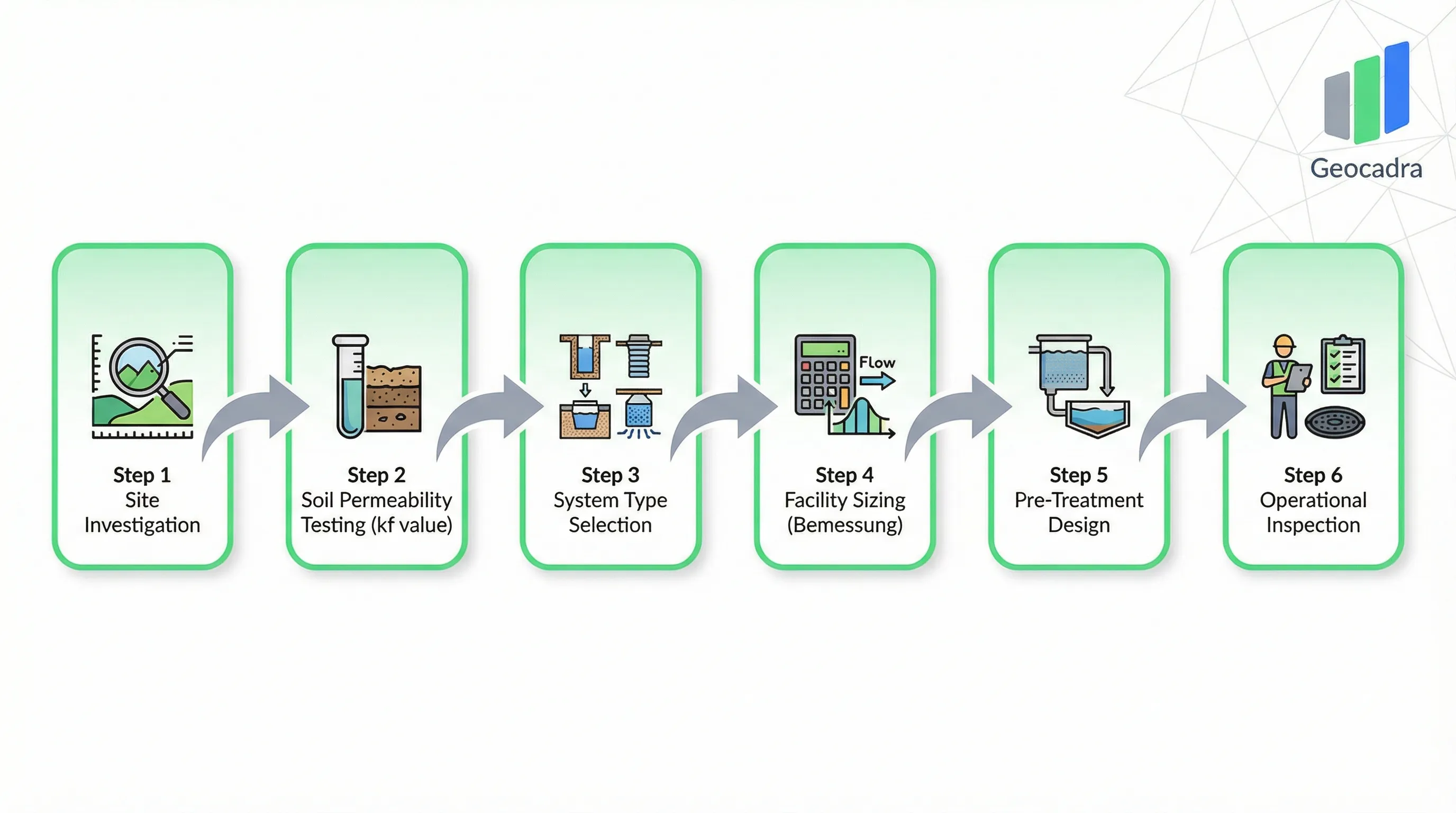
DWA-A 138 is the authoritative German standard governing decentralized stormwater infiltration. Published by the Deutsche Vereinigung für Wasserwirtschaft, Abwasser und Abfall (DWA), it provides engineers and inspectors with a comprehensive framework for evaluating soil suitability, sizing infiltration facilities, and ensuring pre-treatment of polluted runoff before it enters the groundwater. The standard is widely applied by German municipalities, water authorities, and civil engineering firms to comply with the Federal Water Resources Act (Wasserhaushaltsgesetz) requirement that stormwater be managed locally rather than discharged into combined sewer systems. DWA-A 138 covers the full lifecycle of infiltration systems, from initial site investigation through construction approval to ongoing operational inspection and maintenance.
What is DWA-A 138?
DWA-A 138 (Planung, Bau und Betrieb von Anlagen zur Versickerung von Niederschlagswasser) is the German standard for planning, constructing, and operating stormwater infiltration facilities. It defines soil permeability testing, infiltration system sizing, and water quality pre-treatment requirements for on-site rainwater management.
- Full Name
- Planung, Bau und Betrieb von Anlagen zur Versickerung von Niederschlagswasser
- Issuing Body
- DWA (Deutsche Vereinigung für Wasserwirtschaft, Abwasser und Abfall e.V.)
- Current Revision
- DWA-A 138 (2005-04)
SYSTEM TYPES
Infiltration System Types Under DWA-A 138
DWA-A 138 classifies stormwater infiltration systems into distinct categories based on their design principle, each suited to different site conditions and pollutant loads.
DWA-A 138 defines a hierarchy of infiltration system types (Versickerungsanlagen), ranging from simple surface-based methods to complex underground structures. The standard explicitly recommends surface infiltration (Flächenversickerung) as the preferred solution wherever site conditions permit, because it provides the longest contact time between stormwater and the biologically active topsoil layer. This extended contact enables natural filtration, adsorption, and microbial degradation of pollutants before water reaches the groundwater table.
Swale infiltration (Muldenversickerung) uses shallow vegetated depressions, typically 200 to 300 mm deep, to temporarily store and infiltrate stormwater. Swales combine storage volume with the treatment benefits of a vegetated surface layer and are the most commonly implemented system type in German residential developments. Swale-trench systems (Mulden-Rigolen-Systeme) add a subsurface gravel-filled trench beneath the swale, providing additional storage volume for sites where the soil infiltration rate is insufficient to handle peak rainfall events through surface infiltration alone.
| System Type | German Term | Surface Required | Treatment Benefit |
|---|---|---|---|
| Surface Infiltration | Flächenversickerung | Large | Highest (full topsoil contact) |
| Swale Infiltration | Muldenversickerung | Medium | High (vegetated depression) |
| Swale-Trench System | Mulden-Rigolen-System | Medium | High (combined surface/subsurface) |
| Trench Infiltration | Rohr-Rigolenversickerung | Small | Moderate (subsurface only) |
| Shaft Infiltration | Schachtversickerung | Minimal | Low (bypasses topsoil) |
DWA-A 138 recommends surface and swale infiltration wherever site conditions allow. Shaft infiltration is restricted to demonstrably clean runoff due to the absence of biological soil treatment.
Trench infiltration (Rohr-Rigolenversickerung) uses subsurface gravel beds or modular storage units wrapped in geotextile to infiltrate water entirely below ground. This method is suited to sites with limited surface area, such as dense urban environments. Shaft infiltration (Schachtversickerung) channels water through a vertical shaft directly into a permeable soil layer, bypassing the biologically active topsoil. DWA-A 138 restricts shaft infiltration to situations where the runoff is demonstrably clean, because no natural soil treatment occurs. The choice of system type directly determines the pre-treatment requirements, sizing calculations, and inspection intervals defined later in the standard.
For a complementary approach to sustainable urban drainage, see the CIRIA C753 SuDS standard.
SOIL ASSESSMENT
Soil Permeability Testing (Durchlässigkeitsbeiwert kf)
The soil infiltration rate is the single most critical parameter in DWA-A 138. It determines whether infiltration is feasible, which system type is appropriate, and how large the facility must be.
DWA-A 138 requires field measurement of the soil permeability coefficient (Durchlässigkeitsbeiwert kf) at the planned infiltration depth. The kf value, expressed in meters per second (m/s), quantifies how fast water moves through the soil matrix under saturated conditions. The standard specifies an acceptable range of 1 x 10^-3 m/s to 1 x 10^-6 m/s for infiltration facilities. Soils with kf values above 1 x 10^-3 m/s (coarse gravel) transmit water too rapidly to provide adequate pollutant removal, while soils below 1 x 10^-6 m/s (dense clay) infiltrate too slowly to manage stormwater volumes effectively.
| Parameter | Requirement | Unit | Notes |
|---|---|---|---|
| kf (Permeability Coefficient) | 1 x 10^-3 to 1 x 10^-6 | m/s | Measured in-situ at infiltration depth |
| Min. Distance to Groundwater | >= 1.0 | m | Above mean high groundwater level (MHGW) |
| Min. Distance to Buildings | >= 6.0 (typically) | m | Varies by local authority requirements |
| Test Locations per Facility | >= 3 | count | To capture spatial variability |
| Topsoil Layer Thickness | >= 0.2 (surface systems) | m | Required for biological treatment effect |
The kf value must be determined through field testing. Laboratory values may significantly overestimate or underestimate actual infiltration rates due to disturbed soil structure.
The standard recommends in-situ testing methods over laboratory analysis because undisturbed soil structure significantly affects infiltration rates. Commonly used methods include the open-pit infiltration test (offene Versickerung) and the double-ring infiltrometer test. At least three test locations per planned facility are recommended to capture spatial variability in soil conditions. The inspector records the test location, depth below surface, measured kf value, soil classification according to DIN 18196, and groundwater level at the time of testing. The minimum vertical separation between the base of the infiltration facility and the mean high groundwater level (mittlerer höchster Grundwasserstand, MHGW) must be at least one meter to prevent direct stormwater-groundwater contact.
Soil classification follows DIN 18196, which categorizes soils into groups ranging from GW (well-graded gravel) through TL (low-plasticity clay). Sandy soils (SW, SP, SE) and silty sands (SU, ST) generally fall within the acceptable kf range for infiltration. Pure clay soils (TL, TM, TA) are typically unsuitable. The digital form captures these soil parameters together with the test methodology, enabling engineers to verify compliance before approving the infiltration facility design.
Try this DWA-A 138 form in Geocadra
We have a pre-built DWA-A 138 inspection template ready to go. Sign up and start your first condition assessment today.
Free 14-day trial. No credit card required.
SIZING METHODOLOGY
The DWA-A 138 Sizing Calculation (Bemessungsverfahren)
The facility sizing calculation is the methodological core of DWA-A 138, translating site-specific parameters into the required infiltration area and storage volume.
DWA-A 138 uses a simplified empirical method to determine the required size of an infiltration facility. The calculation balances the inflow from impervious surfaces during a design rainfall event against the outflow through soil infiltration. The fundamental equation is: V_required = (r_D,n x A_u x D x 60) - (kf/2 x A_s x D x 60), where V_required is the required storage volume in liters, r_D,n is the design rainfall intensity in liters per second per hectare for a given duration D and return period n, A_u is the connected impervious area in hectares, kf is the soil permeability coefficient in meters per second, and A_s is the infiltration surface area in square meters.
The design rainfall intensity is derived from KOSTRA-DWD 2020 (Koordinierte Starkniederschlags-Regionalisierungs-Auswertungen), the official German rainfall statistics dataset published by the Deutsche Wetterdienst. The standard typically requires sizing for a 5-year return period (n=5, T=5a) as the minimum, with local authorities frequently demanding a 10-year or 20-year return period for facilities in sensitive groundwater protection zones. The inspector records the KOSTRA grid cell coordinates, selected return period, and the resulting design rainfall intensities for multiple durations in the form to document the sizing basis.
The iterative sizing process tests multiple rainfall durations (typically 5, 10, 15, 30, 60, 120, 180, 360, 720, 1080, and 1440 minutes) to identify the critical duration that produces the maximum required storage volume. Short, intense storms generate high peak inflows but brief durations, while long, moderate storms produce lower peak flows but sustained volumes. The critical duration varies by site: highly permeable soils with large infiltration areas are governed by short-duration events, while low-permeability soils are governed by long-duration events. The form captures the calculated storage volume for each duration, highlighting the governing case.
An important nuance in the DWA-A 138 methodology is the application of a safety factor. The standard recommends using only half the measured kf value (kf/2) in the sizing calculation to account for long-term soil clogging, seasonal variations in soil moisture, and measurement uncertainty. This conservative approach means that the designed facility is approximately twice as large as what the raw soil test data would suggest, providing a substantial operational buffer. Engineers document the applied safety factor and any additional factors required by the local water authority in the inspection form.
The design rainfall data (KOSTRA-DWD 2020) used in DWA-A 138 sizing is published by the Deutscher Wetterdienst (DWD). The full standard and accompanying commentary are available from the DWA Deutsche Vereinigung für Wasserwirtschaft.
PRE-TREATMENT
Stormwater Pre-Treatment Before Infiltration
DWA-A 138 mandates pre-treatment of stormwater before infiltration whenever the runoff originates from surfaces with elevated pollutant loads.
Not all stormwater is clean enough for direct infiltration. DWA-A 138 categorizes impervious surfaces into three pollution classes that determine the required level of pre-treatment. Unpolluted surfaces (unbedenklich) include residential roofs without copper or zinc cladding, pedestrian paths, and terraces. These surfaces generate runoff that can be infiltrated without treatment through any system type. Moderately polluted surfaces (tolerierbar) include residential streets with low traffic volumes (under 5,000 vehicles per day), parking areas for passenger vehicles, and metal roofs with copper or zinc components. Runoff from these surfaces requires passage through a vegetated topsoil layer of at least 200 mm thickness before infiltration.
Heavily polluted surfaces (nicht tolerierbar) include industrial yards, truck loading areas, main roads with more than 15,000 vehicles per day, and surfaces where hazardous materials are handled. DWA-A 138 generally prohibits direct infiltration of runoff from these surfaces. If infiltration is required, specialized treatment systems such as sedimentation tanks, oil-water separators, or constructed wetlands must be installed upstream. The inspector documents the connected surface types, their pollution classification, and the installed pre-treatment measures for each infiltration facility.
The pollution classification has a direct impact on the permissible infiltration system type. Surface infiltration and swale systems provide inherent pre-treatment through the vegetated topsoil layer and are therefore approved for moderately polluted runoff. Trench and shaft infiltration systems bypass this natural treatment layer and are restricted to unpolluted runoff unless an upstream mechanical pre-treatment unit is installed. This relationship between surface pollution class, system type, and pre-treatment requirement is a central design decision that the digital form captures through linked dropdown selections.
For stormwater best management practices in the US regulatory context, see the EPA NPDES BMP standard.
INSPECTION & MAINTENANCE
Operational Inspection and Maintenance Requirements
DWA-A 138 requires regular inspection and maintenance of infiltration facilities to ensure long-term hydraulic performance and groundwater protection.
Infiltration facilities degrade over time through soil clogging (Kolmation), sedimentation, vegetation overgrowth, and structural damage. DWA-A 138 defines a mandatory inspection regime that includes visual inspection of the facility surface and inflow structures after every significant rainfall event, scheduled maintenance inspections at least twice per year (spring and autumn), and a comprehensive functional test every five years. The functional test verifies that the facility still achieves the design infiltration rate by measuring the actual drain-down time after filling the facility with a known volume of water.
During a routine inspection, the inspector evaluates the condition of inflow pipes, overflow structures, pre-treatment devices, the infiltration surface itself, and any subsurface components accessible through inspection shafts. Key indicators of performance degradation include standing water more than 24 hours after a rainfall event, visible sediment accumulation on the infiltration surface, erosion channels, vegetation die-off or excessive weed growth, and structural damage to inlet or outlet structures. The digital form captures each of these condition indicators with severity ratings and photo documentation.
Maintenance measures prescribed by DWA-A 138 range from simple vegetation management (mowing, removing debris) to invasive rehabilitation (removing and replacing the clogged topsoil layer). The standard specifies that the topsoil layer of swale and surface infiltration systems should be scarified annually and replaced entirely when infiltration performance drops below 50% of the design value. For trench systems, the geotextile wrapping may need replacement if fine sediment penetration causes sustained clogging. The inspection form records the maintenance history and scheduled next actions, creating a lifecycle management record for the facility.
For sewer system inspection standards that complement stormwater infrastructure management, see the NASSCO PACP sewer inspection standard.
QUESTIONS
Frequently Asked Questions
What is DWA-A 138?
DWA-A 138 is the German standard for planning, constructing, and operating stormwater infiltration facilities. Published by the DWA, it defines soil permeability requirements, infiltration system types, sizing calculations, pre-treatment rules, and inspection intervals for on-site rainwater management systems.
What is the required soil permeability (kf value) for infiltration under DWA-A 138?
DWA-A 138 requires a soil permeability coefficient (kf value) between 1 x 10^-3 m/s and 1 x 10^-6 m/s, measured in-situ at the planned infiltration depth. Soils above this range provide insufficient pollutant removal; soils below it cannot infiltrate stormwater volumes effectively.
What is the difference between Muldenversickerung and Rigolenversickerung?
Muldenversickerung (swale infiltration) uses shallow vegetated surface depressions to store and infiltrate stormwater with natural soil treatment. Rigolenversickerung (trench infiltration) uses subsurface gravel-filled trenches for infiltration without surface storage, suited to sites with limited surface area but requiring pre-treatment for polluted runoff.
How is the infiltration facility size calculated under DWA-A 138?
The sizing calculation balances design rainfall inflow against soil infiltration outflow across multiple storm durations. Using KOSTRA-DWD rainfall data and the measured kf value (halved for safety), the method identifies the critical duration that produces the maximum required storage volume for the selected return period.
Is DWA-A 138 legally mandatory in Germany?
DWA-A 138 is a recognized rule of technology (allgemein anerkannte Regel der Technik) in Germany. While not a law itself, it is referenced by state water laws and municipal building codes. Compliance is typically required for building permits involving stormwater infiltration and is expected by water authorities.
How often must infiltration facilities be inspected under DWA-A 138?
DWA-A 138 requires visual inspection after every significant rainfall event, scheduled maintenance inspections at least twice per year in spring and autumn, and a comprehensive functional performance test every five years to verify the facility still achieves its design infiltration rate.
What is the difference between DWA-A 138 and CIRIA C753 SuDS?
DWA-A 138 is the German standard focused specifically on stormwater infiltration facility design, sizing, and inspection. CIRIA C753 is the UK guidance for Sustainable Drainage Systems (SuDS) covering a broader range of techniques including attenuation, conveyance, and water quality treatment beyond infiltration.
In practice
See how the round runs in Geocadra
The solution page shows this inspection regime on real open data: the import, the form, the round, the record per asset and the export.
Lighting columns, poles, sewers and charge points inspected on a map, with every round appended to the assetOpen the solution page: Utilities & Public LightingTRY IT FREE
Digitize your DWA-A 138 inspections
Replace paper forms and spreadsheets with structured digital inspections, built for standards like DWA-A 138.
No credit card requiredFree trial included