
EPA NPDES BMP Inspection
The US federal framework for inspecting structural stormwater Best Management Practices under NPDES MS4 permits.
EPA NPDES stormwater BMP inspections are mandated under the National Pollutant Discharge Elimination System for Municipal Separate Storm Sewer Systems (MS4s). Minimum Control Measures 5 (Post-Construction Stormwater Management) and 6 (Good Housekeeping) require permit holders to perform routine and post-storm inspections of structural BMPs such as detention basins, bioretention cells, infiltration trenches, and permeable pavements. This guide covers the three-tier compliance rating, the zone-based inspection workflow from inlet to outlet, illicit discharge detection protocols, corrective action prioritization, and how to digitize the entire inspection process with Geocadra.
What is EPA NPDES BMP?
EPA NPDES BMP (Best Management Practices) inspections are required under the US Clean Water Act for Municipal Separate Storm Sewer Systems (MS4s). Inspectors evaluate structural stormwater controls — detention basins, bioretention cells, infiltration trenches, and permeable pavements — using a Pass / Pass (Needs Maintenance) / Fail rating to determine regulatory compliance and trigger corrective actions.
- Full Name
- National Pollutant Discharge Elimination System — Stormwater BMP Inspection
- Issuing Body
- US Environmental Protection Agency (EPA)
- Current Revision
- NPDES Phase I & II MS4 General Permits (ongoing)
OVERVIEW
How EPA NPDES BMP Inspections Work
NPDES BMP inspections serve a fundamentally different purpose from structural condition assessments like NEN 2767 or ASTM D6433. Their primary question is not "what condition is this asset in?" but "is this stormwater control functioning as designed under its NPDES permit?" The answer to that question has direct regulatory consequences: a failing BMP can trigger an enforcement action from the delegated state agency, potential fines, and mandatory corrective work within defined timelines.
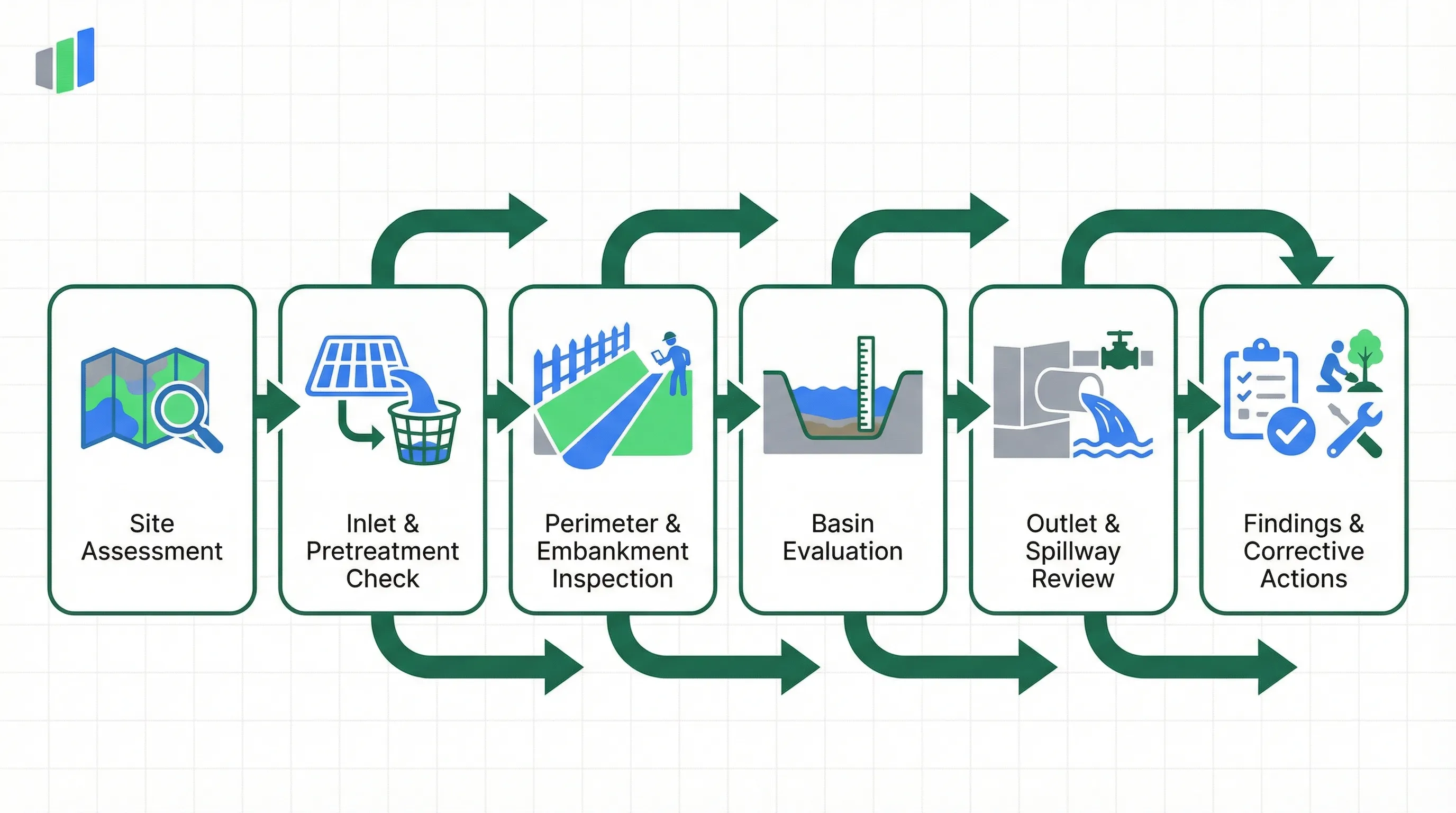
The inspection workflow follows the water path through the BMP system. An inspector begins at the site perimeter to evaluate weather conditions, site status, and the inspection trigger (routine quarterly, post-storm event, complaint response, annual certification, or follow-up re-inspection). From there, the walk-around progresses through four distinct asset zones: inlets and pretreatment structures, the perimeter and embankment, the main basin or treatment area, and the outlet and emergency spillway. Each zone has specific assessment criteria tied to regulatory compliance thresholds.
A critical contextual factor is the inspection trigger. Post-storm inspections, required within 24 hours of a rain event exceeding 0.5 inches in most jurisdictions, capture the BMP under hydraulic load. The inspector records the last rainfall date and 24-hour rainfall amount, which provide the context needed to interpret findings like standing water or sediment transport. A dry detention basin holding water 72 hours after a storm indicates failure; the same basin holding water during active rainfall is expected behavior.
The standard is administered by the US Environmental Protection Agency (EPA), with enforcement delegated to state agencies under the Clean Water Act.
COMPLIANCE RATING
The Three-Tier Compliance Rating Scale
Every BMP receives a Pass, Pass (Needs Maintenance), or Fail rating based on whether it functions as designed under its NPDES permit.
The EPA NPDES BMP inspection uses a three-tier regulatory compliance scale that directly maps to permit status. Unlike graduated condition scores (such as the 1-to-6 NEN 2767 scale or the 0-to-100 PCI), this system is inherently binary at the regulatory level: the BMP is either compliant or non-compliant. The intermediate "Pass (Needs Maintenance)" rating represents a compliant facility that requires routine attention to prevent future non-compliance. This distinction is critical for permit holders because it separates maintenance planning from enforcement risk.
A "Pass" rating means the BMP is functioning as designed with no issues observed, or only cosmetic deficiencies that do not affect hydraulic function or pollutant removal — such as faded markings on an access road. "Pass (Needs Maintenance)" means the facility is compliant but specific tasks are overdue: grass exceeding 12 inches, a sediment forebay at 25-50% capacity, minor trash accumulation, small rodent holes under 2 inches, or minor bank erosion. The inspector selects from a predefined set of corrective actions and assigns a priority. "Fail (Corrective Action Required)" means the BMP is not functioning as designed or poses a safety or environmental hazard — standing water persisting beyond 72 hours, embankment failure, sediment exceeding 50% of storage capacity, a collapsed outlet pipe, evidence of illicit discharge, or woody vegetation (trees) growing on a dam embankment.
| Rating | Permit Status | Description |
|---|---|---|
| Pass | Compliant | BMP functioning as designed. No issues observed or only cosmetic deficiencies with no impact on hydraulic function or pollutant removal. |
| Pass (Needs Maintenance) | Compliant | BMP functioning but routine maintenance overdue. Specific tasks required to prevent future non-compliance (e.g., mowing, minor sediment removal). |
| Fail | Non-Compliant | BMP not functioning as designed or posing a safety/environmental hazard. Corrective action required within defined timelines. |
A "Fail" rating may trigger enforcement action by the delegated state agency under the NPDES MS4 permit.
| Priority | Response Window | Description |
|---|---|---|
| Low | Monitor | No immediate action needed. Continue routine inspection schedule. |
| Medium | < 30 Days | Routine maintenance tasks such as mowing, minor trash removal, or vegetation management. |
| High | < 7 Days | Significant deficiencies affecting function: major sediment accumulation, structural damage, or outlet blockage. |
| Critical | 24 Hours | Emergency response required: embankment failure, illicit discharge, dam safety hazard, or collapse. |
Priority timelines are typical MS4 permit requirements but vary by state-delegated authority (e.g., TDEC, Ohio EPA, Cal EPA).
For a comparable compliance-driven assessment framework in the UK context, see the CIRIA C753 SuDS inspection standard, which uses a similar interventional rating logic.
Try this EPA NPDES BMP form in Geocadra
We have a pre-built EPA NPDES BMP inspection template ready to go. Sign up and start your first condition assessment today.
Free 14-day trial. No credit card required.
BMP TYPES & ZONES
BMP Types and the Zone-Based Inspection Walk-Around
The inspection form covers eight structural BMP types. Each is evaluated through a four-zone walk-around that follows the water path from inlet to outlet.
The EPA NPDES BMP inspection form supports eight distinct structural BMP types: Dry Detention Basin, Wet Pond, Bioretention / Rain Garden, Infiltration Trench, Grassed Swale, Sand Filter, Permeable Pavement, and Underground Vault. The inspector selects the BMP type at the start of the inspection, which establishes the context for all subsequent field assessments. This is critical because expected conditions vary by type — standing water in a wet pond is normal operation, while standing water in a dry detention basin beyond 72 hours indicates clogging and triggers a Fail rating.
The inspection follows a structured four-zone walk-around that traces the water path through the BMP system. The first zone covers inlets and pretreatment structures, where the inspector evaluates obstruction level, structural condition, erosion and scour, sediment forebay depth, and the presence of trash. Each inlet is documented individually because a single detention basin may have anywhere from one to ten or more storm drain inlets feeding into it. The second zone assesses the perimeter and embankment, including vegetation condition, slope erosion severity, the presence of animal burrows (which compromise dam integrity), maintenance access, and fencing condition.
The third zone evaluates the main basin or treatment area. The inspector assesses standing water status, sediment accumulation level, vegetation health (including invasive species identification), trash and debris load, and evidence of illicit discharge. A mandatory overview photo documents the basin condition at the time of inspection. The fourth and final zone covers the outlet and emergency spillway. Outlet obstruction type, structural condition of the primary outlet, emergency spillway status, and downstream stability are all assessed. The outlet zone is where many functional failures manifest — a blocked low-flow orifice, displaced trash rack, or eroded emergency spillway can each independently cause a BMP to fail its compliance inspection.
Dry Detention Basin
Designed to temporarily hold stormwater runoff and release it slowly through a low-flow orifice. Should drain completely between storm events. Standing water beyond 48-72 hours indicates clogging and triggers a Fail rating.
Wet Pond
Maintains a permanent pool of water for pollutant settling and biological treatment. The normal pool level is expected behavior. A dry bed in a wet pond indicates a leak and requires investigation.
Bioretention / Rain Garden
Uses engineered soil media and vegetation to filter, infiltrate, and biologically treat stormwater. Vegetation health and soil infiltration rate are the primary performance indicators.
Infiltration Trench
Stone-filled trench that stores runoff and allows it to percolate into the soil. Sediment clogging of the trench surface is the primary failure mode, requiring periodic rehabilitation.
For more information on BMP design standards, visit the EPA Stormwater BMP resource page.
ILLICIT DISCHARGE
Illicit Discharge Detection During BMP Inspections
Every BMP inspection includes a mandatory screening for illicit discharge indicators — a requirement that distinguishes NPDES inspections from pure structural condition assessments.
Illicit Discharge Detection and Elimination (IDDE) is Minimum Control Measure 3 under the NPDES MS4 permit program, and BMP inspections serve as a frontline screening mechanism for unauthorized discharges. Unlike structural damage or sediment accumulation — which are maintenance issues — illicit discharge indicators signal potential environmental contamination that may require immediate escalation beyond routine maintenance channels.
The inspection form provides a multi-select field for six specific illicit discharge indicators: Oil Sheen / Grease, Foam, Sewage Odor, Unusual Color, and Turbidity. The "None" option is exclusive — selecting it clears all other indicators. When any illicit discharge indicator is recorded, the finding triggers investigation upstream of the BMP itself, because the contamination source is rarely the BMP. Oil sheens may originate from parking lot runoff, sewage odors from cross-connected sanitary sewers, and unusual coloration from industrial process water entering the storm system.
In the corrective action framework, illicit discharge findings typically receive a "High" or "Critical" priority rating. An oil sheen or sewage odor in an active BMP is not just a maintenance item — it is a potential Clean Water Act violation that the MS4 permit holder must document, investigate, and remediate. The photographic documentation requirements for basin inspections are particularly important here, as timestamped geotagged photos provide the evidence trail that regulators and enforcement agencies rely on during compliance audits.
For inspection of underground sewer systems where illicit discharges often originate, see the NASSCO PACP sewer inspection standard. Browse all available inspection standards in the standards directory.
CORRECTIVE ACTIONS
Corrective Action Framework and Priority Assignment
When a BMP does not receive a clean Pass rating, the inspector selects from a predefined menu of corrective actions and assigns a priority that determines the required response window.
The corrective action framework converts inspection findings into specific maintenance work orders. Rather than allowing free-text descriptions of needed work — which produce inconsistent, hard-to-track remediation records — the form provides nine standardized corrective action categories: Remove Sediment, Remove Trash / Debris, Mow / Trim Vegetation, Remove Invasive Species, Repair Inlet / Outlet Structure, Repair Erosion / Stabilize Soil, Remove Woody Vegetation (Trees), Fill Animal Burrows, and Unclog Low Flow Orifice. Multiple actions can be selected simultaneously when a single inspection identifies several deficiencies.
Priority assignment follows a four-tier urgency scale that maps directly to response timelines required by most MS4 permits. "Low (Monitor)" means no immediate action is needed beyond continuing the routine inspection schedule — this is appropriate when a finding is noted but does not yet affect BMP function. "Medium (Routine — <30 Days)" covers standard maintenance tasks like mowing, minor debris removal, or vegetation management. "High (Immediate — <7 Days)" addresses significant functional deficiencies such as major sediment buildup, structural damage to inlet or outlet structures, or outlet blockages that impair drainage. "Critical (Emergency — 24 Hours)" is reserved for situations posing imminent safety or environmental hazards: embankment failure or sliding, active illicit discharge, dam safety concerns, or structural collapse.
Standardized Corrective Action Categories
- Remove Sediment
- Remove Trash / Debris
- Mow / Trim Vegetation
- Remove Invasive Species
- Repair Inlet / Outlet Structure
- Repair Erosion / Stabilize Soil
- Remove Woody Vegetation (Trees)
- Fill Animal Burrows
- Unclog Low Flow Orifice
For further details on MS4 permit requirements, consult the EPA MS4 permit guidance page.
QUESTIONS
Frequently Asked Questions
What is an EPA NPDES BMP inspection?
An EPA NPDES BMP inspection is a regulatory compliance assessment of structural stormwater Best Management Practices required under NPDES MS4 permits. Inspectors evaluate detention basins, bioretention cells, infiltration trenches, and similar controls using a Pass / Pass (Needs Maintenance) / Fail rating to determine whether the facility is functioning as designed under the Clean Water Act.
How often are NPDES BMP inspections required?
Most MS4 permits require routine BMP inspections quarterly, with additional post-storm inspections within 24 hours of rainfall events exceeding 0.25 to 0.5 inches depending on the jurisdiction. Annual certification inspections provide a comprehensive year-end assessment. Follow-up re-inspections verify that corrective actions from previous failures have been completed.
What is the difference between Pass, Pass (Needs Maintenance), and Fail?
Pass means the BMP functions as designed with no deficiencies. Pass (Needs Maintenance) means the BMP is compliant but routine tasks are overdue — such as mowing or minor sediment removal. Fail means the BMP is not functioning as designed or poses a hazard, triggering mandatory corrective action and potential enforcement by the state-delegated permitting authority.
What triggers a Fail rating on a BMP inspection?
Common Fail triggers include standing water persisting beyond 72 hours in a dry detention basin, sediment accumulation exceeding 50% of storage capacity, embankment failure or sliding, collapsed outlet pipes, evidence of illicit discharge such as oil sheens or sewage odor, and woody vegetation (trees) growing on dam embankments that compromise structural integrity.
What are illicit discharge indicators in a BMP inspection?
Illicit discharge indicators are signs of unauthorized non-stormwater discharges entering the BMP. The six indicators assessed are oil sheen or grease, foam, sewage odor, unusual water coloration, and turbidity. Any positive finding triggers upstream investigation under NPDES Minimum Control Measure 3 (Illicit Discharge Detection and Elimination).
Which BMP types does the NPDES inspection form cover?
The form covers eight structural BMP types: Dry Detention Basin, Wet Pond, Bioretention / Rain Garden, Infiltration Trench, Grassed Swale, Sand Filter, Permeable Pavement, and Underground Vault. The selected BMP type establishes the context for expected conditions — for example, standing water is normal in a wet pond but indicates failure in a dry detention basin.
Is NPDES BMP inspection the same across all US states?
The EPA sets the minimum federal framework under NPDES Phase I and Phase II MS4 permits, but enforcement is delegated to state agencies such as TDEC (Tennessee), Ohio EPA, and Cal EPA (California). States may impose stricter thresholds, shorter response timelines, or additional inspection requirements beyond the federal baseline.
In practice
See how the round runs in Geocadra
The solution page shows this inspection regime on real open data: the import, the form, the round, the record per asset and the export.
Lighting columns, poles, sewers and charge points inspected on a map, with every round appended to the assetOpen the solution page: Utilities & Public LightingTRY IT FREE
Digitize your EPA NPDES BMP inspections
Replace paper forms and spreadsheets with structured digital inspections, built for standards like EPA NPDES BMP.
No credit card requiredFree trial included