EN 15312 MUGA Inspection
The European standard for safety inspection of free-access multi-use games areas and sports equipment.
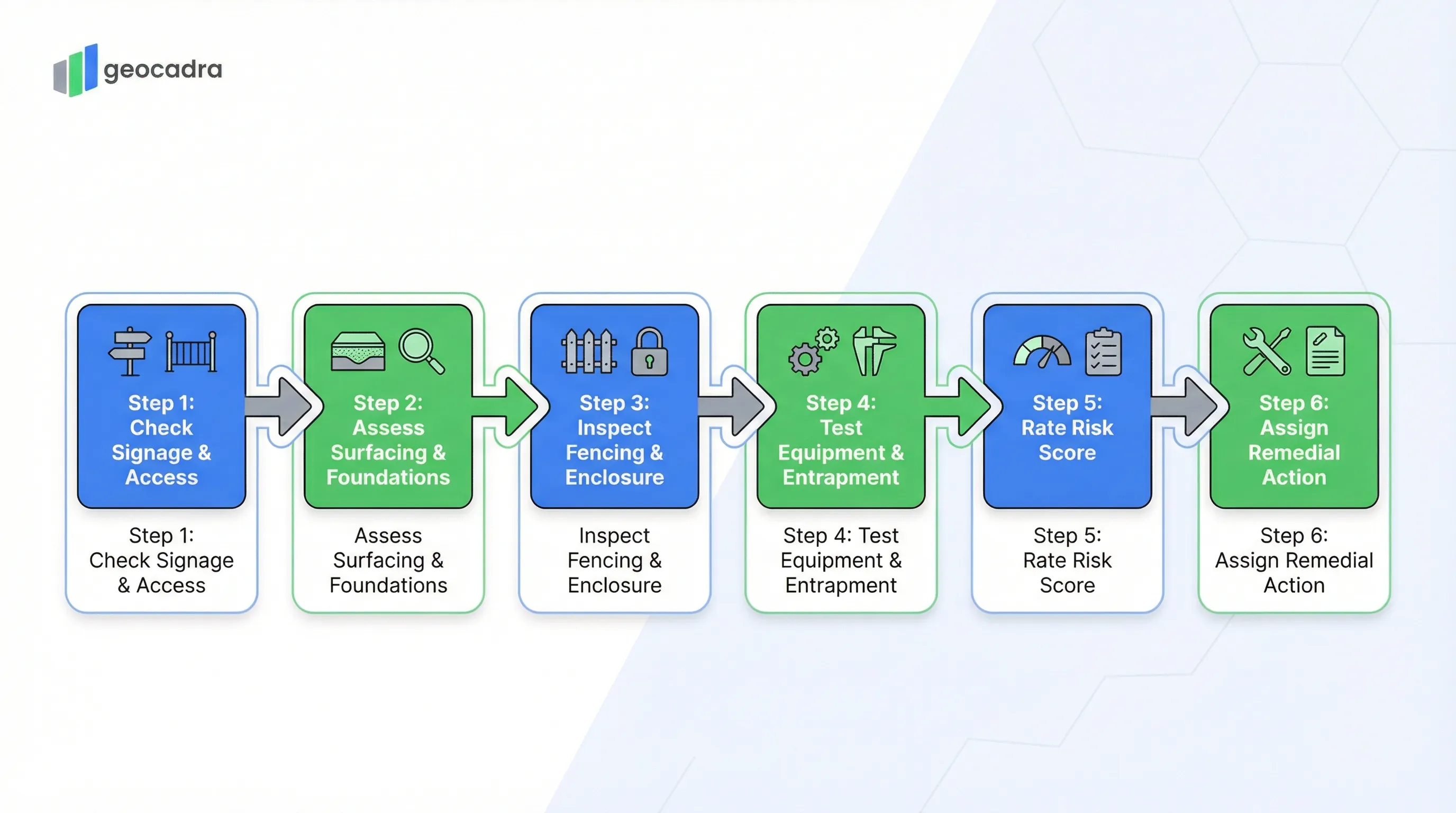
EN 15312:2007+A1:2010 defines the safety requirements, test methods, and inspection protocols for free-access multi-sports equipment — commonly known as MUGAs (Multi-Use Games Areas). These facilities are permanently installed in parks, schools, and public spaces for unsupervised use by children over 36 months and teenagers. The standard covers combination goal units, basketball rings, table tennis tables, and cricket wickets within enclosed playing areas. Inspections follow the EN 1176-7 framework for frequency and competence, while applying MUGA-specific checks for entrapment, structural stability, fencing integrity, and surfacing condition. Each finding is rated using a risk matrix that multiplies Likelihood (1-5) by Severity (1-5) to produce a Risk Score from 1 to 25, driving immediate, planned, or monitored remedial actions.

What is EN 15312?
EN 15312:2007+A1:2010 is the European safety standard for free-access multi-sports equipment installed in public spaces, commonly known as MUGAs (Multi-Use Games Areas). Inspectors assess structural integrity, entrapment hazards, perimeter fencing, surfacing condition, and goal stability, rating each finding using a Likelihood x Severity risk matrix scoring 1 to 25.
- Full Name
- Free Access Multi-Sports Equipment — Requirements Including Safety and Test Methods
- Issuing Body
- CEN (European Committee for Standardization)
- Current Revision
- EN 15312:2007+A1:2010
INSPECTION TYPES
Inspection Types and Mandatory Signage Requirements
EN 15312 defines four distinct inspection types and requires specific safety signage at every MUGA installation to protect unsupervised users.
EN 15312 adopts the inspection framework established by EN 1176-7, defining four inspection types that apply to multi-use games areas. A Routine Visual Inspection is a brief, frequent check — typically weekly or more often for high-use sites — that identifies obvious hazards such as broken glass, vandalism damage, or displaced surfacing. The Operational Inspection is a more detailed monthly assessment covering the functional state of all equipment, gates, and fencing. The Annual Main Inspection is a comprehensive safety audit performed by a competent person, requiring hands-on testing of structural stability, entrapment gaps, and surface impact attenuation. Finally, the Post-Installation Inspection verifies that newly installed or significantly modified equipment meets all EN 15312 requirements before the facility is opened to the public.
The standard places particular emphasis on signage as a safety control for unsupervised facilities. Every MUGA must display signage that is visible from the approach, positioned at the entrance, on equipment, or on the perimeter fence. The required signage content includes an emergency contact number, the site address or location name, the administrator contact details, and several mandatory warnings: "Not for children under 36 months," "Do not climb on framework or nets," "Do not hang on ring," and "No rings or jewelry." The inspector assesses signage condition as Good, Faded or Illegible, Vandalized, or Missing. In the digital form, the Signage Content Check field uses a multi-select input allowing the inspector to verify each required element individually, ensuring that partial compliance is captured rather than a simple pass/fail.
The inspection frequency and competence framework follows EN 1176 playground safety standards.
SURFACING
Surface Condition and Foundation Safety (Clause 4.10)
The playing surface is the first line of defense against impact injuries, making surface condition assessment a critical component of every MUGA inspection.
EN 15312 Clause 4.10 requires that the playing surface provides adequate grip, drainage, and impact absorption appropriate to the activities performed on it. The standard recognizes five surface types commonly found in MUGA installations: Tarmac/Bitumen, Synthetic Turf, Polymeric Rubber, Concrete, and Grass. Each surface type has different deterioration patterns and hazard profiles. Tarmac surfaces develop cracks and potholes that create trip hazards, while synthetic turf can delaminate or develop exposed seams. Polymeric rubber surfaces offer the best impact attenuation but are susceptible to vandalism damage such as burns and cuts. The inspector rates overall Surface Condition as Good, Fair, Poor, or Hazardous, with any Hazardous rating triggering an immediate closure recommendation.
Trip hazards are assessed against a strict threshold: any change in surface level exceeding 3 millimeters constitutes a trip hazard under the standard. This applies to lifted surface edges, cracked tarmac ridges, exposed root growth under synthetic turf, and transitions between different surface materials. The Drainage and Puddling assessment records whether the surface drains effectively (Dry/Clear), has minor standing water, or suffers severe flooding with silt accumulation. Poor drainage not only creates slip hazards during use but accelerates surface deterioration through freeze-thaw cycles and substrate erosion. Foundation exposure is assessed separately from surface condition. Foundations must be fully concealed and must not present tripping or impact hazards. The inspector classifies foundation condition as Concealed (Safe), Exposed (Trip Hazard), Cracked/Loose, or Rot/Corrosion Visible. Exposed or corroded foundations indicate that the ground anchoring system may be compromised, which directly affects the structural stability of goals and fencing attached to those foundations.
For dedicated playground surfacing impact testing requirements, see the ASTM F1487 playground equipment standard.
FENCING & ENCLOSURE
Multi-Sports Surround Inspection (Clause 5.5)
The perimeter enclosure — including rebound fencing, ball stop screens, and access gates — is assessed for structural integrity, entrapment risks, and functional operation.
The multi-sports surround is the collective term for the entire perimeter enclosure of a MUGA. EN 15312 Clause 5.5 addresses rebound fencing, ball stop screens (upper netting designed to contain balls within the playing area), and access gates. The standard recognizes four primary fencing types: Weld Mesh, Rebound Panel, Chain Link, and Wooden Boarding. Each type has distinct failure modes that the inspector must evaluate. Weld mesh fencing can develop broken welds and wire protrusions that create sharp hazards and entrapment points. Rebound panels may crack under repeated ball impact, particularly in goal areas. Chain link fencing deforms over time and can develop finger entrapment gaps. Wooden boarding is susceptible to rot and splintering, particularly at ground level where moisture contact is highest.
The Structural Integrity assessment uses a manual shake test where the inspector applies force to each fencing panel and post to evaluate stability. Results are classified as Stable, Excessive Movement, Loose Fixings, or Failed/Broken. The Fixings and Connections check specifically examines bolt caps, post covers, and mounting brackets. The standard identifies protruding bolt threads exceeding 8 millimeters as hazardous, as they create snagging and laceration risks during play. Gate functionality is assessed separately because gates represent both an access control mechanism and a potential entrapment point. The inspector evaluates whether the gate operates correctly, is seized or stiff, fails to latch, or is missing/detached. Gate hinge gaps and shear points are checked specifically for finger entrapment risk. Noise dampeners — rubber isolators installed between metal panels and framework — are assessed as Intact, Worn/Missing, or Not Applicable. While primarily a nuisance issue rather than a safety concern, missing dampeners often indicate broader maintenance neglect.
For guidance on sports facility construction and enclosure design standards, refer to SAPCA (Sports and Play Construction Association).
Try this EN 15312 form in Geocadra
We have a pre-built EN 15312 inspection template ready to go. Sign up and start your first condition assessment today.
Free 14-day trial. No credit card required.
ENTRAPMENT TESTING
Entrapment Hazards and Probe Testing: The Critical Safety Checks
Entrapment testing is the single most safety-critical element of an EN 15312 inspection, using standardized probes to identify gaps that could trap fingers, heads, or clothing.
EN 15312 identifies three distinct entrapment hazard categories, each with specific dimensional thresholds and testing procedures. Finger Entrapment occurs when gaps between 8 millimeters and 25 millimeters exist in areas above 1 meter height where a child might insert a finger during climbing or hanging. At these dimensions, a finger can enter a gap but the knuckle joint prevents withdrawal, potentially causing fractures, dislocations, or degloving injuries if the child falls while trapped. The inspector performs finger entrapment checks on every joint, connection, mesh opening, and hinge gap throughout the MUGA enclosure and equipment.
Head Entrapment is assessed using standardized probes designated C, D, and E as specified in EN 1176-1. These probes simulate a child's head at different ages and approach angles. Any opening larger than 89 millimeters but smaller than 230 millimeters at a height exceeding 600 millimeters above the playing surface constitutes a head entrapment hazard. The inspector must test for both head-first entry (a child pushes through a gap) and feet-first entry (a child's body slides through an opening but the head is retained). A feet-first entrapment failure is particularly dangerous because the child's full body weight hangs from the trapped head, creating a strangulation risk. Toggle Entrapment addresses the risk of clothing cords, drawstrings, or accessories becoming caught on protruding bolts, hooks, or damaged mesh. Open net hooks on basketball rings are a common toggle entrapment hazard in MUGAs.
Goal Stability and Equipment Safety
Goal stability is classified as the most critical safety item in an EN 15312 MUGA inspection. Unsecured or unstable goals present a toppling risk that has caused fatalities. The inspector assesses each goal unit — whether a combination football/basketball goal, a standalone football goal, or a basketball unit — for Secure, Movement Detected, or Immediate Risk (Toppling). Any goal classified as Immediate Risk requires the facility to be closed until the goal is re-anchored or replaced. The Anti-Climb Design check verifies that goal structures cannot be climbed to access the roof, top rail, or ball stop netting framework. Basketball ring safety checks include verifying the backboard overhang — the standard requires a minimum 60-centimeter free space between the basketball backboard and the fence behind it to prevent collision injuries during play.
RISK ASSESSMENT
The Likelihood x Severity Risk Matrix
Every defect identified during an EN 15312 inspection is rated using a risk matrix that quantifies both the probability and potential severity of injury to produce an actionable risk score.
The EN 15312 risk assessment follows the RPII/RoSPA framework widely adopted across European playground and sports equipment inspection. Each finding is scored on two independent five-point scales: Likelihood of Injury and Severity of Injury. The Likelihood scale ranges from 1 (Very Low — injury is unlikely to occur) through 3 (Medium — injury is probable, such as an exposed sharp edge in a frequent use area) to 5 (Very High — injury is inevitable or certain). The Severity scale ranges from 1 (Minor — superficial injury such as a bruise or graze requiring no medical attention) through 3 (Serious — broken bone, deep laceration, or more than three days off work or school) to 5 (Catastrophic — permanent disability or death). The Risk Score is calculated by multiplying Likelihood by Severity, producing a value between 1 and 25.
| Score | Level | Description | Example |
|---|---|---|---|
| 1 | Very Low | Injury is unlikely to occur | Compliant equipment, minor wear |
| 2 | Low | Injury is possible but not probable | Small surface defect in low-use area |
| 3 | Medium | Injury is probable | Exposed sharp edge in frequent use area |
| 4 | High | Injury is very likely | Broken barrier at height |
| 5 | Very High | Injury is inevitable or certain | Unstable goal with toppling risk |
Likelihood is assessed independently from severity. A high-likelihood low-severity finding (e.g., minor trip hazard on popular surface) may still warrant prompt action.
| Score | Level | Description |
|---|---|---|
| 1 | Minor | Superficial injury (bruise, graze) — no medical attention required |
| 2 | Moderate | Minor medical attention (cut requiring cleaning, sprain) |
| 3 | Serious | Broken bone, deep laceration, more than 3 days off work/school |
| 4 | Major | Severe injury, long-term recovery, hospitalization required |
| 5 | Catastrophic | Permanent disability or death |
Severity reflects the worst credible outcome for the user population, which for MUGAs includes unsupervised children over 36 months.
The Risk Score maps to three Risk Levels that determine the required response timeline. Low Risk (scores 1 to 7) requires monitoring only — no immediate work is needed, and the defect is maintained through the routine inspection schedule. Medium Risk (scores 8 to 12) requires planned action within the operational budget and timeline, typically one to three months. High Risk (scores 13 to 25) demands urgent action: the equipment must be isolated immediately and either repaired or removed before public access is restored. In the digital form, the Risk Score is auto-calculated from the Likelihood and Severity inputs, and the Risk Level is auto-mapped from the score. This eliminates arithmetic errors that occur with paper-based risk matrices and ensures consistent risk categorization across different inspectors and sites. Each defect entry also captures a Recommended Action text describing the specific remedial tasks and a Priority/Timeline classification: Immediate (24 hours), High (1 week), Medium (1 month), or Low (Monitor).
| Score Range | Risk Level | Required Action |
|---|---|---|
| 1–7 | Low | Monitor — no immediate work; maintain via routine schedule |
| 8–12 | Medium | Planned action — repairs within 1 to 3 months |
| 13–25 | High | Urgent — isolate equipment immediately; repair or remove |
Risk Score = Likelihood x Severity. A score of 13 or above requires immediate isolation of the affected equipment to prevent public access.
The risk assessment methodology follows the RPII/RoSPA framework. For further guidance on playground inspection qualifications and risk management, see RoSPA (Royal Society for the Prevention of Accidents).
QUESTIONS
Frequently Asked Questions
What is EN 15312?
EN 15312:2007+A1:2010 is the European standard for free-access multi-sports equipment, commonly known as MUGAs (Multi-Use Games Areas). It defines safety requirements, test methods, and inspection protocols for permanently installed sports equipment used by the public without supervision, including goals, basketball units, and table tennis tables.
What is the difference between EN 15312 and EN 1176?
EN 1176 covers playground equipment designed primarily for play, while EN 15312 covers multi-sports equipment designed for organized sports activities. MUGAs with combination goal/basketball units fall under EN 15312. However, EN 15312 adopts the inspection framework (types and frequency) from EN 1176-7 for guidance on maintenance operations.
How is the risk score calculated in an EN 15312 inspection?
The risk score is calculated by multiplying Likelihood of Injury (1-5) by Severity of Injury (1-5), producing a score from 1 to 25. Scores of 1 to 7 are Low risk (monitor), 8 to 12 are Medium risk (plan repairs within 1-3 months), and 13 to 25 are High risk requiring immediate equipment isolation.
What are the entrapment thresholds in EN 15312?
Finger entrapment applies to gaps between 8mm and 25mm in areas above 1 meter height. Head entrapment applies to openings between 89mm and 230mm above 600mm height, tested with probes C, D, and E. Toggle entrapment covers clothing cords catching on hooks, bolts, or damaged mesh components.
How often should a MUGA be inspected under EN 15312?
EN 15312 follows the EN 1176-7 inspection framework: Routine Visual inspections weekly or more often for high-use sites, Operational inspections monthly, and a comprehensive Annual Main Inspection by a competent person. Post-Installation inspections are required before any new or modified facility opens to the public.
What signage is mandatory for a MUGA under EN 15312?
Every MUGA must display an emergency contact number, site address, administrator contact, and specific warnings: "Not for children under 36 months," "Do not climb on framework or nets," "Do not hang on ring," and "No rings/jewelry." Signage must be visible from the approach and positioned at the entrance or perimeter fence.
Why is goal stability the most critical safety check?
Unsecured or unstable goals present a toppling risk that has caused fatalities. EN 15312 classifies goal stability as the most critical safety item. Any goal rated as Immediate Risk (Toppling) requires the facility to be closed until the goal is re-anchored or replaced. Goals must also incorporate anti-climb design features.
In practice
See how the round runs in Geocadra
The solution page shows this inspection regime on real open data: the import, the form, the round, the record per asset and the export.
Playground checks, headstone tests and green-space acceptances on a map, with every round appended to the siteOpen the solution page: Municipalities & Public SpaceTRY IT FREE
Digitize your EN 15312 inspections
Replace paper forms and spreadsheets with structured digital inspections, built for standards like EN 15312.
No credit card requiredFree trial included