




FHWA NTIS Tunnel Inspection
The U.S. federal standard for element-level tunnel condition assessment, inventory reporting, and critical finding management.
The FHWA NTIS framework governs how highway tunnels across the United States are inspected, rated, and reported to the National Tunnel Inventory. Mandated by the MAP-21 legislation and administered by the Federal Highway Administration, NTIS requires that every tunnel component be assessed through a quantitative element-level system rather than a single holistic rating. Each element's total quantity is distributed across four Condition States, producing granular condition data that drives maintenance scheduling, capital planning, and federal compliance reporting.

What is FHWA NTIS?
The FHWA National Tunnel Inspection Standards (NTIS) and Specifications for the National Tunnel Inventory (SNTI) define the U.S. federal framework for element-level tunnel inspection. Inspectors distribute each element's total quantity across four Condition States (CS1 Good through CS4 Severe) to produce quantitative, comparable condition data.
- Full Name
- National Tunnel Inspection Standards / Specifications for the National Tunnel Inventory
- Issuing Body
- Federal Highway Administration (FHWA), U.S. Department of Transportation
- Current Revision
- SNTI Publication No. FHWA-HIF-15-006
INVENTORY DATA
Tunnel Inventory and Geometric Classification
The SNTI separates tunnel data into static inventory fields verified at each inspection and dynamic condition data captured through element assessment.
Every NTIS-compliant inspection begins with verification of the tunnel's inventory and geometric data. The Specifications for the National Tunnel Inventory (SNTI) define two categories of data: static inventory fields that describe the tunnel's identity and physical characteristics, and dynamic condition data captured through element-level assessment. While inventory data rarely changes between inspection cycles, the SNTI requires that inspectors verify it during every routine inspection to catch undocumented modifications, ownership transfers, or measurement corrections.
The identification fields establish the tunnel's unique position in the National Tunnel Inventory. The Tunnel Number (Item I.1) is a unique identifier assigned by the owning agency. The Tunnel Name (Item I.2) provides a common reference, and the Facility Carried (Item I.10) documents which road, highway, or rail line passes through the structure. Owner codes classify the responsible agency using a standardized numeric system that parallels the National Bridge Inventory coding: 01 for State Highway Agency, 02 for County Highway Agency, 04 for City/Municipal, 27 for Railroad, and 31 for State Toll Authority, among others.
Geometric data captures the tunnel's physical dimensions and structural classification. Tunnel Length in feet and Minimum Vertical Clearance establish the basic envelope. The Tunnel Shape field uses a four-category classification: Oval (1), Horseshoe (2), Rectangular (3), and Circular (4). The Complex Tunnel designation (Item S.5) is a critical binary flag indicating whether the tunnel incorporates advanced mechanical, electrical, or fire/life safety systems such as ventilation fans, fire suppression, or traffic management. Complex tunnels require more frequent inspections and broader system expertise from the inspection team. These geometric and classification fields feed directly into the National Tunnel Inventory database, enabling FHWA to track the national tunnel population's characteristics and allocate inspection resources.
CONDITION STATES
The Four Condition States: CS1 through CS4
Unlike single-grade rating systems, NTIS uses a quantitative distribution model where the total quantity of each element is split across four Condition States.
The SNTI Condition State system is fundamentally different from the single-number condition ratings used in many other inspection standards. Instead of assigning one overall grade to an element, the inspector distributes the element's total quantity across four Condition States: CS1 (Good), CS2 (Fair), CS3 (Poor), and CS4 (Severe). For example, a Cast-in-Place Concrete Liner with a total area of 50,000 square feet might be distributed as 35,000 SF in CS1, 10,000 SF in CS2, 4,000 SF in CS3, and 1,000 SF in CS4. This quantitative approach captures the distribution of deterioration across the element rather than reducing it to a single number.
CS1 (Good) represents portions of the element exhibiting no notable distress. The material is functioning as originally designed, with no visible cracking, spalling, corrosion, or deformation. CS2 (Fair) indicates isolated breakdowns or early-stage deterioration. Minor defects are present but do not compromise the element's structural function or service life. CS3 (Poor) describes widespread deterioration or advanced defects. The element still functions but has experienced significant degradation that warrants planned rehabilitation. CS4 (Severe) marks portions where the element has failed or is no longer effective. This state triggers engineering review and may require immediate intervention, load restrictions, or closure.
| State | Name | Description | Action Implication |
|---|---|---|---|
| CS1 | Good | No notable distress. Element functions as originally designed. | Routine inspection only. No maintenance required. |
| CS2 | Fair | Isolated breakdowns or minor deterioration. Early-stage defects present. | Preventive maintenance recommended. Monitor progression. |
| CS3 | Poor | Widespread deterioration or advanced defects. Element still functions but degraded. | Planned rehabilitation warranted. Include in capital program. |
| CS4 | Severe | Element has failed or is no longer effective. Structural review required. | Immediate engineering evaluation. May require closure or load restriction. |
The distinction between CS3 and CS4 carries particular regulatory significance. Any quantity in CS4 signals that a portion of the element has exceeded its functional threshold, and FHWA guidance directs tunnel owners to evaluate whether the finding constitutes a critical condition requiring immediate action. Specific defect definitions vary by element material. For concrete elements, crack widths exceeding 0.05 inches, active spalling with exposed reinforcement, and section loss beyond defined thresholds each map to specific Condition States. Steel elements use corrosion depth, section loss percentage, and connection deterioration as their classification criteria.
Try this FHWA NTIS form in Geocadra
We have a pre-built FHWA NTIS inspection template ready to go. Sign up and start your first condition assessment today.
Free 14-day trial. No credit card required.
ELEMENT CATALOG
SNTI Tunnel Element Families and Their Units of Measure
The SNTI defines a standardized library of tunnel elements spanning structural liners, civil works, mechanical systems, electrical systems, and fire/life safety components.
The SNTI element catalog is the inspection's structural backbone. Each element in the catalog has a unique five-digit numeric code, a defined unit of measure, and element-specific Condition State descriptions that guide the inspector's quantity distribution. The catalog divides tunnel components into distinct families that together cover the complete tunnel system from structural shell to operational equipment.
Structural elements form the primary family. These include Cast-in-Place Concrete Liner (10000), Precast Concrete Liner (10002), Shotcrete Liner (10003), and Unlined Rock (10006). Structural liners are measured in square feet (SF), and their Condition State definitions focus on cracking patterns, spalling extent, water infiltration, and section loss. The Concrete Portal element (10050) covers the tunnel entrance and exit structures, assessed separately because portals experience different loading patterns and environmental exposure than the interior liner. The Concrete Wearing Surface (10151) tracks the roadway deck condition independently from the structural liner above it.
SNTI Standard Tunnel Element Codes
Code
Element
Unit
Family
| Code | Element | Unit | Family |
|---|---|---|---|
| 10000 | Cast-in-Place Concrete Liner | SF | Structural |
| 10002 | Precast Concrete Liner | SF | Structural |
| 10003 | Shotcrete Liner | SF | Structural |
| 10006 | Unlined Rock | SF | Structural |
| 10050 | Concrete Portal | SF | Structural |
| 10151 | Concrete Wearing Surface | SF | Civil |
| 10500 | Ventilation System | EA | Mechanical |
| 10600 | Lighting System | EA | Electrical |
| 10700 | Fire Protection System | EA | Fire/Life Safety |
| 10850 | Traffic Sign | EA | Signage |
Civil, mechanical, and electrical system elements form the operational families. The Ventilation System (10500) covers jet fans, axial fans, ducting, dampers, and motor controls. The Lighting System (10600) encompasses luminaires, wiring, control panels, and emergency backup circuits. The Fire Protection System (10700) includes detection equipment, suppression systems, standpipe connections, and deluge valves. The Pumps element (10300) covers drainage and groundwater management equipment. Traffic Signs (10850) are assessed for reflectivity, structural mounting, and legibility. Each operational element uses its own unit of measure, typically Each (EA) for discrete components, and its own CS1-CS4 definitions tailored to the equipment type. A ventilation fan in CS3 means reduced airflow capacity, while a lighting circuit in CS3 means sections of the tunnel are below minimum illumination levels. The inspector must understand each element's specific degradation criteria to distribute quantities accurately.
CRITICAL FINDINGS
Critical Findings and Load Rating Assessment
The critical findings workflow is the safety mechanism within NTIS that triggers immediate action when an inspection reveals conditions threatening public safety.
The NTIS critical finding protocol is one of the most consequential aspects of tunnel inspection. When an inspector identifies a condition that poses an immediate safety threat to the traveling public, they flag it as a Critical Finding. This flag triggers a mandatory reporting chain: the tunnel owner must notify the FHWA Division Office within 24 hours of discovery, develop a follow-up plan of action, and implement interim risk mitigation measures while permanent repairs are planned. Critical findings are not limited to structural failures. A non-functional fire suppression system in a complex tunnel, failed ventilation that compromises air quality standards, or inoperable emergency lighting in an evacuation route can all constitute critical findings because they affect life safety systems.
The Load Rating section of the inspection documents the tunnel's structural capacity for carrying traffic loads. The Load Rating Method field (Item L.1) records which analytical approach was used: Field Evaluation and Documented Engineering Judgment (0), Load Factor method (1), Allowable Stress method (2), Load and Resistance Factor Rating (3), Load Testing (4), or No Rating Analysis Performed (5). The choice of method depends on the tunnel's structural type, available design documents, and the complexity of the loading conditions.
| Code | Method | Description |
|---|---|---|
| 0 | Field Eval / Engineering Judgment | Rating based on inspector's field evaluation and documented professional judgment. |
| 1 | Load Factor (LF) | Rating using load factor design methodology with factored loads and nominal resistance. |
| 2 | Allowable Stress (AS) | Rating using allowable stress design comparing actual stresses to material limits. |
| 3 | Load and Resistance Factor (LRFR) | Rating using probability-based load and resistance factor methodology. |
| 5 | No Rating Performed | No structural load rating analysis has been completed for this tunnel. |
The Posting Status field (Item L.4) records the operational outcome of the load rating analysis and any critical findings. A tunnel may be Open with No Restriction (0), Open with Posting Required (1), Open with Temporary Shoring in place (3), or Closed (4). When a tunnel requires posting, the weight restrictions must be physically posted at the tunnel approaches and reflected in the National Tunnel Inventory. The digital form captures the Team Leader's signature to authenticate the inspection record. This signature field confirms that a qualified inspection professional has reviewed all element assessments, verified the critical finding status, and takes professional responsibility for the reported data. The form requires completion of all mandatory fields before the signature can be applied, enforcing data completeness at the point of capture.
| Code | Status | Implication |
|---|---|---|
| 0 | Open, no restriction | Tunnel operates at full legal loading capacity. |
| 1 | Open, posting required | Weight or vehicle restrictions posted at tunnel approaches. |
| 3 | Open, temporary shoring | Temporary structural support in place to maintain operation. |
| 4 | Closed | Tunnel is closed to traffic due to structural or safety concerns. |
VALIDATION LOGIC
Element Quantity Validation: The CS Sum Rule
The SNTI enforces a fundamental validation constraint: for every element, the sum of all four Condition State quantities must exactly equal the Total Quantity.
The most critical data quality rule in the SNTI element-level system is the quantity validation constraint: CS1 + CS2 + CS3 + CS4 must equal the Total Quantity for every inspected element. This rule ensures that the inspector has accounted for 100% of the element's physical extent. If a Cast-in-Place Concrete Liner has a total area of 50,000 square feet, exactly 50,000 square feet must be distributed across the four Condition States with no remainder and no excess. This mathematical closure prevents both under-reporting (leaving portions unassessed) and over-reporting (double-counting deteriorated areas).
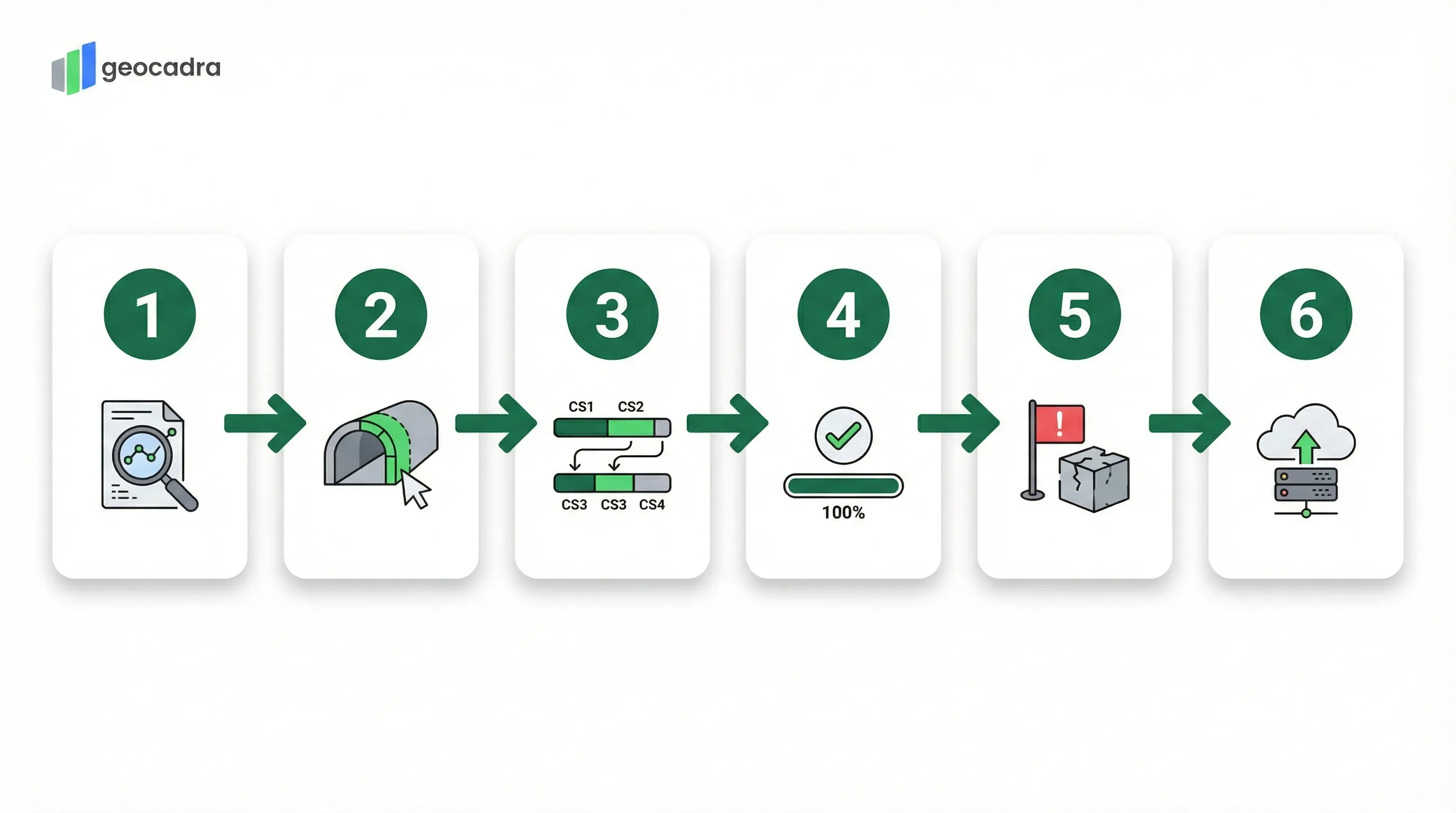
In practice, this validation rule creates a specific field workflow. The inspector first records the Total Quantity, typically derived from inventory records or field measurement. They then systematically assess the element, identifying areas of deterioration and estimating their extent in the same unit of measure. The CS4 quantity captures the most severely deteriorated portions, CS3 captures advanced but still functional deterioration, and CS2 captures early-stage defects. The CS1 quantity is calculated as the remainder: Total Quantity minus CS2 minus CS3 minus CS4. This approach ensures that CS1 is not a subjective assessment of "good" portions but rather the mathematical complement of all identified deterioration.
Digital inspection forms enforce this constraint in real time. When the inspector enters Condition State quantities for an element, the form can immediately validate that the four values sum to the Total Quantity and alert the inspector to any discrepancy before they move to the next element. This real-time validation eliminates one of the most common data quality issues in paper-based NTIS inspections: incomplete element assessments where the Condition State quantities do not account for the full element extent. The validation rule also serves as a self-checking mechanism: if an inspector discovers additional deterioration during a closer examination, they must reduce the CS1 quantity correspondingly, maintaining the mathematical balance and ensuring that the condition profile always reflects the complete element.
The complete SNTI specification is published by the Federal Highway Administration (FHWA). Detailed inspection procedures are described in the TOMIE Manual (Tunnel Operations, Maintenance, Inspection, and Evaluation).
For bridge structures along the same highway corridor, the companion FHWA NBIS/SNBI bridge inspection standard. Explore all available inspection standards in the standards library.
QUESTIONS
Frequently Asked Questions
What is the FHWA NTIS tunnel inspection standard?
The FHWA National Tunnel Inspection Standards (NTIS) and the Specifications for the National Tunnel Inventory (SNTI) define the U.S. federal framework for inspecting highway tunnels. Mandated by MAP-21 legislation, NTIS requires element-level condition assessment using four Condition States (CS1 Good through CS4 Severe) for every tunnel component.
What are the four Condition States in tunnel inspection?
The four Condition States are CS1 (Good) for portions with no notable distress, CS2 (Fair) for isolated minor deterioration, CS3 (Poor) for widespread advanced defects where the element still functions, and CS4 (Severe) for portions that have failed or are no longer effective and require structural review.
How does tunnel element-level inspection differ from bridge inspection?
While bridge inspection under NBIS uses a 0-to-9 single-number condition rating per component, NTIS tunnel inspection requires the inspector to distribute each element's total quantity across four Condition States. This quantitative approach captures the distribution of deterioration rather than reducing it to a single grade.
What is a critical finding in a tunnel inspection?
A critical finding is a condition that poses an immediate safety threat to the traveling public. When flagged, the tunnel owner must notify the FHWA Division Office within 24 hours, develop a corrective action plan, and implement interim risk mitigation measures. Critical findings can be structural, mechanical, or related to fire/life safety systems.
What is the CS quantity validation rule?
The SNTI requires that for every inspected element, the sum of CS1 + CS2 + CS3 + CS4 quantities must exactly equal the Total Quantity. This mathematical closure ensures 100% of the element has been assessed, preventing both under-reporting and double-counting of deteriorated areas.
What is a complex tunnel under NTIS?
A complex tunnel is one that incorporates advanced mechanical, electrical, or fire/life safety systems such as ventilation fans, fire suppression, traffic management, or emergency lighting. Complex tunnels require more frequent inspections, broader system expertise from the inspection team, and assessment of operational elements beyond structural components.
How often must tunnels be inspected under NTIS?
NTIS requires routine inspections of all highway tunnels at regular intervals not exceeding 24 months. Tunnels with critical findings, significant deterioration, or unique risk factors may require more frequent inspections as determined by the FHWA and the tunnel owner based on the structure's condition and operational profile.
In practice
See how the round runs in Geocadra
The solution page shows this inspection regime on real open data: the import, the form, the round, the record per asset and the export.
Main and routine inspections of bridges, walls, roads and signs on a map, with every inspection appended to the structureOpen the solution page: Bridges, Roads & StructuresTRY IT FREE
Digitize your FHWA NTIS inspections
Replace paper forms and spreadsheets with structured digital inspections, built for standards like FHWA NTIS.
No credit card requiredFree trial included