
ILP GN22 ATOMS Inspection
The UK standard for structural inspection of street lighting columns using Severity-Extent defect grading and the Column Condition Index (CCI).
ILP GN22 — Asset Management Toolkit for Minor Structures (ATOMS) — is the current UK industry standard for the inspection, testing, and lifecycle management of lighting columns, sign poles, and CCTV masts. Published by the Institution of Lighting Professionals (ILP), it supersedes the earlier Technical Report 22 (TR22) with a risk-based approach that moves beyond simple time-based replacement. Inspectors assess each structural component individually, grading defects by Severity (1-5) and Extent (A-E), producing the data needed to calculate the Column Condition Index (CCI) and prioritize maintenance, NDT testing, or replacement across entire column portfolios.

What is ILP GN22 ATOMS?
ILP GN22 (ATOMS) is the UK standard for structural inspection of street lighting columns, sign poles, and CCTV masts. Inspectors rate each component — root, door, shaft, bracket, luminaire — on two axes: Severity (1-5) and Extent (A-E). These scores feed the Column Condition Index (CCI), which categorises assets into action bands for targeted maintenance and replacement planning.
- Full Name
- Guidance Note 22: Asset Management Toolkit for Minor Structures (ATOMS)
- Issuing Body
- Institution of Lighting Professionals (ILP)
- Current Revision
- GN22 (replacing TR22)
METHODOLOGY
How ILP GN22 ATOMS Inspections Work
GN22 defines a structured visual inspection protocol that feeds into a risk management model rather than a simple pass/fail assessment.
ILP GN22 fundamentally changed how UK highway authorities manage their lighting column stock by replacing the age-based replacement philosophy of TR22 with a condition-based risk model. Under TR22, columns were typically scheduled for replacement at a fixed age — often 25 or 30 years — regardless of their actual structural state. GN22 recognises that material type, environmental exposure, and maintenance history cause columns of the same age to deteriorate at vastly different rates, making blanket age thresholds both wasteful and unsafe.
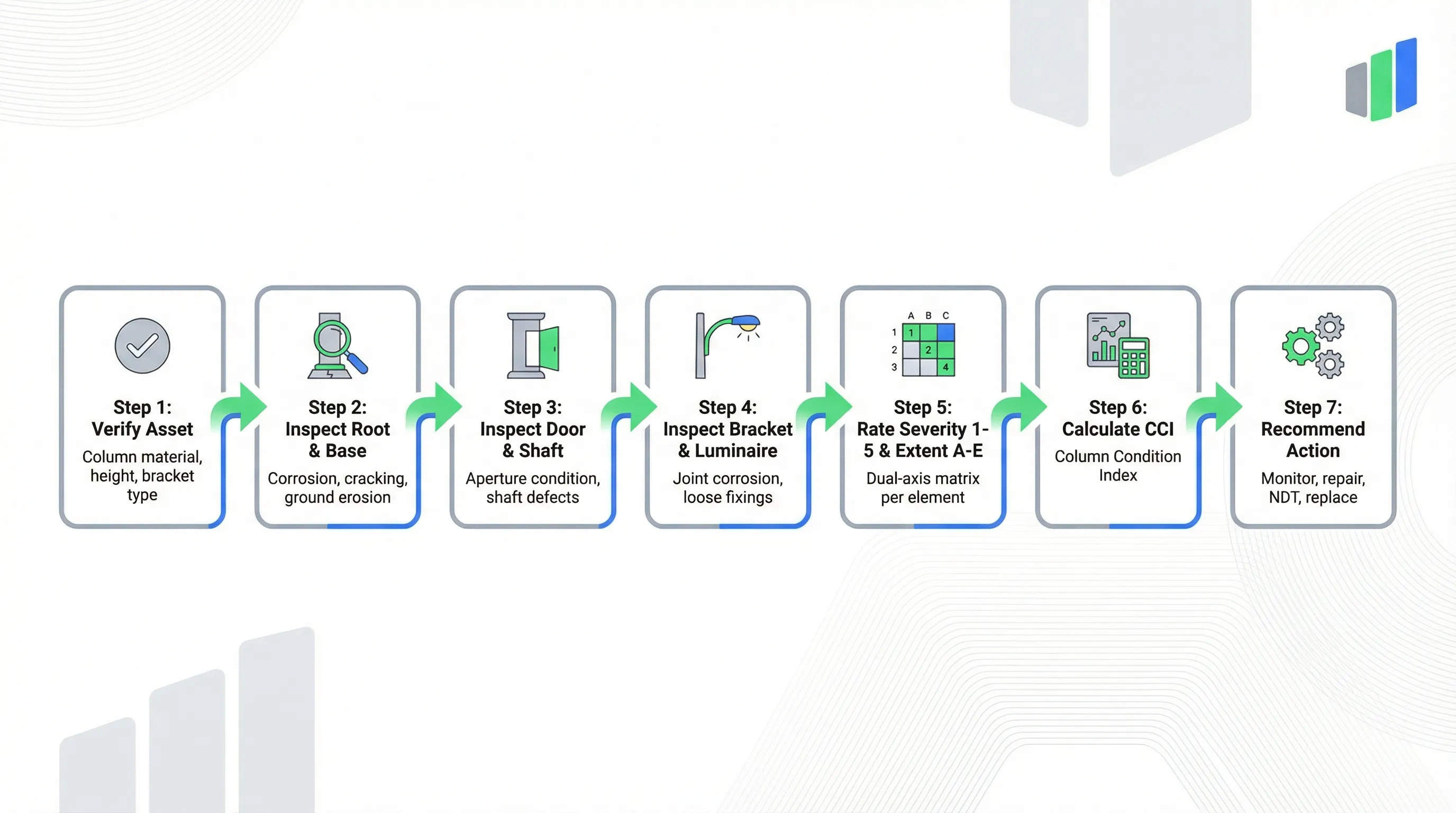
The inspection follows a ground-up sequence. The inspector begins at the root and foundation, examining the interface between the column and the ground for corrosion, cracking, or soil erosion. They then move to the base compartment door, checking for missing doors, misfitting panels, corrosion at the aperture, and cracked corners. The shaft is assessed for general corrosion, swage joint deterioration, impact damage, lean, weld failure, and loss of section. The bracket or arm is checked for joint corrosion, loose connections, misalignment, and structural cracking. Finally, the luminaire is inspected for secure fixings and any attachments such as signs, CCTV cameras, flower baskets, banners, or festive lighting are recorded because they alter the wind loading on the column.
For every defect identified at each component, the inspector assigns two independent ratings: a Severity score from 1 to 5 indicating how bad the defect is, and an Extent code from A to E indicating how widespread it is. This dual-axis approach captures the critical distinction between a small but dangerous defect (high severity, low extent) and a cosmetically widespread but structurally insignificant issue (low severity, high extent). The raw field data is then processed by asset management software to calculate the Column Condition Index (CCI), which places each column into an action band — from "no action required" through "monitor" and "programmed repair" to "emergency make safe."
ILP GN22 ATOMS inspection process: Verify Asset, Inspect Root and Base, Inspect Door and Shaft, Inspect Bracket and Luminaire, Rate Severity 1-5 and Extent A-E, Calculate CCI, Recommend Action
The standard is maintained by the Institution of Lighting Professionals (ILP) as the successor to the earlier Technical Report 22 (TR22).
RATING SCALES
Severity and Extent: The Dual-Axis Rating System
Every component defect is graded on two independent dimensions, producing a matrix that distinguishes critical-but-localised damage from widespread-but-minor deterioration.
The Severity scale is a five-point ordinal measure of how critical the defect is to structural integrity and public safety. A score of 1 (None/Negligible) means no significant defects are found and the component is functioning as intended. Score 2 (Minor) indicates visible defects such as surface corrosion or hairline cracks that do not significantly affect structural strength — the column should be monitored at subsequent inspection cycles. Score 3 (Moderate) means defects are clearly visible — pitting corrosion, concrete spalling, or minor denting — and structural performance may be starting to degrade, warranting maintenance or non-destructive testing. Score 4 (Severe) applies to major defects such as significant loss of section, deep cracks, or a loose base compartment door, where structural integrity is compromised and corrective action is required. Score 5 (Hazardous/Critical) signals that the component has failed or failure is imminent, creating an immediate risk to public safety — for example, a column leaning dangerously or exposed live wiring — demanding emergency action within 24 hours.
The Extent scale uses five alphabetic codes to quantify what proportion of the component surface area is affected by the defect. Code A (Isolated) means less than 5% is affected — a single localised instance. Code B (Minor) covers 5% to 20%. Code C (Moderate) covers 20% to 50%. Code D (Significant) covers more than 50%. Code E (Widespread) indicates that the defect affects the entire component or constitutes total failure. The interaction between severity and extent is crucial: a Severity 4, Extent A defect (a severe but localised crack at the root) may warrant immediate NDT testing, while a Severity 2, Extent D defect (widespread surface corrosion) may only require programmed repainting.
| Score | Grade | Description |
|---|---|---|
| 1 | None / Negligible | No significant defects found. Component functioning as intended. |
| 2 | Minor | Minor defects visible (surface corrosion, hairline cracks). Structural strength not significantly affected. |
| 3 | Moderate | Defects clearly visible (pitting corrosion, spalling). Performance may be affected; maintenance or NDT required. |
| 4 | Severe | Major defects (significant loss of section, deep cracks). Structural integrity compromised; corrective action required. |
| 5 | Hazardous / Critical | Component failed or failure imminent. Immediate risk to public safety; emergency action required. |
Severity is rated independently for each structural component: root, door, shaft, bracket, and luminaire.
| Code | Grade | Affected Area |
|---|---|---|
| A | Isolated | < 5% of component surface area; single isolated instance. |
| B | Minor | 5% - 20% of the area. |
| C | Moderate | 20% - 50% of the area. |
| D | Significant | > 50% of the area. |
| E | Widespread | Entire component affected or total failure. |
Extent is rated in conjunction with severity for every inspected component to populate the CCI calculation.
This dual-axis model mirrors the approach used in other UK infrastructure standards. The CS 450 bridge inspection standard under the Design Manual for Roads and Bridges (DMRB) uses the same Severity 1-5 and Extent A-E framework for highway structures. GN22 adapted this proven methodology specifically for lighting columns, with defect types and component categories tailored to the unique failure modes of slender steel, aluminium, concrete, and cast iron columns.
A comparable multi-dimensional defect rating approach is used in the CS 450 bridge inspection, which uses the same Severity 1-5 and Extent A-E framework for highway structures. The NEN 2767 condition assessment extends this approach with a third dimension (intensity).
Try this ILP GN22 form in Geocadra
We have a pre-built ILP GN22 inspection template ready to go. Sign up and start your first condition assessment today.
Free 14-day trial. No credit card required.
COMPONENT ASSESSMENT
Five-Zone Structural Inspection
GN22 requires inspectors to assess each lighting column as five distinct structural zones, not as a single asset.
The component-level approach is what distinguishes GN22 from simpler inspection regimes. Rather than assigning a single condition grade to an entire column, the inspector must evaluate five discrete zones — each with its own defect types, severity rating, and extent code. This granularity is essential because column failures follow material-specific and location-specific patterns. A steel tubular column may have a perfectly sound shaft but severe pitting corrosion at the root where it meets the ground. A concrete column may show no corrosion at all but exhibit dangerous spalling that exposes reinforcement bars. By capturing condition data per component, the CCI algorithm can weight the most structurally critical zones appropriately.
The Root and Base zone covers the interface between the column and the ground — the most common failure point for steel columns. Inspectors look for surface corrosion, pitting and scaling corrosion, concrete spalling, impact damage from mowing equipment or vehicles, cracking, and soil erosion or ground movement that may undermine the foundation. The Door and Aperture zone assesses the base compartment where electrical connections terminate. Common defects include missing doors, misfitting or loose panels, broken locks, corrosion around the door opening, cracks at aperture corners (stress concentrations from the cut-out), and missing backboards that should insulate conductors from the column wall.
The Shaft zone covers the main vertical structural member — the primary load-bearing element. Defect types include general surface corrosion, corrosion at swage joints (a critical failure point where stepped columns change diameter and water pools in the joint), impact damage or denting from vehicles, lean or loss of verticality, seam weld failure along the longitudinal weld, and loss of section where corrosion has consumed wall thickness. The Bracket zone inspects the projection holding the luminaire, checking for joint corrosion, loose connections, misalignment, and structural cracking. The Luminaire zone verifies that the lantern is securely fixed, with checks for loose fixings, missing bowls or visors, and damaged canopies. Any attachments on the column — signs, flower baskets, CCTV cameras, banners, festive lighting — are also recorded here because they add wind loading that the original column design may not have accounted for.
For more information on highway infrastructure inspection methodologies, browse the standards directory. The Highway Electrical Association (HEA) provides complementary guidance on practical implementation.
COLUMN CONDITION INDEX
From Field Scores to the CCI
The Column Condition Index translates raw severity and extent ratings into a weighted metric that drives replacement and maintenance budgets.
The Column Condition Index (CCI) is the primary output of a GN22 inspection. It is not calculated by the inspector in the field — the inspector collects the raw severity and extent scores for each component, and the CCI is computed by the back-office asset management system using a weighted algorithm. The weighting reflects the structural criticality of each zone: a severe root defect scores higher than an equivalent defect at the bracket because root failure leads to total column collapse, while a bracket failure typically results only in a dropped luminaire.
The CCI places each column into one of several action bands. A "Very Good" rating indicates no action is required. "Good" means the column should be monitored and retested in 3 to 5 years. "Fair" triggers programmed repair planning. "Poor" demands structural testing using non-destructive testing (NDT) methods such as Relative Loss of Section (RLS) ultrasonic measurement. "Very Poor / Unsafe" requires immediate make-safe action — which may mean cutting the column down within 24 hours if it poses an imminent risk to highway users.
Material type is a critical input to the CCI calculation because it determines the failure modes that apply. Steel tubular and steel folded (octagonal) columns are primarily susceptible to corrosion, particularly at the root, swage joints, and door apertures. Aluminium extruded columns resist corrosion but may suffer fatigue cracking at welded joints. Cast aluminium bases are prone to impact damage. Concrete columns develop spalling and reinforcement corrosion. Cast iron columns fracture rather than deform. Timber columns rot from the inside out. Composite and GRP columns are relatively new and have different degradation profiles. In the digital form, the inspector selects the column material from eight options — Steel (Tubular), Steel (Folded/Octagonal), Aluminium (Extruded), Aluminium (Cast Base), Concrete, Cast Iron, Timber, and Composite/GRP — and this selection contextualises the defect grading downstream.
DIGITAL WORKFLOW
Digitize ILP GN22 Inspections with Geocadra
Move from paper-based column inspections to structured digital data capture that feeds directly into CCI calculations and asset management reporting.
Component-structured forms
Pre-built GN22 form templates guide the inspector through each zone in sequence — root, door, shaft, bracket, luminaire — with dropdown selectors for defect types, severity grades, and extent codes. Inspectors select from the standard options; no free-text entry is needed for structured fields, ensuring consistent data quality across hundreds of inspectors.
Material-aware defect options
The column material selection at the start of the inspection automatically contextualises which defect types are relevant. Steel columns present corrosion options; concrete columns present spalling. This prevents mismatched data such as recording "spalling" on a steel column.
Photo-linked defect evidence
Every severity and extent rating is backed by geotagged photo evidence tied to the specific component and defect. Asset managers reviewing the data can see exactly what a Severity 4 root defect looks like at that specific column, not just a number in a spreadsheet.
Automatic CCI data export
Geocadra exports the structured severity, extent, and material data in formats ready for import into asset management systems that calculate the CCI. No manual re-keying from paper forms — the field data flows directly into the replacement planning pipeline.
QUESTIONS
Frequently Asked Questions
What is ILP GN22 ATOMS?
ILP GN22 (Asset Management Toolkit for Minor Structures) is the UK industry standard for structural inspection of street lighting columns, sign poles, and CCTV masts, published by the Institution of Lighting Professionals. It uses a Severity (1-5) and Extent (A-E) dual-axis rating system to calculate a Column Condition Index.
What is the difference between GN22 and TR22?
TR22 (Technical Report 22) was the predecessor standard that used age-based replacement thresholds. GN22 replaced it with a risk-based, condition-led approach where each component is individually rated for severity and extent of defects, allowing columns in good condition to remain in service regardless of age.
How is the Column Condition Index calculated?
The CCI is not calculated manually in the field. Inspectors record severity (1-5) and extent (A-E) ratings for each structural component. The back-office asset management system then applies a weighted algorithm that accounts for component criticality and material type to produce the overall CCI score.
What does NDT mean in a GN22 context?
NDT stands for Non-Destructive Testing. In GN22 workflows, it typically means ultrasonic Relative Loss of Section (RLS) testing performed on columns that the visual inspection flags as potentially compromised. The visual form often triggers the NDT request rather than replacing it.
How often should GN22 inspections be performed?
Inspection intervals depend on the CCI outcome and local risk policy, but typical cycles range from 3 to 6 years for columns in good condition. Columns rated as Poor or Very Poor require more frequent follow-up, and those rated Unsafe demand immediate action within 24 hours.
Why are attachments recorded in a GN22 inspection?
Attachments such as signs, flower baskets, CCTV cameras, banners, and festive lighting add wind loading to the column that the original structural design may not have accounted for. Recording them allows the asset management system to factor additional loading into the risk assessment.
Can GN22 be applied to structures other than lighting columns?
Yes. GN22 ATOMS covers all minor highway structures including traffic sign poles, CCTV masts, bollards, and similar assets. The component assessment zones and severity-extent framework are adapted to suit each structure type while maintaining a consistent data model.
In practice
See how the round runs in Geocadra
The solution page shows this inspection regime on real open data: the import, the form, the round, the record per asset and the export.
Lighting columns, poles, sewers and charge points inspected on a map, with every round appended to the assetOpen the solution page: Utilities & Public LightingTRY IT FREE
Digitize your ILP GN22 inspections
Replace paper forms and spreadsheets with structured digital inspections, built for standards like ILP GN22.
No credit card requiredFree trial included