

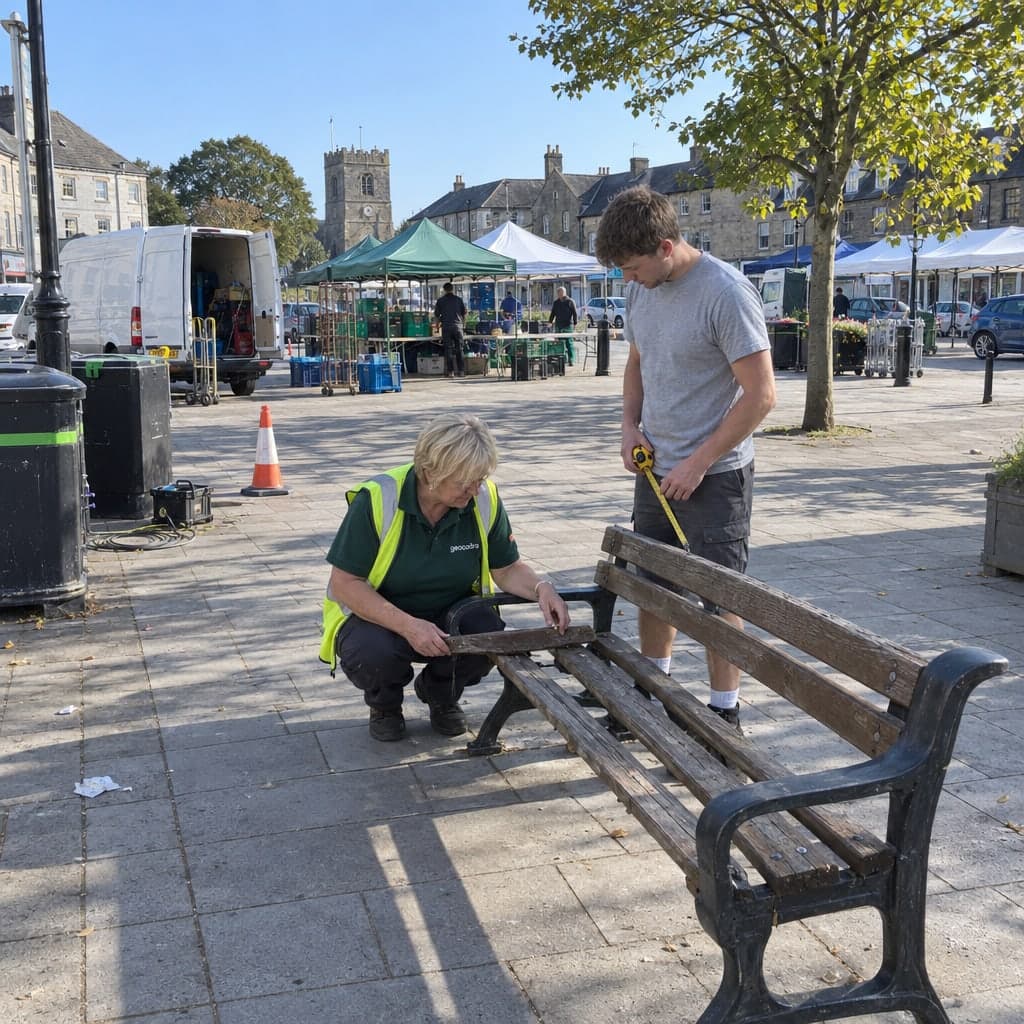
ISO 23599 Tactile Paving
The international standard for inspection and compliance verification of Tactile Walking Surface Indicators (TWSIs).
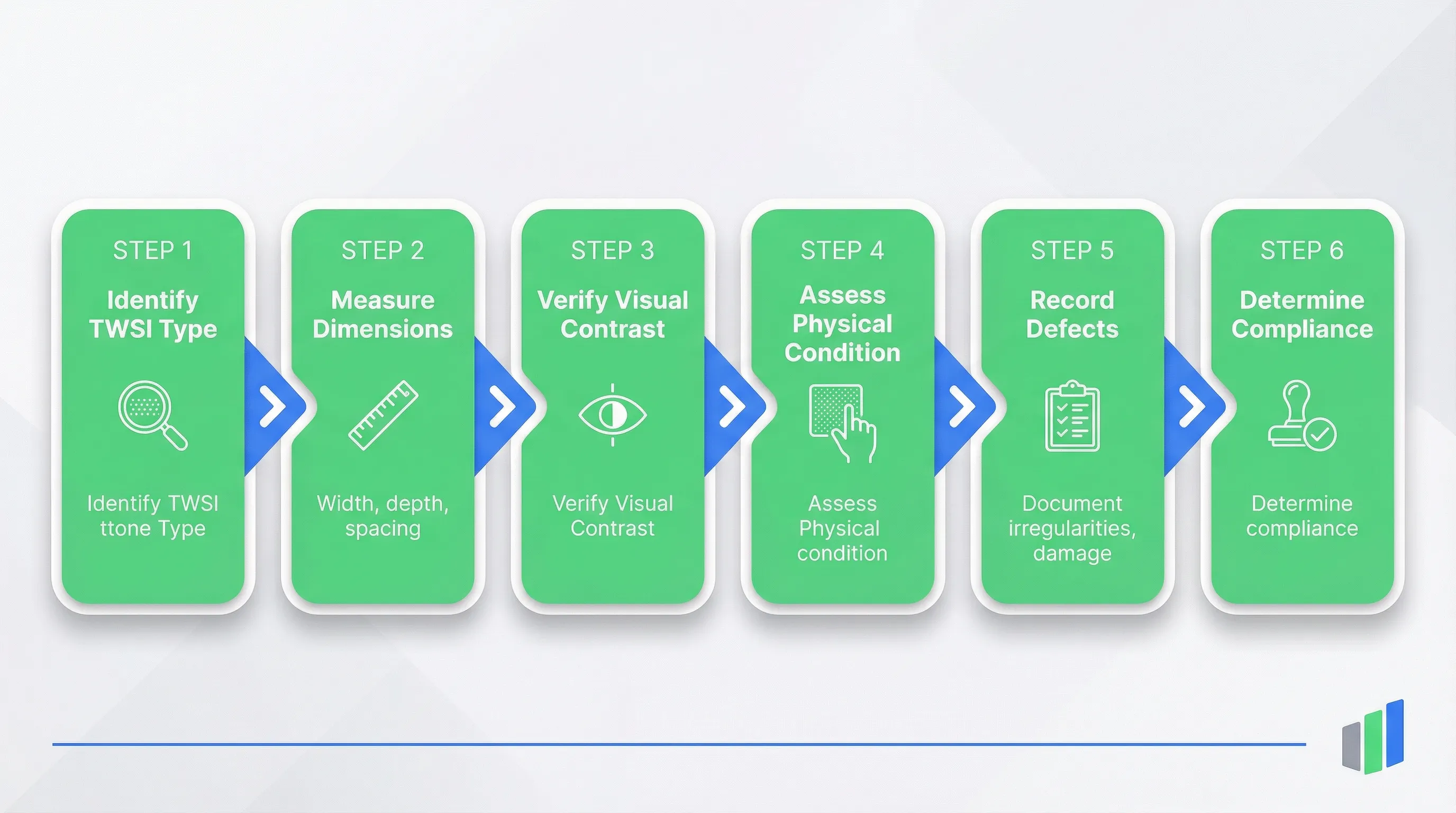
ISO 23599:2019 is the primary international standard governing the design, dimensions, and installation of Tactile Walking Surface Indicators. Published by the International Organization for Standardization (ISO), it defines the inspection criteria for two distinct indicator types: Attention Patterns (truncated domes) that warn of hazards and decision points, and Guiding Patterns (elongated bars) that indicate a direction of travel. The standard combines precise dimensional metrology with visual contrast verification and physical condition assessment to ensure indicators are detectable by white cane and underfoot while not presenting a trip hazard to people with mobility impairments. Adopted worldwide, ISO 23599 provides a universal compliance framework for accessible pedestrian infrastructure.

What is ISO 23599?
ISO 23599:2019 (Assistive products for blind and vision-impaired persons) is the international standard for inspecting Tactile Walking Surface Indicators (TWSIs). Inspectors verify dimensional compliance, visual contrast above 30%, and physical condition on a 1-to-5 scale to ensure safe independent mobility for people with vision impairments.
- Full Name
- Assistive products for blind and vision-impaired persons — Tactile walking surface indicators (ISO 23599:2019)
- Issuing Body
- ISO (International Organization for Standardization)
- Current Revision
- ISO 23599:2019
TWSI CLASSIFICATION
Indicator Types and Installation Configurations
ISO 23599 defines two functionally distinct indicator types and three installation methods, each with specific dimensional requirements and inspection criteria.
ISO 23599 distinguishes between two TWSI types based on their function in the pedestrian environment. Attention Patterns use truncated domes (also called blisters or detectable warning surfaces) arranged in a grid to alert pedestrians of a hazard, decision point, or change in direction. Typical deployment locations include platform edges at transit stations, the top and bottom of staircases, pedestrian crossing points, and transitions from pedestrian zones to vehicular areas. The dome profile must be detectable by a long white cane through its raised tactile profile and simultaneously by the sole of the foot through the change in texture underfoot.
Guiding Patterns use elongated bars (also called directional indicators or corduroy surfaces) oriented parallel to the intended direction of travel. These bars create a linear tactile path that a cane or foot can follow across open spaces where no other wayfinding cues exist, such as large plazas, wide sidewalks, or transit concourses. ISO 23599 specifies that guiding bars must be at least 270 mm long to ensure reliable detection. The standard also defines three installation configurations that affect inspection criteria: Integrated installations use pre-cast pavers or tiles with the tactile profile formed during manufacture; Discrete installations attach individual stainless steel or polymer studs and bars to existing surfaces; Surface Applied installations use adhesive mats or retrofit sheets bonded to the ground. Each method presents different failure modes that inspectors must assess.
For the German national implementation of tactile paving requirements, see the DIN 18040 Accessibility standard.
DIMENSIONAL COMPLIANCE
Metrology Requirements Under ISO 23599 Clause 5.1
The core of ISO 23599 compliance is precise dimensional verification of element height, top width, bottom width, and centre-to-centre spacing against published tolerance ranges.
ISO 23599 specifies strict dimensional tolerances that ensure tactile indicators are reliably detectable without creating trip hazards. The Element Height must fall between 4.0 mm and 5.0 mm for all TWSI types. A height below 4.0 mm renders the indicator undetectable underfoot, while a height above 5.0 mm creates a trip risk for wheelchair users, people with mobility aids, and rolling luggage. For smooth indoor surfaces, 4.0 mm is the preferred height to minimize tripping potential while maintaining detectability. The Top Width or Diameter of each dome or bar is measured at the uppermost surface. For Attention Patterns (truncated domes), the acceptable range is 12 mm to 25 mm. For Guiding Patterns (elongated bars), the range is wider at 17 mm to 30 mm, reflecting the different tactile detection mechanism of bars versus domes.
The relationship between top and bottom dimensions is governed by a fixed formula: the Bottom Width must equal the Top Width plus 10 mm, with a tolerance of plus or minus 1 mm. This controlled taper angle ensures consistent cane detection across all manufacturers and materials. Centre-to-Centre Spacing depends on the top diameter chosen by the manufacturer. ISO 23599 publishes a validation table linking each top diameter to an acceptable spacing range. For example, a dome with a 12 mm top diameter requires spacing between 42 mm and 61 mm, while a 25 mm dome requires spacing between 55 mm and 70 mm. This variable spacing ensures that the spatial frequency of tactile elements remains within the perceptual range detectable by the human foot regardless of dome size.
| Parameter | Min (mm) | Max (mm) | Notes |
|---|---|---|---|
| Element Height (h) | 4.0 | 5.0 | 4.0 mm preferred for indoor smooth surfaces |
| Top Diameter (d1) | 12 | 25 | Attention Patterns (truncated domes) |
| Top Width (d1) | 17 | 30 | Guiding Patterns (elongated bars) |
| Bottom Diameter (d2) | d1 + 9 | d1 + 11 | Fixed taper: d1 + 10 ± 1 mm |
| Spacing (d1 = 12 mm) | 42 | 61 | Centre-to-centre |
| Spacing (d1 = 15 mm) | 45 | 63 | Centre-to-centre |
| Spacing (d1 = 20 mm) | 50 | 68 | Centre-to-centre |
| Spacing (d1 = 25 mm) | 55 | 70 | Centre-to-centre |
| Guiding Bar Length | 270 | — | Minimum for reliable detection |
Dimensional values are from ISO 23599:2019 Table 1 and Clause 5.1. Bottom diameter uses the formula d2 = d1 + 10 ± 1 mm. Spacing ranges are specific to the chosen top diameter.
VISUAL CONTRAST
Luminance Contrast Verification Using LRV Measurements
ISO 23599 mandates a minimum 30% luminance contrast between the TWSI and its adjoining surface, verified through Light Reflectance Value measurements.
Visual contrast is the second critical compliance axis in ISO 23599, ensuring that indicators are visible to people with low vision who may not rely on tactile cane detection. The standard requires a minimum contrast of 30% between the TWSI surface and the immediately adjoining ground surface. This threshold was established through human factors research demonstrating that contrast below 30% becomes unreliable for people with moderate to severe vision impairment, particularly under varying lighting conditions. To calculate contrast, inspectors measure the Light Reflectance Value (LRV) of both surfaces. The LRV of the TWSI (designated Y1) and the LRV of the adjoining surface (designated Y2) are entered into the contrast formula. The most commonly referenced formula in ISO 23599 practice is the Michelson or Weber-derived calculation: Contrast = (Y2 - Y1) / ((Y1 + Y2) / 2) times 100, expressed as a percentage.
In the inspection form, the inspector selects the TWSI Color from predefined options including Safety Yellow, White, Black, Red (restricted to certain controlled crossing applications), Stainless Steel (natural finish), and Other. The LRV values Y1 and Y2 are measured using a photometer in the field or a colorimeter in the lab, and the calculated contrast percentage is recorded alongside a Contrast Compliance determination of Compliant (above 30%) or Non-Compliant (below 30%). Safety Yellow on dark asphalt typically achieves contrast values of 60% or higher, well above the threshold. However, contrast can degrade significantly over time as surfaces become dirty, faded from UV exposure, or stained. Stainless steel indicators on light-colored concrete may start near the 30% threshold and fall below it as the concrete lightens with weathering. Regular contrast re-measurement is therefore a core part of ongoing TWSI maintenance inspection.
For broader accessibility compliance including tactile indicator requirements in US contexts, see the ADA Accessibility standard.
Try this ISO 23599 form in Geocadra
We have a pre-built ISO 23599 inspection template ready to go. Sign up and start your first condition assessment today.
Free 14-day trial. No credit card required.
CONDITION RATING
The 1-to-5 Condition Rating Scale for TWSI Assessment
The condition assessment produces a five-level rating from 1 (Very Good) to 5 (Very Poor) that quantifies the physical integrity and safety status of the installed indicators.
ISO 23599 compliance inspection extends beyond initial dimensional verification to ongoing condition assessment of installed indicators. The inspection form uses a five-level condition rating scale where 1 represents Very Good (new or like-new condition with no visible defects, dimensions strictly within tolerance, and contrast above 60%) and 5 represents Very Poor (immediate safety hazard requiring replacement, with sections lifting, multiple elements missing exceeding 10% of total, or the tactile profile worn flat and non-detectable). A rating of 2 (Good) indicates minor wear such as scuffing but all elements present, secure, and within tolerance. A rating of 3 (Fair) signals moderate wear where surfaces may be slightly polished or faded with contrast approaching 30%, but the tactile profile remains functional with no lifting edges. A rating of 4 (Poor) denotes significant defects including domes worn below 3 mm or exceeding 5 mm, loose or missing elements under 10%, and compromised visual contrast. This scale directly informs maintenance scheduling: ratings of 1 and 2 require only routine monitoring, rating 3 triggers increased inspection frequency, rating 4 requires planned remediation, and rating 5 demands immediate intervention to prevent injury.
| Rating | Condition | Description | Action Required |
|---|---|---|---|
| 1 | Very Good (New) | No defects, strict tolerance compliance, contrast >60% | Routine monitoring only |
| 2 | Good (Satisfactory) | Minor scuffs, all elements present and secure, contrast >30% | Routine monitoring |
| 3 | Fair (Monitor) | Moderate wear, slight polish/fade, contrast near 30%, functional profile | Increased inspection frequency |
| 4 | Poor (Action Required) | Domes worn below 3 mm or above 5 mm, missing elements <10%, low contrast | Planned remediation |
| 5 | Very Poor (Hazard) | Lifting sections, missing elements >10%, flat profile non-detectable | Immediate replacement |
Condition ratings reflect combined assessment of dimensional integrity, visual contrast, tactile detectability, and safety hazard presence. A rating of 4 or 5 triggers mandatory photographic documentation.
DEFECT CLASSIFICATION
Primary Defect Types and Their Impact on Detectability
The inspection identifies six distinct defect categories, each with specific implications for tactile detectability, visual contrast, and pedestrian safety.
What makes TWSI defect classification unique compared to general pavement or building inspections is the dual-safety concern: every defect must be evaluated both for its impact on detectability (does the indicator still function as a navigation aid for blind persons?) and for its impact on mobility safety (does the defect create a trip or slip hazard for people with physical disabilities?). The ISO 23599 inspection form captures the Primary Defect from six categories. Missing or Detached Elements is the most critical detectability failure, where individual domes or bars have separated from the substrate, creating gaps in the tactile field. This defect is particularly common in Discrete installations where mechanical anchors corrode or adhesive bonds fail. When more than 10% of elements are missing, the installation is rated as Very Poor because the remaining pattern may be too sparse to detect reliably with a cane.
Cracked or Broken Units affect Integrated installations where concrete or ceramic tiles fracture, potentially creating sharp edges while reducing the tactile profile height. Lifting or Trip Hazard occurs when surface-applied mats delaminate at edges or when substrate settlement causes the TWSI panel to protrude above the surrounding surface by more than 5 mm. This defect type is especially dangerous because the very indicators designed to improve accessibility can themselves become an obstacle. Worn or Polished surfaces reduce both tactile detectability (the dome profile flattens below the critical 4 mm threshold) and slip resistance (polished surfaces become dangerously slick when wet). Low Visual Contrast from dirt accumulation, UV fading, or surface staining degrades detectability for low-vision users even when the tactile profile remains intact. The Slip Resistance Check field captures a separate pass or fail assessment of the wet friction characteristics, which is essential for outdoor installations exposed to rain and for indoor installations near building entrances where water is tracked in.
The complete ISO 23599 standard is available from the ISO Online Browsing Platform. For comprehensive resources on tactile paving implementation worldwide, see the World Blind Union accessibility guidelines.
QUESTIONS
Frequently Asked Questions
What is ISO 23599?
ISO 23599:2019 is the international standard for Tactile Walking Surface Indicators (TWSIs) used to assist blind and vision-impaired persons. It defines dimensional tolerances, visual contrast requirements, and installation specifications for both attention patterns (truncated domes) and guiding patterns (elongated bars) in pedestrian environments.
What is the minimum contrast requirement for tactile paving under ISO 23599?
ISO 23599 requires a minimum 30% luminance contrast between the TWSI surface and the adjoining ground surface. Contrast is calculated from Light Reflectance Values (LRV) of both surfaces. Safety yellow indicators on dark asphalt typically exceed 60%, while stainless steel on light concrete may border on the 30% threshold.
What is the required dome height for ISO 23599 compliance?
Tactile elements must be between 4.0 mm and 5.0 mm in height. Heights below 4.0 mm are undetectable underfoot, while heights above 5.0 mm create trip hazards for wheelchair users and people with mobility aids. For smooth indoor surfaces, 4.0 mm is the preferred height.
What is the difference between attention patterns and guiding patterns?
Attention patterns use truncated domes in a grid layout to warn of hazards such as platform edges, stairs, or crossings. Guiding patterns use elongated bars oriented parallel to the travel direction to indicate a route across open spaces. Each pattern has distinct dimensional tolerances defined in ISO 23599.
How often should tactile paving be inspected?
ISO 23599 does not prescribe a fixed inspection interval, but best practice recommends annual condition assessments for high-traffic locations such as transit platforms and crossings. Indoor installations and low-traffic areas may be inspected every two to three years. Visual contrast should be re-measured whenever surface cleaning or replacement occurs.
Is ISO 23599 mandatory?
ISO 23599 is a voluntary international standard, but many national building codes and accessibility regulations reference it directly or adopt equivalent requirements. In the EU, EN standards aligned with ISO 23599 are used for accessibility compliance. In practice, compliance is effectively mandatory for public infrastructure projects.
What is the difference between ISO 23599 and DIN 32984?
DIN 32984 is the German national standard for tactile ground indicators, predating and complementing ISO 23599. While ISO 23599 focuses on product dimensions and contrast, DIN 32984 provides detailed guidance on placement patterns, field sizes, and integration with German pedestrian infrastructure design including crossings and platform edges.
In practice
See how the round runs in Geocadra
The solution page shows this inspection regime on real open data: the import, the form, the round, the record per asset and the export.
Playground checks, headstone tests and green-space acceptances on a map, with every round appended to the siteOpen the solution page: Municipalities & Public SpaceTRY IT FREE
Digitize your ISO 23599 inspections
Replace paper forms and spreadsheets with structured digital inspections, built for standards like ISO 23599.
No credit card requiredFree trial included