NASSCO LACP Lateral Inspection
The US standard for systematic CCTV condition assessment of building sewer laterals and service connections.
NASSCO LACP (Lateral Assessment Certification Program) is the companion standard to PACP, purpose-built for the unique challenges of inspecting building sewers and service laterals. While PACP addresses mainline sewer pipes, LACP provides a standardized coding language and grading system specifically for the smaller-diameter pipes that connect individual buildings to the sewer main. Using CCTV push cameras or lateral launch equipment, certified inspectors document structural defects, operation and maintenance conditions, and construction fittings at precise footage locations. Each observation receives a condition grade from 1 to 5, enabling utilities to calculate pipe ratings and prioritize lateral rehabilitation across their entire collection system.

What is NASSCO LACP?
NASSCO LACP (Lateral Assessment Certification Program) is the US standard for CCTV-based condition assessment of building sewer laterals. Inspectors code structural defects, O&M issues, and construction fittings using standardized observation codes and assign condition grades from 1 (Minor) to 5 (Most Significant) to prioritize rehabilitation.
- Full Name
- Lateral Assessment Certification Program (LACP)
- Issuing Body
- NASSCO (National Association of Sewer Service Companies)
- Current Revision
- LACP v7 (current PACP/LACP/MACP suite)
HEADER DATA
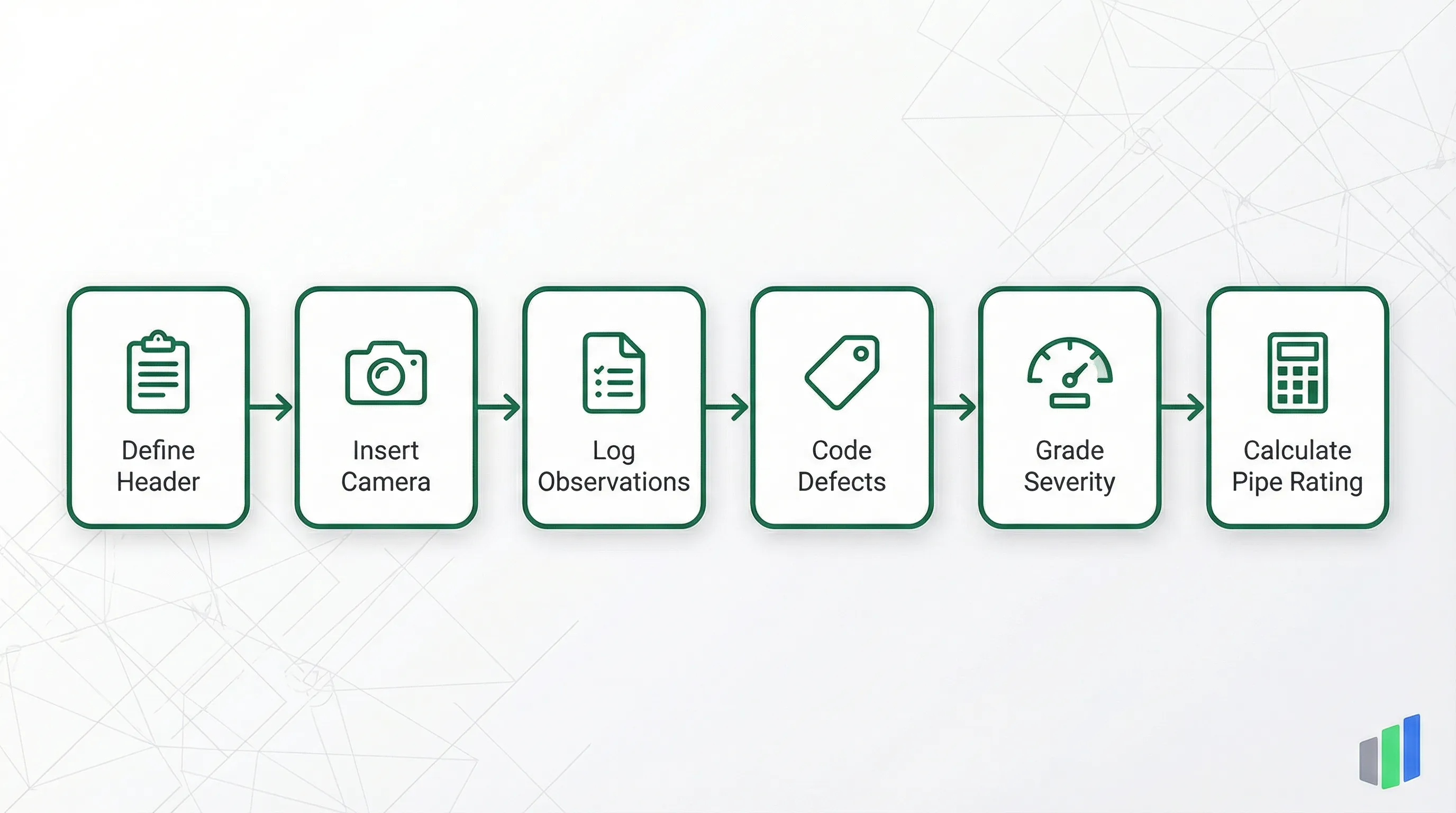
Lateral Header Information: Defining the Asset
Every LACP inspection begins with a comprehensive header that defines the lateral segment, its material properties, access points, and survey direction before any CCTV footage is recorded.
The LACP header section establishes the identity and physical characteristics of the lateral being inspected. The Lateral Segment Reference (LSR) is the unique identifier for the inspection unit, typically derived from the street address and lateral position within the collection system. This identifier links the CCTV inspection data to the utility's GIS and asset management database, enabling tracking of condition changes across multiple inspection cycles.
The Pipe Material field captures the construction material of the lateral, which directly influences the types of defects likely to be encountered. Common lateral materials include PVC (Polyvinyl Chloride), VCP (Vitrified Clay Pipe), CIP (Cast Iron Pipe), DIP (Ductile Iron Pipe), RCP (Reinforced Concrete Pipe), ABS (Acrylonitrile Butadiene Styrene), and Orangeburg (bituminous fiber pipe). Orangeburg laterals, widely installed between the 1860s and 1970s, are particularly prone to deformation and collapse due to their fibrous composition, making them high-priority targets for LACP inspection programs.
The Location Code classifies the surface environment above the lateral. Codes range from A (Paved Road) and F (Sidewalk) to D (Easement/Right-of-Way), G (Parking Lot), and J (Inside Building). This classification matters for rehabilitation planning because the location determines excavation costs, traffic management requirements, and permitting complexity. A lateral under a major arterial road has fundamentally different replacement economics than one running through a backyard easement.
Access Points define where the camera enters and exits the lateral. LACP uses specific codes including ACO (Cleanout General), ACOM (Cleanout Mainline), ACOH (Cleanout House), AMH (Manhole), and ACB (Catch Basin). The Direction of Survey records whether the camera moves Upstream (U) or Downstream (D) relative to flow. Combined with the start and end access points, this establishes the spatial reference frame for all distance-based observations in the inspection log.
For mainline sewer inspections using the companion standard, see the NASSCO PACP sewer inspection standard.
CODING SYSTEM
The LACP Observation Coding System
LACP organizes all observations into four code families, each containing specific defect codes that inspectors log at precise footage locations during the CCTV survey.
The NASSCO LACP coding system is a hierarchical classification that ensures every observation recorded during a lateral inspection follows a standardized format. At the top level, each observation is assigned to one of four Code Families: Structural (S) for physical pipe damage, O&M (M) for operational and maintenance conditions, Construction (C) for fittings and construction features, and Miscellaneous (Z) for observations that do not fit the other categories. This family assignment determines which specific observation codes are available in the next dropdown level.
Structural codes capture the progressive stages of pipe deterioration. A Crack (C) represents a surface-level line visible on the pipe wall without separation of material. A Fracture (F) indicates an open crack where pipe pieces are visible but not displaced. Broken (B) describes displaced pipe pieces where structural integrity is compromised. A Hole (H) means missing pipe wall material, exposing surrounding soil. Deformed (D) indicates the pipe cross-section has changed from its original shape, often seen in flexible materials like PVC or Orangeburg. Collapsed (X) represents complete structural failure where the pipe can no longer convey flow. This progression from Crack to Collapsed mirrors the engineering deterioration sequence and directly maps to increasing condition grades.
| Code | Name | Description | Typical Grade |
|---|---|---|---|
| C | Crack | Surface line, no material separation | 1 |
| F | Fracture | Open crack, pieces visible but not displaced | 2–3 |
| B | Broken | Pipe pieces displaced from original position | 3–4 |
| H | Hole | Missing pipe wall material, soil visible | 4–5 |
| D | Deformed | Cross-section altered from original shape | 2–4 |
| X | Collapsed | Complete structural failure | 5 |
Structural codes follow a deterioration progression from C (least severe) to X (most severe). Actual condition grade assignment depends on the specific descriptor and extent of damage.
Operation and Maintenance codes document conditions that affect pipe function without necessarily indicating structural damage. Roots (R) are classified by severity as Fine, Medium, or Ball, reflecting the degree of root intrusion from minor hair roots to a complete root mass filling the pipe cross-section. Deposits (D) include attached deposits on the pipe wall, settled material at the invert, and ingress of soil or debris through joints or cracks. Infiltration (I) captures groundwater entry and is graded from Weeper (minor seepage) through Dripper and Runner to Gusher (heavy flow), each level corresponding to a higher condition grade.
| Code | Name | Examples | Typical Grade |
|---|---|---|---|
| R | Roots | Fine, Medium, Ball | 1–5 |
| D | Deposits | Attached, Settled, Ingress | 1–3 |
| I | Infiltration | Weeper, Dripper, Runner, Gusher | 1–5 |
O&M codes describe conditions affecting pipe function. Root severity and infiltration flow rate directly determine the condition grade assigned to each observation.
Each observation is logged at a specific Distance (in feet) from the start access point and optionally assigned a Clock Position (1 through 12) to record the circumferential location of the defect within the pipe cross-section. This precise spatial coding enables engineers to locate defects for targeted repairs and to track whether specific defects have progressed between inspection cycles.
CONDITION GRADES
The 1-to-5 Condition Grading Scale
LACP uses the same 1-to-5 grading scale as PACP and MACP, providing a unified severity language across the entire NASSCO inspection suite.
The NASSCO LACP condition grading scale assigns a numerical severity value from 1 to 5 to every structural and O&M observation. Grade 1 (Minor) represents the earliest stage of deterioration, such as a circumferential surface crack or light staining at a joint. Grade 2 (Minor to Moderate) captures early distress signs like longitudinal cracks, surface roughness, or fine root intrusion. Grade 3 (Moderate) indicates defects that require scheduled attention, including multiple fractures or medium root penetration. Grade 4 (Significant) marks severe structural damage or restriction, such as broken pipe segments or deformation exceeding 10% of the pipe diameter. Grade 5 (Most Significant) represents the most critical conditions: collapsed pipe, imminent failure, complete blockage, or large holes with visible soil.
| Grade | Severity | Description | Example Defects |
|---|---|---|---|
| 1 | Minor | Normal wear, earliest deterioration | Circumferential crack, light stain |
| 2 | Minor to Moderate | Early distress, monitoring required | Longitudinal crack, fine roots, surface roughness |
| 3 | Moderate | Defects requiring scheduled attention | Multiple fractures, medium roots, joint offset |
| 4 | Significant | Severe damage, near-term failure likely | Broken pipe, deformation >10%, heavy infiltration |
| 5 | Most Significant | Collapsed or imminent failure | Collapse, hole with soil visible, root ball |
Grades apply to Structural and O&M observations only. Construction features (fittings, access points) receive N/A unless defective. Grade assignment follows NASSCO certification training standards.
The grading scale applies exclusively to Structural and O&M observations. Construction features such as fittings (Tee, Wye, Bend) and access points receive an N/A grade unless they are defective. This distinction is important because a properly functioning Tee connection is an expected construction feature that should not inflate the pipe rating, whereas a cracked or offset Tee would receive a structural grade reflecting its condition. The form enforces this logic by defaulting Construction and Miscellaneous observations to N/A while requiring grade selection for Structural and O&M entries.
Consistency in grade assignment is maintained through the NASSCO certification process. Inspectors must complete LACP training and pass a certification exam that includes coding exercises with standardized video sequences. This certification requirement ensures that a Grade 3 fracture coded by one inspector in Ohio means the same thing as a Grade 3 fracture coded by another inspector in California, enabling meaningful data comparison across utility boundaries.
Try this NASSCO LACP form in Geocadra
We have a pre-built NASSCO LACP inspection template ready to go. Sign up and start your first condition assessment today.
Free 14-day trial. No credit card required.
PIPE RATING
Pipe Rating and Quick Rating: Aggregating Defect Severity
The pipe rating methodology transforms individual observation grades into aggregate metrics that enable system-wide prioritization of lateral rehabilitation.
What distinguishes LACP from a simple defect checklist is its quantitative pipe rating system that aggregates individual observation grades into actionable metrics. The Pipe Rating is calculated as the sum of all condition grades assigned during the inspection. For example, if an inspector records observations graded 5, 4, 3, 1, and 1, the Pipe Rating is 14. This cumulative score reflects both the severity and quantity of defects in the lateral. A lateral with many minor defects may accumulate a higher Pipe Rating than one with a single severe defect, capturing the compounding risk of multiple deterioration points along the pipe length.
The Pipe Rating Index provides a normalized view by dividing the total Pipe Rating by the number of graded defects. In the example above, 14 divided by 5 yields a Pipe Rating Index of 2.8. This average severity metric is useful for comparing laterals with different numbers of observations. A short lateral with two Grade 5 observations (Index = 5.0) may warrant more urgent intervention than a long lateral with twenty Grade 1 observations (Index = 1.0), despite the latter having a higher raw Pipe Rating of 20.
The Quick Rating is a compact 4-character code that summarizes the worst defects found during the inspection. It indicates the count of the highest-severity observations, providing a rapid triage tool. For example, a Quick Rating of "5142" communicates that the inspection found one Grade 5 defect, one Grade 4 defect, four Grade 3 defects, and two Grade 2 defects. Utility managers use Quick Ratings to scan hundreds of lateral inspection records and immediately identify pipes with the most critical conditions. When combined with the pipe material, age, and location data from the header, these three metrics (Pipe Rating, Pipe Rating Index, and Quick Rating) form the decision basis for capital improvement planning.
While the inspector inputs the individual grades in the field, the Pipe Rating and Quick Rating are typically calculated automatically by the data management software. In the digital form, these values can be computed in real time as observations are added, giving the field crew immediate feedback on the overall lateral condition during the inspection. This real-time feedback loop helps inspectors decide whether to extend the survey or focus documentation on critical defects.
The complete LACP coding standard and certification requirements are published by NASSCO. For technical guidance on lateral inspection programs, see the Water Environment Federation (WEF) resources on collection system management.
FITTINGS VS. TAPS
LACP Fittings: The Critical Difference from PACP Taps
The distinction between LACP Fittings and PACP Taps reflects the fundamental change in perspective when the camera moves from the mainline into a lateral.
One of the most important conceptual differences between LACP and PACP is how connections are coded. In PACP mainline inspections, the camera views lateral connections from the outside, so they are coded as Taps (T) representing service connections entering the main pipe. In LACP, the camera is inside the lateral looking outward at connections, so the same physical features are coded as Fittings (F). This is not merely a naming convention but reflects a fundamental change in the inspection reference frame.
The LACP fitting codes include FT (Tee) for 90-degree connections, FY (Wye) for angled connections, FB (Bend) for changes in pipe direction, FC (Cap/Plug) for end-of-line features, FR (Reducer) for changes in pipe diameter, and FA (Adapter) for changes in pipe material. Each fitting type is logged at its precise footage location and clock position. Properly functioning fittings receive an N/A condition grade because they are expected construction features. However, if a fitting shows signs of deterioration such as cracking, displacement, or root intrusion at the joint, the inspector assigns the appropriate structural or O&M code with a severity grade.
Bends (FB) are particularly significant in lateral inspections because laterals typically change direction multiple times between the building connection and the mainline. Each bend creates a stress concentration point where cracks and fractures are more likely to develop. Experienced inspectors pay close attention to the pipe wall condition immediately upstream and downstream of each bend, as these transition zones are common failure points. The digital form captures this by allowing the inspector to log both the fitting itself and any adjacent defects as separate observation entries at nearby footage values.
For manhole inspection within the same NASSCO framework, see the NASSCO MACP manhole inspection standard.
QUESTIONS
Frequently Asked Questions
What is NASSCO LACP?
NASSCO LACP (Lateral Assessment Certification Program) is the US standard for CCTV-based condition assessment of building sewer laterals. It provides standardized observation codes and a 1-to-5 grading scale for documenting structural defects, O&M conditions, and construction fittings in lateral pipes connecting buildings to the sewer main.
What is the difference between LACP and PACP?
PACP inspects mainline sewer pipes, while LACP inspects building laterals (service connections). The key coding difference is that mainline connections coded as Taps (T) in PACP become Fittings (F) in LACP because the camera perspective reverses. Both use the same 1-to-5 condition grading scale.
How is the LACP Pipe Rating calculated?
The Pipe Rating is the sum of all condition grades assigned to structural and O&M observations. The Pipe Rating Index divides this total by the number of graded defects to produce an average severity. The Quick Rating is a 4-character code summarizing the count of highest-severity observations.
What certifications are required to perform LACP inspections?
Inspectors must complete NASSCO LACP certification training, which includes classroom instruction on the coding system and practical exercises coding standardized video sequences. Certification ensures consistent grade assignment across inspectors and jurisdictions. Recertification is required periodically to maintain credentials.
What pipe materials does LACP cover?
LACP covers all common lateral pipe materials including PVC (Polyvinyl Chloride), VCP (Vitrified Clay Pipe), CIP (Cast Iron Pipe), DIP (Ductile Iron Pipe), RCP (Reinforced Concrete Pipe), ABS (Acrylonitrile Butadiene Styrene), and Orangeburg (bituminous fiber pipe).
What is a continuous defect in LACP?
A continuous defect spans a length of pipe rather than occurring at a single point. The inspector marks the start footage with a Continuous Start toggle and the end footage with a Continuous End toggle. Common continuous defects include root intrusion extending several feet and longitudinal cracks running along the pipe.
Can LACP data be integrated with asset management software?
Yes, LACP uses standardized NASSCO exchange formats that integrate directly with asset management platforms like Cityworks, GraniteNet, and ICOM. The standardized coding and grading system ensures data portability between jurisdictions, engineering firms, and software platforms.
In practice
See how the round runs in Geocadra
The solution page shows this inspection regime on real open data: the import, the form, the round, the record per asset and the export.
Lighting columns, poles, sewers and charge points inspected on a map, with every round appended to the assetOpen the solution page: Utilities & Public LightingTRY IT FREE
Digitize your NASSCO LACP inspections
Replace paper forms and spreadsheets with structured digital inspections, built for standards like NASSCO LACP.
No credit card requiredFree trial included