


NCHRP 903 Retaining Walls
The US risk-based framework for retaining wall condition and consequence assessment under Geotechnical Asset Management.
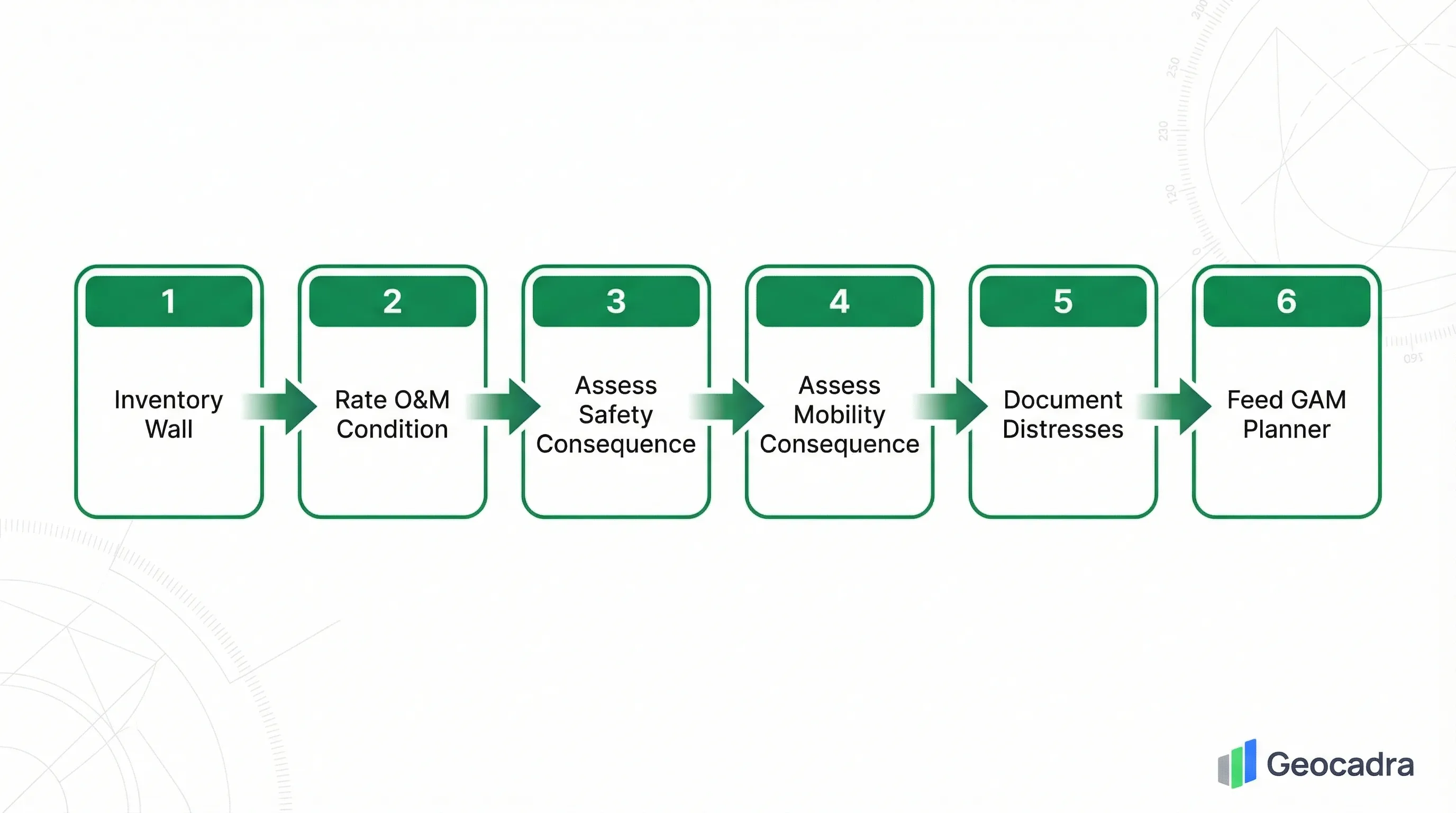
NCHRP Report 903 provides transportation agencies with a comprehensive Geotechnical Asset Management (GAM) framework that transforms retaining wall inspection from reactive repair into proactive, risk-based investment planning. Published by the Transportation Research Board (TRB) under the National Cooperative Highway Research Program, the standard integrates a five-point O&M Condition rating with parallel Safety and Mobility Consequence scores. The collected data feeds directly into the GAM Planner tool, enabling agencies to model deterioration curves, prioritize rehabilitation budgets, and quantify the risk exposure of their retaining wall portfolios across the entire highway network.

What is NCHRP 903?
NCHRP Report 903 (Geotechnical Asset Management for Transportation Agencies) is the US national framework for risk-based retaining wall inspection. Inspectors rate O&M Condition from 1 (Good) to 5 (Failed) alongside Safety and Mobility Consequence scores to drive life-cycle investment decisions via the GAM Planner.
- Full Name
- NCHRP Report 903: Geotechnical Asset Management for Transportation Agencies
- Issuing Body
- TRB / National Cooperative Highway Research Program (NCHRP)
- Current Revision
- NCHRP Report 903 (2019)
O&M CONDITION
The Five-Point O&M Condition Rating Scale
The Operations & Maintenance Condition rating is the primary measure of physical deterioration, directly linking field observations to management action levels and cost implications.
NCHRP Report 903 uses a five-point Operations & Maintenance (O&M) Condition scale that maps each rating level to a specific management action and cost threshold. Unlike traditional bridge inspection scales that may use nine points or more, this deliberately simplified system ensures that every rating has an unambiguous operational meaning. A rating of 1 (Good/New) indicates an asset requiring no work, with agency cost at zero and an adverse event probability below one percent. Rating 2 (Minor Loss) describes incidental maintenance needs costing under $500 or requiring only hours of staff time. Rating 3 (Fair) identifies preservation needs with clear repair requirements, typically costing under $5,000 annually or up to one week of labor.
| Rating | Label | Description | Cost Implication |
|---|---|---|---|
| 1 | Good / New | Like-new condition, no work recommended | Agency cost $0, adverse event < 1% |
| 2 | Minor Loss | Minor condition loss occurring | Incidental maintenance, < $500 or hours of staff time |
| 3 | Fair | Deterioration evident, clear repair needs | Preservation needed, < $5,000/year or 1 week of labor |
| 4 | Poor | Significant deterioration, major rehab required | Regular staff involvement, up to $100,000/year |
| 5 | Failed | Corrective action required immediately | Asset may be out of service or causing adjacent failures |
Ratings map directly to GAM Planner action states: 1-2 = Do Minimum, 3 = Preservation, 4 = Rehabilitation, 5 = Reconstruction.
The critical transition occurs at Rating 4 (Poor), where significant deterioration demands major rehabilitation with potential annual expenses up to $100,000 and regular staff involvement. Rating 5 (Failed) signals that the asset requires immediate corrective action, may be out of service, or is causing adjacent assets such as pavement to fail. This direct coupling between field rating and agency expenditure makes the O&M Condition scale fundamentally different from purely descriptive condition indexes. Each rating carries explicit cost implications that the GAM Planner uses to forecast budget needs over the asset life cycle. In the digital form, the inspector selects the O&M Condition from a dropdown for each wall segment. When a wall spans a significant length with variable conditions, the repeatable segment assessment allows the inspector to assign different ratings to different portions, capturing the heterogeneous deterioration that long retaining walls commonly exhibit.
For highway bridge assets managed under a similar US federal framework, see the FHWA NBIS/SNBI bridge inspection standard.
RISK CONSEQUENCE
Dual-Axis Risk: Safety and Mobility Consequence
NCHRP 903 uniquely requires inspectors to evaluate not just condition but also the potential consequences of failure, separating risk into safety and mobility dimensions.
A defining feature of NCHRP Report 903 is its explicit separation of condition from consequence. Traditional retaining wall inspections note physical defects but rarely ask the inspector to judge what would happen if the wall actually failed. NCHRP 903 requires two independent consequence ratings assessed alongside the O&M Condition. The Safety Consequence scale runs from 1 (None) through 5 (Severe/Possible Fatality). A crumbling wall in an unpopulated area may score O&M Condition 4 (Poor) but Safety Consequence 1 (None), while a wall in better physical condition positioned above a busy highway corridor could warrant Safety Consequence 5 due to the catastrophic potential of collapse onto traffic. This context-dependent evaluation forces inspectors to consider the environment surrounding the asset rather than focusing exclusively on the wall itself.
| Rating | Label | Description |
|---|---|---|
| 1 | None | No safety impact; failure would not affect users |
| 2 | Low | Minor property damage possible but unlikely to cause injury |
| 3 | Moderate | Potential for non-life-threatening injury or significant vehicle damage |
| 4 | High | Failure could result in severe injury |
| 5 | Severe | Possible fatality; immediate threat to life (e.g., collapse onto a busy highway) |
Safety and Mobility are independent axes. A wall may score high on one and low on the other depending on its location and surrounding environment.
The Mobility Consequence scale similarly runs from 1 (None) through 5 (Road Closure). Rating 2 (Low) indicates minor slowing or shoulder closure, Rating 3 (Moderate) triggers lane closure expectations, Rating 4 (High) anticipates major congestion or multiple lane closures, and Rating 5 means complete route closure would be required. A retaining wall supporting a rural cul-de-sac receives fundamentally different mobility consequence treatment than one supporting an interstate artery, even when their physical conditions are identical. The GAM Planner multiplies condition probability by consequence severity to generate a composite risk score that drives budget prioritization. This means an agency can objectively justify allocating more resources to a moderate-condition wall with catastrophic failure consequences than to a heavily deteriorated wall in a low-consequence location. In the form, both consequence fields are required for every segment assessment, ensuring that risk data is captured alongside every condition evaluation.
| Rating | Label | Description |
|---|---|---|
| 1 | None | No mobility impact; traffic flow unaffected |
| 2 | Low | Shoulder closure or minor slowing |
| 3 | Moderate | Lane closure required or significant delays |
| 4 | High | Multiple lane closures or severe congestion |
| 5 | Road Closure | Full closure of the route is required |
Mobility consequence considers the transportation network context. A wall along a high-AADT interstate receives a higher mobility rating than one on a low-volume rural road.
WALL TYPES
Retaining Wall Construction Type Classification
The wall construction type determines the applicable deterioration model, expected failure modes, and repair cost curves used by the GAM Planner for life-cycle analysis.
NCHRP Report 903 classifies retaining walls into nine construction types, each with distinct structural behavior, failure mechanisms, and maintenance cost profiles. Mechanically Stabilized Earth (MSE) walls use reinforcement strips or geogrids within compacted fill to create a gravity-like mass. Their primary vulnerability is reinforcement corrosion, which is invisible from the wall face and may not manifest until sudden panel displacement occurs. Gravity walls constructed from mass concrete or masonry resist earth pressure through sheer weight and are susceptible to overturning, sliding, and bearing capacity failure when foundation conditions change. Cantilever walls, typically cast-in-place concrete, use a structural footing to resist lateral earth pressure and may exhibit cracking patterns that indicate moment-induced stress.
| Type | Description | Primary Failure Mode |
|---|---|---|
| MSE (Mechanically Stabilized Earth) | Reinforced fill with facing panels | Reinforcement corrosion, panel displacement |
| Gravity (Concrete/Masonry) | Mass structure resisting by weight | Overturning, sliding, bearing failure |
| Cantilever (CIP Concrete) | Structural footing with stem wall | Cracking, moment-induced stress |
| Sheet Pile (Steel/Vinyl) | Driven interlocking sections | Corrosion, section loss, toe kick-out |
| Soldier Pile & Lagging | H-piles with horizontal lagging | Lagging deterioration, pile corrosion |
| Soil Nail | Grouted tension elements in soil face | Nail corrosion, face shotcrete spalling |
| Gabion | Wire mesh baskets filled with stone | Wire corrosion, basket deformation |
| Crib Wall | Interlocking precast members with fill | Member displacement, settlement |
| Anchored/Tieback | Prestressed tendons in stable ground | Anchor corrosion, tendon relaxation |
Construction type determines the GAM Planner deterioration curve and cost model. Each type has a different expected service life and maintenance intervention profile.
Sheet pile walls made from steel or vinyl are driven into the ground and rely on embedment depth for stability. Corrosion in marine or acidic soil environments can reduce section thickness and compromise structural capacity. Soldier pile and lagging systems combine driven H-piles with horizontal timber, concrete, or steel lagging between them, making them common for temporary excavation support that sometimes becomes permanent. Soil nail walls use grouted tension elements drilled into the existing soil face, creating a reinforced mass that is particularly effective for slope stabilization. Gabion walls consist of wire mesh baskets filled with stone, offering flexibility and drainage but vulnerable to wire corrosion and basket deformation over time. Crib walls use interlocking precast concrete or timber members filled with granular material, while anchored or tieback walls use prestressed tendons anchored in stable ground behind the wall. The digital form captures the construction type through a required dropdown field because the GAM Planner assigns different deterioration curves and cost models to each type. An MSE wall with a 75-year design life degrades along a different trajectory than a gabion wall with a 50-year expectation.
For retaining wall inspection under the German DIN framework, see the DIN 1076 wall inspection standard.
Try this NCHRP 903 form in Geocadra
We have a pre-built NCHRP 903 inspection template ready to go. Sign up and start your first condition assessment today.
Free 14-day trial. No credit card required.
DISTRESS CHECKLIST
Element-Level Distress Documentation
The distress checklist substantiates the overall O&M Condition rating by documenting specific observable defects organized into global, face, drainage, and backfill categories.
While the O&M Condition rating provides a holistic management-level assessment, NCHRP 903 recognizes the need for field-level evidence to justify that rating. The distress checklist in the form organizes observable defects into four categories that align with retaining wall failure mechanisms. Global stability distresses include sliding, overturning or rotation, and foundation settlement. These are the most critical findings because they indicate potential catastrophic failure of the entire wall system. Any observed global distress typically correlates with an O&M Condition of 4 or 5 and should trigger immediate engineering review. Wall face distresses capture visible deterioration of the facing elements: cracking, spalling or delamination, and bulging or bowing. Cracking may indicate thermal expansion, structural overload, or differential settlement depending on its pattern and orientation.
| Category | Distress Type | Significance |
|---|---|---|
| Global Stability | Sliding | Lateral displacement of entire wall; possible catastrophic failure |
| Global Stability | Overturning / Rotation | Forward tilting; foundation or soil failure |
| Global Stability | Foundation Settlement | Vertical displacement; bearing capacity issue |
| Wall Face | Cracking | Structural or thermal stress; pattern indicates cause |
| Wall Face | Spalling / Delamination | Concrete or masonry surface degradation |
| Wall Face | Bulging / Bowing | Lateral deformation of face elements; overload indicator |
| Drainage | Clogged / Obstructed | Blocked weep holes increase hydrostatic pressure |
| Drainage | Water Seepage | Failed waterproofing or compromised joints |
| Backfill | Erosion | Soil loss behind wall; undermines foundation support |
Global stability distresses are the most critical and typically correlate with O&M Condition ratings of 4 or 5. Any observed global distress should trigger engineering review.
Drainage distresses address the water management system that is essential to retaining wall performance. Clogged or obstructed weep holes and drains increase hydrostatic pressure behind the wall, which is the single most common cause of retaining wall failure. Water seepage through or around the wall may indicate failed waterproofing or compromised joint sealant. Backfill distresses document the condition of the retained soil mass: erosion behind the wall face can undermine foundation support, while settlement of the backfill surface suggests internal soil migration or consolidation. The multi-select format allows inspectors to check all applicable distresses for each wall segment, creating a comprehensive defect profile that justifies the assigned O&M rating. Photo documentation is captured alongside the distress checklist, providing visual evidence that supports maintenance planning and enables future comparisons. The Accelerated Deterioration toggle is a critical flag field that tells the GAM Planner to adjust the standard deterioration curve. When set to Yes, it effectively halves the expected remaining service life of the asset, triggering earlier intervention recommendations in the life-cycle model.
GAM PLANNER
How Field Data Feeds the GAM Planner Decision Model
The GAM Planner is the Excel-based decision support tool developed alongside NCHRP 903 that transforms field inspection data into life-cycle cost analysis and investment prioritization.
What makes NCHRP Report 903 fundamentally different from traditional wall inspection standards is that every field in the assessment form was designed as an input to a quantitative management model. The GAM Planner, distributed as a companion Excel workbook with the report, takes the inventory data, O&M Condition ratings, and consequence scores collected during field inspection and processes them through probabilistic deterioration models. The Planner assigns each wall a position on a type-specific deterioration curve based on its construction type, age, and current condition rating. For example, an MSE wall rated at O&M Condition 3 with a known construction year of 2005 is placed on the MSE deterioration trajectory, and the Planner forecasts when the wall will transition to Condition 4 and eventually Condition 5 under normal and accelerated deterioration scenarios.
The risk score is calculated by multiplying the probability of adverse event (derived from the O&M Condition rating) by the maximum of the Safety and Mobility Consequence scores. This composite risk score drives budget allocation by ranking all walls in the agency portfolio from highest to lowest risk exposure. Agencies can then run optimization scenarios that compare different investment strategies: for example, whether allocating $2 million to rehabilitate ten moderate-risk walls produces a greater network risk reduction than spending the same amount to reconstruct two high-risk walls. The Accelerated Deterioration flag captured in the field form modifies the trajectory curve, compressing the timeline between condition states and triggering earlier recommended interventions. The inspector recommendation field, where the inspector selects from Monitor, Routine Maintenance, Repair/Rehab, Reconstruction, or Immediate Safety Action, provides a human judgment check against the model output. Discrepancies between the model recommendation and the inspector recommendation are flagged for engineering review, creating a feedback loop that improves model calibration over time.
The full NCHRP Report 903 and the GAM Planner tool are available through the Transportation Research Board (TRB).
For additional implementation guidance and case studies from state DOTs, visit the TAM Portal geotechnical resources.
QUESTIONS
Frequently Asked Questions
What is NCHRP Report 903?
NCHRP Report 903 (Geotechnical Asset Management for Transportation Agencies) is the US national framework for managing geotechnical assets including retaining walls, slopes, and embankments. It defines a risk-based inspection methodology using five-point O&M Condition, Safety Consequence, and Mobility Consequence scales to support life-cycle cost analysis.
How does NCHRP 903 differ from traditional wall inspections?
Traditional inspections focus on physical condition alone. NCHRP 903 adds explicit consequence evaluation, requiring inspectors to rate both the probability of failure (condition) and the impact of failure (safety and mobility). This dual assessment enables risk-based prioritization rather than condition-only ranking.
What is the GAM Planner tool?
The GAM Planner is an Excel-based companion tool distributed with NCHRP Report 903. It takes field inspection data (inventory, condition, and consequence ratings) and runs probabilistic deterioration models to forecast when walls will need intervention, calculate life-cycle costs, and optimize agency investment across the asset portfolio.
What does the Accelerated Deterioration flag do?
When an inspector toggles Accelerated Deterioration to Yes, it signals that adverse conditions such as aggressive corrosion, active drainage failure, or rapid erosion are present. The GAM Planner responds by compressing the deterioration curve, effectively halving the expected remaining service life and triggering earlier intervention recommendations.
Is NCHRP 903 a mandatory federal standard?
NCHRP 903 is a research-based framework, not a federally mandated regulation like the NBIS for bridges. However, state DOTs including Colorado, Maryland, and North Carolina have adopted its methodology for their retaining wall programs. It represents the current best practice for geotechnical asset management in the US.
How often should NCHRP 903 wall inspections be performed?
NCHRP 903 does not prescribe a fixed interval but recommends risk-based scheduling. High-consequence walls along major interstates may warrant biennial inspections, while low-consequence walls in rural areas may follow a four-to-six-year cycle. The GAM Planner helps agencies optimize inspection frequency based on risk exposure.
What wall types does NCHRP 903 cover?
The standard covers nine construction types: MSE (Mechanically Stabilized Earth), Gravity, Cantilever, Sheet Pile, Soldier Pile and Lagging, Soil Nail, Gabion, Crib Wall, and Anchored/Tieback. Each type has distinct failure modes and deterioration trajectories modeled separately in the GAM Planner.
In practice
See how the round runs in Geocadra
The solution page shows this inspection regime on real open data: the import, the form, the round, the record per asset and the export.
Main and routine inspections of bridges, walls, roads and signs on a map, with every inspection appended to the structureOpen the solution page: Bridges, Roads & StructuresTRY IT FREE
Digitize your NCHRP 903 inspections
Replace paper forms and spreadsheets with structured digital inspections, built for standards like NCHRP 903.
No credit card requiredFree trial included