


NEN 2767 Street Furniture
Condition assessment for street furniture using the NEN 2767 defect matrix methodology.
NEN 2767-4 extends the proven NEN 2767 condition assessment methodology to infrastructure assets, including street furniture such as benches, waste bins, bollards, bicycle racks, shelters, and signage. By decomposing each asset into material-specific elements and systematically registering defects scored by severity, intensity, and extent, municipalities and asset managers produce objective, comparable condition data that drives maintenance budgets and replacement planning across entire furniture portfolios.

What is NEN 2767-4?
NEN 2767-4 (Infrastructure) is the Dutch standard for objectively assessing the physical condition of street furniture and outdoor assets. It applies the NEN 2767 defect matrix — scoring each defect by severity, intensity, and extent — to produce a condition rating from 1 (Excellent) to 6 (Very Poor) for elements such as benches, bollards, shelters, and signage.
- Full Name
- Conditiemeting van bouw- en installatiedelen — Deel 4: Infrastructuur (Meubilair)
- Issuing Body
- Netherlands Standardization Institute (NEN)
- Current Revision
- NEN 2767-4:2019
OVERVIEW
How NEN 2767 Applies to Street Furniture
While NEN 2767-1 was designed for building elements such as roofs, facades, and HVAC systems, the NEN 2767-4 infrastructure extension adapts the same defect-driven methodology for outdoor assets. Street furniture — benches, waste bins, bollards, bicycle racks, planters, fences, signage, and shelters — is subject to weather exposure, mechanical impact, vandalism, and biological growth that buildings rarely face to the same degree. NEN 2767-4 addresses these differences by defining material-specific defect catalogs tailored to the materials most commonly found in public furniture: wood, steel, aluminum, concrete, natural stone, and plastic composites. Each catalog lists defect types that are physically possible for the given material, preventing incorrect registrations and ensuring consistent data quality across inspections performed by different teams.
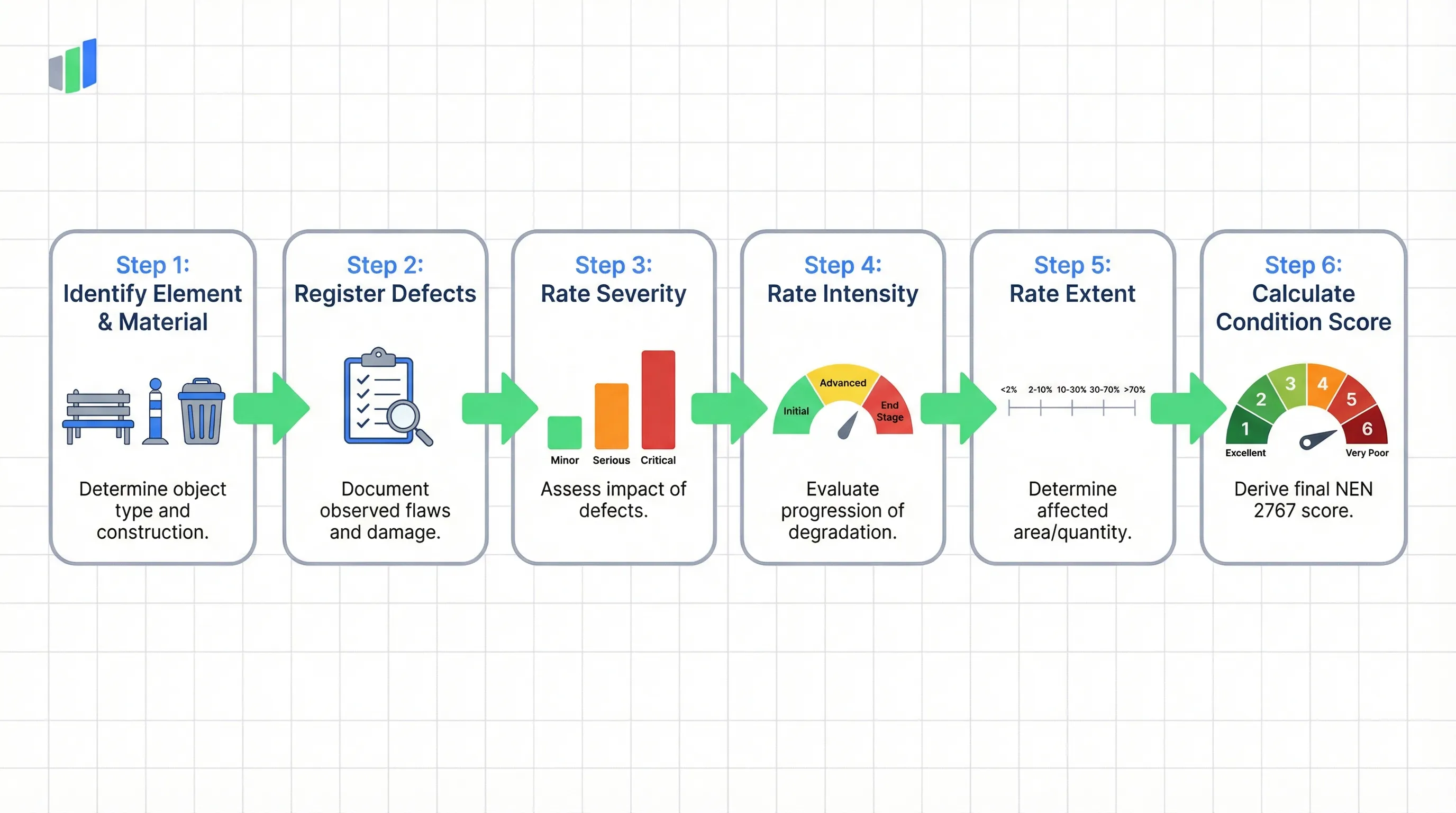
The inspection process follows three phases. First, the inspector decomposes the asset by identifying its element type and primary material. Second, the inspector registers every observable defect — selecting from a predefined defect list that is filtered by material — and scores each defect along three dimensions: severity, intensity, and extent. Third, these individual defect scores feed into a weighted algorithm that produces a single condition score from 1 to 6 for the asset, along with a recommended maintenance action and urgency classification.
Because the methodology is identical across all asset types, condition data from street furniture inspections can be compared directly with building inspections, bridge assessments, and other NEN 2767-based surveys. This cross-asset comparability is one of the greatest strengths of the NEN 2767 framework. It makes NEN 2767-4 particularly valuable for municipalities that manage mixed portfolios of buildings and public space infrastructure under a single asset management system, enabling integrated maintenance planning and consistent budget allocation across all asset categories.
The general building condition assessment is covered in the NEN 2767 condition assessment standard, which applies the same 1-6 rating methodology to building components.
CONDITION SCALE
The 1-to-6 Condition Score
Every inspected furniture element receives a single condition score on the standardized 1-to-6 scale. This score drives maintenance priority, budget allocation, and replacement timing across the entire asset portfolio. Because the score is derived algorithmically from recorded defect data rather than subjective judgment, it enables reliable comparison between assets, locations, and inspection cycles.
The NEN 2767 condition score is not assigned subjectively — it is calculated from the aggregated defect data. When an inspector records multiple defects for a single asset (for example, wood rot on the bench seat and corrosion on the steel armrest), the algorithm weighs each defect by its severity, intensity, and extent to produce the final score. A single critical defect in an advanced stage affecting more than 70% of the element will push the score toward 5 or 6 regardless of how minor the other defects are, because the standard prioritizes the worst functional impact.
| Score | Condition | Description |
|---|---|---|
| 1 | Excellent (Uitstekend) | New condition. No visible defects. The asset functions as designed and requires no maintenance action. |
| 2 | Good (Goed) | Early signs of aging such as minor surface discoloration or light surface scratches. Function is fully intact; no maintenance required yet. |
| 3 | Fair (Redelijk) | Visible defects of limited significance, such as local paint peeling or superficial cracks. Maintenance can be planned within normal cycles. |
| 4 | Mediocre (Matig) | Advanced aging with defects that will worsen: spreading corrosion, noticeable wood rot, loose connections. Maintenance should be scheduled in the short term. |
| 5 | Poor (Slecht) | Serious defects impacting functionality: structural deformation, through-rust, missing parts. Urgent repair or replacement to prevent safety hazard. |
| 6 | Very Poor (Zeer Slecht) | Technically bankrupt. The asset has failed or will fail imminently. Immediate removal or full replacement is mandatory. |
Scores are calculated algorithmically from the severity, intensity, and extent of all registered defects. The inspector confirms or overrides the calculated score with justification.
DEFECT MATRIX
How Severity, Intensity, and Extent Interact
The defect matrix is the core calculation engine of NEN 2767. It combines three independently assessed parameters — severity, intensity, and extent — into a single weighted defect score for each registered defect. Understanding how these three dimensions interact is essential for accurate and reproducible condition scoring across all asset types.
Every defect registered during a street furniture inspection is classified along three independent dimensions. Severity (Ernst) describes the functional impact of the defect type itself — a structural crack always carries higher severity than paint discoloration, regardless of how much of the asset is affected. Severity is largely predetermined by the standard based on the defect category: for instance, wood rot is classified as "Serious" by default because it threatens the load-bearing function of wooden elements, while biological growth (algae) is classified as "Minor" because it is primarily an aesthetic issue.
Intensity (Intensiteit) captures how far the defect has progressed through three stages. In the initial stage (Beginstadium), the defect is barely visible — hairline cracks, surface discoloration, or the first signs of rust spots. In the advanced stage (Gevorderd), the defect is clearly developed — open cracks, pitting corrosion, or wood that yields to pressure. In the end stage (Eindstadium), the defect has reached maximum deterioration — wood is pulverized, steel is rusted through, or concrete has fully spalled. The distinction matters because a small but fully developed defect (end stage, low extent) often scores higher than a widespread but superficial defect (initial stage, high extent).
Extent (Omvang) measures the percentage of the element affected by the defect. NEN 2767 defines five extent classes: incidental (< 2%), local (2-10%), regular (10-30%), significant (30-70%), and general (> 70%). For street furniture, extent is estimated relative to the inspected element. A bench with corrosion on one of four legs has approximately 25% extent for the steel frame component — placing it in the "regular" class. The combination of these three parameters produces a weighted defect score that feeds into the overall condition algorithm.
The standard is maintained by the Royal Netherlands Standardization Institute (NEN), which defines the defect catalog and scoring algorithms.
Try this NEN 2767 form in Geocadra
We have a pre-built NEN 2767 inspection template ready to go. Sign up and start your first condition assessment today.
Free 14-day trial. No credit card required.
MATERIAL-SPECIFIC DEFECTS
Defect Catalogs by Material Type
Street furniture uses diverse materials, each with its own defect catalog. The inspector selects the material first, which determines which defects are applicable.
One of the key differences between NEN 2767 for buildings and NEN 2767 for street furniture is the prominence of material-specific defect lists. A single piece of street furniture often combines multiple materials — a bench may have wooden slats, steel legs, and concrete anchoring — and each material has its own characteristic failure modes. The NEN 2767-4 defect catalog (Gebrekenlijst) maps defect types to materials, ensuring that inspectors only record defects that are physically possible for the material being assessed.
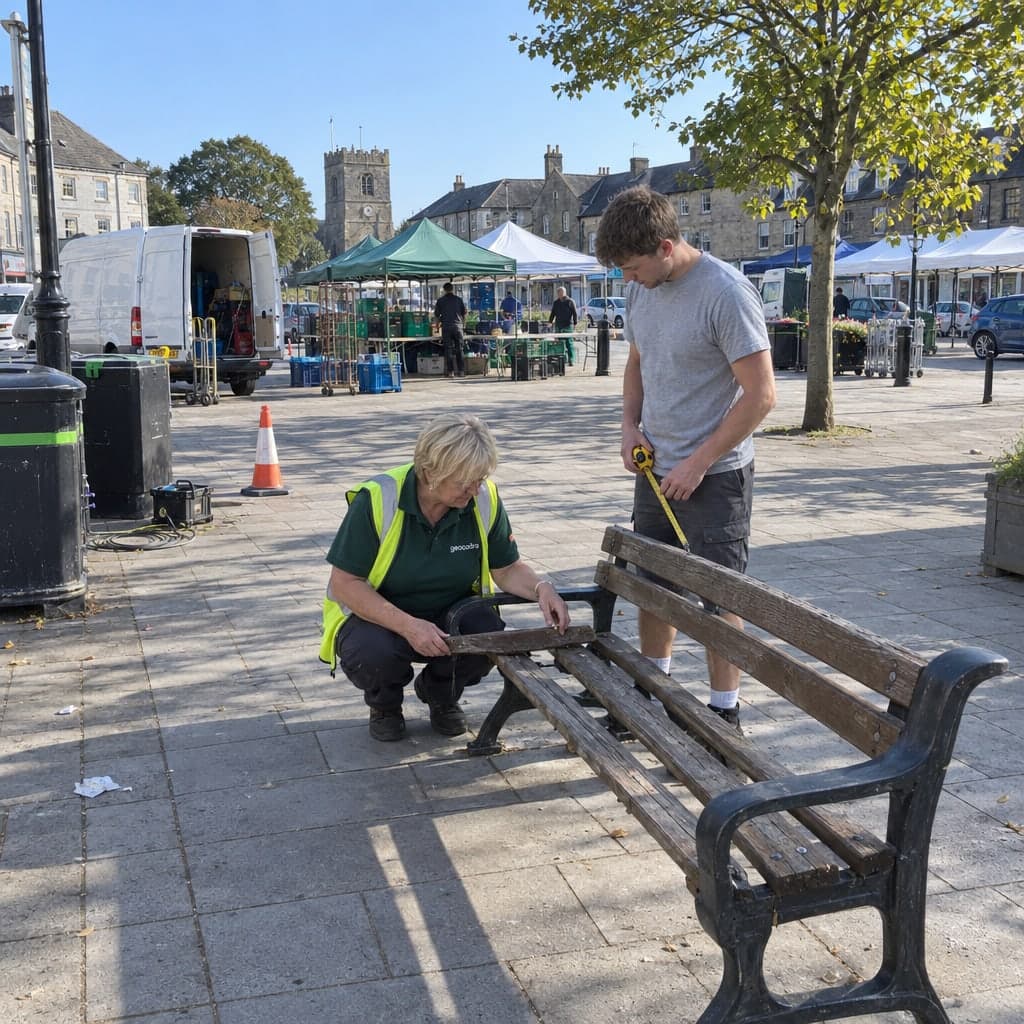
For wood (Hout), the primary defects are rot (Houtrot), splintering, and coating failure. Wood rot is particularly critical for street furniture because outdoor wooden elements are exposed to moisture from rain, ground contact, and condensation. A wooden bench seat with end-stage rot in the seating surface represents a direct safety hazard — a score of 5 or 6 is typical. For metals — steel (Staal) and aluminum (Aluminium) — the dominant defect is corrosion (Corrosie). Steel corrodes aggressively in outdoor environments, especially at joints, bolt connections, and ground-level contact points. Aluminum resists corrosion better but is susceptible to galvanic corrosion when in contact with dissimilar metals.
For concrete (Beton) and stone (Natuursteen), common defects include crack formation (Scheurvorming), spalling, and biological growth such as algae or moss (Aangroei). Concrete planters and bollards often develop surface cracks from freeze-thaw cycles that, while initially minor, can accelerate deterioration when water penetrates. Plastic and composite (Kunststof) elements suffer primarily from UV degradation, deformation under sustained load, and surface wear. Across all materials, vandalism (Vandalisme) — including graffiti, intentional breakage, and arson damage — is a defect category that applies universally to street furniture and is rarely relevant for building inspections.
The visual quality assessment of public space that complements NEN 2767 is covered in the CROW KOR Beeldkwaliteit standard, which grades appearance rather than technical defects.
For more on defect-driven condition assessment, browse the standards directory or the official CROW infrastructure documentation.
DIGITAL WORKFLOW
Digitize Street Furniture Inspections with Geocadra
Paper-based NEN 2767 furniture inspections create bottlenecks in data collection, score calculation, and portfolio analysis. Geocadra replaces the entire workflow.
Material-filtered defect selection
When the inspector selects the material (wood, steel, concrete, etc.) in the asset inventory, the defect dropdown automatically filters to show only relevant defect types. This prevents impossible combinations like recording "wood rot" on a steel bollard and speeds up field data entry.
Repeatable defect registration
A single piece of street furniture often has multiple simultaneous defects — corrosion on the legs and coating failure on the frame. Geocadra supports repeatable defect groups, letting inspectors add as many defect records as needed per asset with severity, intensity, and extent for each.
Photo-linked defect evidence
Every defect record is tied to geotagged photos captured in the field. Reviewers see the exact location and visual evidence of each defect alongside its severity/intensity/extent scores, eliminating ambiguity in post-inspection review.
Portfolio-wide condition dashboards
Aggregate condition scores across hundreds or thousands of furniture assets to identify clusters of deterioration, prioritize maintenance budgets by area or material type, and track degradation trends over multi-year inspection cycles.
QUESTIONS
Frequently Asked Questions
What is NEN 2767-4 for street furniture?
NEN 2767-4 is the infrastructure extension of the Dutch NEN 2767 condition assessment standard. It applies the same defect-driven scoring methodology — severity, intensity, and extent producing a 1-to-6 condition score — to outdoor assets including benches, bollards, waste bins, bicycle racks, shelters, and signage.
How does NEN 2767 furniture differ from NEN 2767 for buildings?
The core methodology is identical, but the defect catalogs differ significantly. Street furniture inspections emphasize outdoor exposure defects like corrosion, UV degradation, vandalism, and biological growth. The element decomposition is also simpler — furniture assets typically have fewer sub-components than buildings.
How is the condition score calculated for street furniture?
Each registered defect is scored by severity (functional impact), intensity (progression stage), and extent (percentage affected). The NEN 2767 algorithm then aggregates all individual defect scores into a single condition rating from 1 (Excellent) to 6 (Very Poor) per element.
Which defects are most common for street furniture?
The most frequently registered defects are corrosion on steel components, wood rot on seating surfaces, coating failure from UV and weather exposure, vandalism including graffiti and intentional damage, and biological growth such as algae and moss on concrete and stone elements.
How often should street furniture be inspected under NEN 2767?
Typical inspection cycles are every 3 to 5 years for a full condition assessment. Assets with a score of 4 or higher may require annual follow-up to track deterioration. High-traffic locations or assets exposed to salt spray often warrant shorter intervals.
Can a single furniture asset have multiple defects recorded?
Yes, and this is expected. A bench may have wood rot on the seat slats, corrosion on the steel legs, and coating failure on the backrest. NEN 2767 requires each defect to be registered separately with its own severity, intensity, and extent scores.
What qualifications are needed for NEN 2767 furniture inspections?
There is no government-mandated certification specifically for street furniture inspections. However, inspectors typically complete a general NEN 2767 training program offered by recognized organizations like SSVV or BOEI to ensure consistent and reliable application of the standardized defect classification methodology.
In practice
See how the round runs in Geocadra
The solution page shows this inspection regime on real open data: the import, the form, the round, the record per asset and the export.
Playground checks, headstone tests and green-space acceptances on a map, with every round appended to the siteOpen the solution page: Municipalities & Public SpaceTRY IT FREE
Digitize your NEN 2767 inspections
Replace paper forms and spreadsheets with structured digital inspections, built for standards like NEN 2767.
No credit card requiredFree trial included