


NZPIM Sewer Pipe Inspection
The New Zealand standard for systematic CCTV condition assessment of gravity sewer and stormwater pipelines.
The New Zealand Pipe Inspection Manual (NZPIM), 4th Edition, is the nationally adopted standard for condition assessment of non-pressure gravity wastewater and stormwater pipelines. Published by Water New Zealand, it provides a structured, code-based methodology for recording structural defects and service deficiencies observed during CCTV inspections. NZPIM bridges the Australian WSA 05 Conduit Inspection Reporting Code and the European EN 13508-2 standard, creating a system tailored to New Zealand's pipe infrastructure and regulatory environment. The standard produces separate Structural and Service Condition Grades from 1 (Very Good) to 5 (Very Poor) that drive rehabilitation planning, maintenance prioritisation, and asset management decisions for councils and network operators across the country.
What is NZPIM?
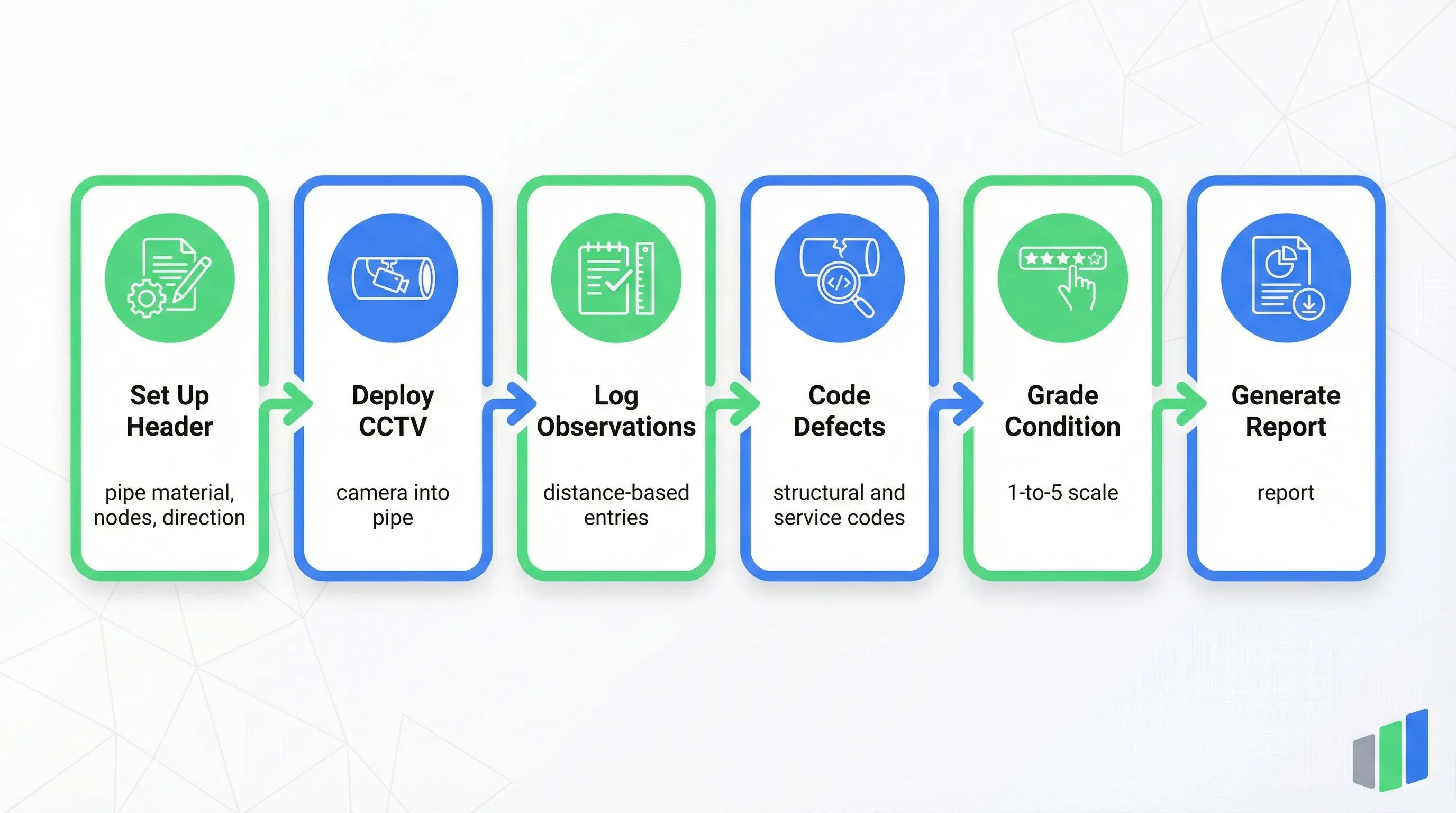
NZPIM 4th Edition (New Zealand Pipe Inspection Manual) is the New Zealand standard for CCTV condition assessment of gravity sewer and stormwater pipelines. Inspectors log coded structural and service defects at measured distances to produce a Condition Grade from 1 (Very Good) to 5 (Very Poor).
- Full Name
- New Zealand Pipe Inspection Manual (NZPIM), 4th Edition (2019)
- Issuing Body
- Water New Zealand
- Current Revision
- 4th Edition, 2019
DEFECT CODES
The NZPIM Defect Code System: Structural vs. Service Defects
NZPIM organises all pipe observations into a hierarchical code system that distinguishes structural defects from service deficiencies, each driving a separate condition grade.
The NZPIM 4th Edition defect code system is the foundation of every pipe inspection report. Each observation recorded during a CCTV survey is assigned a single-letter or two-letter main code that identifies the defect category. The standard divides observations into three groups: Structural Defects, Service Defects, and Construction Features. Structural defects directly affect the physical integrity of the pipe wall and include Crack (C), Broken (B), Deformed (D), Joint Defect (J), Surface Damage (S), and Tomo/Void (T). The Tomo/Void code is unique to NZPIM and captures pipe wall loss or visible voids behind the pipe that indicate ground erosion or external damage not typically coded in other standards.
Service defects impair the hydraulic performance of the pipeline without necessarily compromising structural integrity. These include Roots (R), Deposits Attached (DA), Infiltration (I), and Obstruction (O). Root intrusion is the most common service defect in New Zealand's sewer networks, where mature tree roots penetrate joints and cracks to access nutrient-rich wastewater. Deposits Attached (DA) covers encrustation, grease buildup, and mineral deposits adhering to the pipe wall that reduce effective cross-sectional area. Construction Features such as Lateral (L) and Manhole (MH) are non-defect observations that record the location and condition of connecting infrastructure. General Comment (GC) provides a free-text entry for observations that do not fit the standard code categories.
| Code | Category | Type | Description |
|---|---|---|---|
| C | Crack | Structural | Longitudinal, circumferential, multiple, or spiral cracking of the pipe wall |
| B | Broken | Structural | Pipe wall is broken with pieces displaced or missing |
| D | Deformed | Structural | Cross-section distortion from external loading or ground movement |
| J | Joint Defect | Structural | Open, displaced, or faulty-sealed joints between pipe segments |
| S | Surface Damage | Structural | Spalling, wear, erosion, or chemical corrosion of the pipe surface |
| T | Tomo/Void | Structural | Pipe wall loss or visible voids behind the pipe (NZPIM-specific) |
| R | Roots | Service | Fine, mass, or tap root intrusion through joints or cracks |
| DA | Deposits Attached | Service | Encrustation, grease, or mineral deposits adhering to the pipe wall |
| I | Infiltration | Service | Groundwater ingress through defects in the pipe wall or joints |
| O | Obstruction | Service | Foreign objects or debris reducing pipe flow capacity |
| L | Lateral | Feature | Location and condition of lateral (side) connections |
| MH | Manhole | Feature | Manhole or access point within the inspection run |
| GC | General Comment | Feature | Free-text observation not covered by standard codes |
Structural codes drive the Structural Condition Grade; Service codes drive the Service Condition Grade. Construction Features are recorded for asset inventory but do not affect grading.
This separation of structural and service codes is critical because NZPIM calculates two independent grades for each inspected pipe section: a Structural Condition Grade and a Service Condition Grade. A pipe may have excellent structural integrity but severe root intrusion, or vice versa. By maintaining two parallel grading streams, asset managers can prioritise structural rehabilitation separately from operational maintenance, targeting budgets more effectively. For comparable European sewer defect coding, see the EN 13508-2 standard.
CONDITION GRADES
The 1-to-5 Condition Grading Scale
NZPIM uses a five-point Condition Grade system from 1 (Very Good) to 5 (Very Poor) that separately rates structural integrity and service performance.
The NZPIM 4th Edition Condition Grading system assigns each inspected pipe section a score from 1 to 5, where Grade 1 represents Very Good (as-new condition with no defects) and Grade 5 represents Very Poor (the pipe has failed or failure is imminent). Critically, NZPIM calculates two independent grades: a Structural Condition Grade based on codes C, B, D, J, S, and T, and a Service Condition Grade based on codes R, DA, I, and O. Grade 2 (Good) indicates minor deterioration such as superficial surface wear or minor staining, with no structural risk or flow restriction. Grade 3 (Moderate) marks the threshold where defects become distinct and require monitoring, such as medium fractures, displaced joints, or root intrusion blocking less than 25% of the cross-section.
| Grade | Condition | Structural Example | Service Example |
|---|---|---|---|
| 1 | Very Good / Excellent | No defects; as-new pipe condition | No service deficiencies; clear bore |
| 2 | Good | Superficial surface wear, minor staining | Minor deposits; no measurable flow restriction |
| 3 | Moderate | Medium fractures, displaced joints | Root intrusion < 25% cross-section; moderate deposits |
| 4 | Poor | Large cracks, deformation > 10%, broken with soil visible | Root mass > 50% cross-section; heavy encrustation |
| 5 | Very Poor / Failed | Collapsed pipe, full-wall corrosion | Total blockage, pipe no longer conveys flow |
Grades are calculated separately for Structural and Service conditions. The overall pipe condition is the worse (higher) of the two grades. Grade 3 triggers monitoring; Grade 4 triggers planned intervention; Grade 5 requires immediate action.
Grade 4 (Poor) signals significant defects that demand rehabilitation or repair in the near term: large cracks, deformation exceeding 10% of the pipe diameter, or broken pipe sections with visible soil. Grade 5 (Very Poor / Failed) is reserved for collapsed pipes, total blockages, extensive corrosion through the full pipe wall, or deformation so severe that the pipe can no longer convey flow. The dual-grade approach ensures that a pipe with minor structural cracking but severe root blockage receives a low service grade despite its adequate structural rating. Asset managers use the worse of the two grades to prioritise capital renewal, while the individual grades inform whether the intervention should be structural (relining, replacement) or operational (root cutting, cleaning). New Zealand councils typically integrate these grades into their long-term infrastructure strategies, feeding condition data into predictive deterioration models.
The condition grading methodology is published by Water New Zealand.
Try this NZPIM form in Geocadra
We have a pre-built NZPIM inspection template ready to go. Sign up and start your first condition assessment today.
Free 14-day trial. No credit card required.
OBSERVATION LOG
The Linear Observation Log: Distance-Based Defect Recording
The NZPIM observation log records every defect and feature at its precise distance from the start node, creating a linear map of pipe condition that supports both grading and rehabilitation design.
What distinguishes NZPIM from simpler inspection checklists is its distance-based linear observation log. Rather than providing a single overall assessment, the inspector records each defect at its exact position measured in metres from the upstream start node. This creates a longitudinal profile of the pipe's condition that asset managers can use not only for grading but also for targeted rehabilitation design. A rehabilitation engineer can specify that relining is needed from 12.5 m to 18.3 m where multiple cracks cluster, rather than relining the entire pipe section at far greater cost.
Each observation entry consists of a distance measurement, a main defect code, an optional characterisation, an optional quantification, clock-face position references, a photo capture, and free-text remarks. The distance field must increase monotonically: entries are ordered sequentially from 0.0 metres at the start node to the total pipe length at the finish node. NZPIM also supports continuous defects, where a start and finish distance bracket a defect that spans a measurable length. A longitudinal crack running from 4.2 m to 9.8 m would be logged with a continuous flag rather than as a single point observation.
The clock-face position system records where on the pipe circumference a defect is located, using a 1-to-12 numbering system analogous to a clock face when viewed from the upstream end. Position 12 is the crown (top), Position 6 is the invert (bottom), and positions 3 and 9 are the springlines (sides). Recording both a "from" and "to" position captures the circumferential extent of a defect. A crack spanning from position 10 to position 2 passes over the crown, while a crack from 4 to 8 runs along the lower half of the pipe. This positional data is essential for rehabilitation design, particularly for patch repairs and targeted structural interventions where knowing the exact location and extent of damage determines the repair method and cost.
For a complementary manhole inspection methodology used alongside pipe surveys, see the NASSCO MACP manhole standard.
CHARACTERISATION
Characterisation and Quantification: Describing Defect Severity
After selecting the main defect code, NZPIM requires inspectors to further describe each observation through characterisation and quantification modifiers.
NZPIM's characterisation codes provide the second level of detail for each observation. While the main code identifies what type of defect is present, the characterisation describes how it manifests. For Crack (C) defects, the characterisation distinguishes between Longitudinal, Circumferential, Multiple, and Spiral patterns. A longitudinal crack runs along the length of the pipe and typically indicates beam loading or differential settlement, while a circumferential crack encircles the pipe and often results from shear forces at rigid connections. Multiple cracks in a localised area signal advanced structural deterioration that may soon progress to a Broken (B) condition.
Joint defects (J) are characterised as Open (gap visible between pipe segments), Displaced (angular or lateral offset between segments), or Faulty Sealing Ring (seal material visible or protruding). Root observations (R) distinguish between Fine Roots (individual filaments), Mass Roots (dense mat of root material), and Tap Root (single large root penetration). Surface Damage (S) is characterised as Wear/Erosion, Corrosion/Chemical Attack, or Spalling, each pointing to different deterioration mechanisms and material vulnerabilities.
The quantification field measures the severity or magnitude of the observed defect. For cracks, the inspector selects Small/Hairline, Medium, or Large based on visible crack width. For deformation, the quantification records the percentage of cross-sectional loss: 0-5%, 5-10%, 10-25%, or greater than 25%. Root and deposit observations use percentage of cross-section blocked to indicate flow restriction severity. This quantification data directly influences the Condition Grade calculation: a small hairline crack contributes less to the structural grade than a large crack with visible displacement, even though both carry the same main code of C. In the form, these three fields (main code, characterisation, quantification) work together to produce a complete, standardised description of each defect that any qualified inspector worldwide can interpret consistently.
For a comparable North American sewer coding approach, see the NASSCO PACP sewer standard.
HEADER DATA
Inspection Header: Asset and Environmental Context
Before any observations are recorded, the NZPIM form captures critical asset attributes and environmental conditions that frame the entire inspection.
The NZPIM inspection header establishes the context for every observation that follows. Start Node ID and Finish Node ID identify the manhole or access point references at each end of the pipe section, linking the inspection to the council's GIS asset register. The Direction of Survey (Upstream or Downstream) determines how distance measurements are interpreted and ensures that multiple inspections of the same pipe section can be compared regardless of camera deployment direction. Pipe Material is a required field with options including Asbestos Cement (AC), Cast Iron (CI), Concrete General (CONC), Reinforced Concrete (RC), Earthenware/Clay (EW), Polyvinyl Chloride (PVC), and Polyethylene (PE). The material code is critical because expected defect patterns vary significantly by material. AC pipes are susceptible to longitudinal cracking, EW pipes commonly exhibit joint displacement, and PVC pipes are prone to deformation under external loading.
Pipe Shape (Circular, Egg Shaped, Oval, or Rectangular/Box) and Height/Diameter in millimetres describe the physical geometry. Non-circular shapes require additional width measurements. The Inspection Method field records the technology used: CCTV (TV), Pan-Tilt CCTV (TVPT), Fixed Zoom (FZ), or Photographic (P). Pan-tilt cameras provide superior lateral and circumferential coverage compared to fixed-axial systems, and the method code allows report reviewers to assess the reliability and completeness of the observation data.
Environmental context fields include Weather Conditions (Dry, Rain, Heavy Rain, or Showers), Purpose of Inspection (Maintenance, Handover/Acceptance, Rehabilitation Design, Infiltration Investigation, or Operational Issue), and Pre-Cleaning Status (No Cleaning, Light Cleaning, Heavy Cleaning, or Jetting). The purpose field drives the level of detail expected: a handover inspection for new pipe requires documentation of every minor construction feature, while a maintenance survey focuses primarily on deterioration and blockage. Pre-cleaning status is essential for interpreting the observation log because debris or deposits visible during an uncleaned inspection may mask underlying structural defects. For a comparable approach to pipe inspection documentation used widely in the UK, see the WRC MSCC5 sewer standard.
NZPIM is maintained by Water New Zealand and aligns with the ISO/TR 11295 framework for condition classification of drainage systems.
QUESTIONS
Frequently Asked Questions
What is NZPIM?
NZPIM (New Zealand Pipe Inspection Manual) is the national standard for CCTV condition assessment of gravity sewer and stormwater pipelines. Now in its 4th Edition (2019), it provides coded defect classification and a 1-to-5 condition grading system used by councils and network operators throughout New Zealand.
How does NZPIM differ from EN 13508-2?
NZPIM is closely aligned with EN 13508-2 but includes New Zealand-specific additions such as the Tomo/Void (T) defect code and tailored material codes for local pipe types. NZPIM also maintains closer integration with the Australian WSA 05 standard, reflecting Australasian pipe infrastructure practices.
What is the difference between structural and service grades?
NZPIM calculates two independent Condition Grades for each pipe section. The Structural Grade assesses physical integrity (cracks, breaks, deformation, joints, surface damage, voids). The Service Grade assesses hydraulic performance (roots, deposits, infiltration, obstructions). The overall condition is the worse of the two.
What does a Condition Grade of 5 mean?
Grade 5 (Very Poor / Failed) indicates that the pipe has collapsed, failure is imminent, or flow is completely blocked. It requires immediate action. Structural Grade 5 examples include collapsed pipe or full-wall corrosion. Service Grade 5 examples include total root blockage.
Is a NZPIM inspection mandatory in New Zealand?
NZPIM is not legislation, but it is the de facto mandatory standard for council-funded CCTV pipe inspections. Most territorial authorities in New Zealand specify NZPIM compliance in their infrastructure contracts, and the standard is referenced in Water New Zealand guidelines and codes of practice.
What CCTV equipment is required for a NZPIM inspection?
NZPIM supports several inspection methods: standard CCTV (TV), Pan-Tilt CCTV (TVPT), Fixed Zoom (FZ), and Photographic (P). Pan-tilt cameras are recommended for pipes 150 mm and larger as they allow detailed inspection of laterals and circumferential defects that fixed-axial cameras may miss.
How often should a NZPIM pipe inspection be performed?
Inspection frequency depends on asset criticality, pipe age, material, and historical condition data. New Zealand councils typically inspect critical sewer mains every 5 to 10 years, with more frequent surveys for pipes with known deterioration or those in high-consequence areas such as coastal zones.
In practice
See how the round runs in Geocadra
The solution page shows this inspection regime on real open data: the import, the form, the round, the record per asset and the export.
Lighting columns, poles, sewers and charge points inspected on a map, with every round appended to the assetOpen the solution page: Utilities & Public LightingTRY IT FREE
Digitize your NZPIM inspections
Replace paper forms and spreadsheets with structured digital inspections, built for standards like NZPIM.
No credit card requiredFree trial included