QTRA Tree Risk Assessment
The quantitative, probability-based method for calculating tree risk of harm to people and property.
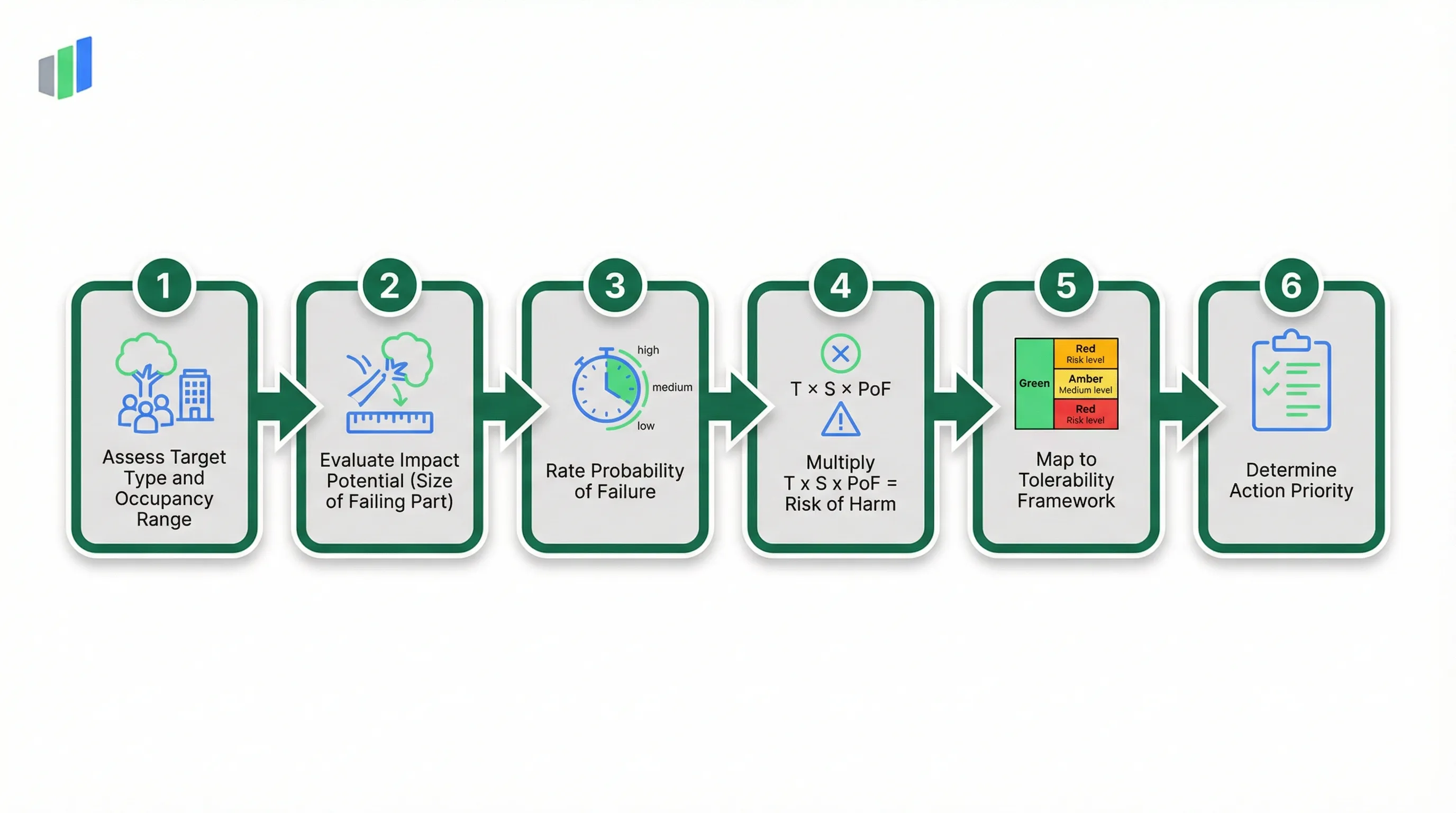
QTRA is the leading quantitative tree risk assessment methodology used across the United Kingdom, Australia, New Zealand, and Europe. Unlike qualitative systems that assign subjective risk labels, QTRA calculates a numerical Risk of Harm (RoH) by multiplying three independent probability factors: the likelihood of the target being present, the impact potential based on the size of the failing part, and the probability of structural failure. The resulting probability is mapped to a four-level traffic-light tolerability framework aligned with the Health and Safety Executive's ALARP principle, giving tree managers a defensible, evidence-based basis for deciding when intervention is justified and when the risk is already acceptable.
What is QTRA?
QTRA (Quantified Tree Risk Assessment) is a probabilistic risk management methodology that calculates a Risk of Harm by multiplying three independent factors: Target value, Impact Potential (size of failing part), and Probability of Failure. The result is classified into a four-level traffic-light system from Broadly Acceptable (Green) to Unacceptable (Red).
- Full Name
- Quantified Tree Risk Assessment
- Issuing Body
- QTRA Ltd (Mike Ellison, Cheshire Woodlands)
- Current Revision
- Version 5
RISK CALCULATION
How QTRA Calculates the Risk of Harm
QTRA is fundamentally a multiplication of three independent probabilities that produces a single Risk of Harm figure expressed as a fraction.
QTRA Version 5 calculates the Risk of Harm (RoH) using the formula: RoH = Target (T) × Impact Potential (S) × Probability of Failure (PoF). Each factor is selected from a range-based scale where every range represents an order of magnitude in probability. For example, if a tree overhangs a moderately used footpath (Target Range 3, probability 1/100), the part likely to fail is a primary branch of 300 mm diameter (Impact Potential Range 2, probability 1/2), and the branch shows moderate signs of decay (PoF Range 3, probability between 1/100 and 1/1,000), the resulting Risk of Harm is approximately 1/100 × 1/2 × 1/500 = 1/100,000 — falling within the Broadly Acceptable (Green) zone where no intervention is required.
This multiplicative approach is what distinguishes QTRA from summation-based systems like the Matheny & Clark Hazard Rating, which adds three scores to produce a composite number. Multiplication means that if any single factor is very low — for instance, if the target is negligible (Range 6) — the overall risk drops to negligible regardless of how dangerous the tree looks. This reflects the real-world principle that a tree about to collapse in the middle of an uninhabited forest poses no risk to people. QTRA enforces this by making the target assessment the first step: if there is no target worth protecting, there is no risk worth calculating, and the inspector can move on without performing a detailed structural assessment.
Two optional modifiers refine the calculation in QTRA Version 5. The Reduced Mass percentage (defaulting to 100%) accounts for dead branches where wood density has degraded, lowering the effective impact. A dead branch of 200 mm diameter that has lost half its mass through desiccation and decay would be assessed at 50%, effectively halving the Impact Potential. The Weather Factor (ratios of 1/1, 1/2, 1/4, or 1/10) reduces the target occupancy during adverse weather conditions — a woodland footpath that attracts 10 walkers per hour in fair weather but fewer than 1 per hour during storms can be assessed with a Weather Factor of 1/10, reflecting the inverse correlation between wind-driven branch failure and pedestrian presence.
The methodology is developed and licensed by QTRA Ltd, and its tolerability thresholds are derived from the UK Health and Safety Executive (HSE).
TARGET ASSESSMENT
Target-Led Inspection: Assessing Occupancy and Value
QTRA is target-led — the inspector evaluates the usage or value of the area beneath and around the tree before assessing the tree itself.
The target assessment is the defining characteristic of QTRA and distinguishes it from tree-focused methods like VTA or ISA TRAQ. The inspector begins by classifying the Target Type: Pedestrian/Cyclist (people on foot or bicycle), Vehicle (road traffic), or Property/Infrastructure (buildings, utilities, structures). Each target type has different measurement units — pedestrians are counted per hour, vehicles per day, and property by replacement value in pounds sterling. This target-first approach means that in low-use environments such as rural woodland or private land with minimal access, the entire assessment may conclude at this stage with a finding that the risk is negligible regardless of the tree’s condition.
Target Range is the most influential single input in the QTRA calculation. Range 1 (Very High) represents constant occupancy — more than 36 pedestrians per hour, more than 26,000 vehicles per day, or property valued above £50,000. At this level, the target probability is 1/1, meaning the target is effectively always present. Range 6 (None/Negligible) represents near-zero occupancy, carrying a probability of 1/100,000 or lower. The six-range scale spans five orders of magnitude, reflecting the enormous variation in target exposure between a busy high street and an isolated field boundary. In the digital form, the inspector selects the Target Type first, which contextualizes the Range descriptors, then selects the applicable Target Range. The Multiple Occupancy field allows the inspector to note when more than one person or item may be present simultaneously — for example, a bus stop where several people wait together.
| Range | Level | Pedestrian | Vehicle | Property | Probability |
|---|---|---|---|---|---|
| 1 | Very High | >36/hr | >26,000/day | >£50,000 | 1/1 |
| 2 | High | >10/hr | >1,300/day | >£13,000 | 1/20 |
| 3 | Moderate | >1/hr | >130/day | >£1,300 | 1/100 |
| 4 | Low | >1/day | >13/day | >£60 | 1/1,000 |
| 5 | Very Low | Weekly use | <13/day | >£10 | 1/10,000 |
| 6 | Negligible | <Weekly | Negligible | <£10 | 1/100,000+ |
Try this QTRA form in Geocadra
We have a pre-built QTRA inspection template ready to go. Sign up and start your first condition assessment today.
Free 14-day trial. No credit card required.
HAZARD ASSESSMENT
Impact Potential and Probability of Failure
The hazard side of QTRA combines two independent assessments: how big is the part likely to fall, and how likely is it to fall within the next 12 months.
Once the target has been established, the inspector shifts to the tree itself. The first step is identifying the Part Likely to Fail from six categories: Whole Tree, Root Plate, Trunk/Stem, Primary Branch, Secondary Branch, or Dead Wood. This selection determines which structural component drives the risk calculation. A single tree may have multiple hazards — a primary branch with included bark and a root plate compromised by fungal decay — and QTRA handles this by allowing repeatable hazard entries, each assessed independently and generating its own Risk of Harm. The inspector acts on the highest-risk finding.
Impact Potential (labelled Size in QTRA) is measured by the diameter of the part likely to fall, not the diameter of the tree as a whole. QTRA defines five size ranges, each carrying a different probability ratio. Range 1 (greater than 450 mm diameter) carries an impact potential of 1/1 — a falling part of this size striking a person would almost certainly cause fatal or serious injury. Range 5 (10–25 mm diameter) carries an impact potential of only 1/2,500, reflecting the very low likelihood that such a small piece of debris would cause significant harm. The non-linear scaling between ranges (1/1, 1/2, 1/8.6, 1/82, 1/2,500) reflects biomechanical research on the relationship between mass, velocity, and injury severity — impact force does not scale linearly with diameter because mass increases with the cube of radius.
| Range | Diameter of Part | Impact Potential |
|---|---|---|
| 1 | > 450 mm | 1/1 |
| 2 | 250–450 mm | 1/2 |
| 3 | 100–250 mm | 1/8.6 |
| 4 | 25–100 mm | 1/82 |
| 5 | 10–25 mm | 1/2,500 |
Probability of Failure (PoF) is the inspector’s expert judgement of the likelihood that the identified part will fail within the coming 12 months. QTRA provides seven ranges spanning from 1/1 (failure is imminent or already occurring) to less than 1/1,000,000 (negligible — the tree is sound). This is the most subjective element of the assessment and requires arboricultural expertise. Signs that push toward higher PoF ranges include visible fungal fruiting bodies, extensive bark loss, significant lean changes, active cavity expansion, root severance, and structural cracks. Signs that support lower PoF ranges include healthy crown density, stable adaptive growth, undamaged root plate, and absence of decay indicators. The inspector must consider species-specific failure characteristics — Eucalyptus species shed limbs in ways that Quercus species do not, and Populus species develop brittleness at earlier ages than Fagus.
| Range | Probability Band | Description |
|---|---|---|
| 1 | 1/1 – 1/10 | Severe / Imminent failure likely |
| 2 | 1/10 – 1/100 | High probability |
| 3 | 1/100 – 1/1,000 | Moderate probability |
| 4 | 1/1,000 – 1/10,000 | Low probability |
| 5 | 1/10,000 – 1/100,000 | Very low probability |
| 6 | 1/100,000 – 1/1,000,000 | Extremely low probability |
| 7 | < 1/1,000,000 | Negligible / Sound tree |
TOLERABILITY
The Traffic-Light Tolerability Framework
QTRA maps the calculated Risk of Harm to a four-zone traffic-light system aligned with the UK Health and Safety Executive’s ALARP principle.
The Risk of Harm result is not used as a raw number — it is mapped to a four-zone tolerability framework that determines whether intervention is required. This framework is directly derived from the UK Health and Safety Executive’s risk tolerability criteria, which define the boundary between acceptable and unacceptable risk for any hazard, not just trees. The ALARP principle (As Low As Reasonably Practicable) is central: a risk is tolerable if reducing it further would require effort disproportionate to the reduction achieved.
The Unacceptable (Red) zone applies when the Risk of Harm equals or exceeds 1/1,000. At this level, the risk must be controlled immediately or urgently regardless of cost or practical difficulty. This threshold corresponds to the HSE’s limit of tolerability for risks imposed on members of the public. The Amber zone (1/1,000 to 1/10,000) represents risk that is unacceptable if imposed without consultation but may be tolerable if the stakeholder — typically the tree owner or land manager — agrees to accept it and can demonstrate that the risk is ALARP. This zone often applies to valued heritage trees where removal would cause significant environmental or amenity loss.
The Tolerable (Yellow) zone spans from 1/10,000 to 1/1,000,000. Risks in this range are considered tolerable provided they are ALARP, and routine monitoring is normally the appropriate response. The Broadly Acceptable (Green) zone applies below 1/1,000,000. At this level, no action is required — the risk is already so low that any intervention would be disproportionate. In the digital form, the Risk Category field displays as a traffic-light indicator, giving the inspector an immediate visual summary. The boundary between zones is not a matter of professional judgement: the thresholds are fixed by the QTRA system and derived from HSE guidance, making outcomes consistent and auditable across different inspectors and organisations.
| Risk of Harm | Colour | Category | Action Required |
|---|---|---|---|
| ≥ 1/1,000 | Red | Unacceptable | Risk must be controlled immediately or urgently. |
| 1/1,000 – 1/10,000 | Amber | Unacceptable / Tolerable | Must be reduced unless stakeholder accepts and risk is ALARP. |
| 1/10,000 – 1/1,000,000 | Yellow | Tolerable | Tolerable if ALARP. Routine monitoring appropriate. |
| < 1/1,000,000 | Green | Broadly Acceptable | No action required. Risk is already ALARP. |
ACTION PRIORITIES
From Risk Category to Remedial Action
QTRA links each risk outcome to an action priority and inspection interval that guide the tree manager’s response.
The Action Priority field translates the abstract Risk of Harm into a practical management timeline. QTRA defines six priority levels: Immediate (24 hours) for trees in the Red zone where failure could occur at any time, Urgent (7 days) for high-risk situations that require rapid but planned intervention, High (3 months) for significant risks that need scheduling within the next quarter, Moderate (12 months) for Amber-zone trees where works should be completed within the standard annual cycle, Monitor Only for trees in the Tolerable zone where no physical works are needed but the tree should remain on the inspection programme, and No Action for Broadly Acceptable risks where the tree can be discharged from active management.
The Next Inspection Interval determines when the tree should be reassessed. QTRA Version 5 offers five standard intervals: 6 Months, 12 Months (the default annual cycle), 18 Months, 3 Years, and 5 Years. The interval is driven by the combination of risk category, the nature of the defect, and how quickly the condition might change. A tree with active fungal decay in the Amber zone would typically receive a 6-month re-inspection, while a sound tree in the Green zone adjacent to a low-use footpath might be placed on a 5-year cycle. The Recommendations field captures the inspector’s specific remedial prescription — crown reduction, dead wood removal, felling, root investigation, or further specialist assessment — along with any operational notes.
| Priority | Timeframe | Typical Application |
|---|---|---|
| Immediate | 24 hours | Red-zone trees with imminent failure risk. Emergency closure or felling. |
| Urgent | 7 days | Red/Amber-zone trees requiring rapid planned intervention. |
| High | 3 months | Significant risks needing scheduling within the quarter. |
| Moderate | 12 months | Amber-zone trees with works within the annual cycle. |
| Monitor Only | Next cycle | Tolerable risks requiring continued observation. |
| No Action | N/A | Broadly Acceptable risks discharged from active management. |
The ability to record multiple hazard entries per tree is critical for comprehensive QTRA assessments. A mature oak in a parkland setting might have three separate hazard entries: a primary branch with included bark junction over a footpath (Amber), a secondary dead branch over a car park (Tolerable), and the whole tree root plate near a boundary wall (Green). Each entry generates its own Risk of Harm, action priority, and recommendation. For related approaches to tree risk, the VTA Mattheck method provides a biomechanical inspection framework based on visual growth indicators. Explore all available inspection standards in the standards library.
QUESTIONS
Frequently Asked Questions
What is QTRA?
QTRA (Quantified Tree Risk Assessment) is a probabilistic risk management method that calculates a numerical Risk of Harm by multiplying Target occupancy, Impact Potential (size of the failing part), and Probability of Failure. The result is classified using a four-level traffic-light system aligned with the ALARP principle.
How is the QTRA Risk of Harm calculated?
The Risk of Harm is calculated by multiplying three independent probability factors: Target (T), Impact Potential or Size (S), and Probability of Failure (PoF). Each factor is selected from a range-based scale. The resulting fraction is compared against fixed tolerability thresholds to determine the risk category.
What is the difference between QTRA and ISA TRAQ?
QTRA produces a quantitative probability (e.g., 1/50,000) using a multiplicative model and fixed tolerability thresholds. ISA TRAQ uses a qualitative matrix combining likelihood and consequences categories to produce a risk rating of Low, Moderate, High, or Extreme. QTRA is more common in the UK and Australasia; TRAQ dominates in North America.
What does ALARP mean in QTRA?
ALARP stands for As Low As Reasonably Practicable. It is a UK Health and Safety Executive principle meaning that risk is tolerable if reducing it further would require effort disproportionate to the benefit gained. QTRA uses ALARP to define the boundary between Tolerable and Unacceptable risk.
Is QTRA certification required to perform assessments?
QTRA Ltd requires practitioners to complete a licensed training course before using the QTRA system commercially. The course covers probabilistic risk assessment theory, the use of the QTRA calculator, and field assessment techniques. Certification is not a legal requirement but is a professional expectation for defensible assessments.
Can QTRA assess multiple hazards on a single tree?
Yes. A single tree may present multiple independent risks — for example, a dead branch over a footpath and a root plate defect near a wall. QTRA handles this through repeatable hazard entries, each generating its own Risk of Harm. The inspector acts on the highest-risk finding.
How does the Weather Factor work in QTRA Version 5?
The Weather Factor reduces target occupancy to account for the inverse correlation between storm conditions and human presence. A woodland path busy in calm weather but deserted during storms can be assessed with a factor of 1/10, effectively dividing the target probability by 10. The default is 1/1 (no reduction).
In practice
See how the round runs in Geocadra
The solution page shows this inspection regime on real open data: the import, the form, the round, the record per asset and the export.
Regular tree checks, biotope mapping and ecological surveys on a map, with every visit appended to the tree or the siteOpen the solution page: Trees, Habitats & EcologyTRY IT FREE
Digitize your QTRA inspections
Replace paper forms and spreadsheets with structured digital inspections, built for standards like QTRA.
No credit card requiredFree trial included