SHRP LTPP Distress Survey
The federal standard for quantitative visual distress surveys on asphalt concrete pavements under the LTPP program.
The SHRP/LTPP Distress Identification Manual (Fifth Revised Edition, FHWA-HRT-13-092) is the definitive reference for recording pavement surface distresses in the United States. Originally developed under the Strategic Highway Research Program, it underpins the Long-Term Pavement Performance database used by state and federal transportation agencies for network-level analysis and rehabilitation planning. This guide covers the five distress categories for asphalt concrete pavement, the three-level severity system, metric quantification by area, length, or count, and station-based rutting measurement.

What is SHRP/LTPP?
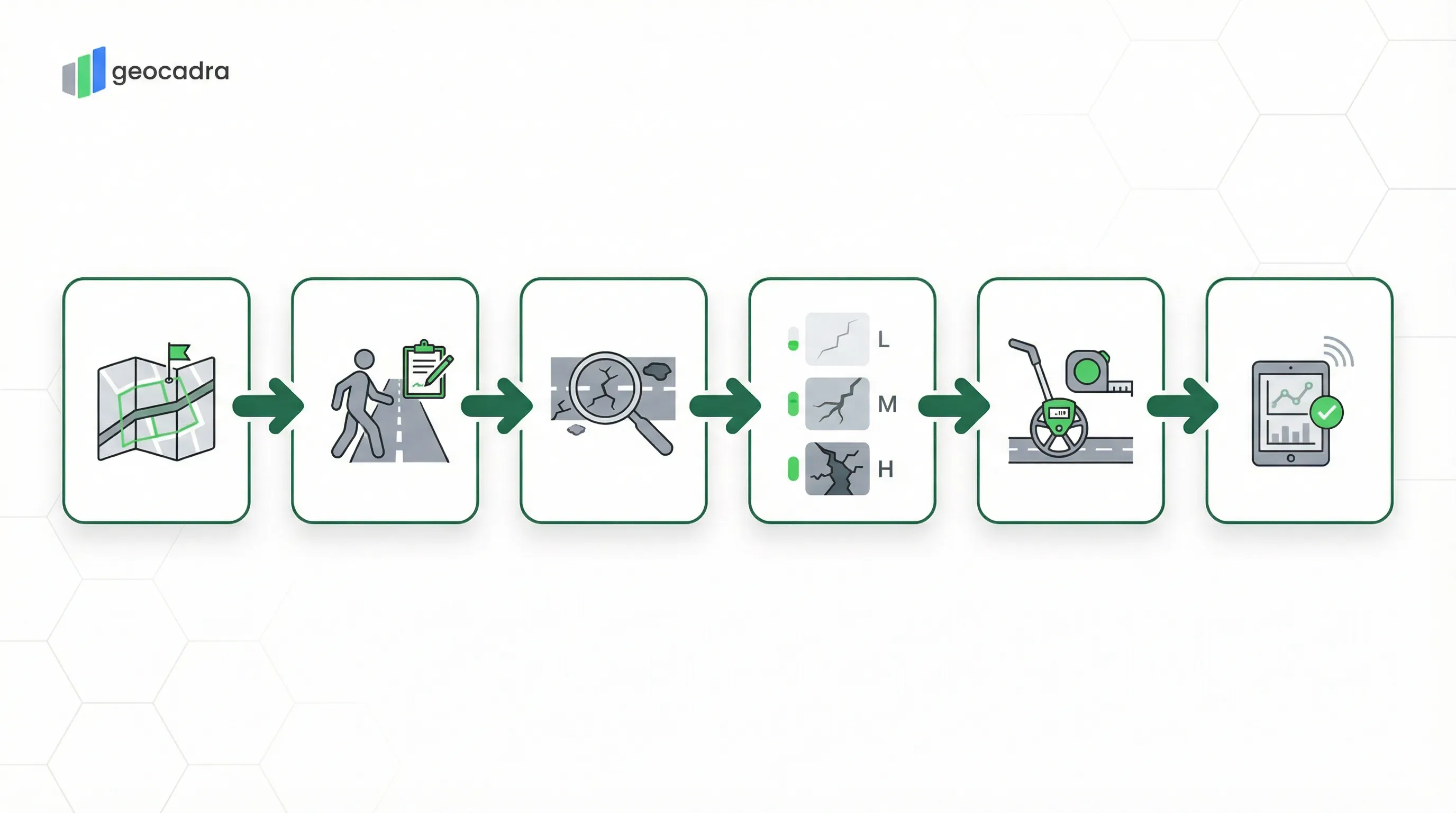
The SHRP/LTPP Distress Identification Manual (FHWA-HRT-13-092, Fifth Revised Edition) is the U.S. federal standard for quantitative visual distress surveys on asphalt concrete pavements. It classifies 15 distress types across five categories — Cracking, Patching & Potholes, Surface Deformation, Surface Defects, and Miscellaneous — each measured in SI units by severity level (Low, Moderate, High).
- Full Name
- Distress Identification Manual for the Long-Term Pavement Performance Program (Fifth Revised Edition)
- Issuing Body
- Federal Highway Administration (FHWA)
- Current Revision
- FHWA-HRT-13-092 (2014)
DISTRESS CATEGORIES
Five Distress Categories for Asphalt Concrete Pavements
The LTPP standard organizes all visible pavement distresses into five functional categories that reflect distinct failure mechanisms. Each category maps to a specific LTPP Data Sheet used during field collection.
Category A: Cracking encompasses all fracture-based distresses and is typically the largest section in any LTPP survey. It includes fatigue (alligator) cracking, block cracking, edge cracking, longitudinal cracking (separated into wheel path and non-wheel path), reflection cracking, and transverse cracking. Cracking distresses are the primary indicators of structural deterioration in asphalt concrete pavements. Fatigue cracking in the wheel path signals that repeated traffic loading has exceeded the pavement section's structural capacity, while block cracking indicates age-related hardening of the asphalt binder independent of load. The LTPP manual requires each cracking type to be measured separately because they arise from different mechanisms and demand different rehabilitation strategies. In the form, the inspector records the extent of each cracking type stratified by Low, Moderate, and High severity — producing up to three area or length measurements per distress type.
Category B: Patching and Potholes addresses maintenance-related distresses. Patches record previous repair interventions and their current condition, while potholes represent bowl-shaped depressions where pavement material has been lost. Both are measured by count and total area at each severity level. Category C: Surface Deformation covers rutting (permanent deformation in the wheel path from traffic loading) and shoving (longitudinal displacement of the surface). Rutting is measured at fixed stations using a straight-edge method with inner and outer wheel path depth readings in millimeters. Category D: Surface Defects includes bleeding (excess binder on the surface), polished aggregate, and raveling (loss of aggregate particles). Notably, the Fifth Edition does not assign severity levels to surface defects — only the affected area is recorded. Category E: Miscellaneous covers lane-to-shoulder dropoff and water bleeding/pumping, which are indicators of subsurface drainage problems and subgrade failure.
This five-category structure directly mirrors the LTPP Data Sheets used in field collection. Data Sheet 1 captures cracking (Category A), Data Sheet 2 captures patching, potholes, surface defects, and miscellaneous distresses (Categories B, D, and E), and surface deformation (Category C) uses station-based measurements that may be collected manually or by automated profiling equipment. The form structure ensures that data flows directly into the LTPP Information Management System (IMS) without manual recoding, maintaining the data integrity that makes the LTPP database the world's most comprehensive pavement performance repository.
| Category | Distress Types | Measurement Unit | Severity Levels |
|---|---|---|---|
| A: Cracking | Fatigue, Block, Edge, Longitudinal (WP/NWP), Transverse, Reflection | Area (m²) or Length (m) | Low, Moderate, High |
| B: Patching & Potholes | Patch/Patch Deterioration, Potholes | Count + Area (m²) | Low, Moderate, High |
| C: Surface Deformation | Rutting, Shoving | Depth (mm) at stations; Area (m²) | By depth measurement |
| D: Surface Defects | Bleeding, Polished Aggregate, Raveling | Area (m²) | None (extent only) |
| E: Miscellaneous | Lane-to-Shoulder Dropoff, Water Bleeding/Pumping | Presence / Count + Length (m) | None |
All measurements use SI (metric) units per the Fifth Edition standard. Surface Defects (Category D) and Miscellaneous (Category E) do not have defined severity levels in the LTPP 5th Edition.
The standard is maintained by the Federal Highway Administration (FHWA) as part of the LTPP program at the Turner-Fairbank Highway Research Center.
SEVERITY LEVELS
The Three-Level Severity System and Physical Definitions
Unlike subjective rating scales, LTPP defines severity using strict physical thresholds — crack widths in millimeters, pothole depths, and spalling conditions — ensuring that any trained inspector will arrive at the same severity classification for the same distress.
The LTPP severity system uses three levels — Low, Moderate, and High — with definitions that vary by distress type but share a common principle: severity increases with the physical extent of deterioration and its impact on ride quality and structural integrity. For linear cracking (longitudinal, transverse, and edge), severity is determined by mean crack width: Low is 6 mm or less, Moderate is greater than 6 mm up to 19 mm, and High is greater than 19 mm. Additionally, the presence of adjacent secondary cracking can elevate severity: a crack of any width up to 19 mm with adjacent low-severity random cracking qualifies as Moderate, and with adjacent moderate-to-high severity random cracking it qualifies as High. Sealed cracks in good condition where the width is indeterminate are classified as Low. This width-plus-adjacency rule is a key distinguishing feature of the LTPP methodology — it recognizes that crack width alone does not capture the full extent of damage when secondary cracking indicates broader structural failure.
Fatigue (alligator) cracking uses a pattern-based severity definition rather than width. Low severity describes individual or loosely connected cracks without spalling and no evidence of pumping. Moderate severity means the cracks have interconnected to form a complete pattern but remain only slightly spalled with no pumping. High severity means the interconnected cracks are moderately or severely spalled, pieces may move under traffic loading, and pumping may be evident. Block cracking severity follows the same width thresholds as linear cracking (6 mm and 19 mm) combined with spalling condition. For potholes, severity is determined entirely by bowl depth: Low is less than 25 mm, Moderate is 25 mm to 50 mm, and High is greater than 50 mm. Patching severity considers the condition of the patch material itself, including any rutting within the patch: Low means rutting under 6 mm, Moderate means 6 to 12 mm, and High means over 12 mm or the presence of pumping.
| Severity | Width Threshold | Additional Condition |
|---|---|---|
| Low | ≤ 6 mm mean width | Sealed cracks in good condition also classified as Low |
| Moderate | > 6 mm to ≤ 19 mm | OR any width ≤ 19 mm with adjacent low-severity random cracking |
| High | > 19 mm | OR any width ≤ 19 mm with adjacent moderate-to-high random cracking |
Applies to longitudinal, transverse, and edge cracking. Fatigue and block cracking use separate definitions that incorporate pattern formation and spalling condition.
| Severity | Pothole Depth | Patch Rutting |
|---|---|---|
| Low | < 25 mm | < 6 mm rutting within patch |
| Moderate | 25–50 mm | 6–12 mm rutting within patch |
| High | > 50 mm | > 12 mm rutting; pumping may be evident |
Pothole severity is based on bowl depth. Patching severity is based on the condition of the repaired area, including any distress and rutting within the patch material.
A critical distinction in the Fifth Edition is that surface defects — bleeding, polished aggregate, and raveling — do not have defined severity levels. The inspector records only the affected area in square meters. This design decision reflects the LTPP philosophy that these distresses are better characterized by extent than by graduated severity, because their functional impact (reduced skid resistance, aggregate loss) is relatively uniform across affected areas. Similarly, miscellaneous distresses (lane-to-shoulder dropoff and water bleeding/pumping) are recorded by presence or count rather than severity. Understanding which distresses carry severity levels and which do not is essential for correct form completion — assigning a severity level to bleeding or raveling would be a protocol error.
Similar severity frameworks are found in the ASTM D6433 PCI standard, which uses the same distress catalog with identical severity definitions but calculates a composite index value.
Try this SHRP/LTPP form in Geocadra
We have a pre-built SHRP/LTPP inspection template ready to go. Sign up and start your first condition assessment today.
Free 14-day trial. No credit card required.
CRACKING ASSESSMENT
Wheel Path Distinction and the Cracking Taxonomy
The LTPP cracking assessment is the most data-intensive section of the survey. It requires the inspector to distinguish between six cracking types, classify each by severity, and — for longitudinal cracking — separate measurements between wheel path and non-wheel path locations.
The wheel path (WP) versus non-wheel path (NWP) distinction for longitudinal cracking is one of the most critical data elements in the LTPP standard. The wheel path is defined as a 1.0-meter-wide strip where tire wear occurs on the pavement surface. Any longitudinal crack falling within this strip is classified as WP; any longitudinal crack outside it is classified as NWP. This distinction matters because wheel path longitudinal cracking is directly associated with traffic loading and structural fatigue, while non-wheel path longitudinal cracking is typically caused by thermal contraction, reflective cracking from underlying layers, or construction joint failure. Misclassifying a WP crack as NWP — or vice versa — corrupts the performance models that state agencies build from LTPP data, because the two types have fundamentally different deterioration curves and different rehabilitation implications. In the form, the inspector records six separate length measurements for longitudinal cracking: Low, Moderate, and High severity for the wheel path, and Low, Moderate, and High severity for the non-wheel path.
Fatigue cracking — commonly called alligator cracking — is measured by affected area in square meters rather than length, because the interconnected crack pattern covers a two-dimensional zone. By definition, fatigue cracking occurs only in wheel paths; if an interconnected crack pattern appears outside the wheel path, the LTPP standard instructs the inspector to classify it as block cracking instead. This rule prevents double-counting and ensures that "fatigue cracking" in the LTPP database always represents load-related structural failure. Block cracking forms rectangular or roughly rectangular pieces defined by intersecting cracks, and it can appear anywhere on the pavement surface regardless of wheel path location. It is caused by age-related shrinkage of the asphalt binder rather than traffic loading.
Transverse cracking is perpendicular to the pavement centerline and is recorded as a repeatable entry: the inspector logs the severity level, count of cracks, and total length for each severity group within the test section. Unlike fatigue and block cracking (measured as area), transverse cracks are measured as linear lengths in meters because they typically span the full lane width as individual events. Edge cracking runs parallel to and within 0.3 meters of the outer edge of the pavement and is also measured by length per severity level. Reflection cracking — cracks that propagate through the asphalt overlay from joints or cracks in an underlying layer — is not measured separately in the Fifth Edition. Instead, the standard instructs inspectors to record them under their apparent type (longitudinal or transverse), with a simple presence toggle to flag that reflection cracking was observed. This approach avoids the subjectivity of determining whether a visible crack is truly reflective or originates in the asphalt layer itself.
All cracking taxonomies and measurement methods are documented in the FHWA LTPP program. For network-level pavement surveys, see the UKPMS CVI guide for the UK counterpart.
MEASUREMENT METHODS
Quantification Rules: Area, Length, Count, and Station-Based Measurement
LTPP surveys require precise quantification — not qualitative assessments. Every distress produces a numerical measurement: square meters for area-based distresses, meters for length-based distresses, simple counts for discrete events, and millimeter depth readings at fixed stations for rutting.
Area-based measurement applies to fatigue cracking, block cracking, patches, potholes, bleeding, polished aggregate, raveling, and shoving. The inspector measures the total affected area in square meters for each severity level. For fatigue and block cracking, this means delineating the boundary of the interconnected crack pattern and estimating its area — not measuring individual crack lengths. A critical validation rule in the LTPP protocol is that the sum of all distress areas by severity cannot exceed the total section area (section length multiplied by lane width). In the form, the section length and lane width are recorded in the Survey Parameters section specifically to enable this cross-check. For example, a section that is 152.4 meters long and 3.6 meters wide has a total area of 548.6 square meters — the combined area of all fatigue cracking (Low + Moderate + High) cannot exceed this total.
Length-based measurement applies to edge cracking, longitudinal cracking (both WP and NWP), and transverse cracking. The inspector records the total length in meters for each severity level. Longitudinal cracking can theoretically equal the full section length for each severity level in each path location, producing up to six length entries that may each approach 152.4 meters for a standard LTPP test section. Transverse cracking is unique in that it uses both count and length: the inspector records the number of transverse cracks at each severity level and the total length of those cracks. This dual measurement captures both the frequency of cracking events and their span across the lane.
Station-based measurement applies specifically to rutting. The LTPP standard requires rut depth measurements at fixed intervals — typically every 15.25 meters (50 feet) — along the test section, producing approximately 11 measurement stations per standard 152.4-meter section. At each station, the inspector places a 1.2-meter straight edge perpendicular to the direction of travel and records the maximum depth in millimeters for both the inner wheel path and the outer wheel path. This station-based approach captures the spatial variation in rutting along the section rather than a single average value. The repeatable station-based entry in the form records three values: the station distance from the start of the section (in meters), the inner wheel path depth (in millimeters), and the outer wheel path depth (in millimeters). Automated profiling equipment such as the Dipstick can replace manual measurement for research-grade surveys, but the manual straight-edge method remains the standard for field distress surveys under SPS-3 programs.
For more information about the LTPP data format, refer to the standards directory for related pavement survey standards.
DIGITAL WORKFLOW
Digitize LTPP Distress Surveys with Geocadra
LTPP distress surveys generate dense quantitative data — severity-stratified measurements for up to 15 distress types plus station-based rutting readings — that must be LTPP IMS compatible. Geocadra replaces paper-based LTPP Data Sheets with structured digital forms purpose-built for pavement distress surveying.
Severity-stratified area and length fields
Each distress type has dedicated Low, Moderate, and High severity input fields with appropriate units (square meters for area distresses, meters for length distresses). The form structure mirrors the LTPP Data Sheet layout so experienced surveyors can transition from paper to digital without retraining. Built-in validation prevents totals from exceeding the section area.
Wheel path separation for longitudinal cracking
Longitudinal cracking is split into two distinct field groups: Wheel Path (WP) and Non-Wheel Path (NWP), each with Low, Moderate, and High severity length inputs. This enforces the LTPP requirement to distinguish between load-related and non-load-related longitudinal cracking — a distinction that paper forms sometimes fail to capture cleanly.
Repeatable station-based rutting entries
Rutting measurements are captured as repeatable station entries: station distance, inner wheel path depth, and outer wheel path depth. The form supports the standard 11-station protocol for a 152.4-meter section and accepts additional stations for non-standard section lengths. Each reading pair is preserved as a spatial data point.
Photo-linked distress documentation
Distress photos are geotagged and associated with specific distress entries. LTPP Directive D-54 requires photographic documentation of observed distresses, and the digital form links images directly to the relevant distress type, severity, and station — building the evidence chain required for LTPP data submission and quality assurance review.
QUESTIONS
Frequently Asked Questions
What is the SHRP/LTPP distress survey?
The SHRP/LTPP distress survey is a quantitative visual inspection protocol defined by the Distress Identification Manual (FHWA-HRT-13-092, Fifth Edition). It classifies 15 distress types on asphalt concrete pavements across five categories, measuring each by area, length, count, or depth in SI units. It feeds the Long-Term Pavement Performance database used by U.S. transportation agencies.
What are the three severity levels in the LTPP standard?
LTPP uses Low, Moderate, and High severity for most distresses. For linear cracking, severity is based on mean crack width: Low is 6 mm or less, Moderate is greater than 6 mm to 19 mm, and High is greater than 19 mm. Pothole severity uses bowl depth thresholds of 25 mm and 50 mm. Surface defects have no defined severity levels — only extent is measured.
Why does LTPP separate wheel path and non-wheel path longitudinal cracking?
Wheel path longitudinal cracking results from repeated traffic loading and structural fatigue, while non-wheel path cracking is typically caused by thermal contraction or reflective cracking. Separating them ensures accurate deterioration modeling — the two types have fundamentally different causes, progression rates, and rehabilitation requirements in the LTPP performance database.
How is rutting measured in an LTPP distress survey?
Rutting is measured at fixed stations every 15.25 meters along the test section using a 1.2-meter straight edge placed perpendicular to traffic flow. At each station, the inspector records the maximum rut depth in millimeters for both the inner and outer wheel paths. A standard 152.4-meter section produces approximately 11 station readings.
What is the difference between fatigue cracking and block cracking in LTPP?
Fatigue (alligator) cracking occurs only in wheel paths and results from repeated traffic loading that exceeds structural capacity. Block cracking forms rectangular patterns anywhere on the surface due to age-related binder shrinkage. If an interconnected crack pattern appears outside the wheel path, LTPP classifies it as block cracking, not fatigue.
Is the SHRP/LTPP distress survey mandatory?
LTPP distress surveys are mandatory for sections enrolled in the federal LTPP program and commonly adopted by state DOTs for network-level pavement management. While not legally mandated for all roads, the standard is the de facto reference for quantitative pavement condition assessment in the United States and is referenced by AASHTO guidelines.
What is the difference between LTPP distress surveys and ASTM D6433 PCI?
Both assess pavement distress, but LTPP records detailed severity-stratified area and length measurements for each distress type separately. ASTM D6433 uses the same distress catalog but calculates a single composite Pavement Condition Index (PCI) score from 0 to 100. LTPP prioritizes raw data capture for long-term research; PCI prioritizes a summary index for maintenance decisions.
In practice
See how the round runs in Geocadra
The solution page shows this inspection regime on real open data: the import, the form, the round, the record per asset and the export.
Main and routine inspections of bridges, walls, roads and signs on a map, with every inspection appended to the structureOpen the solution page: Bridges, Roads & StructuresTRY IT FREE
Digitize your SHRP/LTPP inspections
Replace paper forms and spreadsheets with structured digital inspections, built for standards like SHRP/LTPP.
No credit card requiredFree trial included