
AASHTO MASH Guardrail Inspection
The US standard for verifying crash-tested W-beam guardrail systems and assessing in-service condition.
AASHTO MASH (Manual for Assessing Safety Hardware) defines the crash-testing criteria that highway guardrail systems must pass before deployment. Once installed, in-service inspections ensure that these systems retain their crashworthy configuration. This form combines MASH compliance verification with the NCHRP Report 656 damage assessment methodology, covering the Midwest Guardrail System (MGS) at 31-inch mounting height, standard W-beam, thrie-beam, and box beam configurations. Inspectors evaluate rail corrosion, post condition using the DL0–DL3 decay scale, splice integrity, end terminal functionality, and soil embedment to produce an overall condition rating from 1 (Good) to 4 (Critical) with corresponding repair priority.

What is AASHTO MASH?
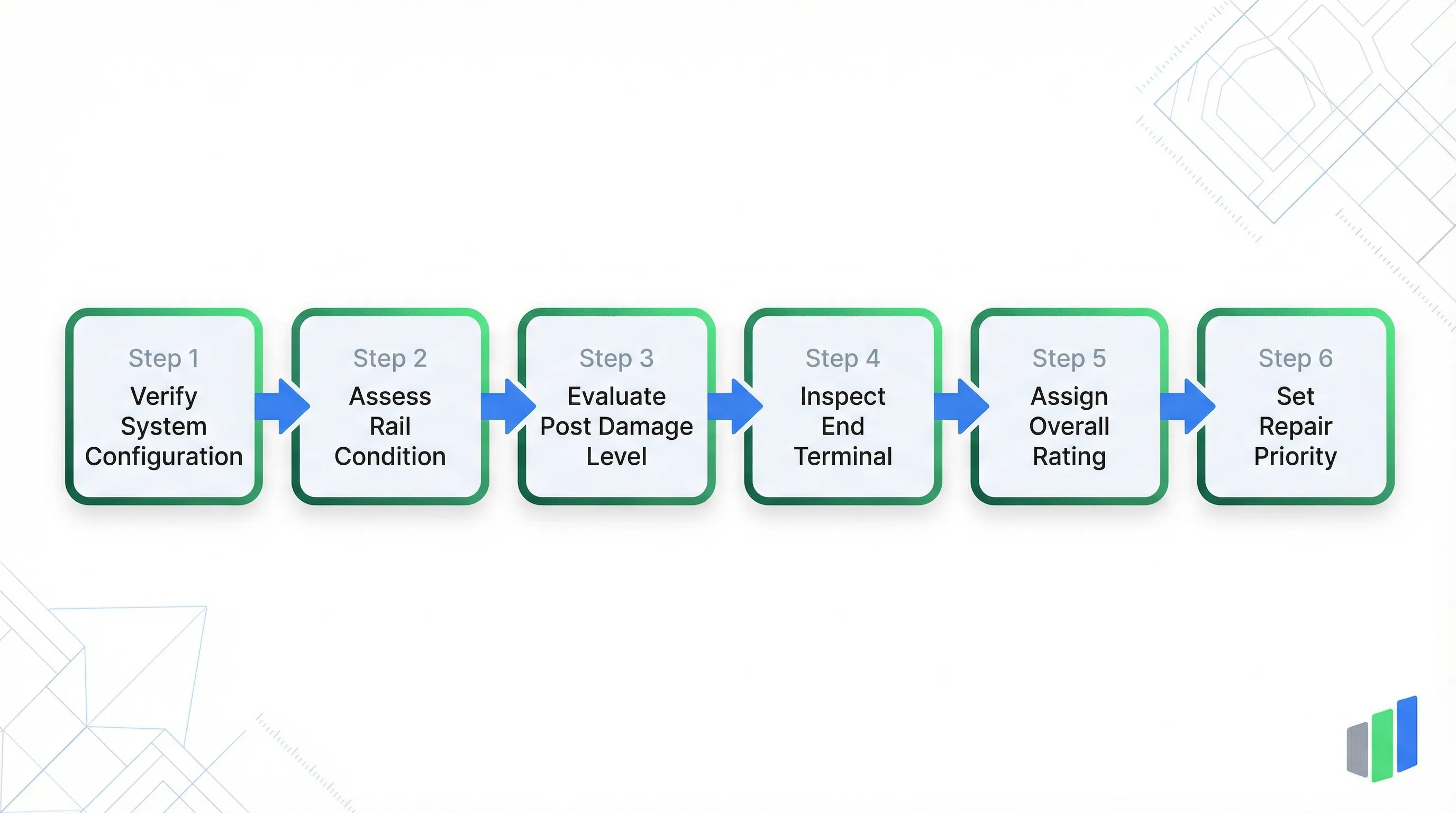
AASHTO MASH (Manual for Assessing Safety Hardware) is the US standard governing crash-tested guardrail systems. Inspectors verify system configuration, rate rail and post condition using the NCHRP 656 DL0–DL3 damage scale, assess end terminal integrity, and assign an overall condition rating from 1 (Good) to 4 (Critical).
- Full Name
- Manual for Assessing Safety Hardware (MASH) / NCHRP Report 656
- Issuing Body
- AASHTO (American Association of State Highway and Transportation Officials)
- Current Revision
- MASH 2016 (2nd Edition) / NCHRP 656
SYSTEM CONFIGURATION
MASH Compliance Verification: System Configuration
Every guardrail inspection begins by verifying that the installed system matches its MASH-tested configuration, because even minor deviations from the tested setup can invalidate crashworthiness.
The AASHTO MASH standard requires that roadside safety hardware be crash-tested in a specific configuration before it can be approved for use on public highways. The Midwest Guardrail System (MGS) with a 31-inch rail mounting height is the primary MASH-compliant W-beam system used across the United States. Standard W-beam systems at 27.75 inches, thrie-beam, and box beam configurations are also recognized but have different performance characteristics and application contexts. The System Type field captures which configuration is installed, establishing the baseline against which all subsequent condition checks are validated.
Post Material is a critical configuration parameter because it determines which damage assessment scale applies. Galvanized steel posts (typically W6x9 or W6x8.5 sections) are evaluated using a visual deformation scale ranging from Good through Twisted, Bent, Torn/Sheared, to Missing. Wood (timber) posts use the entirely different NCHRP 656 DL0–DL3 decay scale that requires physical testing with a hammer. Composite posts represent newer alternatives with their own assessment criteria. The Post Spacing field verifies whether the standard 6-foot-3-inch spacing is maintained, or whether reduced spacing (half at 3-foot-1.5-inch, or quarter at 1-foot-6.75-inch) has been applied for hazardous locations such as bridge approaches or tight curves.
Splice Location is one of the most critical MASH compliance parameters. MGS systems must use mid-span splices located between posts, not at the post. Splices located at the post create a rigid point that prevents the rail from properly deflecting during impact, which can lead to vehicle snagging or rail rupture. The Blockout Type field records whether wood, composite/plastic, steel, or no blockouts are used. The MGS design typically requires 12-inch blockouts that maintain the correct offset between the rail face and post flange, ensuring the post does not interact with the vehicle wheel during impact.
For bridge-approach guardrail transitions and structural inspection requirements, see the FHWA NBIS/SNBI bridge inspection standard.
CONDITION ASSESSMENT
Rail and Post Condition Assessment
The condition assessment section evaluates the structural integrity of the W-beam rail, splice connections, posts, and blockouts using graduated severity scales.
Rail Corrosion is assessed on a four-level scale that progresses from no corrosion through cosmetic surface rust, to pitted and flaking galvanization, and finally to section loss with visible holes. Surface rust is purely cosmetic and does not affect structural performance, but pitted or flaking corrosion indicates that the protective galvanized coating has failed and the underlying steel is actively deteriorating. Section loss with holes represents structural compromise where the rail cross-section has been reduced, potentially affecting its ability to contain and redirect vehicles during impact. In coastal or high-salt environments, corrosion progression from surface rust to section loss can occur within 10 to 15 years.
| Level | Condition | Structural Impact | Action |
|---|---|---|---|
| None | No corrosion visible | None | No action required |
| Surface Rust | Cosmetic rust on galvanized surface | Negligible | Monitor during routine inspections |
| Pitted/Flaking | Galvanized coating failure, active rust | Moderate — progressive section reduction | Schedule repair or replacement |
| Section Loss | Visible holes through rail web | Severe — reduced impact containment | Immediate replacement required |
Corrosion assessment applies to both the W-beam rail and steel posts. Coastal and high-salt environments accelerate progression from surface rust to section loss.
Rail Deformation captures the physical shape of the W-beam profile. A flattened rail has lost its characteristic W-shape, reducing bending stiffness. A kinked or bent rail indicates localized impact damage or settlement that alters the rail alignment. A torn or ruptured rail is the most severe condition, indicating that the rail has been breached and can no longer function as a continuous barrier. Splice Bolt Condition verifies that all eight bolts at each splice connection are present and properly tightened. Missing even a single splice bolt reduces the connection strength and can lead to rail separation under impact. Missing more than one bolt at any splice is typically classified as a critical deficiency requiring immediate repair.
Rail Lapping direction is a safety-critical detail that is frequently overlooked during routine inspections. W-beam guardrail panels must overlap in the direction of traffic so that a vehicle sliding along the rail face encounters the smooth overlapping edge rather than a protruding panel end that could act as a snag point. Incorrect lapping creates a pocket that can catch a vehicle bumper or wheel, dramatically increasing the severity of an impact event. Post Embedment assesses the soil condition around each post base. Firm and solid soil provides the expected resistance during impact. Eroded soil below six inches reduces embedment depth but may still provide adequate performance, while severe erosion exceeding six inches significantly compromises the post resistance that the MASH crash test assumes.
WOOD POST DAMAGE
NCHRP 656 Wood Post Damage Levels (DL0–DL3)
The DL0–DL3 scale from NCHRP Report 656 is the standardized method for assessing internal decay in timber guardrail posts, a critical factor that is invisible from external observation alone.
Wood (timber) guardrail posts present a unique inspection challenge because the most structurally significant deterioration often occurs below the ground line or inside the post cross-section, invisible to external visual inspection. NCHRP Report 656, "Criteria for Restoration of Longitudinal Barriers," developed by RoadSafe LLC for the Transportation Research Board, established the DL0–DL3 Damage Level classification specifically to address this challenge. The scale requires inspectors to combine visual observation with physical testing using a standard inspection hammer, sounding the post to detect internal decay cavities.
DL0 (Good) indicates a solid post with no deterioration evident. The post sounds firm and resonant when struck with a hammer, and no surface deterioration is visible. DL1 (Functional / Minor Aging) describes a post with minor weathering at the surface but no structural deterioration. The top of the post shows no rot, and the post still sounds solid when struck. DL1 posts remain fully functional and require no action beyond continued monitoring. DL2 (Questionable / Shallow Decay) represents the critical transition point. Shallow deterioration at the top of the post extends less than one inch deep, and rot may extend over most of the cross-section. When struck with a hammer, the post sounds soft but not hollow or punky. DL2 posts near fixed objects such as bridge rails, utility poles, or sign structures should be prioritized for replacement because their reduced energy absorption capacity compounds the hazard of the nearby object.
| Level | Classification | Physical Indicators | Hammer Test | Action Required |
|---|---|---|---|---|
| DL0 | Good | No deterioration visible, solid surface | Firm, resonant sound | None — continue monitoring |
| DL1 | Functional (Minor Aging) | Minor surface weathering, no rot at top | Solid sound | Monitor — no replacement needed |
| DL2 | Questionable (Shallow Decay) | Shallow rot < 1″ at top, rot across cross-section | Soft sound, not hollow | Priority replacement near fixed objects |
| DL3 | Failed (Critical Decay) | Deep rot > 1″, full cross-section, mold at ground line | Punky / hollow sound | Immediate replacement — non-functional |
The DL0–DL3 scale was developed by RoadSafe LLC under NCHRP Report 656. DL2 posts near fixed objects and all DL3 posts require priority replacement to maintain crashworthy performance.
DL3 (Failed / Critical Decay) indicates severe structural compromise. Deterioration at the top of the post exceeds one inch in depth, with full cross-section rot often accompanied by visible mildew or mold near the ground line. When struck with a hammer, the post sounds punky, meaning hollow and soft with no resonance. A DL3 post is considered essentially non-functional and cannot provide the soil resistance assumed in the MASH crash test. DL3 posts require high-priority replacement regardless of location. The distinction between DL2 and DL3 has direct cost implications for DOT maintenance programs: DL2 posts may be deferred if they are in mid-run locations away from fixed objects, while DL3 posts demand immediate action. In the form, the inspector selects the applicable Damage Level after performing the hammer sounding test and visual inspection of the post top and ground line.
For a comparable tree-based structural assessment methodology, see the VTA Mattheck tree assessment standard.
Try this AASHTO MASH form in Geocadra
We have a pre-built AASHTO MASH inspection template ready to go. Sign up and start your first condition assessment today.
Free 14-day trial. No credit card required.
END TERMINALS
End Terminal and Anchor Inspection
End terminals are the most safety-critical components of a guardrail system, because a malfunctioning terminal can transform a survivable run-off-road event into a fatal impalement.
MASH-compliant end terminals are designed to either absorb the energy of a head-on impact by allowing the rail to extrude through the impact head, or to redirect the vehicle away from the terminal. The MSKT (Midwest Sequential Kinking Terminal), SoftStop, and MAX-Tension systems are current MASH-approved designs. Legacy terminals such as the SKT-350 and ET-2000 were approved under the earlier NCHRP 350 crash-test standard and remain in service across many state highway networks. Flared or buried-in-backslope treatments avoid the end-on impact problem entirely by routing the guardrail end away from the travel lane or burying it in an earthen slope.
| Terminal | MASH Status | Mechanism | Key Inspection Points |
|---|---|---|---|
| MSKT | MASH Approved | Sequential kinking and rail extrusion | Head alignment, cable tension, bearing plate orientation |
| SoftStop | MASH Approved | Controlled deceleration via energy absorber | Head position, cable anchor, ground strut |
| MAX-Tension | MASH Approved | High-tension cable release and rail extrusion | Cable tautness, head slide freedom, anchor integrity |
| SKT-350 / ET-2000 | Legacy (NCHRP 350) | Earlier extrusion designs | Head condition, cable, compatibility with current rail |
| Flared/Buried | Configuration-based | Avoids head-on exposure | Flare angle, burial depth, approach grading |
Legacy NCHRP 350 terminals remain in service but are no longer approved for new installations. States are progressively upgrading to MASH-compliant terminals.
The Impact Head Status check verifies that the terminal head is properly aligned and undamaged. The impact head must slide freely along the rail to function correctly during a head-on collision. A misaligned head may jam during extrusion, converting the terminal from an energy-absorbing device into a rigid spear point. A missing or damaged head renders the terminal completely non-functional. The Cable Anchor must be taut with less than one inch of play. A loose cable allows the rail to shift during impact without engaging the controlled energy absorption mechanism. A detached or missing cable anchor is a critical deficiency because the entire terminal system relies on cable tension to control the extrusion sequence.
The Bearing Plate must be in the correct position and orientation. For MSKT systems, the standard specifies a 5-inch-up and 3-inch-down configuration relative to the ground strut connection. A rotated bearing plate can prevent the rail from extruding smoothly, causing the terminal to behave unpredictably during impact. Missing bearing plates eliminate the controlled friction that regulates the deceleration rate experienced by the vehicle occupants. Terminal inspections should always include a wide-angle approach photo that captures the full terminal assembly from the traffic-facing direction, allowing off-site reviewers to verify alignment and component presence.
Detailed MASH crash-test requirements and approved hardware lists are maintained by AASHTO and the Roadside Safety Pooled Fund.
OVERALL RATING
Overall Condition Rating and Repair Priority
The assessment summary combines all component evaluations into a single overall condition rating that drives maintenance scheduling and budget allocation.
The Overall Condition Rating uses a four-point scale from 1 (Good) to 4 (Critical). Unlike condition indices that produce a calculated score from weighted inputs, this rating represents the inspector's professional judgment after evaluating all system components. A rating of 1 (Good) indicates that the guardrail system meets MASH or applicable standard plan specifications with no significant defects. All posts are DL0 or DL1, the rail shows no deformation, splice bolts are complete, and the terminal is fully functional. Rating 2 (Fair) describes a system with minor cosmetic damage such as surface rust, DL1 posts, or lateral deflection under six inches. The system remains functional but should be monitored for progression during subsequent inspection cycles.
| Rating | Condition | Typical Findings | Required Action |
|---|---|---|---|
| 1 — Good | MASH Compliant | No defects, DL0/DL1 posts, full bolt count, functional terminal | No action — routine monitoring |
| 2 — Fair | Monitor | Surface rust, DL1 posts, deflection < 6″, minor cosmetic issues | Monitor — track progression |
| 3 — Poor | Repair Required | DL2 posts, deflection 6–9″, loose cable, missing 1 splice bolt | Schedule repair within maintenance cycle |
| 4 — Critical | Immediate Hazard | DL3 posts, rail rupture, deflection > 9″, missing blockouts, non-functional terminal | Immediate action — temporary traffic control |
The overall rating reflects the inspector's professional judgment. A single Critical component finding (e.g., DL3 post near bridge rail, torn rail, missing terminal head) can drive the entire system to a Rating 4 regardless of other component conditions.
Rating 3 (Poor) indicates moderate damage requiring scheduled repair. Typical conditions include DL2 wood posts, lateral deflection between six and nine inches, loose cable anchors, or missing single splice bolts. The system's crashworthy performance is compromised but not eliminated. Poor-rated systems are placed on the repair priority list and should be addressed within the next maintenance cycle. Rating 4 (Critical) represents an immediate safety hazard. DL3 wood posts, torn or ruptured rail, missing blockouts, lateral deflection exceeding nine inches, missing multiple splice bolts, or a non-functional terminal all trigger a Critical rating. Critical systems require immediate action, which may include temporary traffic control measures such as advance warning signs or barrier delineation until permanent repairs are completed.
The Repair Priority field translates the condition rating into an actionable maintenance timeline. Low (Routine Maintenance) applies to systems rated 1 or 2 where no immediate work is required beyond standard maintenance cycles. Medium (Schedule Repair) applies to rating 3 systems that need planned intervention. High (Safety Hazard) applies to rating 4 systems demanding urgent response. The inspector's signature field provides accountability and traceability, linking each assessment to a qualified individual who takes professional responsibility for the condition findings.
For a comparable US infrastructure condition rating methodology, see the USACE levee safety inspection standard.
QUESTIONS
Frequently Asked Questions
What is AASHTO MASH?
AASHTO MASH (Manual for Assessing Safety Hardware) is the US standard that defines crash-test evaluation criteria for roadside safety hardware including guardrails, end terminals, crash cushions, and bridge rails. Hardware must pass full-scale vehicle crash tests under MASH before it can be approved for use on federally funded highways.
What is the difference between MASH and NCHRP 350?
NCHRP 350 was the predecessor crash-test standard used from 1993 until MASH superseded it. MASH introduced more demanding test conditions including heavier test vehicles (5,000 lb pickup trucks), higher impact speeds, and stricter occupant risk criteria. Hardware tested only under NCHRP 350 is considered legacy and is no longer eligible for new installations.
What do the DL0 through DL3 damage levels mean?
DL0 through DL3 are wood post damage levels defined in NCHRP Report 656. DL0 is a solid post with no decay. DL1 shows minor aging but remains functional. DL2 has shallow decay less than one inch deep and requires priority replacement near fixed objects. DL3 has deep cross-section rot and is non-functional, requiring immediate replacement.
Why must MGS guardrail splices be located mid-span?
Mid-span splice location is a MASH compliance requirement for the Midwest Guardrail System. Splices at the post create a rigid connection point that prevents the rail from deflecting properly during vehicle impact. Mid-span splices allow the rail to flex and absorb energy as designed in the MASH crash tests.
How often should guardrail systems be inspected?
Most state DOTs require routine guardrail inspections every one to two years, with additional inspections after reported crash impacts or severe weather events. High-priority corridors such as interstate highways and bridge approaches may be inspected more frequently. FHWA recommends integrating guardrail inspection into broader roadside safety hardware inventories.
What is the correct rail height for an MGS guardrail?
The Midwest Guardrail System specifies a 31-inch rail mounting height measured from the roadway surface to the top of the W-beam rail. A tolerance of plus or minus one inch is generally accepted, giving an acceptable range of 30 to 32 inches. Standard W-beam systems use the lower 27.75-inch height.
What makes a guardrail end terminal MASH-compliant?
A MASH-compliant end terminal must pass full-scale crash tests defined in MASH Test Level 3, including a 2,425-pound car at 62 mph and a 5,000-pound pickup at 62 mph. Approved designs include the MSKT, SoftStop, and MAX-Tension terminals. The terminal must safely decelerate or redirect impacting vehicles without penetrating the passenger compartment.
In practice
See how the round runs in Geocadra
The solution page shows this inspection regime on real open data: the import, the form, the round, the record per asset and the export.
Main and routine inspections of bridges, walls, roads and signs on a map, with every inspection appended to the structureOpen the solution page: Bridges, Roads & StructuresTRY IT FREE
Digitize your AASHTO MASH inspections
Replace paper forms and spreadsheets with structured digital inspections, built for standards like AASHTO MASH.
No credit card requiredFree trial included