

MUTCD Sign Retroreflectivity
Federal compliance assessment for traffic sign retroreflectivity under MUTCD Section 2A.08 and FHWA Table 2A-3 minimum levels.
The Manual on Uniform Traffic Control Devices (MUTCD) Section 2A.08 requires every public agency in the United States to maintain traffic sign retroreflectivity at or above the minimum levels specified in Table 2A-3. This standard transformed sign management from purely subjective maintenance into a performance-based federal requirement. This guide covers the five approved assessment methods, the Table 2A-3 minimum retroreflectivity thresholds by sign color and sheeting type, the ASTM D4956 sheeting classification system, the visual nighttime inspection rating scale, sign defect identification, and the maintenance action workflow from field assessment to work order.

What is MUTCD 2A.08?
MUTCD Section 2A.08 is the U.S. federal standard requiring public agencies to maintain traffic sign retroreflectivity at or above minimum levels defined in Table 2A-3. It specifies five approved assessment methods, including visual nighttime inspection and measured retroreflectivity, with thresholds varying by sign color, sheeting type (ASTM D4956), and symbol style.
- Full Name
- Manual on Uniform Traffic Control Devices for Streets and Highways, Section 2A.08
- Issuing Body
- Federal Highway Administration (FHWA)
- Current Revision
- MUTCD 11th Edition (2023)
ASSESSMENT METHODS
Five Approved Methods for Retroreflectivity Compliance
MUTCD Section 2A.08 does not mandate a single assessment procedure. Instead, it defines five methods that agencies may adopt based on their resources, inventory size, and desired precision. The choice of method determines the inspection workflow, required equipment, and resulting data granularity.
Visual Nighttime Inspection is the most widely adopted method among local and state agencies because it requires no specialized equipment beyond a vehicle and trained inspector. The inspector drives or walks the road network after dark and evaluates each sign against a calibration standard or comparison panel. Signs that appear dim, washed out, or illegible are rated Poor and flagged for replacement. The critical requirement is procedural consistency: the FHWA requires that the inspector use either calibration signs with known retroreflectivity values, comparison panels mounted on the inspection vehicle, or a documented consistent-parameter protocol where headlight alignment, observation distance, and vehicle speed are controlled across every inspection run. Without this calibration step, the subjective visual judgment has no regulatory anchor.
Measured Retroreflectivity uses a portable retroreflectometer conforming to ASTM E1709 to obtain objective readings of the coefficient of retroreflection (Ra), expressed in candelas per lux per square meter (cd/lx/m2). Standard practice typically requires four readings per sign color area, averaged to reduce local variation from scratches, dirt deposits, or sheeting edge effects. The measured value is compared directly against the Table 2A-3 minimums for the sign's specific color, sheeting type, and symbol classification. This method provides legally defensible data and quantitative trending over time, but the cost of retroreflectometer equipment and the time required for individual sign measurement make it impractical for agencies with large sign inventories unless targeted at specific high-risk corridors.
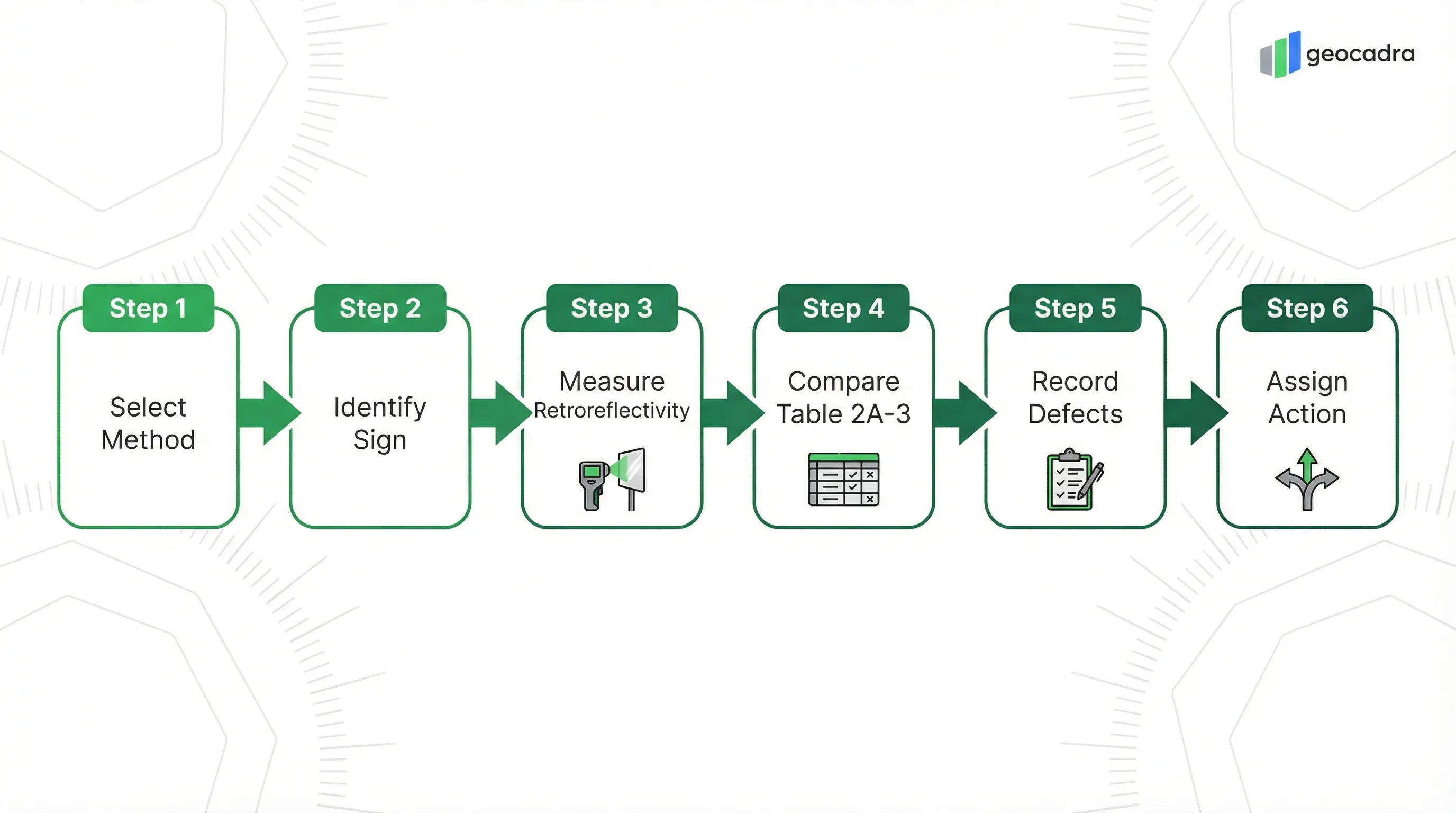
The three remaining methods require no field assessment at all. The Expected Sign Life method uses manufacturer warranty data and known degradation curves for each sheeting type to predict when a sign will fall below minimums, replacing signs proactively at a fixed age regardless of actual condition. The Blanket Replacement method replaces all signs of a given type or corridor on a fixed cycle. The Control Signs method installs sample signs of each sheeting type at the time of a corridor installation and measures only those control signs periodically; when the control sign falls below the minimum, all signs of that type in the corridor are replaced. In the digital form, the inspector selects the Assessment Method field first, which toggles the subsequent fields: choosing Visual Nighttime Inspection enables the Visual Rating dropdown (Good, Marginal, Poor), while choosing Measured Retroreflectivity enables the Background Ra numeric input and the Meets Table 2A-3 Minimums compliance field.
Retroreflectivity requirements are maintained by the Federal Highway Administration (FHWA) under the MUTCD framework.
TABLE 2A-3 MINIMUMS
Minimum Maintained Retroreflectivity Levels by Sign Color
Table 2A-3 is the regulatory core of MUTCD Section 2A.08. It defines the minimum coefficient of retroreflection (Ra) in cd/lx/m2 that each sign color must maintain, differentiated by sheeting type and whether the sign legend uses text/fine symbols or bold symbols.
The thresholds in Table 2A-3 are not uniform across all sign types. White, yellow, and orange retroreflective backgrounds have explicit minimum Ra values that vary based on the sheeting type installed. For example, a white background on Type I (Engineer Grade) sheeting has a minimum of 50 cd/lx/m2, while the same white background on Type III (High Intensity) or higher sheeting carries a minimum of 250 cd/lx/m2 for text and fine symbols. Yellow backgrounds follow a similar pattern at lower absolute values, reflecting the inherent optical properties of yellow retroreflective materials. Orange backgrounds, used for temporary traffic control and work zone signs, have their own set of minimums.
Red backgrounds present a unique compliance challenge. Instead of specifying a single minimum Ra value for the red surface, Table 2A-3 requires that white-on-red signs (STOP, YIELD, DO NOT ENTER, and similar regulatory signs) maintain a contrast ratio of at least 3:1 between the white legend and the red background. This means the inspector or retroreflectometer must measure both the white legend Ra and the red background Ra, then verify that the ratio meets the threshold. A stop sign where the red background has degraded to 5 cd/lx/m2 and the white legend reads 12 cd/lx/m2 produces a contrast ratio of 2.4:1 and fails compliance, even though the white legend alone might exceed its standalone minimum.
Green, blue, and brown backgrounds used on guide, information, and recreational signs are exempt from retroreflectivity minimums for the background color itself; only the white legend on these signs must meet the applicable minimum. Fluorescent yellow-green backgrounds, used for pedestrian, school zone, and bicycle warning signs, have higher minimums than standard yellow because they serve critical safety functions in areas with vulnerable road users. A key distinction in Table 2A-3 is the bold symbol versus text/fine symbol classification: bold symbols, such as curve arrows, chevron alignment markers, and large directional arrows, have lower minimum thresholds than text legends or fine symbolic graphics. In the form, the inspector selects the Symbol Type field (Text/Fine Symbol or Bold Symbol) to determine which column of Table 2A-3 applies.
| Sign Color | Sheeting Type | Text / Fine Symbol | Bold Symbol |
|---|---|---|---|
| White on Green | Types III, IV, VIII, IX, XI | 120 | 50 |
| White on Red | Types III, IV, VIII, IX, XI | Contrast Ratio >= 3:1 | Contrast Ratio >= 3:1 |
| Yellow (Warning) | Type I | 50 | 25 |
| Yellow (Warning) | Types III, IV, VIII, IX, XI | 150 | 75 |
| Orange (Work Zone) | Types III, IV, VIII, IX, XI | 75 | 37 |
| White (Regulatory) | Type I | 50 | 25 |
| White (Regulatory) | Types III, IV, VIII, IX, XI | 250 | 125 |
| Fluorescent Yellow-Green | Types III, IV, VIII, IX, XI | 200 | 100 |
Type I (Engineer Grade) sheeting is not permitted for warning signs, regulatory signs with red backgrounds, or overhead signs. Green, blue, and brown backgrounds have no minimum; only the white legend is measured. Red backgrounds require a contrast ratio rather than an absolute Ra value.
Similar infrastructure assessment methodologies are applied in the ASTM D6433 PCI pavement survey, which covers the same road corridor.
Try this MUTCD form in Geocadra
We have a pre-built MUTCD inspection template ready to go. Sign up and start your first condition assessment today.
Free 14-day trial. No credit card required.
ASTM D4956 SHEETING
Retroreflective Sheeting Classification Under ASTM D4956
The ASTM D4956 standard defines the retroreflective sheeting materials used on traffic signs. The sheeting type determines the initial brightness, degradation rate, expected service life, and applicable Table 2A-3 minimums. Correctly identifying the sheeting type is the first step in any retroreflectivity assessment.
Type I (Engineer Grade) is the oldest and lowest-performing retroreflective sheeting still in use. It relies on enclosed glass-bead technology where small glass spheres are embedded in a reflective layer. Type I sheeting has a typical service life of 7 to 10 years and a relatively low initial retroreflectivity that degrades significantly in the first few years. Critically, the FHWA prohibits Type I sheeting on warning signs, regulatory signs with red backgrounds (STOP, YIELD), and overhead signs because its performance falls below safety thresholds too quickly. Despite this restriction, large numbers of Type I signs remain in service on local roads, and identifying them during inspection is essential because they have the lowest Table 2A-3 thresholds and the fastest degradation rates.
Type III (High Intensity) marks the transition from glass-bead to encapsulated-lens technology, where the glass beads are sealed in individual cells that protect them from moisture and contamination. This dramatically improves both initial brightness and long-term durability, with typical service lives of 10 to 12 years. Types IV (High Intensity Prismatic) and VIII (Super High Intensity) use microprismatic technology instead of glass beads, reflecting light through total internal reflection within engineered prism arrays. This produces retroreflectivity levels three to five times higher than Type I at installation and maintains performance for 12 to 15 years. Type IX (Very High Prismatic) and Type XI (Diamond Grade) represent the highest-performing sheeting classes, used for overhead signs, freeway guide signs, and critical regulatory signs where maximum nighttime visibility is essential.
In the form, the inspector selects the Sheeting Type from a dropdown aligned with the ASTM D4956 classification: Type I (Engineer Grade), Type II (Super Engineer), Type III (High Intensity), Type IV (High Intensity Prismatic), Type VIII (Super High Intensity), Type IX (Very High Prismatic), Type XI (Diamond Grade), or Unknown. The Unknown option is critical for older signs where the sheeting type was never recorded in the inventory or where the sheeting label has weathered away. When the sheeting type is unknown, agencies typically default to the most conservative (highest) Table 2A-3 minimum for that sign color, or schedule the sign for measured retroreflectivity assessment to determine compliance empirically.
| Type | Common Name | Technology | Typical Service Life |
|---|---|---|---|
| Type I | Engineer Grade | Enclosed glass-bead | 7-10 years |
| Type II | Super Engineer | Enclosed glass-bead (improved) | 7-10 years |
| Type III | High Intensity | Encapsulated lens | 10-12 years |
| Type IV | High Intensity Prismatic | Microprismatic | 12-15 years |
| Type VIII | Super High Intensity | Microprismatic (wide-angle) | 12-15 years |
| Type IX | Very High Prismatic | Advanced prismatic | 12-15 years |
| Type XI | Diamond Grade | Full-cube prismatic | 15+ years |
Sheeting type determines both the applicable Table 2A-3 minimum and the expected degradation curve. Type I is prohibited on warning signs and red-background regulatory signs per FHWA guidance.
The ASTM D4956 standard is published by ASTM International and defines the material specifications for retroreflective sheeting.
DEFECTS & ACTIONS
Sign Face Defects and Maintenance Action Planning
Retroreflectivity loss is only one failure mode. The MUTCD assessment also captures physical sign face defects that affect visibility and the structural condition of the mounting assembly. Each finding maps to a specific recommended action and priority level.
The form captures six distinct face defect types through a multi-select field, allowing the inspector to document multiple simultaneous degradation modes on a single sign. Cracking of the retroreflective sheeting breaks the continuous reflective surface into fragments that scatter light instead of returning it to the driver, causing dark zones on the sign face. Delamination occurs when the sheeting separates from the aluminum substrate, creating bubbles or lifted edges that trap moisture and accelerate further degradation. Peeling is the advanced stage of delamination where sheeting sections have fully detached and expose bare aluminum. Fading and chalking indicate UV degradation of the pigment layer, reducing both daytime color contrast and nighttime retroreflective performance. Vandalism and graffiti obscure the sign message and can block retroreflective areas. Tree sap and dirt deposits are particularly insidious because they may be invisible during daytime inspection but dramatically reduce retroreflectivity by absorbing or scattering returned light.
The Recommended Action field provides six standardized disposition codes. No Action Needed applies to signs that pass both the retroreflectivity assessment and the physical condition check. Clean Sign Face addresses signs where dirt, tree sap, or biological growth is the primary cause of reduced visibility; cleaning alone can often restore a sign to compliance without replacement. Clear Vegetation applies when overgrown foliage obstructs the sign face or approach sight distance. Re-erect / Straighten Post addresses structural issues where the sign has been displaced by wind, vehicle impact, or ground settling. Replace Sign Face Only is used when the sheeting has failed but the support structure remains sound. Replace Entire Assembly is the most intensive action, required when both the sign face and the post or mounting hardware have failed. Each action is paired with a Priority field: Low (Routine) for findings that can be addressed in normal maintenance cycles, Medium (Schedule) for signs requiring attention within a defined timeframe, and High (Safety Hazard) for signs that pose an immediate danger to road users. STOP and YIELD signs that fall below minimum retroreflectivity automatically receive High priority because they control critical conflict points.
| Rating | Meaning | Action Required |
|---|---|---|
| Good (Pass) | Sign is bright and clearly legible at the required distance. Retroreflectivity is obviously above the minimum threshold or brighter than the calibration sign. | No action needed. Document and continue. |
| Marginal (Monitor) | Sign is visible but brightness is fading. It is near the threshold of the comparison panel. Legibility is intact but degradation is evident. | Schedule for replacement within 1-2 years. Re-inspect at next cycle. |
| Poor (Fail) | Sign is dark, washed out, or illegible at night. Retroreflectivity is below the minimum threshold. | Must be replaced. High priority if STOP, YIELD, or critical regulatory sign. |
Visual ratings are subjective and require calibration using reference signs, comparison panels, or documented consistent-parameter protocols per FHWA guidance.
For more information on U.S. federal inspection programs, see the FHWA NBIS/SNBI bridge inspection guide and the standards directory.
DIGITAL WORKFLOW
Digitize MUTCD Retroreflectivity Assessments with Geocadra
MUTCD sign retroreflectivity assessments require agencies to maintain compliant records across thousands of signs. Geocadra replaces paper-based field sheets with structured digital workflows that capture inventory data, retroreflectivity assessments, defect documentation, and maintenance actions in a single integrated form.
Conditional field logic by assessment method
The Assessment Method selector toggles subsequent fields dynamically. Visual Nighttime Inspection reveals the Visual Rating dropdown (Good, Marginal, Poor). Measured Retroreflectivity reveals numeric input fields for Background Ra and Legend Ra values in cd/lx/m2, plus the Table 2A-3 compliance check. This prevents data entry errors and ensures only relevant fields are presented to the inspector.
Complete sign inventory capture
Every assessment begins with the MUTCD Code, Background Color, Legend Color, Sheeting Type (ASTM D4956), and Symbol Type. These five fields together determine which Table 2A-3 minimum applies. Sheeting type and color data persist across inspection cycles, building a longitudinal inventory that supports Expected Sign Life analysis.
Photo evidence with flash-on and flash-off capture
The Photo Evidence field prompts inspectors to capture both flash-on and flash-off images. A flash-on photograph simulates headlight retroreflection, revealing how the sign appears to approaching drivers at night. A flash-off photograph documents the sign face condition under ambient light. This paired-photo protocol provides visual proof of retroreflectivity status alongside physical defect documentation.
Priority-driven work order integration
Each assessment generates a Recommended Action and Priority level. Signs rated Poor or below Table 2A-3 minimums are flagged for replacement, with STOP and YIELD signs automatically elevated to High (Safety Hazard) priority. The structured output feeds directly into maintenance management systems for work order generation and budget allocation.
QUESTIONS
Frequently Asked Questions
What is MUTCD Section 2A.08 sign retroreflectivity?
MUTCD Section 2A.08 is the federal requirement for U.S. public agencies to maintain traffic sign retroreflectivity at or above minimum levels defined in Table 2A-3. It specifies five approved assessment methods and sets minimum retroreflectivity thresholds based on sign color, sheeting type, and symbol classification.
What are the five approved assessment methods under MUTCD?
The five methods are: Visual Nighttime Inspection (using calibration signs or comparison panels), Measured Sign Retroreflectivity (using a retroreflectometer), Expected Sign Life (age-based replacement), Blanket Replacement (cycle-based corridor replacement), and Control Signs (monitoring sample signs to trigger batch replacement).
What is the contrast ratio requirement for STOP and YIELD signs?
White-on-red signs such as STOP, YIELD, and DO NOT ENTER must maintain a contrast ratio of at least 3:1 between the white legend retroreflectivity and the red background retroreflectivity. Both values are measured separately and the ratio is calculated to determine compliance.
Why is Type I (Engineer Grade) sheeting restricted?
Type I sheeting uses older enclosed glass-bead technology with lower initial retroreflectivity and faster degradation. The FHWA prohibits it on warning signs, red-background regulatory signs, and overhead signs because its performance drops below safety thresholds too quickly for these critical applications.
What is Ra in sign retroreflectivity measurement?
Ra is the coefficient of retroreflection, measured in candelas per lux per square meter (cd/lx/m2). It quantifies how much light a retroreflective surface returns toward the light source. Higher Ra values indicate brighter nighttime sign visibility. It is measured using a portable retroreflectometer conforming to ASTM E1709.
How often should sign retroreflectivity inspections be performed?
The MUTCD does not specify a fixed inspection interval. However, the FHWA recommends that agencies inspect signs on a two-year cycle for critical regulatory and warning signs, and up to four years for guide and information signs. The frequency depends on the assessment method adopted.
What is the difference between bold symbol and text/fine symbol minimums?
Table 2A-3 provides separate retroreflectivity minimums for bold symbols (large arrows, chevrons, curve warnings) and text or fine symbols (detailed graphics, alphanumeric legends). Bold symbols have lower thresholds because their larger visual area compensates for reduced retroreflectivity.
In practice
See how the round runs in Geocadra
The solution page shows this inspection regime on real open data: the import, the form, the round, the record per asset and the export.
Main and routine inspections of bridges, walls, roads and signs on a map, with every inspection appended to the structureOpen the solution page: Bridges, Roads & StructuresTRY IT FREE
Digitize your MUTCD inspections
Replace paper forms and spreadsheets with structured digital inspections, built for standards like MUTCD.
No credit card requiredFree trial included