BS 5837 Tree Survey
The British Standard for tree surveys in development planning and construction.
BS 5837:2012 is the primary guidance document used across the UK planning system to reconcile tree retention with new development. The standard provides arboricultural consultants and local planning authorities with a systematic methodology for surveying trees, recording species and dimensions, assessing condition and life expectancy, assigning retention categories through the Cascade Chart, and calculating Root Protection Areas that define construction exclusion zones around retained trees.
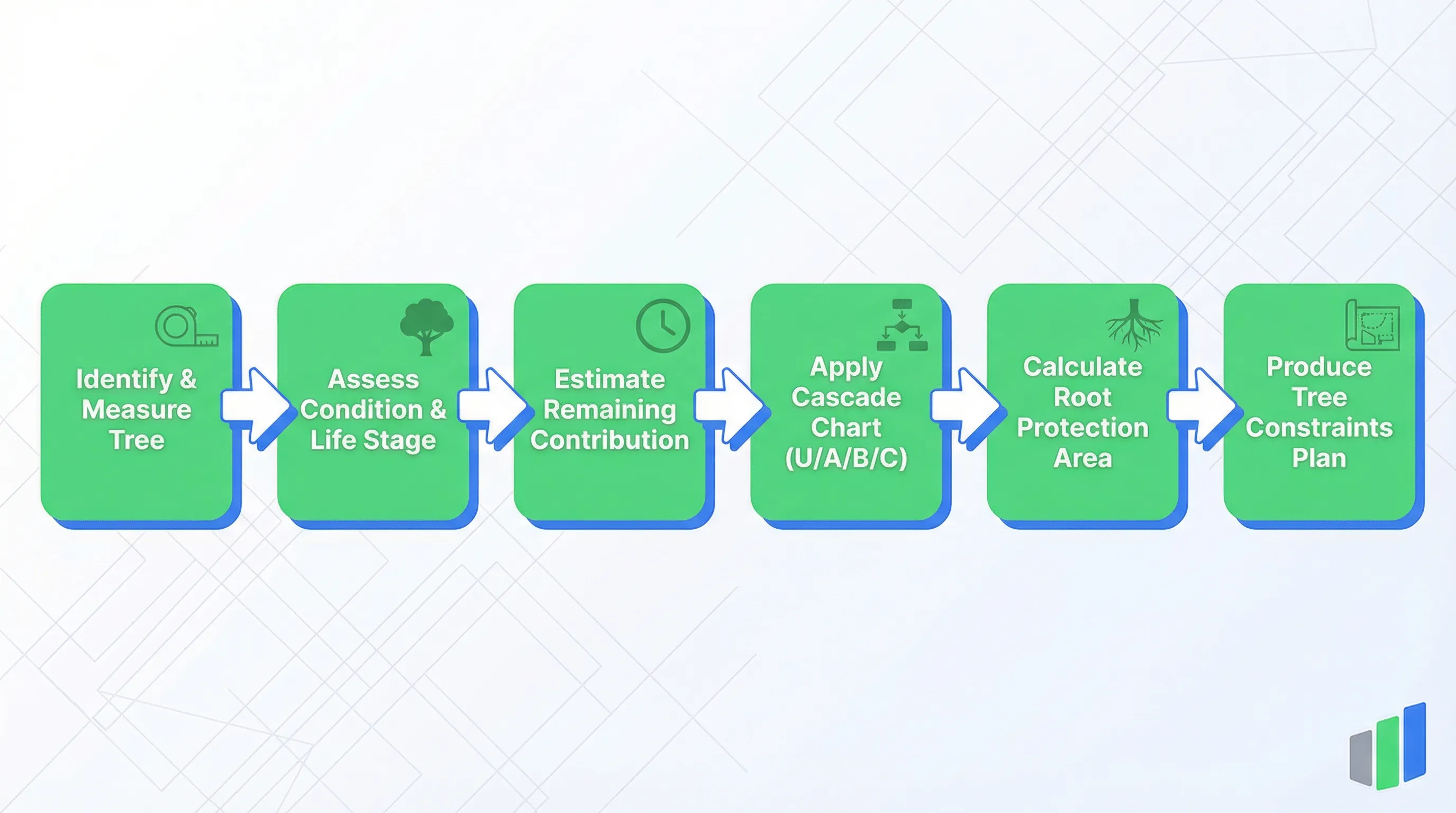
What is BS 5837?
BS 5837:2012 (Trees in Relation to Design, Demolition and Construction) is the British Standard for pre-development tree surveys in the UK planning system. It classifies trees into retention categories A, B, C, or U using the Cascade Chart and calculates Root Protection Areas from stem diameter to define construction exclusion zones.
- Full Name
- Trees in Relation to Design, Demolition and Construction -- Recommendations
- Issuing Body
- BSI (British Standards Institution)
- Current Revision
- 2012 Edition
SURVEY DATA
Survey Features, Species Identification, and Dimensional Recording
The first phase of a BS 5837 survey captures the physical geometry of every tree, group, hedge, or woodland on or adjacent to the development site.
BS 5837:2012 requires that every arboricultural feature on or adjacent to a development site is surveyed and individually referenced. The standard recognises four distinct survey feature types: Individual Tree (T), Group (G), Hedge (H), and Woodland (W). Each feature type receives a unique reference number following the convention T1, G1, H1, or W1, which persists through all subsequent plans and reports. The feature type determines how measurements are taken and how the Root Protection Area is calculated. Groups and woodlands are assessed collectively rather than tree-by-tree, which reflects the practical reality that their amenity value derives from the ensemble rather than individual specimens.
| Code | Feature Type | Description |
|---|---|---|
| T | Individual Tree | A single tree surveyed individually with its own reference, dimensions, and category grade. |
| G | Group | A cluster of trees assessed collectively; amenity value derives from the ensemble, not individuals. |
| H | Hedge | A managed linear planting of trees or shrubs, assessed for its landscape and screening function. |
| W | Woodland | A larger area of trees assessed as a whole; internal diversity and edge condition are key factors. |
Each feature receives a unique reference (e.g., T1, G3) that persists across all plans, schedules, and reports.
Dimensional recording under BS 5837 is geometrically precise. For each tree, the surveyor records stem diameter in millimeters measured at 1.5 metres above ground level (the standard Diameter at Breast Height or DBH). Height is recorded to the nearest 0.5 metres for trees under 10 metres and to the nearest metre for taller specimens. Crown spread is measured as the radius from the trunk to the dripline at four cardinal points: North, East, South, and West. This four-directional measurement captures asymmetric canopies, which are common for trees growing near buildings or at woodland edges. Crown clearance height records the lowest significant branch, along with its compass direction, which feeds into shade arc calculations and clearance assessments for vehicles and pedestrians.
For multi-stemmed trees, the standard has a specific measurement protocol. The stem count field distinguishes single from multi-stemmed specimens, and when multi-stemmed is selected, the stem diameter field becomes repeatable so that each individual stem can be measured. This is not merely for record-keeping: BS 5837 prescribes a Root Mean Square (RMS) calculation for multi-stemmed RPA, where the equivalent single-stem diameter is derived from the square root of the sum of the squares of each stem diameter. A tree with three stems of 300 mm, 250 mm, and 200 mm has an RMS-equivalent diameter of approximately 439 mm, producing a significantly larger RPA than any individual stem would suggest.
CONDITION
Condition Assessment: Life Stage, Health, and Remaining Contribution
The second phase evaluates each tree's physiological health, structural integrity, and estimated remaining contribution to determine its future potential.
BS 5837 condition assessment operates across three complementary dimensions. Life Stage classifies where the tree sits in its biological development arc, from Young through Semi-mature, Early-mature, Mature, and Over-mature to Veteran. This is not a simple age proxy: a Young tree is one still establishing and typically staked, while a Veteran tree is one of biological or cultural interest specifically because of its age-related features such as hollows, deadwood habitats, and bark complexity. The distinction between Early-mature and Mature matters for RPA: an Early-mature tree is reaching full height but still vigorously growing, meaning its root system is still expanding, whereas a Mature tree has stabilised its crown and root extent.
| Life Stage | Description |
|---|---|
| Young | Establishing, usually staked or recently planted. Root system still developing. |
| Semi-mature | Established and growing fast, but not yet at full height or crown spread. |
| Early-mature | Reaching full height, still vigorous. Root system still expanding. |
| Mature | Full height and crown spread achieved; vigorous but growth rate slowing. |
| Over-mature | Crown retrenching, vitality declining. May have significant habitat features. |
| Veteran | Tree of biological or cultural interest due to age-related features such as hollows and deadwood. |
Life stage informs the Estimated Remaining Contribution: Veterans and Over-mature trees may still qualify for Category A if their cultural or habitat value warrants a 40+ year ERC.
Physiological Condition captures the tree's biological health as Good, Fair, Poor, or Dead. A Good rating indicates normal foliage density, colour, and shoot extension for the species and season. Fair describes trees with noticeable but non-critical reduction in vigour, such as partial crown thinning or minor dieback. Poor identifies trees with severe vitality decline, often linked to root damage, disease, or prolonged drought stress. Dead is self-explanatory but important because a dead tree that is still standing has no future contribution yet may pose an immediate safety risk. In the form, the inspector selects from these four options in the Physiological Condition field, providing a rapid but standardised assessment that feeds directly into the Cascade Chart categorisation.
Structural Condition assesses the tree's physical stability as Good, Fair, Poor, or Hazardous. Good indicates sound architecture with no significant structural defects. Fair describes trees with manageable defects such as minor cavities, included bark unions, or remedial pruning wounds. Poor identifies trees with significant structural compromise, such as extensive decay, major lean, or large cavity openings. Hazardous marks trees posing an imminent risk of failure. The structural assessment is independent of the physiological one: a tree can be physiologically Good (full canopy, vigorous growth) yet structurally Poor (large basal cavity), or physiologically Poor (severe dieback) yet structurally Good (sound trunk architecture).
The Estimated Remaining Contribution (ERC) is the most consequential single field in the entire survey because it directly gates category eligibility. BS 5837 defines four thresholds: less than 10 years, 10+ years, 20+ years, and 40+ years. A tree with less than 10 years of remaining contribution is automatically Category U (Unsuitable for retention). Category A (High Quality) requires at least 40 years. Category B (Moderate Quality) requires at least 20 years. Category C (Low Quality) requires at least 10 years. The ERC is a professional judgement informed by species longevity, current condition, site factors, and management history. It is not a prediction of how long the tree will live, but an estimate of how long it will meaningfully contribute to the site's character.
Try this BS 5837 form in Geocadra
We have a pre-built BS 5837 inspection template ready to go. Sign up and start your first condition assessment today.
Free 14-day trial. No credit card required.
CASCADE CHART
The Cascade Chart: BS 5837 Retention Category Classification
The Cascade Chart is the central decision engine of BS 5837. It translates survey data into a retention category that directly influences the planning outcome for each tree.
The BS 5837 Cascade Chart is the most referenced element of the standard and the primary tool that local planning authorities use when evaluating arboricultural impact assessments. It classifies every surveyed feature into one of four retention categories: U (Unsuitable for retention), A (High Quality), B (Moderate Quality), or C (Low Quality). The classification is not a simple scoring exercise. It follows a hierarchical decision process that the standard calls a "cascade" because each category has gateway criteria that must be satisfied before the tree can enter the subcategory evaluation.
Category U acts as the first filter. Any tree whose condition is such that it cannot realistically be retained as a living tree for longer than 10 years in the context of the current land use is placed in Category U, regardless of species, size, or amenity value. This includes dead trees, trees with irreversible structural failure, and trees where the Estimated Remaining Contribution is less than 10 years. Category U trees are typically shown in dark red on the Tree Constraints Plan and are recommended for removal irrespective of the development proposal. A critical nuance is the phrase "in the context of the current land use": a tree that is Category U on a busy street (where its lean poses a hazard) might not be Category U in a remote woodland setting.
| Category | Quality | Colour Code | ERC Threshold | Key Criteria |
|---|---|---|---|---|
| U | Unsuitable for retention | Dark Red | <10 years | Cannot realistically be retained as a living tree in the context of the current land use. |
| A | High Quality | Light Green | 40+ years | Exceptional specimens, essential landscape components, or significant conservation/historical value. |
| B | Moderate Quality | Mid Blue | 20+ years | Trees with impaired condition (remediable), distinct landscape features, or moderate cultural benefit. |
| C | Low Quality | Grey | 10+ years | Unremarkable trees, limited merit, or young trees with stem diameter below 150 mm. |
Categories A, B, and C must be further qualified by at least one subcategory: 1 (Arboricultural), 2 (Landscape), or 3 (Cultural/Conservation).
Trees that pass the Category U filter enter the quality classification. Category A (High Quality) requires an Estimated Remaining Contribution of at least 40 years and at least one qualifying subcategory. Subcategory 1 (Arboricultural) applies to trees that are good examples of their species, have rare or unusual form, or demonstrate exceptional vitality. Subcategory 2 (Landscape) applies to trees that form essential components of formal features, avenues, or groups with significant visual amenity. Subcategory 3 (Cultural) covers trees with conservation, historical, or commemorative value, such as ancient woodland indicators or trees linked to historical events. Category B (Moderate Quality) requires a 20+ year ERC and applies the same three subcategories at a reduced threshold. Category C (Low Quality) requires a 10+ year ERC and covers unremarkable trees, those with limited individual merit, or young trees with a stem diameter below 150 mm.
The subcategory system is what gives the Cascade Chart its nuance. A tree must qualify under at least one subcategory (1, 2, or 3) to receive a Category A, B, or C grade. A tree can qualify under multiple subcategories simultaneously. For instance, an ancient oak might be Category A with subcategories 1 (exceptional specimen), 2 (dominant landscape feature), and 3 (historical boundary marker). The subcategory assignment is recorded in the form via three boolean toggles, ensuring that the arboriculturist explicitly documents the basis for the category grade. This transparency is critical for planning officers who must weigh the category against the development proposal.
ROOT PROTECTION
Root Protection Area: Calculating the Construction Exclusion Zone
The Root Protection Area (RPA) is the spatial output of the BS 5837 survey that directly constrains site layout and construction methodology.
The Root Protection Area (RPA) is the minimum area around a retained tree that must remain undisturbed to ensure the tree's long-term viability. BS 5837 defines the RPA as a circle with a radius equal to 12 times the stem diameter, expressed in metres. For a tree with a stem diameter of 500 mm, the RPA radius is 6.0 metres, yielding a circular area of approximately 113 square metres. The standard caps the RPA radius at 15 metres (corresponding to a stem diameter of 1,250 mm or greater), which produces a maximum RPA area of approximately 707 square metres.
The calculation is straightforward for single-stemmed trees: RPA radius (m) = stem diameter (mm) x 0.012. For multi-stemmed trees, BS 5837 prescribes a Root Mean Square method. The surveyor measures each stem at 1.5 metres above ground, squares each diameter, sums the squares, and takes the square root to derive the equivalent single-stem diameter. This equivalent diameter then feeds into the standard 12x multiplier. The RMS method recognises that a multi-stemmed tree with several moderate stems has a larger combined root system than any individual stem would suggest. In the digital form, the stem diameter field is repeatable when the Stem Count is set to Multi-stemmed, allowing each stem to be measured individually while the RPA is calculated automatically.
While the default RPA is circular, BS 5837 acknowledges that site constraints may require modifications to the RPA shape. Where existing hard surfaces, buildings, or infrastructure demonstrably prevent root growth in a particular direction, the arboriculturist may modify the RPA to a non-circular shape provided the total area is maintained. The RPA Shape Modification Notes field in the form captures the justification for any such adjustment. Common scenarios include trees against boundary walls where roots cannot extend beyond the wall, street trees where road construction has historically restricted root growth, and trees adjacent to deep basements. Any modification must be justified by site evidence, not by development convenience.
The RPA translates directly onto the Tree Constraints Plan (TCP), which is one of the mandatory documents accompanying a planning application where trees are affected. The TCP shows every surveyed tree plotted to scale with its RPA displayed as a shaded circle (or modified shape). Category A trees are shown in green, Category B in blue, Category C in grey, and Category U in dark red. The TCP allows the design team to visualise the spatial constraints before committing to a site layout, and the planning authority to verify that retained trees will not be compromised by construction activity, level changes, or service runs within the RPA.
BS 5837:2012 is published by the British Standards Institution (BSI). For professional guidance on arboricultural surveys and tree reports, the Arboricultural Association provides practitioner resources and accreditation pathways.
For German tree inspection covering traffic safety obligations, see the FLL Baumkontrolle tree inspection guide. For biomechanical tree assessment using the body language of trees, see the VTA Mattheck tree assessment guide. Explore all available inspection standards in the standards library.
QUESTIONS
Frequently Asked Questions
What is BS 5837?
BS 5837:2012 (Trees in Relation to Design, Demolition and Construction) is the British Standard that provides recommendations for surveying trees on development sites. It defines a methodology for recording species, dimensions, and condition, then classifying trees into retention categories (U, A, B, or C) and calculating Root Protection Areas to inform design and planning decisions.
How is the BS 5837 retention category determined?
The retention category is determined through the Cascade Chart. Trees are first assessed for Category U (unsuitable for retention if their remaining contribution is under 10 years). Surviving trees are graded A (High, 40+ years ERC), B (Moderate, 20+ years), or C (Low, 10+ years) and qualified by subcategories for arboricultural merit, landscape value, or cultural significance.
How is the Root Protection Area (RPA) calculated?
The RPA is calculated as a circle with radius equal to 12 times the stem diameter in metres. For a 400 mm stem, the radius is 4.8 m (area approximately 72 m2). For multi-stemmed trees, a Root Mean Square of all stem diameters is used. The maximum RPA radius is capped at 15 m, yielding a maximum area of approximately 707 m2.
Is a BS 5837 survey legally required for planning applications?
BS 5837 surveys are not a statutory legal requirement, but the vast majority of UK local planning authorities request them as a condition of valid planning applications when trees are present on or adjacent to a development site. National Planning Policy Framework guidance and local tree protection policies make BS 5837 compliance effectively mandatory in practice.
What is the difference between BS 5837 and a tree risk assessment?
BS 5837 is a pre-development survey focused on tree quality, retention value, and spatial constraints for design. A tree risk assessment (such as QTRA or ISA TRAQ) evaluates the probability of tree failure and the consequences of that failure for people or property. BS 5837 informs planning decisions; risk assessments inform safety management.
What qualifications are needed to conduct a BS 5837 survey?
BS 5837 surveys should be conducted by a qualified arboricultural consultant. Most planning authorities expect the surveyor to hold professional membership of the Arboricultural Association or equivalent body, with relevant qualifications such as a degree in arboriculture or forestry, or Technician Certificate in Arboriculture (TechArborA).
What are the BS 5837 subcategories?
Each retention category (A, B, or C) must be qualified by at least one subcategory. Subcategory 1 (Arboricultural) relates to the tree as a specimen of its species. Subcategory 2 (Landscape) relates to its visual or spatial contribution. Subcategory 3 (Cultural/Conservation) relates to historical, commemorative, or ecological value. A tree may qualify under multiple subcategories.
In practice
See how the round runs in Geocadra
The solution page shows this inspection regime on real open data: the import, the form, the round, the record per asset and the export.
Regular tree checks, biotope mapping and ecological surveys on a map, with every visit appended to the tree or the siteOpen the solution page: Trees, Habitats & EcologyTRY IT FREE
Digitize your BS 5837 inspections
Replace paper forms and spreadsheets with structured digital inspections, built for standards like BS 5837.
No credit card requiredFree trial included