ISA TRAQ Tree Risk Assessment
The international standard for systematic tree risk assessment based on ANSI A300 Part 9.
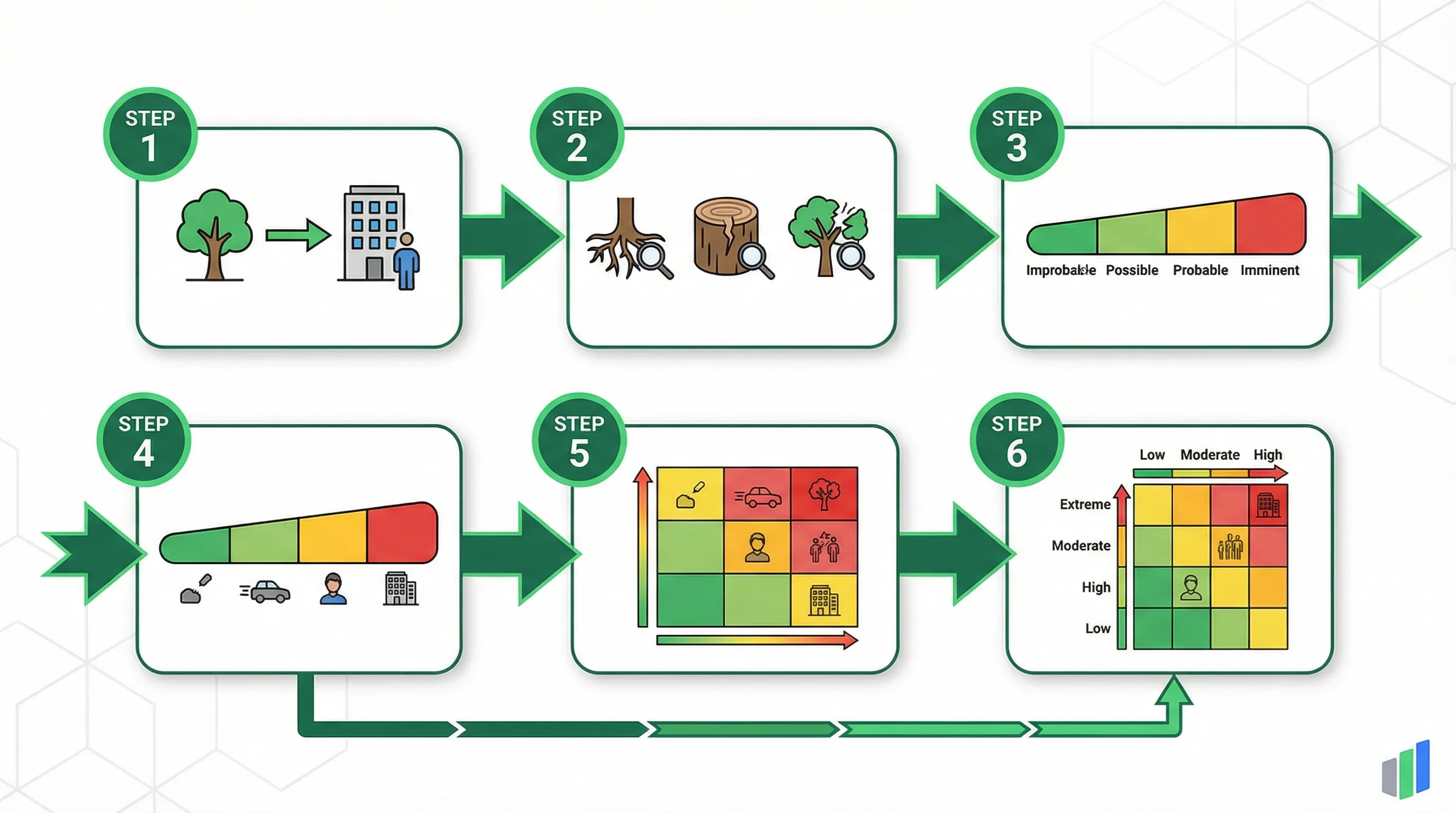
ISA TRAQ is the leading methodology for tree risk assessment in North America and increasingly worldwide. It provides a structured, repeatable framework that transforms subjective arboricultural judgment into a standardized risk rating. The assessor identifies structural defects across roots, trunk, and crown, evaluates site and environmental factors, then runs each condition of concern through a dual-matrix system that combines likelihood of failure, likelihood of impact, and consequences of failure. The output is a defensible risk rating — Low, Moderate, High, or Extreme — for each tree part and target combination.
What is ISA TRAQ?
ISA TRAQ (Tree Risk Assessment Qualification) is the internationally recognized methodology for evaluating tree risk based on ANSI A300 Part 9. It combines likelihood of failure, likelihood of impact, and consequences through a dual-matrix system to produce a final risk rating of Low, Moderate, High, or Extreme.
- Full Name
- Tree Risk Assessment Qualification (ANSI A300 Part 9)
- Issuing Body
- International Society of Arboriculture (ISA)
- Current Revision
- ANSI A300 Part 9 — 2017
RISK MATRIX
How the Dual-Matrix System Determines Risk
ISA TRAQ uses two sequential matrices — the first combines failure and impact likelihood, the second combines that result with consequences to produce the final risk rating.
The ISA TRAQ methodology is built around a two-step matrix calculation that is unique among tree assessment standards. Unlike simpler pass/fail or single-score systems, TRAQ separates the risk equation into distinct, independently evaluated components before combining them. This separation is deliberate: it forces the assessor to consider each factor on its own merits rather than jumping directly to an overall impression, reducing cognitive bias and improving consistency across different assessors.
Matrix 1 takes two inputs: the Likelihood of Failure (Improbable, Possible, Probable, or Imminent) and the Likelihood of Impact (Very Low, Low, Medium, or High). The intersection produces a combined likelihood output of Unlikely, Somewhat Likely, Likely, or Very Likely. For example, a tree part rated as Probable to fail with a High likelihood of hitting its target produces a combined result of Likely. But that same Probable failure with a Very Low impact likelihood drops to Unlikely — reflecting the reality that a tree in a remote area poses less risk than one overhanging a playground, even if the structural condition is identical.
| Likelihood of Failure | Very Low Impact | Low Impact | Medium Impact | High Impact |
|---|---|---|---|---|
| Imminent | Unlikely | Somewhat Likely | Likely | Very Likely |
| Probable | Unlikely | Unlikely | Somewhat Likely | Likely |
| Possible | Unlikely | Unlikely | Unlikely | Somewhat Likely |
| Improbable | Unlikely | Unlikely | Unlikely | Unlikely |
Matrix 1 combines likelihood of structural failure with likelihood of the failed part striking the identified target.
Matrix 2 then takes the Matrix 1 output and crosses it with the Consequences of Failure (Negligible, Minor, Significant, or Severe). The intersection produces the final Risk Rating: Low, Moderate, High, or Extreme. A Very Likely combined likelihood with Severe consequences yields an Extreme rating, while that same Very Likely result with Negligible consequences produces only a Low rating. This two-step approach ensures that risk is never conflated with hazard alone — a structurally compromised tree with no target is still a low-risk tree.
| Combined Likelihood | Negligible | Minor | Significant | Severe |
|---|---|---|---|---|
| Very Likely | Low | Moderate | High | Extreme |
| Likely | Low | Moderate | High | High |
| Somewhat Likely | Low | Low | Moderate | Moderate |
| Unlikely | Low | Low | Low | Low |
Matrix 2 crosses the combined likelihood from Matrix 1 with the consequences of failure to determine the final risk rating.
RATING SCALES
Likelihood of Failure and Impact Scales
TRAQ defines precise criteria for each likelihood level — precise language is legally critical because tree risk assessments are frequently cited in liability proceedings.
The Likelihood of Failure scale is the assessor's judgment of whether a specific tree part will structurally fail within the defined assessment time frame. ISA TRAQ defines four levels with very specific language that has been refined through legal and technical review. Improbable means the tree or branch is not likely to fail during normal weather and may not fail even in many severe weather events. Possible means failure could occur but is unlikely under normal weather. Probable means failure may be expected under normal weather conditions. Imminent means failure has already started or is most likely to occur in the near future, even without significant wind or load increase.
The distinction between Probable and Imminent is particularly important in practice. A tree rated as Probable is expected to fail eventually within the time frame — perhaps a large branch with significant decay that will come down in the next major storm. Imminent means the failure process is already underway — visible separation, active root plate lifting, or a trunk crack that has opened further since the last inspection. The Imminent rating typically triggers immediate action regardless of the target or consequence analysis.
| Rating | Definition | Typical Indicators |
|---|---|---|
| Improbable | Not likely to fail during normal weather; may not fail in many severe weather conditions | Sound wood, minor included bark, no visible decay |
| Possible | Failure could occur but is unlikely during normal weather | Early-stage decay, moderate codominant stems, partial root damage |
| Probable | Failure may be expected under normal weather conditions | Significant cavity, heavy lean with soil cracking, advanced decay |
| Imminent | Failure has started or is most likely to occur in the near future | Active root plate lifting, open trunk crack, visibly separating union |
All likelihood ratings are tied to the assessment time frame selected at the start of the inspection (6 months, 1 year, 3 years, or 5 years).
The Likelihood of Impact scale evaluates whether, once a tree part fails, it will actually strike the identified target. This depends on the target's location relative to the tree, the direction of likely failure, and the target's occupancy rate. In the form, the assessor selects from four levels: Very Low (chance of impact is remote), Low (impact is not likely), Medium (impact could occur but is not expected), and High (the failed part is likely to impact the target). A dead branch directly overhanging a park bench with constant occupancy warrants a High impact likelihood, while the same branch pointing away from the bench over an empty field warrants a Very Low rating.
Try this ISA TRAQ form in Geocadra
We have a pre-built ISA TRAQ inspection template ready to go. Sign up and start your first condition assessment today.
Free 14-day trial. No credit card required.
DEFECT CHECKLIST
Structural Defect Assessment by Tree Zone
The TRAQ defect checklist organizes the visual inspection by tree zone — roots, trunk, and crown — with specific defect indicators for each.
The structural defect assessment is the core data-capture phase of a TRAQ Level 2 Basic Assessment. The assessor performs a 360-degree ground-based visual inspection, systematically examining three zones of the tree: the root zone and root collar, the trunk, and the crown and branches. Each zone has a defined set of defect indicators drawn from the ANSI A300 Part 9 standard and the ISA Best Management Practices for Tree Risk Assessment.
Root zone assessment begins with a fundamental question captured in the form as a boolean field: is the root collar visible? A buried root collar prevents the assessor from evaluating the most structurally critical zone of the tree, where decay pathogens most commonly enter and where stem girdling roots can compromise the tree's structural anchorage. When the root collar is buried, the assessor must note this limitation and may recommend excavation (root collar examination) as a follow-up. Root defects tracked in the form include decay, conks or mushrooms (fruiting bodies of wood-decay fungi), stem girdling roots, root plate lifting, and cracks. Root plate lifting is an especially critical finding because it indicates active uprooting — the soil on the side opposite the lean is visibly separating, and failure may be imminent.
Trunk defects represent the next zone of inspection. The form captures codominant stems (multiple leaders competing for dominance), included bark (bark trapped in the union of codominant stems, creating a structural weakness), cavities and nest holes, decay, and lean. Codominant stems with included bark is one of the most common high-risk structural defects in urban trees because the bark acts as a wedge preventing the stems from forming a strong union. The assessor also evaluates whether a trunk lean is natural (the tree grew that way) or acquired (recent tilt, often with soil cracking on the opposite side), which dramatically changes the risk assessment.
Crown and branch defects complete the inspection. Dead branches, broken branches or hangers (partially detached branches caught in the canopy), weak attachments, overextended branches, and crown dieback are all documented. Dead branches above a certain diameter threshold are among the most predictable failure modes — they will eventually fall, making the Likelihood of Failure assessment relatively straightforward. Crown dieback, where the outer canopy is receding, often indicates systemic decline that affects the tree's overall structural resilience. For more detailed tree assessments focused on biological vitality rather than risk, the complementary VTA (Visual Tree Assessment) methodology provides a deeper decay-focused approach.
TARGET ANALYSIS
Target Identification and Occupancy Assessment
Risk exists only when a tree can hit something of value — the target assessment determines what is at stake and how often it is exposed.
A fundamental principle of ISA TRAQ is that a defective tree without a target is not a high-risk tree. A massive oak with extensive basal decay in the middle of an uninhabited forest is a low-risk tree; the same oak overhanging a school playground is potentially extreme-risk. The target assessment is what separates hazard assessment (how likely is the tree to fail?) from risk assessment (what are the consequences if it does?). The form captures three key elements for each target: what it is, how often it is occupied, and what the consequences of a strike would be.
The Target Description field allows the assessor to describe the target in plain language — a single-family home, a playground, a heavily traveled sidewalk, a parked vehicle, or a park bench. The Target Occupancy Rate is a critical input that directly feeds into the Likelihood of Impact calculation. The form provides four levels: Rare (the zone is not commonly used), Occasional (infrequent or irregular use), Frequent (the target area is used for a large portion of the day or week), and Constant (present nearly 24/7, such as an occupied building or a major arterial road). A dead branch overhanging a bench in a busy city park has a fundamentally different risk profile than the same branch over a bench on a rarely visited nature trail.
Because a single tree can threaten multiple targets simultaneously, the TRAQ form's Risk Analysis section is repeatable. The assessor can create separate risk calculations for each tree part and target combination. A tree with a dead branch over a sidewalk and basal decay threatening an adjacent building generates two distinct risk assessments — one for the branch-sidewalk combination and one for the trunk-building combination. The Overall Tree Risk Rating is then set to the highest individual risk rating found among all combinations, ensuring that the final classification reflects the worst-case scenario. This repeatable structure is captured in the form through the Conditions of Concern group, which supports multiple instances. For a broader overview of available tree and infrastructure inspection standards, visit the standards library.
RISK RATINGS
Final Risk Rating and Mitigation
The overall tree risk rating drives the response — from routine monitoring for Low-risk trees to immediate action for Extreme-risk trees.
The Risk Rating is the final output of the TRAQ dual-matrix system. Each condition of concern receives its own risk rating, and the Overall Tree Risk Rating reflects the highest rating among all evaluated conditions. ISA TRAQ defines four risk levels: Low, Moderate, High, and Extreme. A Low rating means consequences are negligible or failure is improbable — the tree can remain in place with normal monitoring cycles. Moderate indicates that consequences are minor to significant but likelihood is relatively low — enhanced monitoring or minor mitigation may be appropriate. High means failure is likely with significant consequences — targeted intervention such as pruning, cabling, or bracing is typically recommended within a defined time frame.
An Extreme rating indicates that failure is imminent with severe consequences — this triggers immediate action, which may include area restriction, emergency pruning, or tree removal. In practice, Extreme ratings are relatively rare but carry significant legal weight. A documented Extreme rating that is not acted upon creates substantial liability exposure. This is why ISA TRAQ emphasizes precise terminology: the legal difference between "Probable" and "Imminent" failure can determine liability outcomes in court proceedings, and the standard was developed with this legal context in mind.
| Rating | Description | Typical Response |
|---|---|---|
| Low | Consequences are negligible or failure is improbable. No immediate action required. | Routine monitoring at standard intervals |
| Moderate | Consequences are minor to significant but likelihood is somewhat likely or unlikely. | Enhanced monitoring, minor mitigation, re-assess at shorter interval |
| High | Failure is likely or very likely with significant consequences, or probable with severe consequences. | Targeted intervention: prune, cable/brace, or remove within defined time frame |
| Extreme | Failure is imminent with severe consequences. Immediate action required. | Emergency response: restrict area, emergency pruning, or removal |
The overall tree risk rating is set to the highest individual risk rating found among all evaluated tree part and target combinations.
The Mitigation Actions field allows the assessor to recommend specific interventions — pruning, removal, cable and brace installation, target relocation, access restriction, or continued monitoring. Once mitigation is proposed, the assessor can record a Residual Risk rating that estimates the risk level after the recommended work is completed. This before-and-after documentation is valuable for both asset management planning and liability protection. The standard maintained by the International Society of Arboriculture (ISA) provides certification programs that validate an assessor's competency with the TRAQ methodology.
QUESTIONS
Frequently Asked Questions
What is ISA TRAQ?
ISA TRAQ (Tree Risk Assessment Qualification) is the internationally recognized methodology for systematically evaluating tree risk. Based on ANSI A300 Part 9, it uses a dual-matrix system combining likelihood of failure, likelihood of impact, and consequences to produce a final risk rating of Low, Moderate, High, or Extreme.
How is the ISA TRAQ risk rating calculated?
The risk rating is calculated through two sequential matrices. Matrix 1 combines Likelihood of Failure (Improbable to Imminent) with Likelihood of Impact (Very Low to High) to produce a combined likelihood. Matrix 2 crosses that combined likelihood with Consequences (Negligible to Severe) to produce the final rating of Low, Moderate, High, or Extreme.
What is the difference between Probable and Imminent failure in TRAQ?
Probable means failure may be expected under normal weather conditions within the assessment time frame. Imminent means failure has already started or is most likely to occur in the near future, even without significant wind or load. Imminent typically triggers immediate action regardless of other factors.
What qualifications are needed to perform a TRAQ assessment?
ISA offers the Tree Risk Assessment Qualification (TRAQ) credential, which requires ISA Certified Arborist status and completion of a TRAQ course including a field component. The qualification validates competency in applying the ANSI A300 Part 9 methodology and must be renewed periodically.
What is the difference between a Level 1, Level 2, and Level 3 tree risk assessment?
Level 1 is a limited visual assessment, often a walk-by or drive-by survey of large populations. Level 2 is a basic assessment — a 360-degree ground-based visual inspection of individual trees, which is what the TRAQ form implements. Level 3 is an advanced assessment using specialized equipment such as resistographs, sonic tomography, or aerial inspection.
How does target occupancy affect the TRAQ risk rating?
Target occupancy directly influences the Likelihood of Impact rating. A target with Constant occupancy (present nearly 24/7) results in a higher impact likelihood than one with Rare occupancy. This means a structurally identical tree over a busy sidewalk receives a higher risk rating than one over a rarely visited trail.
Is ISA TRAQ used outside North America?
Yes. While ANSI A300 Part 9 is a North American standard, the ISA TRAQ methodology is recognized and used globally, including in the United Kingdom, Australia, and New Zealand. Many international arboricultural organizations reference or adapt the TRAQ framework for their own tree risk management programs.
In practice
See how the round runs in Geocadra
The solution page shows this inspection regime on real open data: the import, the form, the round, the record per asset and the export.
Regular tree checks, biotope mapping and ecological surveys on a map, with every visit appended to the tree or the siteOpen the solution page: Trees, Habitats & EcologyTRY IT FREE
Digitize your ISA TRAQ inspections
Replace paper forms and spreadsheets with structured digital inspections, built for standards like ISA TRAQ.
No credit card requiredFree trial included