CSA Z614 Playground Safety
The Canadian national standard for systematic playground equipment and surfacing safety inspection.
CSA Z614 is Canada's primary regulatory framework for the design, installation, maintenance, and inspection of public-use playground equipment and protective surfacing. Published by the CSA Group and supported by the Canadian Playground Safety Institute (CPSI), the standard defines three inspection levels -- visual, detailed, and comprehensive -- each with increasing scope and documentation requirements. Rather than eliminating all risk, CSA Z614 focuses on preventing life-threatening and debilitating injuries such as head entrapment, entanglement, and falls onto inadequate surfacing. The standard produces equipment condition ratings from 1 (Excellent) to 5 (Critical) and classifies identified hazards using the industry-standard A-B-C priority system that drives maintenance response timelines across Canadian municipalities and school districts.
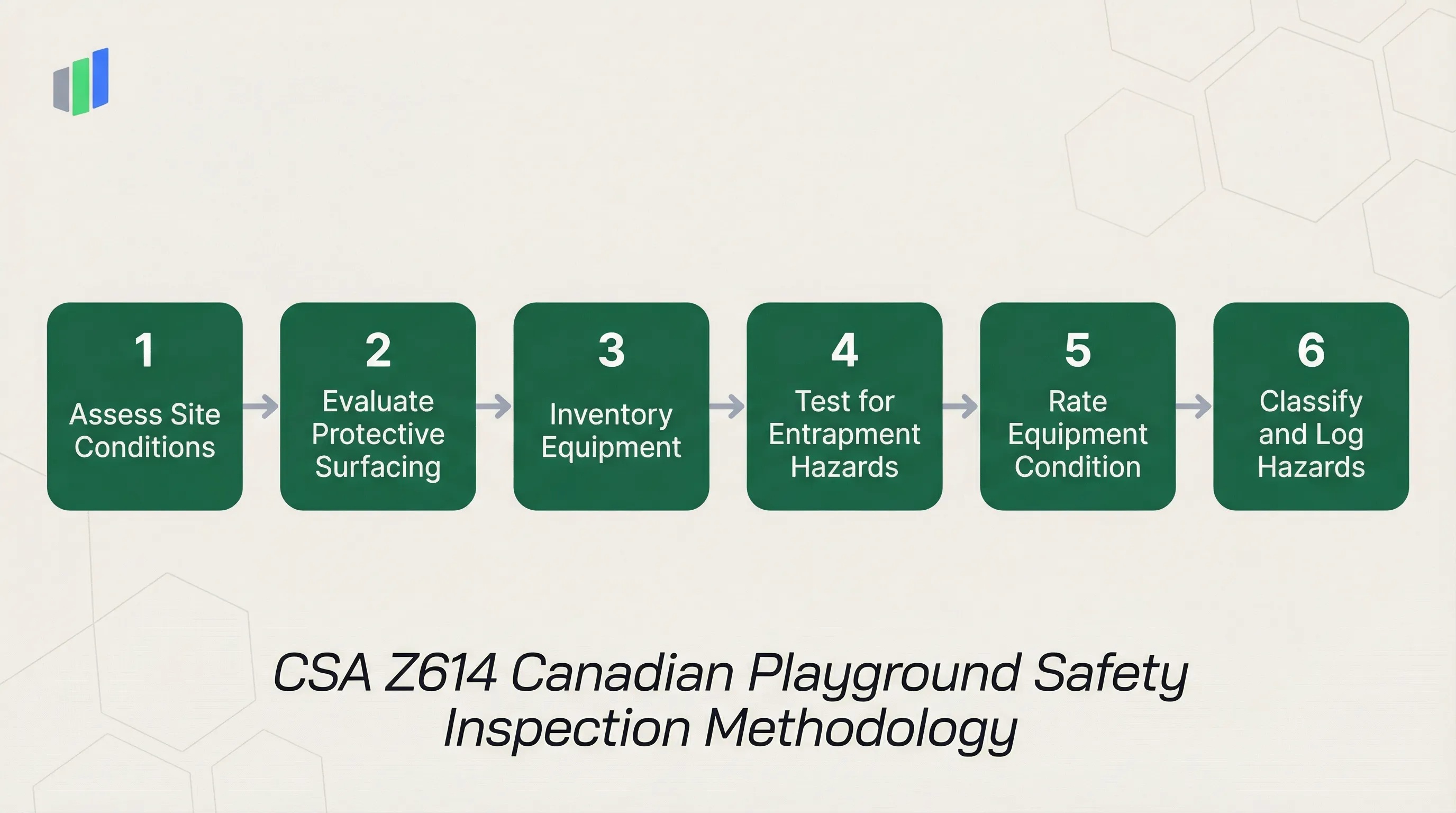
What is CSA Z614?
CSA Z614 (Children's Playground Equipment and Surfacing) is the Canadian national standard for playground safety inspection. Inspectors assess equipment condition on a 1-to-5 scale and classify hazards as Class A (life-threatening), Class B (serious), or Class C (minor) to prioritize corrective action across three inspection levels.
- Full Name
- Children's Playground Equipment and Surfacing (CSA Z614:20)
- Issuing Body
- CSA Group (Canadian Standards Association)
- Current Revision
- CSA Z614:20
INSPECTION LEVELS
Three Levels of Playground Inspection Under CSA Z614
CSA Z614 and the CPSI methodology define three distinct inspection tiers, each with increasing scope, documentation depth, and required competency.
CSA Z614 recognizes that playground safety cannot be maintained through a single inspection approach. The standard defines three inspection levels, each designed for a different frequency and depth of assessment. The Visual Inspection (Daily/Weekly) is a quick walk-through intended to catch obvious hazards such as broken glass, vandalism, missing components, and standing water. This level requires no specialized instruments and can be performed by trained maintenance staff. Its primary purpose is rapid hazard identification so that life-threatening conditions are caught before children use the equipment.
The Detailed Inspection (Monthly/Seasonal) examines wear patterns, hardware tightness, structural stability, and surfacing depth. At this level, the inspector physically tests moving parts, checks for loose bolts and protruding hardware, and verifies that protective surfacing has not compacted or displaced below minimum depth thresholds. Seasonal timing is important in Canadian climates, where freeze-thaw cycles can loosen footings, crack rubber surfaces, and compact engineered wood fiber. The Comprehensive Audit (Annual/Prior-to-Use) is the most thorough assessment level. It verifies full compliance with CSA Z614, including entrapment probe testing with standardized gauges, fall height measurement against surfacing critical height ratings, and a complete structural integrity evaluation. The comprehensive audit is typically performed by a Canadian Certified Playground Inspector (CCPI) and produces a formal compliance report. A post-installation inspection follows the same scope as the comprehensive audit and is required before any new or modified equipment is opened to the public.
For the related US playground safety framework, see the ASTM F1487 playground standard.
CONDITION RATING
Equipment Condition Rating Scale (1 to 5)
Each piece of playground equipment receives an overall condition rating from 1 (Excellent) to 5 (Critical) that quantifies its physical state independent of immediate safety hazards.
The CSA Z614 equipment condition rating is a five-point scale that captures the overall physical state of each play structure or standalone equipment item. Unlike the hazard classification system, which addresses immediate safety risks, the condition rating reflects long-term asset health and informs capital replacement planning. A rating of 1 (Excellent) indicates new or like-new equipment with no visible wear. A rating of 2 (Good) describes equipment with minor cosmetic wear such as faded paint or superficial scratches, but fully functional with no repairs needed. A rating of 3 (Fair) signals moderate wear where the equipment remains functional but preventative maintenance is recommended. Typical Fair conditions include worn bearings on swings, minor surface rust on metal components, and check cracking on wooden elements.
| Rating | Condition | Description | Action Required |
|---|---|---|---|
| 1 | Excellent | New or like-new; no visible wear | None |
| 2 | Good | Minor cosmetic wear; fully functional | None / Routine monitoring |
| 3 | Fair | Moderate wear; functional but maintenance recommended | Preventative maintenance |
| 4 | Poor | Significant wear or corrosion; near end of life | Repair required |
| 5 | Critical | Structural failure imminent or present | Immediate removal / Replacement |
Condition ratings assess long-term asset health. Immediate safety hazards are classified separately using the A-B-C hazard priority system.
A rating of 4 (Poor) indicates significant wear or corrosion that places the equipment near end of life. At this level, repair is required to maintain safe operation, and the inspector should cross-reference the defect log to ensure all associated hazards are documented with appropriate priority classes. A rating of 5 (Critical) means structural failure is imminent or already present, and the equipment requires immediate removal from service or complete replacement. In the inspection form, each equipment entry captures the condition rating alongside the equipment type, age range design (Toddler, Child, or All Ages), manufacturer, and asset identification code. This combination allows municipalities to track deterioration trends per equipment type and manufacturer over successive inspection cycles, supporting data-driven procurement decisions.
HAZARD CLASSIFICATION
The A-B-C Hazard Priority System (CPSI/CSA)
Every identified hazard is classified into one of three priority classes that determine the urgency and type of corrective action required.
The A-B-C hazard classification system is the cornerstone of Canadian playground risk management. Used by Canadian Certified Playground Inspectors and adopted across municipal, school board, and childcare facility inspection programs, this three-tier priority system translates inspection findings into actionable maintenance timelines. Class A (Life Threatening) designates conditions with the potential to cause permanent disability, loss of life, or loss of a body part. Head and neck entrapment in openings between 89 mm and 230 mm, severe structural rot on load-bearing members, and missing rungs on elevated climbers are typical Class A findings. The required response is immediate: the equipment must be removed from service by taping off, dismantling, or physically barricading until the hazard is corrected.
| Class | Severity | Response Time | Examples |
|---|---|---|---|
| A | Life Threatening | Immediate (remove from service) | Head entrapment, severe structural rot, missing elevated components |
| B | Serious | ASAP (24–48 hours) | Protruding bolts, inadequate surfacing, sharp edges, crush points |
| C | Minor | Monitor / Schedule | Missing labels, cosmetic damage, minor drainage issues |
Class A hazards require equipment to be removed from service until corrected. Class B and C timelines depend on municipal maintenance policies and available resources.
Class B (Serious) covers conditions that could cause a serious injury resulting in temporary disability. Protruding bolts extending more than two threads, inadequate surfacing depth below the required minimum, sharp edges created by metal fatigue or vandalism, and crush or shear points in moving equipment are classified as Class B. The expected response is repair as soon as possible, typically within 24 to 48 hours through the regular maintenance cycle. Class C (Minor) captures conditions that may cause minor, non-disabling injury or represent a technical non-compliance with CSA Z614 without creating an immediate risk. Missing age-range labels, cosmetic damage, minor drainage issues, and S-hooks that are closed but slightly worn fall into Class C. These items are monitored and scheduled for repair when resources permit. In the digital form, the inspector selects the hazard class for each defect entry alongside the recommended action, which ranges from Monitor and Tighten/Adjust through Repair Part, Replace Part, Remove Equipment Immediately, and Top-up Surfacing.
Try this CSA Z614 form in Geocadra
We have a pre-built CSA Z614 inspection template ready to go. Sign up and start your first condition assessment today.
Free 14-day trial. No credit card required.
PROTECTIVE SURFACING
Protective Surfacing Assessment (CSA Z614 Clause 10)
Protective surfacing is the single most critical safety element on a playground, and CSA Z614 Clause 10 defines specific requirements for material type, depth, coverage zone, and impact attenuation.
Falls are the leading cause of playground injuries in Canada, and the protective surfacing system is the primary defense against serious fall-related trauma. CSA Z614 Clause 10 requires that impact-attenuating surfacing extend a minimum of 1.8 meters in all directions from the perimeter of any equipment with a fall height. The standard recognizes eight surfacing system types, each with different installation requirements, maintenance characteristics, and critical height ratings. Engineered Wood Fiber (EWF) is the most common loose-fill material, requiring a minimum installed depth of 300 mm to provide adequate impact attenuation for fall heights up to approximately 3 meters. Sand and pea gravel are also accepted loose-fill options. Unitary surfaces include poured-in-place rubber (PIP), rubber tiles, and synthetic turf, all of which must meet ASTM F1292 impact attenuation testing requirements. Soil and grass are explicitly non-compliant for equipment with fall heights exceeding 450 mm.
The inspection form captures three depth measurements at different locations for loose-fill materials, reflecting the CSA Z614 requirement to verify depth at high-traffic areas where displacement and compaction are most likely. Entry points, slide exits, and swing landing zones are the primary measurement locations. The surfacing condition field documents six states: Good, Compacted (needs tilling), Displaced (kick-out areas), Contaminated (debris or glass), Worn/Cracking (for unitary surfaces), and Gaps/Separation (for tile systems). Drainage status is recorded separately because standing water and ice accumulation can both reduce impact attenuation capacity and create slip hazards. For comprehensive audits, the standard also supports recording HIC (Head Injury Criterion) and Gmax scores from TRIAX impact testing, where HIC must not exceed 1000 and Gmax must not exceed 200.
For the US approach to playground surfacing requirements, see the CPSC 325 playground safety standard.
ENTRAPMENT & ENTANGLEMENT
Head Entrapment, Entanglement, and Protrusion Testing
CSA Z614 devotes significant attention to entrapment and entanglement hazards because these failure modes can cause the most severe injuries, including strangulation and asphyxiation.
What makes CSA Z614 inspection methodology distinctive is its rigorous approach to entrapment, entanglement, and protrusion hazards. These are not assessed through general visual observation alone but require specific probe testing during comprehensive audits. Head and neck entrapment is the most critical hazard category. The standard defines dangerous openings as those between 89 mm and 230 mm through which a child's body can pass but the head cannot exit. These openings are tested with standardized rigid probes that simulate a child's torso and head dimensions. V-shaped openings and partially enclosed spaces require particular attention because a child can slide feet-first into a narrowing gap that traps the head or neck. Every opening on the equipment within the reach zone of the designated age group must be evaluated during a comprehensive audit.
Entanglement hazards involve projections, gaps, or hardware that can catch clothing toggles, drawstrings, or accessories. The standard differentiates between a projection (a component that extends from the equipment surface) and a protrusion (a projection that exceeds the allowable limit or has entanglement potential). A bolt extending more than two threads beyond the nut is classified as a protrusion hazard. Crush and shear points occur where moving components create pinch zones, such as the pivot point of a see-saw, the chain attachment of a swing, or the rotation axis of a spinner. The inspection form captures these hazards through a multi-select field that allows the inspector to flag one or more of six hazard types for each equipment item: None, Head/Neck Entrapment, Toggle/Clothing Entanglement, Sharp Edge/Point, Protrusion (Bolt exceeding two threads), and Crush/Shear Point. This multi-select approach is critical because a single piece of equipment frequently presents multiple concurrent hazard types that must each be documented and addressed.
The standard is published and maintained by the CSA Group. Inspector certification and training programs are administered by the Canadian Playground Safety Institute (CPSI).
QUESTIONS
Frequently Asked Questions
What is CSA Z614?
CSA Z614 (Children's Playground Equipment and Surfacing) is the Canadian national standard for playground safety. It defines requirements for equipment design, installation, maintenance, and inspection, covering protective surfacing, entrapment prevention, structural integrity, and a three-tier hazard classification system (Class A, B, C).
What are the three inspection levels in CSA Z614?
CSA Z614 defines three inspection levels: Visual (daily or weekly walk-through for obvious hazards), Detailed (monthly or seasonal check of wear, hardware, and surfacing depth), and Comprehensive Audit (annual full-compliance verification including probe testing and impact attenuation assessment).
What is the difference between Class A, Class B, and Class C hazards?
Class A hazards are life-threatening and require immediate equipment removal from service. Class B hazards are serious and require repair within 24 to 48 hours. Class C hazards are minor non-compliances or low-risk conditions that are monitored and scheduled for repair when resources allow.
What is head entrapment under CSA Z614?
Head entrapment occurs when an opening between 89 mm and 230 mm allows a child's body to pass through but traps the head. CSA Z614 requires probe testing of all openings within the reach zone during comprehensive audits. Head entrapment is classified as a Class A life-threatening hazard.
How deep must loose-fill playground surfacing be under CSA Z614?
Loose-fill surfacing such as Engineered Wood Fiber must maintain a minimum installed depth of 300 mm (approximately 12 inches) to provide adequate impact attenuation. Depth must be verified at high-traffic areas including entry points, slide exits, and swing landing zones where compaction and displacement occur.
Is CSA Z614 mandatory in Canada?
CSA Z614 is a voluntary consensus standard, but it is referenced by many Canadian provinces, municipalities, and school boards in their regulations, bylaws, and procurement contracts. In liability cases, courts commonly use CSA Z614 as the benchmark for reasonable playground safety practices.
What is the difference between CSA Z614 and ASTM F1487?
CSA Z614 is the Canadian playground safety standard, while ASTM F1487 is the US equivalent. Both cover similar areas including surfacing, entrapment, and structural requirements, but CSA Z614 includes Canadian-specific climate considerations and is aligned with CPSI inspector certification. Equipment often must comply with both standards.
In practice
See how the round runs in Geocadra
The solution page shows this inspection regime on real open data: the import, the form, the round, the record per asset and the export.
Playground checks, headstone tests and green-space acceptances on a map, with every round appended to the siteOpen the solution page: Municipalities & Public SpaceTRY IT FREE
Digitize your CSA Z614 inspections
Replace paper forms and spreadsheets with structured digital inspections, built for standards like CSA Z614.
No credit card requiredFree trial included