FHWA Bicycle RSA
The US federal guideline for systematic bicycle safety evaluation of roadways, pathways, and intersections.
The FHWA Bicycle Road Safety Audit Guidelines and Prompt Lists (FHWA-SA-12-018), published in May 2012 by the Federal Highway Administration, provide transportation agencies and RSA teams with a structured methodology for evaluating bicycle safety across all elements of the roadway and pathway network. Unlike general road safety audits, the Bicycle RSA emphasizes the cycling environment from a "behind the handlebars" perspective, recognizing that cyclists face unique vulnerabilities at intersections, on shared roadways, and along off-road facilities. The guidelines cover on-road accommodations such as bike lanes and shared lanes, as well as off-road facilities like shared-use paths and separated bike infrastructure. Each audit produces a prioritized findings report with actionable countermeasures that feed directly into project design, retrofit planning, and Complete Streets initiatives.
What is FHWA Bicycle RSA?
The FHWA Bicycle Road Safety Audit (FHWA-SA-12-018) is the US Federal Highway Administration guideline for systematically evaluating bicycle safety on roadways and pathways. Audit teams use structured prompt lists across five facility categories to identify crash risks and recommend countermeasures for cyclists.
- Full Name
- Bicycle Road Safety Audit Guidelines and Prompt Lists (FHWA-SA-12-018)
- Issuing Body
- FHWA (Federal Highway Administration, US DOT)
- Current Revision
- FHWA-SA-12-018 (May 2012) / FHWA-SA-20-042 (2020 Update)
AUDIT PROCESS
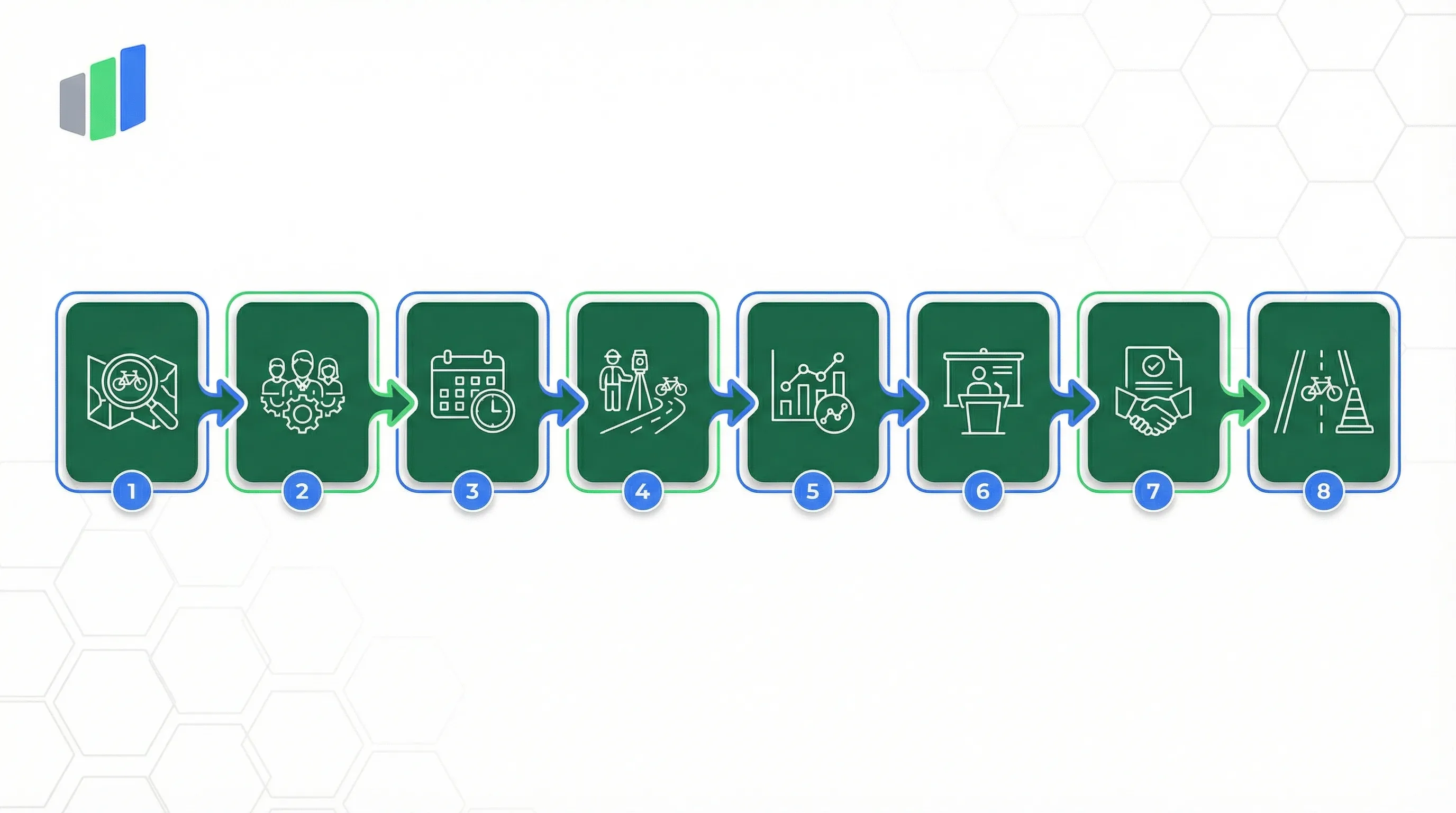
The Eight-Step Road Safety Audit Process
The FHWA Bicycle RSA follows a structured eight-step process that moves from project identification through field observation to a formal findings report with countermeasure recommendations.
The FHWA Road Safety Audit process for bicycle facilities follows eight sequential steps that ensure systematic, independent evaluation of cycling safety. Step 1 involves identifying the project or in-service road to be audited, typically triggered by crash data, community concerns, or planned roadway modifications. Step 2 requires selecting a multidisciplinary RSA team that includes members with bicycle safety expertise, traffic engineering knowledge, and human factors understanding. The team should be independent of the original design team to provide an unbiased perspective. Step 3 is the pre-audit meeting where the project owner describes objectives, the design team presents plans, and the RSA team receives background materials including crash history, traffic volumes, and bicycle count data.
Step 4 is the field observation phase, which the Bicycle RSA guidelines emphasize must include observations under multiple conditions: daytime and nighttime, peak and off-peak traffic, and where possible, wet weather conditions. For bicycle-specific audits, the team should physically ride or walk the route to experience the facility from a cyclist's perspective. Step 5 involves conducting the audit analysis using the structured prompt lists to systematically identify safety issues. Step 6 requires the RSA team to present findings to the project owner and design team in a collaborative discussion. Step 7 is the project owner's formal response indicating which recommendations will be implemented, modified, or deferred with justification. Step 8 involves incorporating accepted findings into the project design, construction plans, or maintenance program. The entire process typically spans two to four weeks from initial meeting to final report delivery.
PROMPT LISTS
Five Prompt List Categories for Bicycle Safety Evaluation
The FHWA-SA-12-018 organizes bicycle safety evaluation into five distinct prompt list categories, each targeting a different type of cycling facility or environment.
The core of the FHWA Bicycle RSA methodology is its structured prompt lists, which guide audit teams through systematic evaluation of cycling safety elements. The five prompt list categories correspond to the five primary types of cycling environments that an RSA team may encounter. Category A covers Road Segments, addressing safety on straight sections of roadway between intersections where cyclists share space with motor vehicles or use designated facilities. Category B addresses Intersections, which are the most critical locations for bicycle-motorist conflicts, covering signal timing, turning movement conflicts, sight distance, and crossing treatments. Category C covers Interchanges, where the complexity of merging and diverging traffic creates unique hazards for cyclists navigating on-ramps, off-ramps, and multi-lane configurations.
| Category | Focus Area | Key Safety Elements | Typical Issues |
|---|---|---|---|
| A: Road Segments | Roadway sections between intersections | Lane width, surface quality, sight lines, signage | Inadequate bike lane width, door-zone conflicts, debris accumulation |
| B: Intersections | At-grade junctions and crossings | Signal timing, turning conflicts, sight distance, markings | Right-hook conflicts, insufficient signal detection, poor visibility |
| C: Interchanges | Highway ramps and merge zones | Merge/diverge conflicts, high-speed differentials, wayfinding | Missing bike route through interchange, forced merging with traffic |
| D: Structures | Bridges, tunnels, overpasses | Cross-section width, drainage grates, lighting, barriers | Narrow bridge shoulders, parallel drainage grates, dark tunnels |
| E: Transit Facilities | Bus stops, rail crossings, transit lanes | Bus-bike conflicts, rail flangeway gaps, shared lane design | Door-zone at bus stops, diagonal rail crossings, shared bus-bike lanes |
Each category contains 15-40 specific prompt questions. Prompts are open-ended safety considerations, not a pass/fail checklist. Teams select and adapt prompts based on site conditions.
Category D addresses Structures such as bridges and tunnels, where constrained cross-sections, limited escape routes, and reduced visibility create distinct safety challenges for cyclists. Narrow bridge decks with no shoulder, drainage grates oriented parallel to travel direction, and inadequate lighting in tunnels are common findings in this category. Category E covers Transit Facilities, examining the interaction between cyclists and public transit operations, including bus stops, transit lanes, and rail crossings. Each category contains between 15 and 40 specific prompt questions organized by sub-theme. The prompts are not a checklist to be answered yes or no. Rather, they are open-ended safety considerations that guide the RSA team's observation and analysis. An experienced audit team adapts the prompts to the specific context of the facility being evaluated, focusing deeply on the categories most relevant to the site.
For UK-based cycling infrastructure assessment, see the LTN 1/20 CLOS assessment framework.
ROAD DESIGN
Road Segment Safety Prompts and Evaluation Criteria
The road segment prompt list evaluates the safety of cycling facilities along the length of a roadway, covering both on-road and off-road bicycle accommodations.
Road segment evaluation under the FHWA Bicycle RSA examines the physical environment that cyclists experience along the length of a corridor. The prompt list for Category A begins with the fundamental question of whether the roadway design accommodates cyclists at all, and if so, whether the type of accommodation matches the roadway context. A high-speed arterial with a narrow painted bike lane next to a travel lane carrying 45 mph traffic represents a fundamentally different risk profile than a neighborhood greenway with traffic calming. The audit team evaluates lane widths against AASHTO guidance, noting that a minimum four-foot bike lane is required but wider lanes are preferred on higher-speed and higher-volume roads. Surface condition receives particular attention because hazards that are minor inconveniences for motorists can be serious crash risks for cyclists: potholes, raised utility covers, longitudinal cracks, and loose gravel can all cause loss of control.
Sight distance is evaluated from the cyclist's perspective, which differs from the motorist's perspective due to the cyclist's lower eye height and slower speed. Vertical and horizontal curves that provide adequate stopping sight distance for a 35 mph motorist may be inadequate for a cyclist approaching a blind crest at 20 mph where a hazard in the bike lane is not visible until too late. Signage and pavement markings are assessed for completeness and condition, including bicycle route wayfinding signs, "Share the Road" warning signs, and bike lane markings at driveways and side streets. Drainage is a critical sub-topic: the audit checks whether drainage grates have bicycle-safe grate patterns (perpendicular to travel direction), whether water pools in areas where cyclists ride, and whether drainage inlets create edge-of-road hazards. In the form, inspectors record each road design finding with its location, description, risk assessment, and a recommended countermeasure drawn from the FHWA Proven Safety Countermeasures catalog.
For pavement-specific surface condition assessment methodology, see the ASTM D6433 PCI standard.
Try this FHWA Bicycle RSA form in Geocadra
We have a pre-built FHWA Bicycle RSA inspection template ready to go. Sign up and start your first condition assessment today.
Free 14-day trial. No credit card required.
INTERSECTIONS & CROSSINGS
Intersection Safety: Where Most Bicycle Crashes Occur
Intersections are the highest-risk locations for cyclists. The FHWA Bicycle RSA dedicates its most detailed prompt list to evaluating signal timing, turning conflicts, visibility, and crossing treatments.
FHWA crash data consistently shows that intersections and driveways account for approximately 57% of all bicycle-motor vehicle crashes in the United States. The Bicycle RSA prompt list for Category B reflects this reality by providing the most detailed set of evaluation criteria of any category. The audit team examines turning movement conflicts, particularly the "right hook" scenario where a right-turning motorist crosses the path of a through-moving cyclist. The prompts guide the team to evaluate whether bike lanes are positioned to minimize this conflict, whether green-colored bike lane markings are used through the conflict zone, and whether separate signal phases or protected intersections physically separate turning vehicles from through-moving cyclists.
| Issue | Risk Level | Description | Typical Countermeasure |
|---|---|---|---|
| Right-Hook Conflict | High | Right-turning motorist crosses cyclist's path at intersection approach | Protected intersection, bike box, green conflict zone markings |
| Inadequate Signal Detection | Medium-High | Inductive loops or detectors fail to register bicycles | Video detection, bicycle-specific loops, push-button actuator |
| Insufficient Clearance Interval | Medium | Signal timing assumes motor vehicle speeds, not cycling speeds | Extend yellow/all-red phase, add Leading Bicycle Interval |
| Left-Cross Conflict | High | Opposing left-turning vehicle fails to yield to through cyclist | Protected left-turn phase, high-visibility cyclist crossing |
| Disappearing Bike Lane | Medium | Bike lane markings end before or within the intersection | Extend markings through intersection with green pavement treatment |
| Sight Distance Obstruction | Medium-High | Parked cars, vegetation, or structures block cyclist visibility | Daylighting (remove parking near intersection), vegetation trimming |
Risk levels are relative assessments used by RSA teams to prioritize findings. Countermeasures are drawn from the FHWA Proven Safety Countermeasures catalog and adapted to site-specific conditions.
Signal timing and detection receive thorough evaluation. Many signalized intersections use inductive loop detectors embedded in the pavement that cannot detect bicycles, leaving cyclists stranded at red lights. The audit checks whether bicycle detection is provided through video detection, microwave sensors, bicycle-specific loop detectors, or push-button actuators accessible from the bike lane. Signal timing is assessed to determine whether clearance intervals are adequate for cyclists to clear the intersection at typical cycling speeds of 10-12 mph, which is significantly slower than the 20 mph assumption used for motor vehicle clearance calculations. Sight distance triangles at intersections are evaluated from the cyclist's position, including visibility obstructions from parked cars, vegetation, utility cabinets, and building corners. The audit also examines the quality of pavement markings through intersections, noting that bike lanes often disappear at the intersection where they are needed most. High-visibility green bike lane markings and bike boxes are evaluated as potential countermeasures for conflict areas identified during the audit.
BEHIND THE HANDLEBARS
The "Behind the Handlebars" Perspective: What Makes This Audit Unique
The FHWA Bicycle RSA's defining methodological principle is the "behind the handlebars" perspective, requiring audit teams to evaluate road safety from the cyclist's physical and perceptual experience.
What distinguishes the FHWA Bicycle Road Safety Audit from a standard road safety audit is its insistence on evaluating the transportation environment from the cyclist's unique perspective. The "behind the handlebars" principle recognizes that cyclists experience road infrastructure fundamentally differently from motorists. A cyclist sits lower, travels slower, is more vulnerable to surface conditions, has a narrower stable operating width, and lacks the physical protection of a vehicle cabin. These physical differences translate into different safety-critical factors. A two-inch raised utility cover that a motorist never notices can cause a cyclist to lose control. A right-turn-only lane that a motorist navigates without thought forces a cyclist into a complex lane-change maneuver in mixed traffic. A road shoulder that appears adequate for emergency vehicle stops may be entirely too narrow for safe cycling when accounting for the door zone of parked cars.
The guidelines explicitly recommend that RSA team members physically ride or walk the study corridor to experience these conditions firsthand. Nighttime observations are particularly important because cyclists are overrepresented in after-dark crashes, and the adequacy of lighting, retroreflectivity of signs and markings, and visibility of potential hazards can only be assessed in actual darkness. The methodology also requires consideration of different cyclist populations: experienced commuter cyclists who ride predictably in traffic behave very differently from novice riders, children cycling to school, or elderly cyclists with reduced balance and slower reaction times. The FHWA Bicycle RSA categorizes road users into three types: the "Strong and Fearless" cyclist comfortable with high-traffic environments, the "Enthused and Confident" cyclist who prefers designated facilities, and the "Interested but Concerned" majority who will only cycle when provided with protected or separated infrastructure. This user-type framework ensures that audit findings address the needs of all potential cyclists, not just those currently using the facility.
The complete FHWA Bicycle RSA guidelines and prompt lists are published by the Federal Highway Administration (FHWA). For the updated 2020 combined pedestrian and bicycle guide, see the FHWA-SA-20-042 Pedestrian and Bicyclist RSA Guide.
QUESTIONS
Frequently Asked Questions
What is the FHWA Bicycle Road Safety Audit?
The FHWA Bicycle Road Safety Audit (FHWA-SA-12-018) is the US Federal Highway Administration guideline for systematically evaluating bicycle safety on roads and pathways. Published in 2012, it provides structured prompt lists that guide multidisciplinary audit teams through safety evaluation of road segments, intersections, interchanges, structures, and transit facilities.
How does a Bicycle RSA differ from a general Road Safety Audit?
A Bicycle RSA evaluates road infrastructure specifically from the cyclist's perspective, using the "behind the handlebars" approach. While general RSAs focus primarily on motor vehicle safety, the Bicycle RSA examines cyclist-specific hazards like door-zone conflicts, inadequate signal detection for bicycles, drainage grate orientation, and surface condition issues that only affect two-wheeled vehicles.
Who should be on a Bicycle RSA team?
A Bicycle RSA team should include members with expertise in bicycle safety, traffic engineering, human factors, and road design. The team must be independent of the original design team to provide unbiased evaluation. Local cycling advocates or experienced cyclists are often included to bring practical knowledge of how the facility is used by the cycling community.
Is a FHWA Bicycle RSA mandatory for US roadway projects?
A Bicycle RSA is not federally mandated for all projects, but it is strongly encouraged by FHWA as a Proven Safety Countermeasure. Some states and municipalities require RSAs for projects receiving federal funding or for Complete Streets projects. The 2020 update (FHWA-SA-20-042) strengthened the recommendation for bicycle-specific safety evaluation.
What are the prompt list categories in the Bicycle RSA?
The FHWA Bicycle RSA uses five prompt list categories: Road Segments (A), Intersections (B), Interchanges (C), Structures such as bridges and tunnels (D), and Transit Facilities (E). Each category contains 15 to 40 open-ended safety prompts that guide the audit team through systematic evaluation of bicycle-specific hazards.
How long does a Bicycle RSA take to complete?
A typical Bicycle RSA spans two to four weeks from the initial pre-audit meeting to final report delivery. The field observation phase usually requires one to three days depending on corridor length, and must include observations under varying conditions including daytime, nighttime, and different traffic periods.
What is the "behind the handlebars" perspective?
The "behind the handlebars" perspective is the FHWA Bicycle RSA's core methodological principle. It requires audit teams to evaluate road safety from the cyclist's physical experience, accounting for lower eye height, slower speed, vulnerability to surface conditions, and exposure to weather and traffic. Teams are encouraged to physically ride or walk the study corridor.
In practice
See how the round runs in Geocadra
The solution page shows this inspection regime on real open data: the import, the form, the round, the record per asset and the export.
Main and routine inspections of bridges, walls, roads and signs on a map, with every inspection appended to the structureOpen the solution page: Bridges, Roads & StructuresTRY IT FREE
Digitize your FHWA Bicycle RSA inspections
Replace paper forms and spreadsheets with structured digital inspections, built for standards like FHWA Bicycle RSA.
No credit card requiredFree trial included