

FIT Count Pollinator Monitoring
The UK standard for systematic pollinator abundance monitoring through timed flower-insect observation counts.
The Flower-Insect Timed Count (FIT Count) is the core field protocol of the UK Pollinator Monitoring Scheme (PoMS), developed by the UK Centre for Ecology & Hydrology (UKCEH) and adopted as the basis for the EU Pollinator Monitoring Scheme (EU-PoMS). The methodology defines a standardized, repeatable observation of a 50×50 cm flower patch over exactly 10 minutes, during which the surveyor tallies every insect that lands on the target flowers. By categorizing visitors into 11 broad morphological groups rather than requiring species-level identification, the FIT Count enables citizen scientists, ecologists, and green infrastructure managers to generate scientifically robust pollinator abundance data without specialist entomological training. The resulting datasets feed directly into national and European biodiversity trend analyses that inform pollination service assessments and habitat management decisions.

What is FIT Count?
The FIT Count (Flower-Insect Timed Count) is the UK standard methodology for monitoring pollinator abundance. Surveyors observe a 50×50 cm flower patch for exactly 10 minutes, tallying visiting insects across 11 morphological groups including bumblebees, hoverflies, and solitary bees to track population trends.
- Full Name
- Flower-Insect Timed Count (FIT Count) — UK Pollinator Monitoring Scheme
- Issuing Body
- UKCEH (UK Centre for Ecology & Hydrology) / PoMS
- Current Revision
- FIT Count v6 (2024)
SURVEY METHODOLOGY
The 10-Minute Timed Count Protocol
The FIT Count defines a fixed-area, fixed-time observation protocol that produces standardized, comparable pollinator abundance data across sites and seasons.
The FIT Count protocol centres on a precisely defined observation event: the surveyor selects a 50×50 cm patch of a single target flower species, counts the number of flower units within the patch, then starts a 10-minute timer and tallies every insect that lands on the target flowers within that area. The 10-minute duration was chosen through statistical power analysis to balance data quality against volunteer fatigue, ensuring that a single count captures a representative snapshot of pollinator activity at the site. Shorter counts produce excessive zero-inflation in the data, while longer counts risk observer attention decay and double-counting of returning individuals.
Before starting the timer, the surveyor must complete all site setup fields: location, habitat category, target flower identification, patch context, floral cover estimation, and flower unit count. This pre-survey phase is deliberately separated from the active count to prevent disturbance to the patch during setup. The standard explicitly instructs surveyors not to take photographs during the 10-minute window, as camera activity near the flowers can deter insect visitors and introduce systematic bias. Representative insect photographs should be taken after the timer completes.
Each FIT Count produces a single data record: the tally of insects across 11 groups observed on one target flower species at one location under recorded weather conditions. The scientific value emerges from repetition. The UK PoMS encourages monthly counts at the same location from April through September, building temporal series that reveal seasonal flight curves and year-over-year population trends. When aggregated across hundreds of volunteer surveyors, these individual 10-minute snapshots form the statistical backbone of national pollinator abundance indices.
For broader habitat classification surveys that provide context for pollinator monitoring sites, see the JNCC Phase 1 Habitat Survey standard.
INSECT GROUPS
The 11 Morphological Classification Groups
The FIT Count categorizes flower-visiting insects into 11 broad groups based on visual appearance rather than species-level taxonomy, enabling non-specialist surveyors to produce consistent data.
The FIT Count insect classification system is intentionally coarse-grained. Rather than requiring surveyors to identify insects to species level, which would demand specialist training and magnification equipment, the protocol uses 11 morphological groups that can be distinguished by body shape, size, and behaviour visible to the naked eye. This design decision is fundamental to the scheme's success as a citizen science methodology: it dramatically lowers the participation barrier while still generating data that is taxonomically meaningful for population trend analysis.
The three bee categories distinguish Bumblebees (large, furry, robust body), Honeybees (medium-sized, slender, amber-brown), and Solitary bees (variable size, often with distinct pollen-carrying structures). Wasps, including ichneumon wasps, form a single group. The Diptera (flies) are split into Hoverflies, which are important pollinators that often mimic bee or wasp colouration, and Other flies, capturing the remaining flower-visiting Diptera. Butterflies and Moths are grouped together, as both Lepidoptera orders visit flowers and can be difficult to separate when resting with wings folded. Beetles larger than 3 mm form their own group, while Small insects under 3 mm, such as pollen beetles and tiny parasitic wasps, are counted separately. The final Other insects category captures any flower visitor that does not fit the preceding ten groups, such as shield bugs, lacewings, or earwigs.
| Group | Examples | Key Identification Features |
|---|---|---|
| Bumblebees | Bombus spp. | Large, furry, robust body with broad stripes |
| Honeybees | Apis mellifera | Medium, slender, amber-brown with narrow stripes |
| Solitary bees | Andrena, Osmia spp. | Variable size, often metallic or ginger-haired |
| Wasps (incl. Ichneumon) | Vespula, Ichneumonidae | Smooth body, narrow waist, yellow/black or elongated |
| Hoverflies | Syrphidae | Hover in flight, often bee/wasp mimics, single wing pair |
| Other flies | Various Diptera | Single wing pair, no hovering behaviour, diverse forms |
| Butterflies and Moths | Lepidoptera | Scaled wings, coiled proboscis, fluttering flight |
| Beetles (>3 mm) | Coleoptera | Hard wing cases (elytra), often seen crawling on flowers |
| Small insects (<3 mm) | Pollen beetles, thrips | Tiny, often found inside flower heads |
| Other insects | Shield bugs, lacewings | Any flower visitor not fitting above categories |
Surveyors count only insects that land on the target flowers within the 50×50 cm patch. Insects on leaves, stems, or adjacent non-target flowers are excluded from the tally.
The 3 mm size threshold for beetles is a critical validation rule in the form. Beetles above this size are ecologically significant flower visitors that can be reliably identified and counted from the standard observation distance. Insects below 3 mm are still counted but placed in the Small insects category because they are difficult to classify accurately in the field. In the digital form, each group has a dedicated numeric tally field with a default of zero, and the surveyor increments each counter as insects land on the target flowers during the 10-minute observation window.
SITE & WEATHER
Site Setup and Environmental Condition Recording
Every FIT Count records standardized habitat and weather metadata that enables statistical correction for environmental variables when analysing pollinator abundance trends.
The FIT Count protocol requires detailed environmental context because insect activity is profoundly influenced by weather and habitat conditions. Temperature, cloud cover, wind strength, and sunshine duration all affect pollinator flight behaviour, and without recording these variables, it would be impossible to distinguish genuine population changes from weather-driven variation in count data. The standard defines minimum weather thresholds for valid surveys: a temperature of at least 13°C in sunny conditions or 15°C under cloud cover, dry conditions, and wind no stronger than leaves moving gently.
The Habitat Category field classifies the survey location into one of 13 habitat types ranging from Garden and School grounds to Upland moorland and Woodland. This classification follows a simplified version of UK habitat typology and serves two analytical purposes: it allows data aggregation by habitat type to compare pollinator abundance across different land uses, and it provides ecological context for interpreting count results. A count of five bumblebees on a brownfield site has different ecological significance than the same count in a managed garden.
| Parameter | Level | Description | Survey Validity |
|---|---|---|---|
| Sky Conditions | Clear | All or mostly blue sky | Valid (min 13°C) |
| Sky Conditions | Mixed | Half blue and half cloud | Valid (min 15°C) |
| Sky Conditions | Cloudy | All or mostly cloud | Valid (min 15°C) |
| Wind Strength | Low | Leaves still or moving occasionally | Valid |
| Wind Strength | Medium | Leaves moving gently all the time | Valid |
| Wind Strength | High | Leaves moving strongly | Usually invalid |
| Sunshine | Full sun | Entirely in sunshine | Valid |
| Sunshine | Partial | Partly in sun and partly shaded | Valid |
| Sunshine | Shaded | Entirely shaded | Valid (reduced activity expected) |
Counts conducted under high wind or below the temperature threshold are flagged during data validation. The minimum temperature requirement is 13°C in sunny conditions or 15°C under cloudy skies.
Sky Conditions, Sunshine During Count, and Wind Strength each use a three-level categorical scale that corresponds to defined observational criteria. Sky conditions range from "All or mostly blue" through "Half blue and half cloud" to "All or mostly cloud." Wind strength uses the leaf-movement proxy: "Leaves still or moving occasionally" indicates low wind, "Leaves moving gently all the time" indicates medium wind, and "Leaves moving strongly" indicates high wind that may invalidate the count. These proxies were chosen because they require no instruments and can be consistently assessed by any surveyor regardless of experience level.
Try this FIT Count form in Geocadra
We have a pre-built FIT Count inspection template ready to go. Sign up and start your first condition assessment today.
Free 14-day trial. No credit card required.
TARGET FLOWERS
Target Flower Selection and the 50×50 cm Quadrat
The choice of target flower and the definition of the observation patch are the most critical decisions in a FIT Count, directly affecting data comparability and scientific value.
The FIT Count protocol specifies 15 priority target flower species or groups that have been selected for their widespread UK distribution, their attractiveness to a broad range of pollinators, and their recognisability by non-specialist surveyors. These include Bramble (Blackberry), Buddleja, Buttercup, Dandelion, Hawthorn, Heather, Hogweed, Ivy, Knapweed, Lavender, Ragwort, Red Clover, Thistle, White Clover, and White Dead-nettle. Surveyors are instructed to prioritise these species when available at their survey site because the resulting data contributes to standardised trend analyses for specific plant-pollinator interactions.
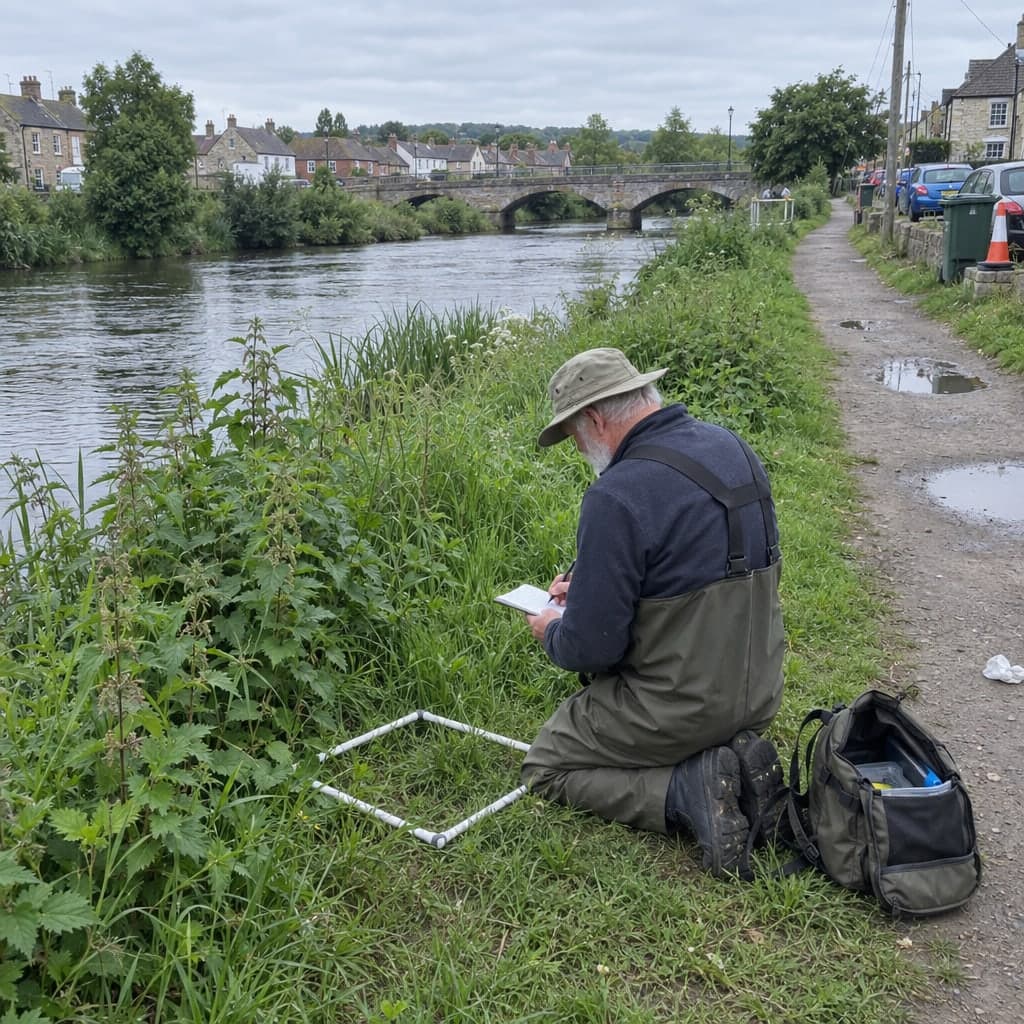
Once the target flower is identified, the surveyor defines a 50×50 cm patch, roughly the area of a large dinner plate or open newspaper. The standard does not require a physical quadrat frame, but the area must be consistently estimated. Within this patch, the surveyor records the Flower Unit Type, which varies by plant morphology: individual flowers for species like Buttercup, flower heads for Dandelion or Clover, flower umbels for Hogweed, and flower spikes for Lavender or Heather. The surveyor then counts the number of flower units within the patch. This count is essential for data normalisation, as insect visitation rates scale with floral resource density.
Two additional context fields capture the patch environment. Patch Context records whether the target flowers are growing in a larger patch of the same species, in a mixed-flower patch, or are more or less isolated. Floral Cover estimates whether the target flower covers less than half, about half, or more than half of the 50×50 cm area. Together, these fields allow analysts to control for local floral resource availability when comparing counts between sites. A photo of the target flower is required for every count to enable remote verification of the plant identification, which is the most common source of data error in citizen science biological surveys.
The official FIT Count recording form and identification guides are published by the UK Pollinator Monitoring Scheme (PoMS).
Scientific methodology and trend analyses are published by the UK Centre for Ecology & Hydrology (UKCEH).
DATA QUALITY
Data Quality Rules and Validation Logic
The FIT Count protocol includes specific validation rules that distinguish valid surveys from those that should be flagged or excluded from trend analyses.
Data quality in the FIT Count relies on three layers of validation: environmental thresholds, temporal consistency, and photographic evidence. The environmental threshold rules are the strictest. Surveys conducted below 13°C in sunny conditions or below 15°C under cloud are flagged as potentially invalid because insect flight activity drops dramatically below these temperatures, producing artificially low counts that would skew trend analyses. Similarly, counts taken during heavy rain or strong wind (leaves moving strongly) are considered unreliable because adverse weather suppresses pollinator activity regardless of actual population levels.
Temporal consistency requires that the 10-minute timer runs to completion. Shortened counts cannot be proportionally scaled because insect visitation is not uniformly distributed across time. The first minute of observation typically shows higher counts due to insects already present on the flowers when the timer starts, followed by a more steady arrival rate. A 5-minute count doubled does not equal a 10-minute count. The digital form enforces this through a timer completion toggle that must be confirmed before submission.
Photographic validation serves a dual purpose. The required target flower photo allows data validators to confirm that the plant species was correctly identified. This is essential because misidentification of the target flower would assign insect visitation data to the wrong plant-pollinator interaction, corrupting the trend analysis for that species pair. Optional insect photographs, taken after the count completes, provide verification of unusual group assignments and can flag identification errors for borderline cases such as distinguishing hoverflies from solitary bees. The combination of these validation layers ensures that the aggregated dataset maintains the statistical rigour required for national-scale pollinator trend reporting.
For tree-level biodiversity assessments that complement pollinator habitat surveys, see the BS 5837 Trees standard.
QUESTIONS
Frequently Asked Questions
What is the FIT Count (Flower-Insect Timed Count)?
The FIT Count is the UK standard methodology for monitoring pollinator abundance developed by UKCEH. A surveyor observes a 50×50 cm flower patch for exactly 10 minutes, tallying every insect that lands on the target flowers across 11 morphological groups. It forms the core protocol of the UK and EU Pollinator Monitoring Schemes.
What weather conditions are required for a valid FIT Count?
Valid FIT Counts require dry conditions, a minimum temperature of 13°C in sunny weather or 15°C under cloud, and wind no stronger than leaves moving gently. Counts conducted below these thresholds or in rain are flagged as potentially invalid because adverse weather suppresses insect flight activity.
How many insect groups does the FIT Count use?
The FIT Count uses 11 morphological groups: Bumblebees, Honeybees, Solitary bees, Wasps, Hoverflies, Other flies, Butterflies and Moths, Beetles over 3 mm, Small insects under 3 mm, and Other insects. These groups were designed for visual identification without specialist equipment.
Why is the count exactly 10 minutes?
The 10-minute duration was determined through statistical power analysis to balance data quality against observer fatigue. Shorter counts produce excessive zero-inflation, while longer counts risk attention decay and double-counting. The fixed duration ensures comparability across all surveys in the national dataset.
What are the target flower species for a FIT Count?
The protocol specifies 15 priority species including Bramble, Buddleja, Buttercup, Dandelion, Hawthorn, Heather, Hogweed, Ivy, Knapweed, Lavender, Ragwort, Red Clover, Thistle, White Clover, and White Dead-nettle. Surveyors may also record other species not on this list.
How often should FIT Counts be repeated at the same location?
The UK PoMS recommends monthly counts from April through September at each survey site. Repeating counts at the same location throughout the season builds temporal series that reveal seasonal flight curves and year-over-year population trends for statistical trend analysis.
Is the FIT Count used outside the United Kingdom?
Yes. The FIT Count methodology has been adopted by Ireland, Cyprus, and forms the basis of the EU Pollinator Monitoring Scheme (EU-PoMS). The European Commission selected the protocol for its standardised, repeatable design that enables cross-country comparison of pollinator abundance data.
In practice
See how the round runs in Geocadra
The solution page shows this inspection regime on real open data: the import, the form, the round, the record per asset and the export.
Regular tree checks, biotope mapping and ecological surveys on a map, with every visit appended to the tree or the siteOpen the solution page: Trees, Habitats & EcologyTRY IT FREE
Digitize your FIT Count inspections
Replace paper forms and spreadsheets with structured digital inspections, built for standards like FIT Count.
No credit card requiredFree trial included