



JNCC Phase 1 Habitat Survey
The UK standard methodology for classifying, mapping, and auditing wildlife habitats across entire landscapes.
The JNCC Phase 1 Habitat Survey, published by the Joint Nature Conservation Committee, is the industry-standard technique for environmental audit in the United Kingdom. It provides a systematic method for classifying and mapping habitats using standardised alphanumeric codes, recording plant species abundance on the DAFOR scale, and logging ecologically significant features through Target Notes. This guide covers the complete habitat classification hierarchy from woodland to miscellaneous land use, the field survey methodology, the DAFOR abundance recording system, target note protocols, and how Geocadra digitises the entire Phase 1 workflow.

What is JNCC Phase 1?
The JNCC Phase 1 Habitat Survey is the UK standard methodology for classifying and mapping wildlife habitats at a landscape scale. Published by the Joint Nature Conservation Committee, it uses alphanumeric codes across ten broad habitat categories (A through J) and records plant species abundance using the DAFOR scale to produce baseline ecological audit maps for Environmental Impact Assessment and conservation management.
- Full Name
- Handbook for Phase 1 Habitat Survey — A Technique for Environmental Audit
- Issuing Body
- Joint Nature Conservation Committee (JNCC)
- Current Revision
- Revised reprint (2010)
SURVEY METHODOLOGY
How a JNCC Phase 1 Habitat Survey Works
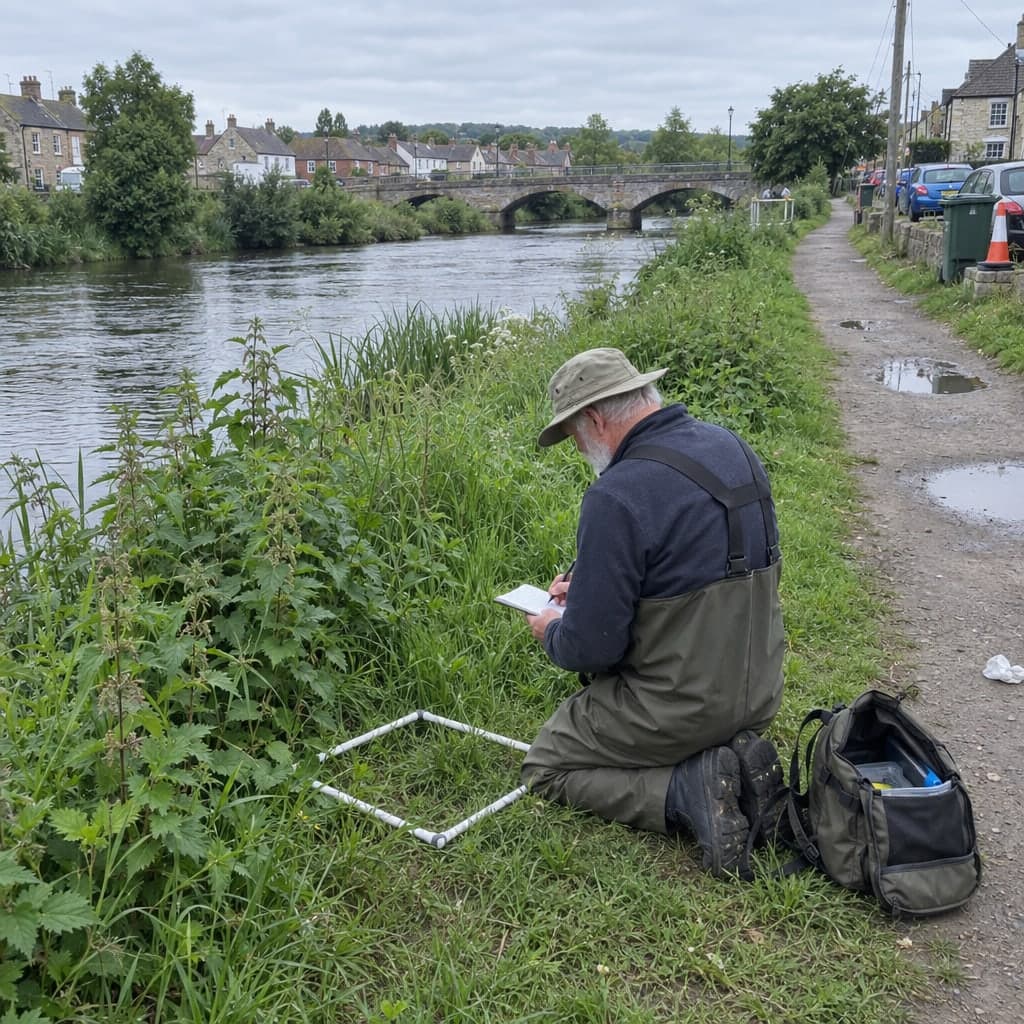
The JNCC Phase 1 Habitat Survey is a walkover technique designed to classify and map all land parcels within a defined survey area. Unlike targeted species surveys that focus on individual organisms, Phase 1 operates at the habitat level — the ecologist traverses the entire site and assigns every distinct parcel of land a standardised habitat code. The result is a complete colour-coded habitat map that serves as the baseline ecological record for planning decisions, Environmental Impact Assessments, and conservation management plans.
The survey workflow follows three parallel data streams that are collected simultaneously in the field. First, the ecologist records survey conditions at the start of each survey day — site reference, grid reference, precipitation, wind speed, and any limitations such as dense vegetation, steep terrain, or access restrictions. These metadata fields establish the validity and completeness of the survey record. Second, the ecologist maps habitat polygons, assigning each area a JNCC habitat code from the standardised classification hierarchy. Third, significant ecological features that cannot be captured by the broad habitat code alone — such as rare species locations, badger setts, bat roost potential trees, invasive species stands, or water vole signs — are recorded as numbered Target Notes at precise grid references.
Phase 1 surveys are typically conducted between April and September, when vegetation is actively growing and species identification is most reliable. Surveys outside this optimal window must record seasonal constraints as a limitation. The methodology is explicitly designed for large-scale coverage rather than detailed botanical analysis — a trained ecologist can map 2 to 3 km² per day under good conditions. Where higher botanical detail is required, the results of a Phase 1 survey are used to identify areas warranting a more intensive Phase 2 (National Vegetation Classification) survey.
The handbook is published by the Joint Nature Conservation Committee (JNCC) and is the primary reference for habitat mapping in the United Kingdom.
HABITAT CODES
The JNCC Habitat Classification Hierarchy
The JNCC Phase 1 system classifies all terrestrial, freshwater, and coastal habitats into ten broad categories designated A through J, each subdivided into specific habitat types identified by alphanumeric codes.
The habitat classification hierarchy is the core of the Phase 1 methodology. Every parcel of land surveyed receives a primary habitat code that describes its vegetation community and land use. The ten broad categories — Woodland and Scrub (A), Grassland and Marsh (B), Tall Herb and Fen (C), Heathland (D), Mire (E), Swamp (F), Open Water (G), Coastland (H), Exposure and Waste (I), and Miscellaneous (J) — encompass every habitat type found in the British Isles. Within each category, codes drill down to increasing specificity: for example, A1.1.1 denotes broadleaved semi-natural woodland, while A1.2.2 denotes coniferous plantation woodland. This hierarchical structure allows data to be analysed at any level of detail, from broad landscape-scale habitat proportions to fine-grained community mapping.
In the digital form, the ecologist selects the habitat code from a structured dropdown that mirrors this hierarchy. The form captures the selected JNCC code along with a mosaic indicator flag — which is set to true when a polygon contains an intimate mixture of two or more habitat types that cannot be mapped separately at the survey scale. For mosaic habitats, the ecologist records both the primary and secondary codes. The dominant species field allows free-text recording of the principal plant species defining the habitat, providing additional detail beyond the code alone. Each habitat record can also include geotagged photographs as visual evidence of the habitat condition at the time of survey.
The distinction between semi-natural and plantation habitats is particularly important for ecological valuation. Semi-natural habitats (coded .1 in the second decimal position for woodland) have developed through natural ecological processes and typically support higher biodiversity than plantation habitats (coded .2), which have been deliberately established through planting. Similarly, the distinction between unimproved and semi-improved grasslands (B1.1 versus B1.2, B2.1 versus B2.2, B3.1 versus B3.2) reflects the degree of agricultural modification — unimproved grasslands are significantly more ecologically valuable and are often priority habitats under UK Biodiversity Action Plans.
| Code | Broad Habitat | Examples |
|---|---|---|
| A | Woodland and Scrub | A1.1.1 Broadleaved semi-natural, A1.2.2 Coniferous plantation, A2.1 Dense scrub |
| B | Grassland and Marsh | B1.1 Acid grassland unimproved, B2.2 Neutral semi-improved, B4 Improved grassland |
| C | Tall Herb and Fen | C1.1 Bracken continuous, C3.1 Tall ruderal |
| D | Heathland | D1 Dry dwarf shrub heath |
| E | Mire | E1.6 Sphagnum bog, E2.1 Flush and spring |
| F | Swamp | F1 Swamp, F2.1 Marginal vegetation |
| G | Open Water | G1 Standing water, G2 Running water |
| H | Coastland | H1 Intertidal, H2 Saltmarsh, H6 Sand dune |
| I | Exposure and Waste | I2.1 Quarry, I2.2 Spoil, I2.4 Refuse-tip |
| J | Miscellaneous | J1.1 Arable, J1.2 Amenity grassland, J2.1 Intact hedge, J3.6 Buildings |
Each broad category subdivides into specific habitat types. The full JNCC handbook defines over 90 individual habitat codes with standardised colour mapping conventions.
For tree stock assessments within woodland habitats (category A), see the FLL Baumkontrolle tree inspection standard, which assesses the condition and safety of individual trees.
Try this JNCC Phase 1 form in Geocadra
We have a pre-built JNCC Phase 1 inspection template ready to go. Sign up and start your first condition assessment today.
Free 14-day trial. No credit card required.
DAFOR SCALE
Recording Species Abundance with the DAFOR Scale
The DAFOR scale is a semi-quantitative method for recording the relative abundance of plant species within a defined survey area. It is the standard recording convention used alongside Phase 1 habitat codes.
The DAFOR scale provides a rapid, standardised way for ecologists to record how common or rare each plant species is within a habitat polygon or target note area. The acronym stands for Dominant, Abundant, Frequent, Occasional, and Rare — five categories that describe species cover in descending order. A species scored as Dominant (D) covers more than 75% of the survey area and is typically the principal canopy or sward former. Abundant (A) indicates very common species with high cover between 51% and 75%. Frequent (F) denotes species found regularly across 26% to 50% of the area. Occasional (O) describes scattered individuals covering 11% to 25%, while Rare (R) means only a few individuals are present, covering 1% to 10% of the area.
It is essential to understand that "Rare" in the DAFOR context means rare within the specific survey area, not nationally rare in a conservation sense. A nationally common species might be DAFOR-Rare in a particular habitat polygon simply because it occurs at the margin of the surveyed parcel. Conversely, a nationally scarce species could be DAFOR-Dominant if it forms the main canopy in a small woodland. The DAFOR recording is further refined by two optional qualifiers: "L" (Locally) modifies the abundance to indicate clustering rather than even distribution — for example, "LD" means Locally Dominant, indicating the species dominates a sub-area within the polygon but not the whole parcel. "E" (Edge) indicates species found only at the boundaries of the mapped habitat.
In the digital form, the ecologist records species alongside their DAFOR score as part of the species list within each target note. This structured approach replaces unformatted field notes with consistent, queryable data. For example, an ecologist surveying a broadleaved woodland (A1.1.1) might record Quercus robur as Dominant, Fraxinus excelsior as Frequent, and Corylus avellana as Abundant — immediately conveying the woodland community structure in a machine-readable format.
| Code | Label | Cover Range | Description |
|---|---|---|---|
| D | Dominant | > 75% | Covers most of the area. Usually the main canopy or sward former. |
| A | Abundant | 51 – 75% | Very common with many individuals and high cover. |
| F | Frequent | 26 – 50% | Found regularly across the area. |
| O | Occasional | 11 – 25% | Scattered individuals, not common. |
| R | Rare | 1 – 10% | Only a few individuals found within the survey area. |
Qualifiers: L (Locally) = species clusters in a sub-area, E (Edge) = species found only at habitat boundaries. “Rare” refers to local abundance, not national conservation status.
TARGET NOTES
The Target Note Protocol for Ecological Features
Target Notes are the mechanism by which Phase 1 surveys record ecologically significant point features that cannot be captured by broad habitat codes alone.
Target Notes (TNs) are numbered point records that document specific ecological features of interest encountered during the walkover survey. Each Target Note is tied to a precise grid reference and is marked on the habitat map with its reference number (TN1, TN2, TN3, and so on). The Target Note protocol serves a critical function: it captures the fine-grained ecological detail that habitat polygons, by their nature as broad classifications, cannot represent. A broadleaved woodland polygon coded A1.1.1 tells a planner that semi-natural woodland is present, but it does not reveal that TN4 marks a veteran oak with high bat roost potential, or that TN7 records a stand of Japanese knotweed requiring invasive species management.
In the digital form, each Target Note record includes five mandatory fields and one optional field. The Target Note Number (e.g., TN1) must be unique within the survey. The Location / Grid Ref captures the precise coordinates of the feature. The Feature Type field categorises the note into one of seven standardised types: Rare Species Location, Invasive Species, Badger Sett, Bat Roost Potential (Tree), Water Vole Sign, Significant Habitat Feature, or Other. The Description field provides detailed free-text documentation of the feature, its structure, condition, and management context. Feature Photos are mandatory — every Target Note must be accompanied by photographic evidence. Finally, an optional Species List & DAFOR field allows the ecologist to record the plant community around the feature using structured DAFOR abundance scores.
The categorisation of Target Notes into feature types has important regulatory implications. Badger setts are protected under the Protection of Badgers Act 1992, and their discovery triggers specific legal obligations for any proposed development. Similarly, bat roost potential trees recorded through Target Notes inform the requirement for further bat surveys under the Wildlife and Countryside Act 1981 and the Conservation of Habitats and Species Regulations. Invasive species records, particularly for species listed under Schedule 9 of the Wildlife and Countryside Act, create obligations under biosecurity legislation. The Target Note record therefore serves as both an ecological inventory and a regulatory trigger log.
Rare Species Location
Records the precise location of nationally or locally scarce plant or animal species. These records may trigger Section 41 (NERC Act 2006) habitat protection requirements and inform Biodiversity Net Gain assessments for proposed developments.
Invasive Species
Documents the presence of non-native invasive species such as Japanese Knotweed (Fallopia japonica), Himalayan Balsam (Impatiens glandulifera), or Giant Hogweed (Heracleum mantegazzianum). Schedule 9 species create legal obligations for containment during construction works.
Badger Sett
Records active, disused, or partially used badger setts. Setts and the animals are protected under the Protection of Badgers Act 1992. Development works within 30 metres of an active sett typically require a Natural England licence.
Bat Roost Potential (Tree)
Identifies trees with features suitable for roosting bats: cavities, cracks, loose bark, woodpecker holes, or dense ivy cover. Trees are graded for bat roost potential, and those rated moderate or high trigger the need for further bat surveys.
Water Vole Sign
Records evidence of water vole (Arvicola amphibius) activity along watercourses: latrines, burrows, feeding stations, and runways. Water voles are fully protected under Schedule 5 of the Wildlife and Countryside Act 1981.
Significant Habitat Feature
Captures any ecologically important feature not covered by the other categories: veteran trees, species-rich hedgerows, ponds with amphibian potential, or habitat connectivity corridors that function as wildlife movement routes.
For further detail on the legal framework, consult the Wildlife and Countryside Act 1981. Browse all available inspection standards in the standards directory.
DIGITAL WORKFLOW
Digitise Phase 1 Habitat Surveys with Geocadra
Paper-based Phase 1 surveys rely on hand-drawn maps, paper field sheets, and separate photo logs that must be digitised after the survey. Geocadra replaces this fragmented workflow with a single integrated digital process.
Map-linked habitat recording
Draw habitat polygons directly on the digital map and assign JNCC codes from a structured dropdown. Each polygon is automatically linked to its attribute data — habitat code, mosaic flag, dominant species, and photos — eliminating the manual transfer from paper to GIS that introduces transcription errors and delays reporting.
Georeferenced Target Notes
Place Target Note points on the map with a single tap. GPS coordinates, feature type, description, species list, and mandatory photographs are captured in one linked record. The numbered TN markers appear on the map exactly where they were recorded, replacing hand-drawn annotations on paper maps.
Structured DAFOR species recording
Record species abundance using dropdown selectors for DAFOR codes and qualifiers rather than handwritten notes. The structured format ensures every species record is consistent, queryable, and directly exportable to ecological databases and Environmental Statement appendices.
Instant GIS-ready output
Survey data exports directly as GIS-compatible layers with habitat polygons, target note points, and all attribute data intact. The manual digitisation step — which typically adds days between fieldwork and report delivery — is eliminated entirely. Habitat maps are available immediately after the survey day.
QUESTIONS
Frequently Asked Questions
What is a JNCC Phase 1 Habitat Survey?
A JNCC Phase 1 Habitat Survey is the standard UK methodology for classifying and mapping all habitats within a defined area. Published by the Joint Nature Conservation Committee, it uses alphanumeric codes (A through J) to categorise habitats, the DAFOR scale to record plant species abundance, and Target Notes to document ecologically significant features.
What does DAFOR stand for in Phase 1 surveys?
DAFOR stands for Dominant (>75% cover), Abundant (51–75%), Frequent (26–50%), Occasional (11–25%), and Rare (1–10%). It is a semi-quantitative scale for recording relative plant species abundance within a habitat area. The qualifier "L" (Locally) can be added to indicate species clustering in a sub-area rather than even distribution.
When should a Phase 1 Habitat Survey be conducted?
Phase 1 surveys are optimally conducted between April and September during the active growing season, when vegetation is identifiable and species composition can be accurately assessed. Surveys outside this window must record seasonal constraints as a limitation and may require a return visit to confirm habitat classifications.
What is the difference between Phase 1 and Phase 2 habitat surveys?
Phase 1 is a broad-scale walkover that classifies and maps habitats using standardised JNCC codes. Phase 2 involves detailed botanical quadrat surveys using the National Vegetation Classification (NVC) system. Phase 1 identifies areas of ecological interest; Phase 2 provides the fine-grained community data needed for those specific areas.
Are Phase 1 Habitat Surveys mandatory for planning applications in the UK?
Phase 1 surveys are not prescribed by statute but are effectively mandatory for most planning applications involving greenfield or semi-natural land. Local Planning Authorities routinely require an Extended Phase 1 survey as part of the Preliminary Ecological Appraisal within Environmental Impact Assessment submissions.
What qualifications are needed to conduct a Phase 1 Habitat Survey?
There is no statutory licence requirement, but Phase 1 surveys should be conducted by ecologists with demonstrable botanical identification skills and training in the JNCC methodology. Most practitioners hold membership of the Chartered Institute of Ecology and Environmental Management (CIEEM) and carry professional indemnity insurance.
What are Target Notes in a Phase 1 survey?
Target Notes are numbered point records that document specific ecological features of interest, such as rare species, invasive species, badger setts, bat roost potential trees, or significant habitat features. Each note includes a grid reference, feature type, detailed description, and photographs, and is marked on the habitat map.
In practice
See how the round runs in Geocadra
The solution page shows this inspection regime on real open data: the import, the form, the round, the record per asset and the export.
Regular tree checks, biotope mapping and ecological surveys on a map, with every visit appended to the tree or the siteOpen the solution page: Trees, Habitats & EcologyTRY IT FREE
Digitize your JNCC Phase 1 inspections
Replace paper forms and spreadsheets with structured digital inspections, built for standards like JNCC Phase 1.
No credit card requiredFree trial included