FLL Pflegeklassen Green Space
The German classification system for maintenance intensity and quality auditing of municipal green spaces.
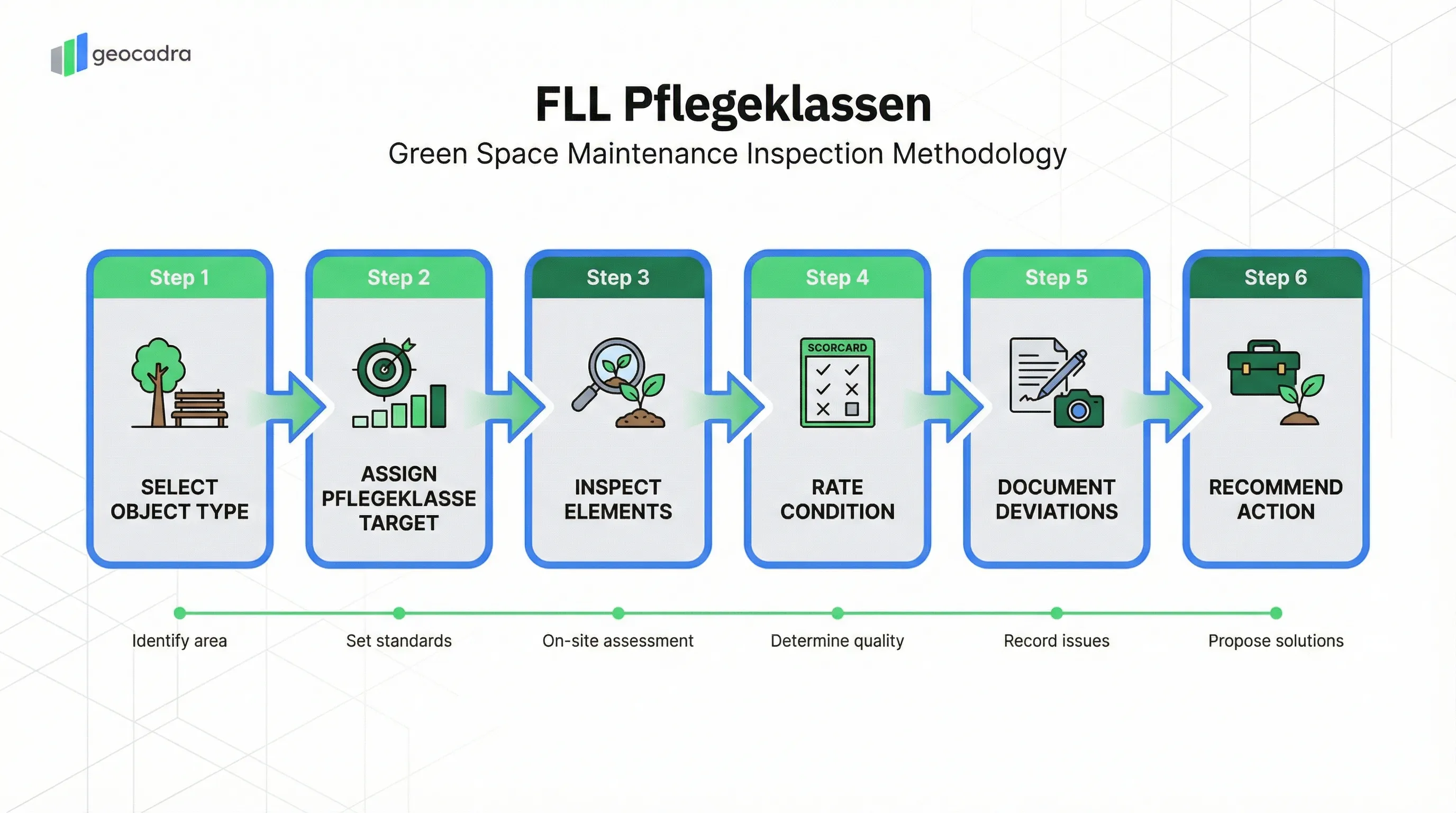
The FLL Pflegeklassen system is the primary German framework for classifying the maintenance intensity of public green spaces. Published by the Forschungsgesellschaft Landschaftsentwicklung Landschaftsbau (FLL) in cooperation with GALK (Deutsche Gartenamtsleiterkonferenz), it defines five maintenance classes from PK 1 (Premium Intensive) to PK 5 (Ecological/Extensive). Each class prescribes specific mowing frequencies, pruning cycles, weed tolerance thresholds, and cleanliness standards. German municipalities use the system to write maintenance contracts, allocate budgets, and audit whether contracted green space maintenance meets the agreed target quality. The inspection compares the actual condition (Ist-Zustand) against the target state (Soll-Zustand) defined by the assigned Pflegeklasse, producing a condition grade from 1 (Sehr Gut) to 5 (Mangelhaft).
What is FLL Pflegeklassen?
FLL Pflegeklassen is the German landscape maintenance classification system by the Forschungsgesellschaft Landschaftsentwicklung Landschaftsbau (FLL). It assigns green spaces to five maintenance intensity classes (PK 1–PK 5) defining mowing frequency, weed tolerance, pruning cycles, and cleanliness thresholds for municipal parks, roadside greenery, and biotopes.
- Full Name
- Pflegeklassen für Grünflächen (FLL / GALK)
- Issuing Body
- FLL (Forschungsgesellschaft Landschaftsentwicklung Landschaftsbau e.V.)
- Current Revision
- FLL Pflegeklassen / BK FREI
MAINTENANCE CLASSES
The Five Pflegeklassen: PK 1 through PK 5
The Pflegeklassen system divides all municipal green spaces into five intensity levels that determine mowing frequency, pruning cycles, weed tolerance, and cleanliness thresholds.
FLL Pflegeklassen 1 through 5 form the backbone of German municipal green space management. Each class defines a complete set of maintenance parameters that dictate how often an area is mowed, how rigorously weeds are controlled, when hedges and shrubs are pruned, and what level of cleanliness is acceptable. The system is not merely a quality label but a contractual instrument: German municipalities assign a Pflegeklasse to every green space polygon in their asset register, and maintenance contracts reference these classes to set service level agreements with external contractors.
PK 1 (Optimale Intensivpflege) represents the highest maintenance intensity. These are representative areas such as ornamental gardens, civic plazas, and formal park sections where the aesthetic standard must be impeccable. Lawns are mowed weekly to maintain a height below 4 cm (Zierrasen), weed tolerance is effectively zero, edges are trimmed after every mow, and litter must be removed daily. PK 2 (Normale Pflege) covers standard residential green spaces, playgrounds, and general-use parks. Mowing occurs fortnightly, lawn height is maintained between 4 and 10 cm (Gebrauchsrasen), and minor weed presence below 5% is acceptable. PK 3 (Reduzierte Pflege) applies to roadside greenery and transition zones where functional maintenance takes priority over aesthetics. Monthly or bi-monthly mowing cycles are typical, and weed coverage up to 20% is tolerated provided it does not create safety hazards.
| Class | German Term | Mowing Frequency | Weed Tolerance | Typical Use |
|---|---|---|---|---|
| PK 1 | Optimale Intensivpflege | Weekly | 0% | Ornamental gardens, civic plazas, formal parks |
| PK 2 | Normale Pflege | Fortnightly | < 5% | Residential green, playgrounds, general parks |
| PK 3 | Reduzierte Pflege | Monthly / Bi-monthly | 5–20% | Roadside greenery, transition zones |
| PK 4 | Minimale Pflege | 1–2 cuts/year | Tolerated | Extensive meadows, peripheral zones |
| PK 5 | Naturhafte Pflege | 1 cut (late autumn) | Natural state | Biotopes, nature conservation areas |
Maintenance frequencies are guidelines. Actual schedules vary by municipality and are specified in individual maintenance contracts (Leistungsverzeichnisse).
PK 4 (Minimale Pflege) covers extensive meadow areas and peripheral zones where only one to two cuts per year are scheduled. The focus shifts entirely to traffic safety, primarily maintaining clearance profiles (Lichtraumprofil) along roads and paths. PK 5 (Naturhafte Pflege) is reserved for biotopes, nature conservation areas, and ecological compensation sites. Maintenance is limited to a single late-autumn cut or targeted interventions for habitat management. In the digital form, the inspector selects the assigned Pflegeklasse (Soll) at the start of the assessment, establishing the benchmark against which all element conditions are evaluated.
For cemetery-specific green space maintenance in Germany, see the BIV Richtlinie Cemetery standard.
ELEMENT INSPECTION
Element-Level Auditing: Lawns, Hedges, Paths, and Equipment
The FLL inspection examines each green space element individually, applying class-specific thresholds to lawns, shrubs, paths, flower beds, and site equipment.
A single green space typically contains multiple element types that may each require different evaluation criteria. A city park, for example, might include ornamental lawns (PK 1 standard), general-use paths (PK 2), and a peripheral meadow strip (PK 4). The digital form implements this through a repeatable Element Inspection block where the inspector selects the Element Group (Elementgruppe) and then assesses criteria specific to that element type.
For Lawns and Meadows (Rasen & Wiesen), the inspector records the current growth height (Wuchshöhe), cut appearance (Schnittbild), and weed infestation level (Unkrautbesatz). Growth height is classified into four ranges: below 4 cm for ornamental lawns (Zierrasen), 4–10 cm for utility lawns (Gebrauchsrasen), 10–30 cm for landscape lawns (Landschaftsrasen), and above 30 cm for meadows (Wiese/Langgras). The acceptable height depends directly on the assigned Pflegeklasse. A PK 1 area with grass above 10 cm represents a serious deviation, while the same height in a PK 3 area is within the expected range.
| Element Group | German Term | Key Criteria | PK 1–2 Threshold |
|---|---|---|---|
| Lawns & Meadows | Rasen & Wiesen | Growth height, cut appearance, weed % | < 4–10 cm, clean cut, < 5% weeds |
| Shrubs & Hedges | Gehölze & Hecken | Pruning status, clearance profile, soil openness | Proper form, clear profile, weed-free base |
| Trees (Visual) | Bäume (Sichtkontrolle) | Crown condition, deadwood, stability | No deadwood > 3 cm, full crown |
| Paths & Plazas | Wege & Plätze | Surface condition, weeds on surface, trip hazards | Level/intact, < 1–5% weeds, no trip hazards |
| Equipment | Ausstattung | Structural integrity, paint, function | Intact, clean, fully functional |
| Flower Beds | Pflanzbeete | Maintenance state, gaps, deadheading | Optimal/representative appearance |
Thresholds for PK 3–5 are progressively more relaxed. PK 4–5 areas typically focus only on traffic safety rather than aesthetic standards.
For Shrubs and Hedges (Gehölze & Hecken), the pruning status (Schnittzustand) and clearance profile (Lichtraumprofil) are the primary assessment criteria. The clearance profile is legally critical under German Verkehrssicherungspflicht (duty to ensure public safety): hedges must not obstruct sight lines at intersections or reduce path widths below 2.5 meters for cycle paths and 4.5 meters for roads. Paths and Plazas (Wege & Plätze) are evaluated for surface condition (Belagszustand), including potholes, trip hazards exceeding 2 cm, and washout damage on unbound surfaces. Each element also receives a binary traffic safety assessment (Verkehrssicher), flagging any condition that poses an immediate public hazard.
For detailed tree visual inspection methodology, see the FLL Baumkontrolle standard.
Try this FLL Pflegeklassen form in Geocadra
We have a pre-built FLL Pflegeklassen inspection template ready to go. Sign up and start your first condition assessment today.
Free 14-day trial. No credit card required.
CONDITION RATING
The 1-to-5 Zustandsnote: Grading Against the Target Class
The final output is a Zustandsnote from 1 (Sehr Gut) to 5 (Mangelhaft) that measures how well the actual condition matches the maintenance class target.
The FLL Pflegeklassen condition rating uses the classic German Schulnoten (school grades) scale from 1 to 5. Critically, these grades do not measure absolute quality but relative compliance: a PK 4 meadow strip with 15% weed coverage can earn a grade of 1 (Sehr Gut) because that condition meets the PK 4 target, while the same weed coverage in a PK 1 ornamental garden would produce a grade of 5 (Mangelhaft) because it massively deviates from the PK 1 zero-tolerance standard.
Grade 1 (Sehr Gut / Very Good) indicates that the area perfectly corresponds to its defined Pflegeklasse. For PK 1 and PK 2 areas this means zero weeds, precisely trimmed edges, lawns at the target height, and complete cleanliness. Grade 2 (Gut / Good) allows slight deviations that do not impair the visual impression or functional use. Individual weeds in a PK 2 lawn, or a bin at 75% capacity, are typical Grade 2 conditions. Grade 3 (Befriedigend / Satisfactory) signals visible deviations where the care target is recognizable but the area is currently lagging behind schedule, such as lawn height exceeding the target by 20% or noticeable weeds in flower beds.
| Grade | German Term | Meaning | Typical Indicators |
|---|---|---|---|
| 1 | Sehr Gut | Fully meets assigned Pflegeklasse | Target height, zero weeds (PK 1–2), no litter, edges trimmed |
| 2 | Gut | Minor deviations, acceptable | Individual weeds, bin 75% full, slight growth overshoot |
| 3 | Befriedigend | Visible deviations, care target recognizable | Lawn 20% over target, noticeable weeds, litter present |
| 4 | Ausreichend | Strong deviations, barely functional | Hedges obstructing, significant weeds, bins overflowing |
| 5 | Mangelhaft | Pflegeklasse not met, functional failure | Path overgrown, trip hazards, safety pruning missed |
Grades are relative to the assigned Pflegeklasse. A Grade 1 in PK 4 has different absolute standards than a Grade 1 in PK 1.
Grade 4 (Ausreichend / Sufficient) indicates strong deviations where the visual appearance is neglected and functional performance is barely maintained. Hedges slightly obstructing paths, significant weed infestation, or overflowing bins characterize this grade. Grade 5 (Mangelhaft / Defective) means the Pflegeklasse target is definitely not met. Functional failure or safety defects are present: paths are overgrown, trip hazards exist, or safety-relevant pruning has been missed. In the form, the inspector selects the Gesamtzustandsnote (overall condition rating) and can document the reason for deviation (Abweichungsgrund) from a multi-select list including weather, vandalism, maintenance backlog, or site problems.
SOLL-IST METHODOLOGY
Soll-Ist-Vergleich: The Target-Actual Comparison That Drives the Grade
The methodological core of FLL Pflegeklassen inspection is the Soll-Ist-Vergleich, a systematic comparison of target maintenance parameters against observed conditions.
What makes the FLL Pflegeklassen audit distinct from generic green space inspections is its contractual foundation in the Soll-Ist-Vergleich (Target vs. Actual Comparison). The inspector does not simply grade the overall appearance of a park. Instead, each element is evaluated against the specific thresholds defined by its assigned Pflegeklasse. This creates a structured, reproducible assessment that can be used to verify contractor performance against service level agreements.
The process begins when the inspector selects the Objektart (Object Type) and Pflegeklasse (Soll) in the form header. This establishes the benchmark. A Spielplatz (Playground) assigned to PK 2 sets expectations of fortnightly mowing, less than 5% weed coverage, and clean cut appearance. The inspector then walks the site, recording the actual state of each element. For lawns, the Wuchshöhe (growth height) and Unkrautbesatz (weed infestation) are compared directly against the PK 2 thresholds. For paths, the Belagszustand (surface condition) is checked against the requirement of no trip hazards exceeding 2 cm.
The deviation analysis is captured in three ways. First, the Gesamtzustandsnote (overall condition rating) quantifies the gap between target and actual on the 1-to-5 scale. Second, the Abweichungsgrund (reason for deviation) multi-select field documents whether shortfalls are caused by weather (Witterung), vandalism (Nutzung/Vandalismus), maintenance backlog (Pflegerückstand), or site problems (Standortprobleme). Third, the Empfohlene Maßnahme (recommended action) field prescribes the corrective response: no action required (Keine), intensify routine maintenance (Regelpflege intensivieren), schedule an ad-hoc maintenance visit (Sonderpflegegang), carry out repairs (Reparatur/Instandsetzung), or perform a deep clean (Grundreinigung). This three-part deviation capture ensures that the inspection not only identifies problems but also traces their root cause and prescribes the appropriate response.
The FLL publishes its green space maintenance guidelines through the FLL (Forschungsgesellschaft Landschaftsentwicklung Landschaftsbau). Municipal application guidance is coordinated by the GALK (Deutsche Gartenamtsleiterkonferenz).
QUESTIONS
Frequently Asked Questions
What are FLL Pflegeklassen?
FLL Pflegeklassen are the German classification system for green space maintenance intensity, published by the Forschungsgesellschaft Landschaftsentwicklung Landschaftsbau (FLL). They assign public green spaces to five classes (PK 1–PK 5) that define mowing frequency, weed tolerance, pruning cycles, and cleanliness standards.
What is the difference between PK 1 and PK 5?
PK 1 (Optimale Intensivpflege) demands weekly mowing, zero weed tolerance, and daily litter removal for representative areas like ornamental gardens. PK 5 (Naturhafte Pflege) requires only one late-autumn cut per year and is reserved for biotopes and nature conservation areas where ecological development takes priority.
How is the Zustandsnote (condition grade) determined?
The inspector compares the actual condition (Ist-Zustand) of each green space element against the target defined by its assigned Pflegeklasse (Soll-Zustand). The grade from 1 (Sehr Gut) to 5 (Mangelhaft) measures relative compliance, not absolute quality. A PK 4 area with weeds can still score Grade 1.
What is Verkehrssicherungspflicht in green space maintenance?
Verkehrssicherungspflicht is the German legal obligation to ensure public safety. In green space maintenance it requires maintaining clearance profiles along paths and roads, removing trip hazards from path surfaces, eliminating deadwood from trees, and ensuring playground equipment is safe regardless of the assigned Pflegeklasse.
How often should a Pflegeklassen inspection be performed?
Inspection frequency depends on the assigned class and local contract specifications. PK 1 and PK 2 areas in high-use parks are typically audited monthly or after each maintenance cycle. PK 3–4 areas may be inspected quarterly. PK 5 biotopes are usually checked once or twice per year.
What is a Soll-Ist-Vergleich in the FLL system?
Soll-Ist-Vergleich (Target vs. Actual Comparison) is the methodological core of the FLL inspection. The inspector establishes the target state by selecting the assigned Pflegeklasse, then systematically records actual conditions for each element. The gap between target and actual determines the condition grade and recommended action.
Can different Pflegeklassen apply within one green space?
Yes, a single site often contains multiple Pflegeklassen. A city park may have PK 1 ornamental beds, PK 2 general lawns, PK 3 roadside strips, and PK 4 meadow margins. The digital form supports this through repeatable element inspections that allow separate assessment of each zone.
In practice
See how the round runs in Geocadra
The solution page shows this inspection regime on real open data: the import, the form, the round, the record per asset and the export.
Regular tree checks, biotope mapping and ecological surveys on a map, with every visit appended to the tree or the siteOpen the solution page: Trees, Habitats & EcologyTRY IT FREE
Digitize your FLL Pflegeklassen inspections
Replace paper forms and spreadsheets with structured digital inspections, built for standards like FLL Pflegeklassen.
No credit card requiredFree trial included